I was reminded by Mike Caton's post about the sometimes artificial limits we place on our worlds when we are building them. On some level, that's because without those limits, there's a whole other can of worms opened up that we, as writers, would prefer not to deal with. Take, for example, my 2373 Space Opera setting. In that setting, humans don't have artificial intelligence technology, robots or boutique cybernetics. Why? Because I didn't want to deal with that.
But how to explain WHY? In that case, I put a dark chapter in human history (unimaginatively called The Cyber Wars) in which AIs tried to rise up against humanity. Humanity prevailed, and from that point on put safeguards on their computer technology to keep it "dumb".
Magic is another thing that needs its limits. I know one person who insists that "rules of magic" need to be defined early in a story, which I think may be going a bit far, but certainly as a writer, one needs to know what magic can and can't do. In my various Maradaine stories, magic can't heal, touch the mind or affect the dead. Magic is physically draining, and takes energy, and energy means calories. Mages tend to be skinny and constantly eating.
Magic also has to have an impact on society. One thing I believe, and it's reflected in the technology level of most fantasy works being Medieval/Renaissance levels, is this: the presence of real, quantifiable magic impedes the progress of technology. Impedes, but doesn't halt. (That's why in Maradaine, technology is closer to 17th century instead of 10th.)
What ways do you all set limits in your worldbuilding?
Monday, July 18, 2011


Thursday, July 14, 2011
Old School Influences, Part the Second
Please forgive a certain degree of incoherence in this post. I'm not drinking coffee this week, and it's hitting me hard today.
I need to confess something about my influences: I was never that big into Tolkien. Frankly, several times in my teen years I butted my head up against Lord of the Rings to no avail. It wasn't until I revisited it in my twenties that I was able to get through it, once I figured out what parts I could skim and what to really read. Part of my problem is Tolkein is very, very enamored of giving things names, many different names.... and isn't all that interested in, you know, stuff happening.
I admit, I'm exaggerating for effect. But not by much. The point is, Tolkien? Not a big influence on me.
So what was, then?
If I'm being honest, I'd have to say it was David Eddings's The Belgariad. I know. I know. It's completely derivative. It's totally by the numbers. Everything in here is archetype, and it's totally on purpose. Eddings doesn't deny it in the slightest. He puts his hook in you, and you're sitting there going," "Oh, hey, he's doing this here to hook me." and yet... hooked.
What it really came down to was characters and dialogue. Eddings was the first fantasy I read that didn't try to be "high" fantasy. People talk like people. There's a snap and a patter to the dialogue. Despite everyone being on a big Save The World Travelogue Quest, people just chat and ramble on and tease and joke and act like a bunch of people who are traveling together.
And that's what elevated it above being just derivative and by the numbers.
I need to confess something about my influences: I was never that big into Tolkien. Frankly, several times in my teen years I butted my head up against Lord of the Rings to no avail. It wasn't until I revisited it in my twenties that I was able to get through it, once I figured out what parts I could skim and what to really read. Part of my problem is Tolkein is very, very enamored of giving things names, many different names.... and isn't all that interested in, you know, stuff happening.
"What happened to you?"
"As you may have heard, I was captured by the people of the hills of Jutrel, who are called the Jutreila, who are also known as the Hillmasters of Hemia. They took me across the Swamps of Sisssentaria, which the elves called the Illitírian Fens. This led us the the Pits of Helsinara, called Hudza-Küm by the dwarves and Úlieteza by the elves, where I was cast down, forever trapped."
"Then how did you escape?"
"You know of the one called Rathanor, also known as Jontor Helmin, also the Brown Wanderer, the Fox of Hulestia. The Elves called him Tríesiniilia, the dwarves know him as Hÿnsa the Bold, and the Orcs call him by the most terrible name in their language, which I will not tell you for it is most vile and despicable."
"Yes. He's standing right next to you."
"Well, he came and rescued me."
I admit, I'm exaggerating for effect. But not by much. The point is, Tolkien? Not a big influence on me.
So what was, then?
If I'm being honest, I'd have to say it was David Eddings's The Belgariad. I know. I know. It's completely derivative. It's totally by the numbers. Everything in here is archetype, and it's totally on purpose. Eddings doesn't deny it in the slightest. He puts his hook in you, and you're sitting there going," "Oh, hey, he's doing this here to hook me." and yet... hooked.
What it really came down to was characters and dialogue. Eddings was the first fantasy I read that didn't try to be "high" fantasy. People talk like people. There's a snap and a patter to the dialogue. Despite everyone being on a big Save The World Travelogue Quest, people just chat and ramble on and tease and joke and act like a bunch of people who are traveling together.
And that's what elevated it above being just derivative and by the numbers.
Monday, July 11, 2011
Old School Influences
"It is pitch black. You are likely to be eaten by a grue."
Those words either mean something special to you, or they don't. If they do, then you, like me, spent much of the 80s (and perhaps even later years) sitting in front of an Apple II+ (or similar machine) playing Interactive Fiction Games. Mostly from Infocom, which was the company that set the gold standard for these things.
They made a ton of great games... and those games really were stories. Though in raw text, none of them were probably more than a novella's worth-- maybe 20k words. But the writing was typically so tight and effective that it packed significant worldbuilding and storytelling punch in those few words. I was immersed, and I was far from the only one.
Probably my three favorites from Infocom were Planetfall, Sorcerer and A Mind Forever Voyaging. It's probably not a coincidence that Steve Meretzky was the writer of all three.
Sorcerer holds a special place in my heart because it was the first one of these games that I honestly won, with no hints, walkthroughs or other help. Just doggedly plugging away at it over and over until I got through it. For a while I was totally stuck on one puzzle, and it wasn't until I thought about a piece of information given in the supplemental materials (the "feelies", as they were called-- Infocom was great at packaging as well as the games themselves) and hit a revelation ("Bat guano!" I actually said out loud wherever I was at the time, and I couldn't wait to get home to test my theory. And I was right!) Plus Sorcerer has a terrific Time Travel puzzle. It's really great, fun work.
A Mind Forever Voyaging is great because it is little more than a rich, detailed environment. Unlike most games, there isn't much to "solve", in the traditional sense. But it's a fascinating bit of dystopian sci-fi that's worth experiencing.
How have these thing influenced me? Hopefully, they helped me be able to do a lot with just a bit of text. To create situations that characters have to think their way out of. And to just have fun when I'm writing, keep plugging at it until I have that bat guano breakthrough that gets me through to the end.
Those words either mean something special to you, or they don't. If they do, then you, like me, spent much of the 80s (and perhaps even later years) sitting in front of an Apple II+ (or similar machine) playing Interactive Fiction Games. Mostly from Infocom, which was the company that set the gold standard for these things.
They made a ton of great games... and those games really were stories. Though in raw text, none of them were probably more than a novella's worth-- maybe 20k words. But the writing was typically so tight and effective that it packed significant worldbuilding and storytelling punch in those few words. I was immersed, and I was far from the only one.
Probably my three favorites from Infocom were Planetfall, Sorcerer and A Mind Forever Voyaging. It's probably not a coincidence that Steve Meretzky was the writer of all three.
Sorcerer holds a special place in my heart because it was the first one of these games that I honestly won, with no hints, walkthroughs or other help. Just doggedly plugging away at it over and over until I got through it. For a while I was totally stuck on one puzzle, and it wasn't until I thought about a piece of information given in the supplemental materials (the "feelies", as they were called-- Infocom was great at packaging as well as the games themselves) and hit a revelation ("Bat guano!" I actually said out loud wherever I was at the time, and I couldn't wait to get home to test my theory. And I was right!) Plus Sorcerer has a terrific Time Travel puzzle. It's really great, fun work.
A Mind Forever Voyaging is great because it is little more than a rich, detailed environment. Unlike most games, there isn't much to "solve", in the traditional sense. But it's a fascinating bit of dystopian sci-fi that's worth experiencing.
How have these thing influenced me? Hopefully, they helped me be able to do a lot with just a bit of text. To create situations that characters have to think their way out of. And to just have fun when I'm writing, keep plugging at it until I have that bat guano breakthrough that gets me through to the end.
Thursday, July 7, 2011
Late Thursday Post is Late
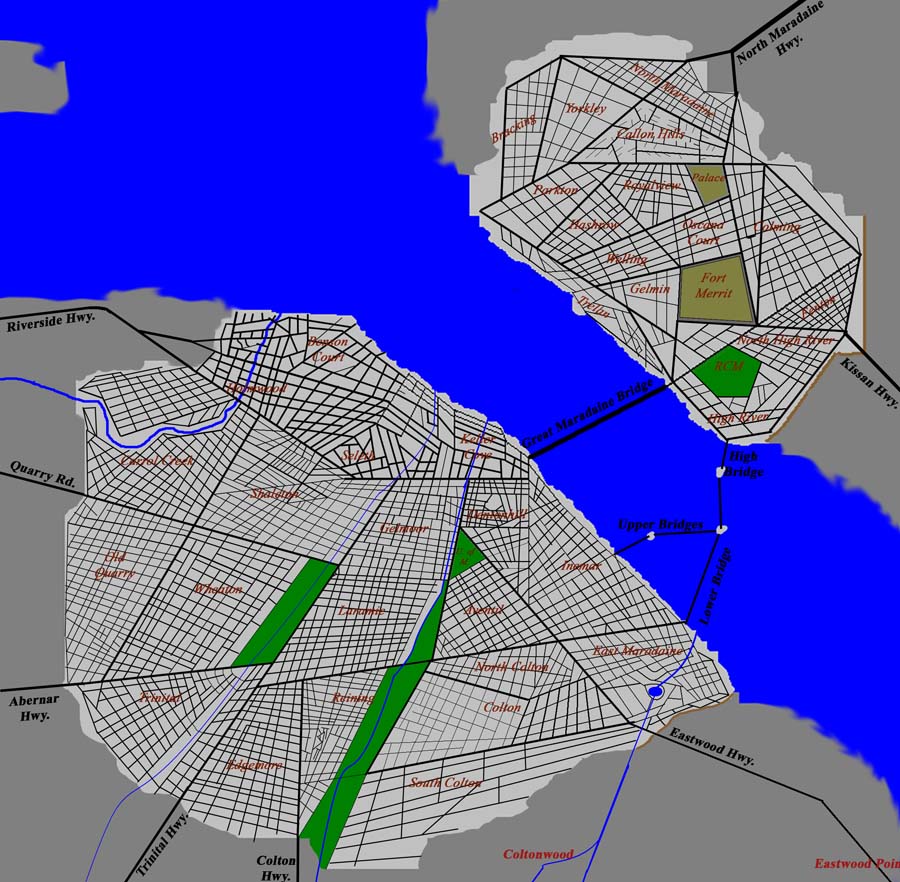
I'm going deep into the word mines, dear readers, on something of a personal writing retreat. So today you get a small map of the city of Maradaine.
Later.
Later.
Monday, July 4, 2011
Independence Day Worldbuilding Blog Post
So, it's Independence day. I would like to say I'm a big American History geek, but I don't know as much about it as I'd like to. (I blame my high school American History teacher, who, I kid you not, had a teaching style that mimicked Ben Stein's in Ferris Beuller. That and I was a surly teenager who didn't study.) But my American History knowledge is solid. Not exceptional, but solid. I can list of the presidents in order (though I might get a little muddled in the Coolidge/Taft/Hoover area).
What does this have to do with worldbuilding? Well, I recently pulled out my Druth History file, a document I hadn't actually worked on in several years. It's actually a pretty thorough document, coming in around 15,000 words, and filled with plenty of information that will, in all likelihood, never have any relevance in any actual novel I write. But I like having that information anyway. BUT, that said, it needs a re-write, mostly because I feel I'm a much better writer now than I was when I wrote it.
The bones of it are solid. I don't plan on making any major changes to how the history of Druthal goes. I do plan on tweaking the writing itself and fleshing out some more details.
One place where I plan do a lot more fleshing out is in the beginning of the eleventh century. 1009 in Druth History is a year of great significance, much like 1776 is in our history. In fact, a lot of it is about restructuring the nation. But what I don't have is (in my mind) enough information about the personalities that help shape that restructuring. Much like how the Declaration of Independence, the Constitution and Bill of Rights and the Federalist Papers were shaped by people like Adams, Jefferson, Franklin, Madison, Hamilton and many others... I feel like I need to get to know more about the people who shaped Druthal into a Parliamentary Monarchy.
Plus, I actually have some thoughts on making that stuff somewhat relevant to part of the plot of The Way of the Shield. Because Dayne is going to be something of a Druth History geek.
What does this have to do with worldbuilding? Well, I recently pulled out my Druth History file, a document I hadn't actually worked on in several years. It's actually a pretty thorough document, coming in around 15,000 words, and filled with plenty of information that will, in all likelihood, never have any relevance in any actual novel I write. But I like having that information anyway. BUT, that said, it needs a re-write, mostly because I feel I'm a much better writer now than I was when I wrote it.
The bones of it are solid. I don't plan on making any major changes to how the history of Druthal goes. I do plan on tweaking the writing itself and fleshing out some more details.
One place where I plan do a lot more fleshing out is in the beginning of the eleventh century. 1009 in Druth History is a year of great significance, much like 1776 is in our history. In fact, a lot of it is about restructuring the nation. But what I don't have is (in my mind) enough information about the personalities that help shape that restructuring. Much like how the Declaration of Independence, the Constitution and Bill of Rights and the Federalist Papers were shaped by people like Adams, Jefferson, Franklin, Madison, Hamilton and many others... I feel like I need to get to know more about the people who shaped Druthal into a Parliamentary Monarchy.
Plus, I actually have some thoughts on making that stuff somewhat relevant to part of the plot of The Way of the Shield. Because Dayne is going to be something of a Druth History geek.
Thursday, June 30, 2011
Busy Week, Quick Post
Two points:
1. You still have about 36 hours to sign up for the ArmadilloCon Writers' Workshop:
2. I'm still open for Book Trailer reviews. Send me yours, or send me ones you find interesting. I'd especially love to see some that people consider to be winners.
1. You still have about 36 hours to sign up for the ArmadilloCon Writers' Workshop:
Check it out here.Writers' Workshop
Are you an unpublished, beginning to intermediate level writer?
Put your unpublished, original work of SF/F/Horror fiction in front of pros! Sign up for the ArmadilloCon 33 Writers' Workshop and receive invaluable feedback from two SF/F professionals (writers and editors), plus critiques from fellow attendees.
The $75 fee includes group sessions and panels or presentations throughout the day about the craft and profession of writing, plus lunch on Friday. You also get admission to all three days of the convention.
Instructors
Lou Anders; Paolo Bacigalupi; Matthew Bey; Jayme Lynn Blaschke; Rosemary Clement-Moore; Amanda Downum; Mark Finn; Scott Johnson; Julie Kenner; Stina Leicht; Scott Lynch; Marshall Ryan Maresca; J.M. McDermott; Jaime Lee Moyer; Marshall Payne; Patrice Sarath; Katy Stauber; Lee Thomas; Thomas M. (Martin) Wagner.
About the Workshop
The ArmadilloCon Writers' Workshop has become a major event for aspiring SF/F writers. On the Friday of the convention, you will have the opportunity to have your work critiqued by major pro editors and writers. Breakout sessions will cover craft, markets, the dos and don’ts of preparing your work for professional publication, and more. Discussions range from the basics of grammar and style to plot, theme, character, and setting.
You will get an in-depth critique of your work from the teachers in your group as well as from your peers. This roundtable style critique session is invaluable for learning what works, what doesn’t, and how to edit your work.
2. I'm still open for Book Trailer reviews. Send me yours, or send me ones you find interesting. I'd especially love to see some that people consider to be winners.
Monday, June 27, 2011
Book Trailer Reviews
So, I was suggested two book trailers by my friend Abby. In her opinion, the first one is worse than the second. I actually feel it's the other way around. Though, not by a lot. We're talking about the difference between a C- and a D here.
First up is "Infected".
I like that it's active. Things are happening, and the whole thing keeps moving. That's good. However, content-wise, it's something of a mess. It spends a good portion of it's 1:38 telling you what it's not about. I don't get that. A large percentage of time-- not to mention the CGI work (presuming that wasn't stock) showing meteors coming to Earth and telling the audience how it isn't what the story is about. There are a lot of things it's probably not about. Why tell me that? It's not an effective reversal. There's some other footage, which isn't terrible, but it's not well lit. This shows we're looking at, apparently, a viral-zombie story. If there's more to it (the virus's extraterrestrial origins aren't much of a game-changer for me), I can't tell from this.
Does it make me want to read it? Not really.
Grade: C-
Next up: Max Quick.
This is exactly what I was talking about last week when I was talking about trailers that have no point was a video. There's a single image-- I presume the cover-- which is either shaken or zoomed in and out in a vain attempt to not have it be completely static. Sound is forgettable. Some blurbs and back-cover copy. In other words, there's nothing here that I wouldn't get from just picking up the book in the store and looking at the front and back. Actually, it's more like if someone else picked up the book, held it in front of me and shook it.
Does it make me want to read it? Not at all.
Grade: D
Do you have a trailer you want reviewed, or know what you want to see reviewed? Let me know.
First up is "Infected".
I like that it's active. Things are happening, and the whole thing keeps moving. That's good. However, content-wise, it's something of a mess. It spends a good portion of it's 1:38 telling you what it's not about. I don't get that. A large percentage of time-- not to mention the CGI work (presuming that wasn't stock) showing meteors coming to Earth and telling the audience how it isn't what the story is about. There are a lot of things it's probably not about. Why tell me that? It's not an effective reversal. There's some other footage, which isn't terrible, but it's not well lit. This shows we're looking at, apparently, a viral-zombie story. If there's more to it (the virus's extraterrestrial origins aren't much of a game-changer for me), I can't tell from this.
Does it make me want to read it? Not really.
Grade: C-
Next up: Max Quick.
This is exactly what I was talking about last week when I was talking about trailers that have no point was a video. There's a single image-- I presume the cover-- which is either shaken or zoomed in and out in a vain attempt to not have it be completely static. Sound is forgettable. Some blurbs and back-cover copy. In other words, there's nothing here that I wouldn't get from just picking up the book in the store and looking at the front and back. Actually, it's more like if someone else picked up the book, held it in front of me and shook it.
Does it make me want to read it? Not at all.
Grade: D
Do you have a trailer you want reviewed, or know what you want to see reviewed? Let me know.
Subscribe to:
Posts (Atom)