I won't pretend that Constructed Languages aren't a lot of work. To
really get into it, to do every element of it, you have to love it. And
if you have a world full of different cultures, different languages....
that's it's own project completely, and not one you're likely to want
to engage in if you actually want to, you know, write stories.
Especially if you're not going really need full languages in your stories. You probably won't.
What
you will need, though, is a certain degree of linguistic
verisimilitude, so that names of places, people and culturally unique
terms will seem like they come from the same language base.
Easiest
way to do that is to construct a phonology. A phonology describes what
sounds can be used in the language, and how syllables are constructed.
With that information, you know what words can exist in the language, and to a degree, that's all you need to know.
So,
how to you make a phonology, especially if you really don't know
anything about linguistics? Fortunately, the internet has some tools
you can use to make it easier. Right here
is a webpage that randomly generates a phonology: phonemic inventory,
syllable structure, allophony (the rules for breaking the rules,
essentially) and sample words.
Now, the catch with this is, it's all done in IPA: the International Phonetic Alphabet.
You'll probably want, for the sake of your writing, to figure out a way
to latinize the words, so your readers can wrap their heads around it.
Mind you, this will have nothing to do with how the language is
written, whether it's alphabetical or syllabic or pictographic. It's
simply figuring out how to write the words in simple text.
I
recommend taking the sounds of your phonology and coming up with a
consistent way to express each sound with a latin letter. It does not have to be a one-for-one. For example, your phonology might contain both a nasal alveolar (n) and a laminal nasal alveolar (n̻)--
the difference between the two are subtle, and you might choose, for
the sake of writing words out, to describe both with just an "n". Of
course, you could load up your latin approximation with diacritics (for
example: å,ä,á,â and à could all represent different sounds), but if you
do that, you should first understand what those diacritics mean and how
they are traditionally used.* However, if you are going to use
diacritics, I recommend you use them surgically and sparingly. Same
with apostrophes. Fantasy authors love throwing those in, but you
should only do it if it means something-- for example a glottal stop or
another sound that isn't easily latinized.
So,
with a phonology and a defined latinization of that phonology, you've
got the tools to make words and names in another language that feel like
they come from the same language, without having to overwhelm yourself
with making up an entire language from scratch.
--
*-
You might decide that å,ä,á,â and à represent various open-mouthed vowel
sounds, but if the sound you match it to doesn't correspond to how it's
typically used, you'll just created confusion. For example "Ä", the
A-with-umlaut, is used in in Finnish and Swedish as a "near-open front
unrounded vowel", or "æ" in the IPA, so if you use "ä" for, say, an open back rounded vowel ("ɒ"
in the IPA), your readers in the know will just think you don't know
what you're doing. Or, more likely, throwing in diacritics because you
look neat and foreign.
Showing posts with label worldbuilding. Show all posts
Showing posts with label worldbuilding. Show all posts
Monday, December 1, 2014


Thursday, November 13, 2014
My Culinary Obsessions
 So,
last week I talked about how drawing maps and doing worldbuilding is my
non-writing artistic outlet. But, to a large degree, that's still about writing.
So,
last week I talked about how drawing maps and doing worldbuilding is my
non-writing artistic outlet. But, to a large degree, that's still about writing.Of course, it's all about writing, even this one.
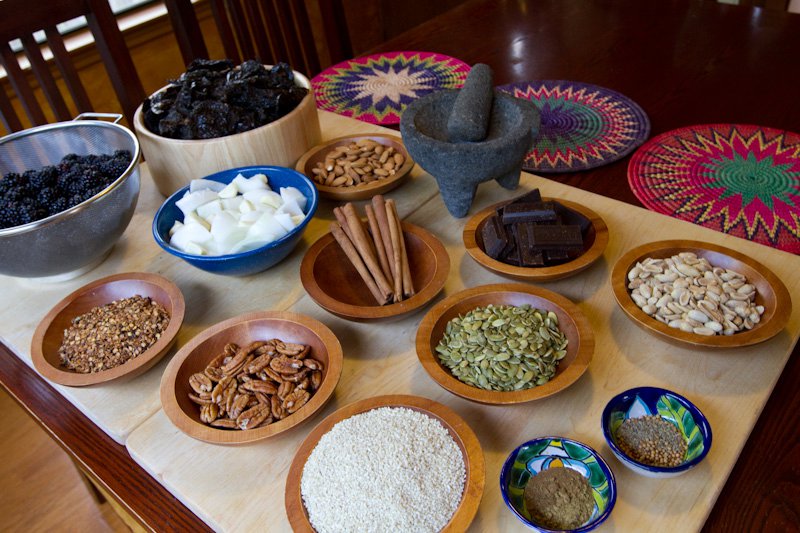
Because my other artistic outlet is cooking. I love to cook, and I'm strangely obsessive about doing things from scratch. And to some degree, that comes from writing and worldbuilding. I like to think about where food comes from, what it means to the people, and how disparate flavors can help define a culture.
 And
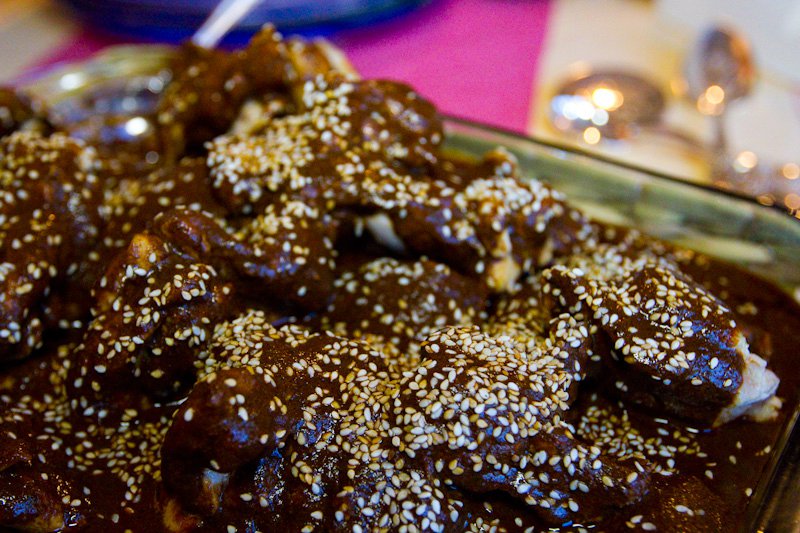
today I have a special project! Today I'll be taking blackberries and a
whole variety of nuts, seeds, spices and dried chiles and making a
glorious molé de zarzamoras. And, of course, beyond that, I
intend to get some writing in. But as you can imagine, this is a
project that's going to take up a good chunk of my day.
And
today I have a special project! Today I'll be taking blackberries and a
whole variety of nuts, seeds, spices and dried chiles and making a
glorious molé de zarzamoras. And, of course, beyond that, I
intend to get some writing in. But as you can imagine, this is a
project that's going to take up a good chunk of my day.But once it's done, oh, it'll be something quite special.
And then I'll go down into the word mines. See you in there.
One more thing: as I've updated my website, I've created an Appearances page listing where I'll be in 2015. There's only a few listed for now, but that will probably increase as the year goes on.
Thursday, November 6, 2014
Creative Outlets That Aren't Writing
One can't just pound out words for eight hours a day, five days a week. Well, maybe some people can, but I sure can't. So what else do I do to chum the creative waters?
 For me, and I know this is going to be a real shocker-- it's worldbuilding work, especially maps.
Now, I'm sure a lot of writers just build the world for the stories, or craft a world around a story idea. Which is probably the smarter thing to do. I mean, if you're doing all that worldbuilding work, it should be for a purpose, right?
 And for each of these, maybe there will be a purpose somewhere down the
line. But when I'm-- I don't want to say stuck or blocked, because I
don't think that's accurate, but let's say conceptual brewing,
and my brain needs to mull on where things are going or how to do a
certain bit, then doing some map-drawing or other worldbuilding activity
(like figuring out biomes and then connecting rise of agriculture to
said biomes, and thus determining where those Fertile Centers of Origin
are going to be that civilization arises in) or micromanaging a pair of
linked villages for what sort of setting might be there. Or the rise of
multiple interstellar empires.
And for each of these, maybe there will be a purpose somewhere down the
line. But when I'm-- I don't want to say stuck or blocked, because I
don't think that's accurate, but let's say conceptual brewing,
and my brain needs to mull on where things are going or how to do a
certain bit, then doing some map-drawing or other worldbuilding activity
(like figuring out biomes and then connecting rise of agriculture to
said biomes, and thus determining where those Fertile Centers of Origin
are going to be that civilization arises in) or micromanaging a pair of
linked villages for what sort of setting might be there. Or the rise of
multiple interstellar empires.
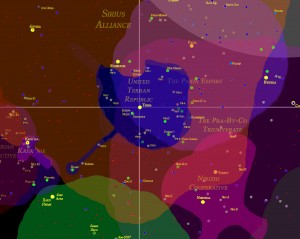 This
is probably the sort of thing that other sf/fantasy writers dread.
And I get that. But for me, it's a lot of fun. And dorky. I will
fully admit to compiling spreadsheets filled with just raw data of
animal domestication or tech development of number of planets for
hundreds of stars or regions or whatever else. That gets the processing
and analytical part of my brain in gear, and lets the writing brain
churn and simmer, and then, hey... a thousand words show up.
This
is probably the sort of thing that other sf/fantasy writers dread.
And I get that. But for me, it's a lot of fun. And dorky. I will
fully admit to compiling spreadsheets filled with just raw data of
animal domestication or tech development of number of planets for
hundreds of stars or regions or whatever else. That gets the processing
and analytical part of my brain in gear, and lets the writing brain
churn and simmer, and then, hey... a thousand words show up.
Plus, maps are fun. I can't draw very well, but I can do maps.
That's all for now. I'll be at OryCon this weekend, and if you're in the area, I hope to see you there.
----
An admin note: I'm in the process of consolidating and updating my website, so everything, including this blog will be in the same place. I'll post in both places for a while, but eventually the Blogger version will go away, and everything will be over there.
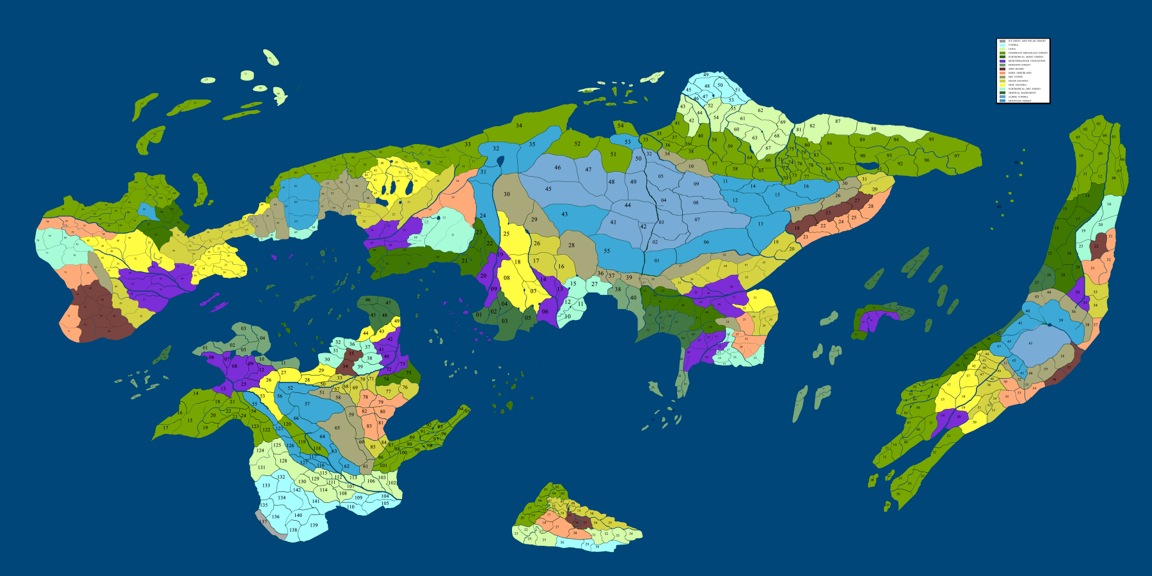 For me, and I know this is going to be a real shocker-- it's worldbuilding work, especially maps.
 Now, I'm sure a lot of writers just build the world for the stories, or craft a world around a story idea. Which is probably the smarter thing to do. I mean, if you're doing all that worldbuilding work, it should be for a purpose, right?

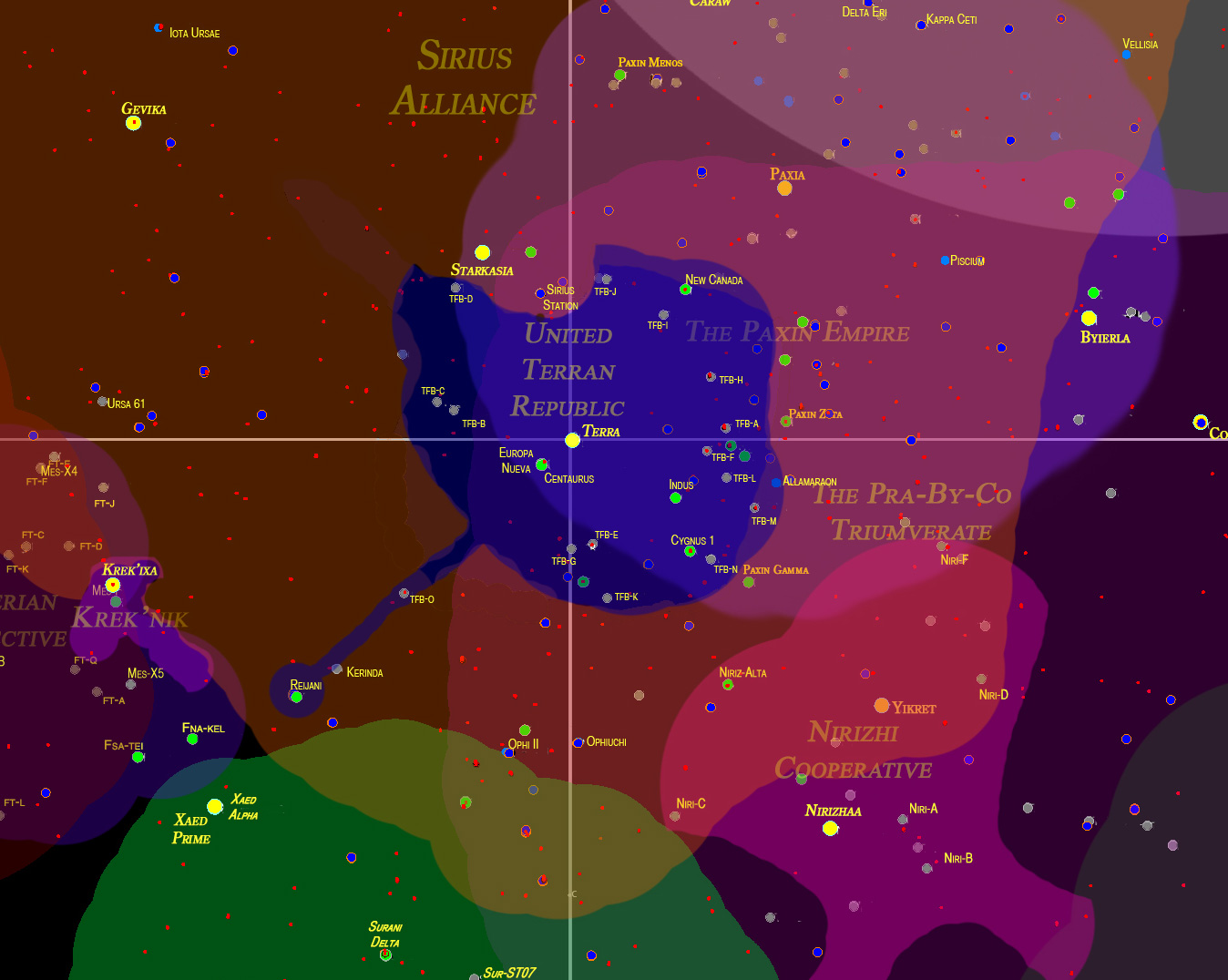 This
is probably the sort of thing that other sf/fantasy writers dread.
And I get that. But for me, it's a lot of fun. And dorky. I will
fully admit to compiling spreadsheets filled with just raw data of
animal domestication or tech development of number of planets for
hundreds of stars or regions or whatever else. That gets the processing
and analytical part of my brain in gear, and lets the writing brain
churn and simmer, and then, hey... a thousand words show up.
This
is probably the sort of thing that other sf/fantasy writers dread.
And I get that. But for me, it's a lot of fun. And dorky. I will
fully admit to compiling spreadsheets filled with just raw data of
animal domestication or tech development of number of planets for
hundreds of stars or regions or whatever else. That gets the processing
and analytical part of my brain in gear, and lets the writing brain
churn and simmer, and then, hey... a thousand words show up. Plus, maps are fun. I can't draw very well, but I can do maps.
That's all for now. I'll be at OryCon this weekend, and if you're in the area, I hope to see you there.
----
An admin note: I'm in the process of consolidating and updating my website, so everything, including this blog will be in the same place. I'll post in both places for a while, but eventually the Blogger version will go away, and everything will be over there.
Monday, October 27, 2014
Worldbuilding: Building Blocks and Lists
I've talked before about the importance of understanding how agriculture and domestication of animals influences the building of societies. Cultures don't move past hunter-gather stages without domesticating animals and mastering agriculture, and they can't do that if the proper plants or animals aren't present.
So, what are the "proper" plants and animals?
Well, I've done research (built off other people's research, of course), and compiled it here for easy access.
ANIMALS
Here's a list of forty animals which form the basis for early-culture domestication. I'll break this into three sections: large domesticatible animals, small domesticatible animals, and semi-domesticatible animals. The semi-domesticatibles are ones where various individual factors (such as ability to breed in captivity, or demeanor) prevent full domestication from occurring. I've also included how each animal can be useful to the culture domesticating them.
AGRICULTURE
For this list, I'm going to look less at individual plants, and more at centers of origin for plant domestication. Roughly speaking, there were eight "centers of origin" on Earth for independent rise of agriculture (two with subcenters), so the more realistic option would be to keep these various species of plants grouped together. So here are the centers, including where they were developed.
Hopefully, you'll find these lists helpful to build some interesting things. Good luck.
So, what are the "proper" plants and animals?
Well, I've done research (built off other people's research, of course), and compiled it here for easy access.
ANIMALS
Here's a list of forty animals which form the basis for early-culture domestication. I'll break this into three sections: large domesticatible animals, small domesticatible animals, and semi-domesticatible animals. The semi-domesticatibles are ones where various individual factors (such as ability to breed in captivity, or demeanor) prevent full domestication from occurring. I've also included how each animal can be useful to the culture domesticating them.
Large
Alpaca (Vicugna pacos) USES: fibre, meat, show, pets
Domestic Bactrian camel (Camelus bactrianus) USES: milk, transportation, working, hunting, plowing, draft, mount, fighting, show, racing, meat, hair
Domestic pig (Sus scrofa domesticus) USES: meat, leather, research, show, racing, fighting, truffles, pets
Yak (Bos grunniens) USES: milk, transportation, working, plowing, mount, racing, fighting, meat, fibre
Domestic dromedary camel (Camelus dromedarius) USES: transportation, working, hunting, plowing, draft, mount, show, racing, fighting, milk, meat
Bali cattle (Bos javanicus domestica) USES: meat, milk, show, racing, working, plowing, draft
Donkey (Equus africanus asinus) USES: transportation, working, plowing, draft, mount, meat, milk, pets, racing, guarding
Domestic goat (Capra aegagrus hircus) USES: milk, meat, fibre, skin, show, racing, fighting, clearing land, pets
Horse (Equus ferus caballus) USES: transportation, meat, working, guiding, servicing, hunting, execution, plowing, draft, mount, fighting, show, racing, milk, pets
Water buffalo, including "river buffalo" (Bubalus arnee) and "swamp buffalo" (Bubalus bubalis carabenesis) USES: working, plowing, draft, mount, fighting, meat, show, racing, milk
Zebu (Bos primigenius indicus) USES: meat, milk, leather, hides, working, plowing, draft, vellum, blood, transportation, soil fertilization, fighting, show, racing
Gayal (Bos frontalis) USES: meat
Cattle (Bos primigenius taurus) USES: meat, milk, leather, hides, working, plowing, draft, vellum, blood, transportation, soil fertilization, fighting, show, pets
Llama (Lama glama) USES: transportation, working, draft, pack, meat, show, racing, pets, guarding
Sheep (Ovis aries) USES: fibre, meat, milk, leather, pelt, vellum, pets, show, racing, research, guarding, fighting, ornamental
SMALL
Domestic goose (Anser anser domesticus) USES: meat, feathers, eggs, show, guarding, pets
Domestic duck (Anas platyrhynchos domesticus) USES: meat, feathers, eggs, pets, show, racing, ornamental
Domestic pigeon (Columba livia domestica) USES: show, ornamental, messenger, meat, racing, pets
Chicken (Gallus gallus domesticus) USES: meat, eggs, feathers, leather, show, racing, ornamental, fighting, pets
Ferret (Mustela putorius furo) USES: pets, hunting, pest control, show, racing
Domestic turkey (Meleagris gallopavo) USES: meat, feathers, eggs, show, pets
Domestic silkmoth (Bombyx mori) USES: silk, animal feed, pets, meat
Guinea pig (Cavia porcellus) USES: pets, meat, show, racing, research
Domestic rabbit (Oryctolagus cuniculus) USES: meat, pelt, fibre, pets, show, racing, research
Cat (Felis silvestris catus) USES: pets, pest control, show, pelt, research
Dog (Canis lupus familiaris) USES: Pets, hunting, herding, guarding, pest control, transportation, draft, working, show, racing, sport, rescuing, guiding, servicing, meat, research
Domestic guineafowl (Numida meleagris) USES: meat, eggs, pest control, show, alarming, pets
SEMI
Mandarin duck (Aix galericulata) USES: meat, ornamental
Stingless bee (Melipona beecheii) USES: honey, pollination
Indian peafowl (Pavo cristatus) USES: show, feathers, meat, ornamental, pets
Egyptian mongoose (Herpestes ichneumon) USES: pest control, pets
Addax (Addax nasomaculatus) USES: meat, horns, leather, skin
Muscovy duck (Cairina moschata) USES: meat, feathers, eggs, show, pets
Red deer (Cervus elaphus) USES: meat, velvet, hides, leather, antlers
Western honey bee (Apis mellifera), including subspecies Italian bee (A. mellifera ligustica), European dark bee (A. mellifera mellifera), and Carniolan honey bee (A. mellifera carnica) USES: honey, wax, pollination
Fallow deer (Dama dama) USES: meat, hides, antlers
Semi-domesticated reindeer (Rangifer tarandus) USES: meat, milk, transportation, working, draft, mount, hides, racing, leather, antlers
Asiatic honey bee (Apis cerana), including subspecies Indian honey bee (Apis cerana indica) USES: honey, pollination
Asian elephant (Elephas maximus), including subspecies Indian elephant (Elephas maximus indicus) USES: working, transportation, hunting, show, racing, fighting
Scimitar oryx (Oryx dammah) USES: meat, hides, horns
AGRICULTURE
For this list, I'm going to look less at individual plants, and more at centers of origin for plant domestication. Roughly speaking, there were eight "centers of origin" on Earth for independent rise of agriculture (two with subcenters), so the more realistic option would be to keep these various species of plants grouped together. So here are the centers, including where they were developed.
Center 1 (Mexico/Central America)
Grains and Legumes: maize, common bean, lima bean, tepary bean, jack bean, grain amaranth
Melon Plants: malabar gourd, winter pumpkin, chayote
Fiber Plants: upland cotton, bourbon cotton, henequen (sisal)
Miscellaneous: sweetpotato, arrowroot, pepper, papaya, guava, cashew, wild black cherry, chochenial, cherry tomato, cacao.
Center 2 (South America, northwestern region)
Root Tubers: potato, Other endemic cultivated potato species. Fourteen or more species with chromosome numbers varying from 24 to 60, edible nasturtium
Grains and Legumes: starchy maize, lima bean, common bean
Root Tubers: edible canna, potato
Vegetable Crops: pepino, tomato, ground cherry, pumpkin, pepper
Fiber Plants: cotton
Fruit and Miscellaneous: cocoa, passion flower, guava, heilborn, quinine tree, tobacco, cherimoya
2A (Chilean region)
Common potato (48 chromosomes), Chilean strawberry
2B (Brazilian region)
manioc, peanut, rubber tree, pineapple, Brazil nut, cashew, Erva-mate, purple granadilla.
Center 3 (Mediterranean Coasts)
Cereals and Legumes: durum wheat, emmer, Polish wheat, spelt, oats, sand oats, canarygrass, grass pea, pea, lupine
Forage Plants: clover, white clover, crimson clover, serradella
Oil and Fiber Plants: flax, rape, black mustard, olive
Vegetables: garden beet, cabbage, turnip, lettuce, asparagus, celery, chicory, parsnip, rhubarb,
Ethereal Oil and Spice Plants: caraway, anise, thyme, peppermint, sage, hop.
Center 4 (Middle East)
Grains and Legumes: einkorn wheat, durum wheat, poulard wheat, common wheat, oriental wheat, Persian wheat, two-row barley, rye, Mediterranean oats, common oats, lentil, lupine
Forage Plants: alfalfa, Persian clover, fenugreek, vetch, hairy vetch
Fruits: fig, pomegranate, apple, pear, quince, cherry, hawthorn.
Center 5 (Ethiopia)
Grains and Legumes: Abyssinian hard wheat, poulard wheat, emmer, Polish wheat, barley, grain sorghum, pearl millet, African millet, cowpea, flax, teff
Miscellaneous: sesame, castor bean, garden cress, coffee, okra, myrrh, indigo.
Center 6 (Central Asia)
Grains and Legumes: common wheat, club wheat, shot wheat, peas, lentil, horse bean, chickpea, mung bean, mustard, flax, sesame
Fiber Plants: hemp, cotton
Vegetables: onion, garlic, spinach, carrot
Fruits: pistacio, pear, almond, grape, apple.
Center 7 (India)
Cereals and Legumes: rice, chickpea, pigeon pea, urd bean, mung bean, rice bean, cowpea,
Vegetables and Tubers: eggplant, cucumber, radish, taro, yam
Fruits: mango, orange, tangerine, citron, tamarind
Sugar, Oil, and Fiber Plants: sugar cane, coconut palm, sesame, safflower, tree cotton, oriental cotton, jute, crotalaria, kenaf
Spices, Stimulants, Dyes, and Miscellaneous: hemp, black pepper, gum arabic, sandalwood, indigo, cinnamon tree, croton, bamboo.
7A (Southeast Asia)
Cereals and Legumes: Job's tears, velvet bean
Fruits: pummelo, banana, breadfruit, mangosteen
Oil, Sugar, Spice, and Fiber Plants: candlenut, coconut palm, sugarcane, clove, nutmeg, black pepper, manila hemp.
Center 8 (China)
Cereals and Legumes: e.g. broomcorn millet, Italian millet, Japanese barnyard millet, Koaliang, buckwheat, hull-less barley, soybean, Adzuki bean, velvet bean
Roots, Tubers, and Vegetables: e.g. Chinese yam, radish, Chinese cabbage, onion, cucumber
Fruits and Nuts: e.g. pear, Chinese apple, peach, apricot, cherry, walnut, litchi
Sugar, Drug, and Fiber Plants: e.g.sugar cane, opium poppy, ginseng camphor, hemp.
Hopefully, you'll find these lists helpful to build some interesting things. Good luck.
Monday, October 20, 2014
Worldbuilding: Putting the Civil in Civilization
The real test of a civilization is not just its laws, but how its laws are put into practice. Criminal law is one aspect, of course: does the society care more about justice, or maintaining order? Are trials designed to be fair, and truly find the guilty, or simply expedite a resolution. Are the people protected from the state, or is the state protected from the people?
But civil law is another matter, and is often less examined in worldbuilding. How do two citizens resolve a dispute or wrong in which, strictly speaking, no crime has occurred? At least, in something resembling a culturally-accepted "official" way. For some people, regardless of the level of civilization, the answer is, "Punch the other person in the face." And at that point, quite possibly, a crime has occurred, or if nothing else, the situation will continue to escalate into more violence.
However, a society, in general, is going to want to avoid "punch person in the face" solutions in favor of non-violent, non-escalating one.
Depending on how advanced the society is, this can take a lot of forms. Sometimes it's just a ritual in which one party acknowledges they wronged the other, gives some form of recompense, and things return to normal. However, the larger a society is, the more likely the two parties are complete strangers, and have little reason to trust each other to "do the right thing". The right thing must be imposed, usually by contract or third-party arbitration. Is this a formal or an informal process? Is the third-party's authority universally recognized, or is simply agreed upon by the initial parties involved?
Now, in a lot of fantasy fiction, which often has its roots in an idealized version of medieval or Renaissance Europe, there is often the solution that is violent, but under strictly controlled rules and traditions. I'm speaking, of course, of the duel. But the duel does boil down to a formalized version of "punch the other person in the face" where it's designed to not escalate into further fighting, or even war.
So, how does it work in your worlds, when no crime has been committed, but someone's honor must be satisfied, or a grievance must be addressed, or some other wrong righted?
But civil law is another matter, and is often less examined in worldbuilding. How do two citizens resolve a dispute or wrong in which, strictly speaking, no crime has occurred? At least, in something resembling a culturally-accepted "official" way. For some people, regardless of the level of civilization, the answer is, "Punch the other person in the face." And at that point, quite possibly, a crime has occurred, or if nothing else, the situation will continue to escalate into more violence.
However, a society, in general, is going to want to avoid "punch person in the face" solutions in favor of non-violent, non-escalating one.
Depending on how advanced the society is, this can take a lot of forms. Sometimes it's just a ritual in which one party acknowledges they wronged the other, gives some form of recompense, and things return to normal. However, the larger a society is, the more likely the two parties are complete strangers, and have little reason to trust each other to "do the right thing". The right thing must be imposed, usually by contract or third-party arbitration. Is this a formal or an informal process? Is the third-party's authority universally recognized, or is simply agreed upon by the initial parties involved?
Now, in a lot of fantasy fiction, which often has its roots in an idealized version of medieval or Renaissance Europe, there is often the solution that is violent, but under strictly controlled rules and traditions. I'm speaking, of course, of the duel. But the duel does boil down to a formalized version of "punch the other person in the face" where it's designed to not escalate into further fighting, or even war.
So, how does it work in your worlds, when no crime has been committed, but someone's honor must be satisfied, or a grievance must be addressed, or some other wrong righted?
Monday, October 13, 2014
Worldbuilding: Magic, Sorcery and Witchcraft
Magic is usually an integral part of any secondary fantasy world. That tends to be the thing that makes it a "fantasy world", rather than just some form of alternate Earth. But "magic" is a broad, wide-ranging term. What exactly does it mean, and how does it work?
If you're trying to define magic in the simplest, most accurate way possible, the best I've got is "Energy that can be shaped to generate effects contrary to natural order." Which can cover a pretty wide range.
How magic works in your world is a pretty crucial concern, as well as what you call it. Hell, talk to just about anyone about process of writing fantasy, and the phrase "rules of magic" will probably come up. In Thorn of Dentonhill, I call it only "magic"-- at least in what Veranix can do-- and since it's in an academic setting, I name the energy itself ("numina"), but what magic can do in that world is relatively open-ended, so there's little need for a more specific term.
But what marks the line between a mage, a wizard, a witch, a warlock, a sorcerer, a necromancer, etc? Well, necromancer is easy: they deal with the dead. But even that can be open-ended. A necromancer might be raising a zombie-army, or might be investigating the dead and contacting spirits to solve murders.* But are those all things in your world?
But what is "witchcraft"? What is "sorcery"? Are these all just different names for the same thing in your world, or does your world have one of them specifically? Does your world have all of them, as different forms of "magic"?
I've often cited The Belgariad as an early influence on me, and one thing I liked was how he had several different powers in his world, though "magic" and "witchcraft" were limited forms, while "sorcery" was a more direct connection to the source-code of the universe, giving its users immortality and the ability to create something-- including a new species-- out of nothing.
Magic in Thorn of Dentonhill is not so limitless. For one, it can't heal, nor can it touch the dead or the afterlife. (Strictly speaking, a mage could make a dead body get up and walk around, but it would be literally nothing more than puppetry of any inanimate object.) It can't directly affect the mind, or give one the ability to read someone's thoughts. However, in the world of Thorn, there are other powers beyond that of "magic". At the beginning of Thorn, Veranix isn't as familiar with them as he probably should be. He's not exactly the best student, after all.
---
*- Have you read Amanda Downum's Necromancer Chronicles, specifically The Bone Palace? Well, you should.
If you're trying to define magic in the simplest, most accurate way possible, the best I've got is "Energy that can be shaped to generate effects contrary to natural order." Which can cover a pretty wide range.
How magic works in your world is a pretty crucial concern, as well as what you call it. Hell, talk to just about anyone about process of writing fantasy, and the phrase "rules of magic" will probably come up. In Thorn of Dentonhill, I call it only "magic"-- at least in what Veranix can do-- and since it's in an academic setting, I name the energy itself ("numina"), but what magic can do in that world is relatively open-ended, so there's little need for a more specific term.
But what marks the line between a mage, a wizard, a witch, a warlock, a sorcerer, a necromancer, etc? Well, necromancer is easy: they deal with the dead. But even that can be open-ended. A necromancer might be raising a zombie-army, or might be investigating the dead and contacting spirits to solve murders.* But are those all things in your world?
But what is "witchcraft"? What is "sorcery"? Are these all just different names for the same thing in your world, or does your world have one of them specifically? Does your world have all of them, as different forms of "magic"?
I've often cited The Belgariad as an early influence on me, and one thing I liked was how he had several different powers in his world, though "magic" and "witchcraft" were limited forms, while "sorcery" was a more direct connection to the source-code of the universe, giving its users immortality and the ability to create something-- including a new species-- out of nothing.
Magic in Thorn of Dentonhill is not so limitless. For one, it can't heal, nor can it touch the dead or the afterlife. (Strictly speaking, a mage could make a dead body get up and walk around, but it would be literally nothing more than puppetry of any inanimate object.) It can't directly affect the mind, or give one the ability to read someone's thoughts. However, in the world of Thorn, there are other powers beyond that of "magic". At the beginning of Thorn, Veranix isn't as familiar with them as he probably should be. He's not exactly the best student, after all.
---
*- Have you read Amanda Downum's Necromancer Chronicles, specifically The Bone Palace? Well, you should.
Monday, September 1, 2014
Worldbuilding: From the Neolithic to the Agricultural
Progressing from my initial ideas of bottom-up worldbuilding, once you've established your geography, your basic flora and fauna, and then had your people rise up and spread throughout the world, you've more or less finished your paleolithic phase. Can you go into more detail here? Absolutely. Especially if you're interested in doing stories that are paleolithic or paleo-to-neolithic-transition in nature.*
But odds are you'll be ready to move into defining those neolithic cultures, and their multi-millennia transition to agricultural cultures-- if that's something they are going to logically do. And there are plenty of reasons why they wouldn't.
Cultures don't transition from hunter-gatherer to agricultural without good reason, mostly in terms of geographical conditions. Climate, water source and base foods that are easily domesticated all need to be present. Egypt had perfect conditions, for example, since you had the gentle Nile with predictable flooding patterns, allowing for easily irrigated and constantly renewed soil, as well as early native wheats to domesticate. As a contrast, southwestern Australia had similar environmental conditions, but no native plants worth domesticating.
And without some form of agricultural revolution, your cultures won't progress toward civilization or past stone-age technology. I'm not assigning that any sort of value judgment-- simply that the two go hand-in-hand. You can't have a culture that remains hunter-gatherer but yet has cities with electricity and quantum computers.**
So, what foods can be the ones people eat and domesticate in this period? You can look to the "founder crops", which were crucial in our Fertile Crescent, but that wasn't the only place where agriculture appeared. There are other ways to go.
Fortunately, Lynne Olver has put tons of work into The Food Timeline, a website that is an absolute treasure trove of information. Pretty much every kind of food, she tells you when and where it came into use.
It's important to remember this transition is a slow one, taking several thousand years, and once it get going, it tends to spread, at least along east-west lines. But that means a lot of things can be happening in your world long before anyone figures out to write it down.
---
*- Is Stonepunk a thing? If not, shouldn't it be?
**- Not to poke at any specific Hugo-winning novel.
But odds are you'll be ready to move into defining those neolithic cultures, and their multi-millennia transition to agricultural cultures-- if that's something they are going to logically do. And there are plenty of reasons why they wouldn't.
Cultures don't transition from hunter-gatherer to agricultural without good reason, mostly in terms of geographical conditions. Climate, water source and base foods that are easily domesticated all need to be present. Egypt had perfect conditions, for example, since you had the gentle Nile with predictable flooding patterns, allowing for easily irrigated and constantly renewed soil, as well as early native wheats to domesticate. As a contrast, southwestern Australia had similar environmental conditions, but no native plants worth domesticating.
And without some form of agricultural revolution, your cultures won't progress toward civilization or past stone-age technology. I'm not assigning that any sort of value judgment-- simply that the two go hand-in-hand. You can't have a culture that remains hunter-gatherer but yet has cities with electricity and quantum computers.**
So, what foods can be the ones people eat and domesticate in this period? You can look to the "founder crops", which were crucial in our Fertile Crescent, but that wasn't the only place where agriculture appeared. There are other ways to go.
Fortunately, Lynne Olver has put tons of work into The Food Timeline, a website that is an absolute treasure trove of information. Pretty much every kind of food, she tells you when and where it came into use.
It's important to remember this transition is a slow one, taking several thousand years, and once it get going, it tends to spread, at least along east-west lines. But that means a lot of things can be happening in your world long before anyone figures out to write it down.
---
*- Is Stonepunk a thing? If not, shouldn't it be?
**- Not to poke at any specific Hugo-winning novel.
Monday, August 25, 2014
Worldbuilding and the Challenges of the Cosmopolitan City
So, I've finally begun the work on The Little East (aka the sequel to A Murder of Mages) in earnest. Without delving too deep into spoilers, it deals with investigations in the sub-neighborhood generally referred to as The Little East, which is kind of Maradaine's equivalent to Chinatown, Koreatown, Little Italy and Little Ukraine all rolled together.
Except not exactly, because none of the foreign cultures that are enclaved the Little East are really equivalent to Earth cultures. Not exactly.
And that's the big challenge I've given myself with this book. I need to depict these cultures as their own thing, unique to my world. If readers start going through and going, "Oh, these people are just Japan with the serial numbers filed off" or something like that... then I've done something wrong.
So, how do I accomplish that, exactly? One way is by trying to avoid any cultural buzzwords that will immediately but a specific culture in mind, especially in combinations. You might be able to get away with "silk" or "paper lanterns" without evoking China, but put both together, and that's where your readers will go.
The other thing I try to do is give each culture some unique element or feel that doesn't directly evoke any real world culture. For one culture, for example, there's a caste system that involves dying the hair specific colors.
How do you evoke new cultures in your worldbuilding without making it feel like a copy-and-paste job?
Except not exactly, because none of the foreign cultures that are enclaved the Little East are really equivalent to Earth cultures. Not exactly.
And that's the big challenge I've given myself with this book. I need to depict these cultures as their own thing, unique to my world. If readers start going through and going, "Oh, these people are just Japan with the serial numbers filed off" or something like that... then I've done something wrong.
So, how do I accomplish that, exactly? One way is by trying to avoid any cultural buzzwords that will immediately but a specific culture in mind, especially in combinations. You might be able to get away with "silk" or "paper lanterns" without evoking China, but put both together, and that's where your readers will go.
The other thing I try to do is give each culture some unique element or feel that doesn't directly evoke any real world culture. For one culture, for example, there's a caste system that involves dying the hair specific colors.
How do you evoke new cultures in your worldbuilding without making it feel like a copy-and-paste job?
Thursday, August 21, 2014
Worldbuilding: Fantastic Beasts and Where To Find Them
As an old school D&D person, one of the things I loved about the old Monster Manual was that it wasn't just a listing of monsters and their combat stats. Care was taken it A. also putting regular animals in there and B. discussing the behavior, habitats, biology and ecology of all the creatures discussed.
Earlier when I talked about Bottom-Up Worldbuilding, I touched briefly on adding the flora and fauna, and how those decisions would shape the cultures around them. Of course, those choices also have to fit the environments around them. You can't just, for example, stick lions or tigers or bears just anywhere because they're awesome.
Nor can you have any animals just be domesticated, just because that's what you want. The animals domesticated over the course of human history were domesticatible for a reason. And more to the point, those that were NOT, were not for a reason. Zebras are the angry jerks of the equine family, and they do not want to be your friend. Bison are skittish and can JUMP like you wouldn't believe, and thus are challenging to put into a corral. Elephants can be tamed, but they stay pregnant for two years, just to have one calf, which makes raising them for meat or transport unideal.
But this is fantasy worldbuilding, and you can make whatever creatures you want, right? Right. But make sure they make ecological sense. Fast-moving apex-predators, for example, are going to need a lot of calories, so their food supply should be ample, and there's a limit to how much competition they should have for that supply. Non-domesticatible megafauna should have a good reason for not having been hunted to extinction for their delicious meat.*
And if you want to create a from-whole-cloth domesticated animals, remember that they should include many or all of the following traits:
--
*- Australia had quite a bit of mega-fauna**, including cow-sized marsupials and sheep-sized monotremes (platypuses), but a leading theory is that when early humans arrived in Australia, they were already accomplished hunters, while the Australian animals were not accustomed to humans or being hunted, and thus were easily hunted. Contrast that to African megafauna, which had the advantage of evolving with humans, and thus learning how to adapt to human hunting techniques.
**- If you want some inspiration for fantastic-seeming creatures, googling "Australian Megafauna" is a wonderful way to go.
Earlier when I talked about Bottom-Up Worldbuilding, I touched briefly on adding the flora and fauna, and how those decisions would shape the cultures around them. Of course, those choices also have to fit the environments around them. You can't just, for example, stick lions or tigers or bears just anywhere because they're awesome.
Nor can you have any animals just be domesticated, just because that's what you want. The animals domesticated over the course of human history were domesticatible for a reason. And more to the point, those that were NOT, were not for a reason. Zebras are the angry jerks of the equine family, and they do not want to be your friend. Bison are skittish and can JUMP like you wouldn't believe, and thus are challenging to put into a corral. Elephants can be tamed, but they stay pregnant for two years, just to have one calf, which makes raising them for meat or transport unideal.
But this is fantasy worldbuilding, and you can make whatever creatures you want, right? Right. But make sure they make ecological sense. Fast-moving apex-predators, for example, are going to need a lot of calories, so their food supply should be ample, and there's a limit to how much competition they should have for that supply. Non-domesticatible megafauna should have a good reason for not having been hunted to extinction for their delicious meat.*
And if you want to create a from-whole-cloth domesticated animals, remember that they should include many or all of the following traits:
- Flexible diet (i.e., it can eat a variety of things, especially the foods that humans can either spare or not need themselves)
- Reasonably fast growth rate (i.e., one where it's worth the trouble to domesticate it-- if it takes several years of care before you have a useable animal, it's not worth it.)
- Can breed in captivity
- Pleasant disposition and minimal/usable panic reflex.
- Social hierarchy, especially ones where humans can take over the role of pack leader.
- Useful resource for humans: including and not limited to meat, milk, cloth, transport or labor.
--
*- Australia had quite a bit of mega-fauna**, including cow-sized marsupials and sheep-sized monotremes (platypuses), but a leading theory is that when early humans arrived in Australia, they were already accomplished hunters, while the Australian animals were not accustomed to humans or being hunted, and thus were easily hunted. Contrast that to African megafauna, which had the advantage of evolving with humans, and thus learning how to adapt to human hunting techniques.
**- If you want some inspiration for fantastic-seeming creatures, googling "Australian Megafauna" is a wonderful way to go.
Monday, August 18, 2014
Worldbuilding: Pure Bottom-Up Worldbuilding
Since I'm in the process of editing my draft of Thorn II and working on the rough of Murder of Mages II, I clearly don't have enough on my plate.
At least, that's what part of my brain seems to think.
Because that part of my brain has become strangely obsessed with an idea of a brand-spanking-new-from-scratch worldbuilding project. And by "from-scratch", I mean completely.
Whenever we do worldbuilding, there is typically some form of top-down idea guiding the process. There's some underlying idea of what we want the world to be or have, the technology leer, the way the culture is. We start from that concept and build down, forming the infrastructure to make that idea work.
And there's nothing wrong with that.
But it tends to create limiting ideas-- secondary fantasy worlds that still are, in essence, England or Italy or Arabia or Japan in medieval or rennaisance times, or steampunked or otherwise tweaked. The scent of the familiar stays with it.
And, again, there's nothing wrong with that. It makes it easy to define when it comes to writing stories.
But I've been thinking more and more about what really, truly working from the bottom-up would bring about. That means starting with the land itself, building the details of geography and climate. From there, decisions about flora and fauna-- especially the key domesticatible plants and animals, and then determining where the "cradle of life" where humans or other intelligent life emerges (indeed, if it's a fantasy world, the decision to have multiple intelligent species is crucial). Once that cradle is determined, you would determine the pre-historic diaspora, as people spread across the world as hunter-gatherers before they start settling into agriculture. And that's dependent on if settling into agriculture is even a viable option given their terrain and available possible crops.
From that point, the slow development of civilization and cultures as states and empires rise and fall, develop and regress.
Of course, the question is, would this be a valuable exercise? Would the deliberate bottom-up process yield results that were significantly different than the more typical top-down one? And more to the point, would it give a world that would be an interesting and dynamic setting for stories, or would it be little more than an intellectual exercise to its own end?
And is it a process a person can realistically do on their own?
I'm honestly not sure. But I think it's worth exploring, and I'd love to hear other thoughts on the subject.
At least, that's what part of my brain seems to think.
Because that part of my brain has become strangely obsessed with an idea of a brand-spanking-new-from-scratch worldbuilding project. And by "from-scratch", I mean completely.
Whenever we do worldbuilding, there is typically some form of top-down idea guiding the process. There's some underlying idea of what we want the world to be or have, the technology leer, the way the culture is. We start from that concept and build down, forming the infrastructure to make that idea work.
And there's nothing wrong with that.
But it tends to create limiting ideas-- secondary fantasy worlds that still are, in essence, England or Italy or Arabia or Japan in medieval or rennaisance times, or steampunked or otherwise tweaked. The scent of the familiar stays with it.
And, again, there's nothing wrong with that. It makes it easy to define when it comes to writing stories.
But I've been thinking more and more about what really, truly working from the bottom-up would bring about. That means starting with the land itself, building the details of geography and climate. From there, decisions about flora and fauna-- especially the key domesticatible plants and animals, and then determining where the "cradle of life" where humans or other intelligent life emerges (indeed, if it's a fantasy world, the decision to have multiple intelligent species is crucial). Once that cradle is determined, you would determine the pre-historic diaspora, as people spread across the world as hunter-gatherers before they start settling into agriculture. And that's dependent on if settling into agriculture is even a viable option given their terrain and available possible crops.
From that point, the slow development of civilization and cultures as states and empires rise and fall, develop and regress.
Of course, the question is, would this be a valuable exercise? Would the deliberate bottom-up process yield results that were significantly different than the more typical top-down one? And more to the point, would it give a world that would be an interesting and dynamic setting for stories, or would it be little more than an intellectual exercise to its own end?
And is it a process a person can realistically do on their own?
I'm honestly not sure. But I think it's worth exploring, and I'd love to hear other thoughts on the subject.
Thursday, July 17, 2014
Worldbuilding: Columbian Exchange in Secondary Worlds
Many of the worlds you'll build will have multiple continents, and if you're doing things correctly, each of those continents will have their own biodiversity. Each one will have its own specific native plants and animals that may or may not be domesticatible, and the nature of those species help determine the civilizations that thrive there.
But sooner or later in the history of your world, those two cultures are going to meet, and when they do... interesting things will happen.
Some call when that happened in our world-- when Eurasian/African biodiversity met American-- the Columbian Exchange. Now, just ignoring the political and social elements of what happened when Columbus and those that followed him came to Americas, on a pure level of biological exchange, it was incredibly uneven for the Americas.
By which I mean, the Columbian Exchange meant that the cultures of Europe, Asia and Africa got. to name a few: potatoes, beans, corn, blueberries, peppers, tomatoes, chocolate and vanilla. Foodstuffs and flavors that were nutritiously dense and became integral parts of the diets of those cultures, and helped result in population booms throughout those continents. And the Americas got a Disease Apocalypse. Yes, the Americas also got horses, pigs, cattle and wheat, but those mostly came with settlers who moved into the Americas, which was relatively easy to do, what with the Disease Apocalypse, killing an estimate 80% of the population.
So, that's the big question: does your worldbuilding take into account what may (or did) happen when Culture A crosses the ocean and meets up with Culture B? Will that exchange be relatively equal, or will it strongly weigh in favor of one or the other? How will those cultures see each other? Will there be unintended consequences from that meeting? How will your world be changed?
But sooner or later in the history of your world, those two cultures are going to meet, and when they do... interesting things will happen.
Some call when that happened in our world-- when Eurasian/African biodiversity met American-- the Columbian Exchange. Now, just ignoring the political and social elements of what happened when Columbus and those that followed him came to Americas, on a pure level of biological exchange, it was incredibly uneven for the Americas.
By which I mean, the Columbian Exchange meant that the cultures of Europe, Asia and Africa got. to name a few: potatoes, beans, corn, blueberries, peppers, tomatoes, chocolate and vanilla. Foodstuffs and flavors that were nutritiously dense and became integral parts of the diets of those cultures, and helped result in population booms throughout those continents. And the Americas got a Disease Apocalypse. Yes, the Americas also got horses, pigs, cattle and wheat, but those mostly came with settlers who moved into the Americas, which was relatively easy to do, what with the Disease Apocalypse, killing an estimate 80% of the population.
So, that's the big question: does your worldbuilding take into account what may (or did) happen when Culture A crosses the ocean and meets up with Culture B? Will that exchange be relatively equal, or will it strongly weigh in favor of one or the other? How will those cultures see each other? Will there be unintended consequences from that meeting? How will your world be changed?
Monday, July 14, 2014
Edits and Research and Maps, Oh my!
This blog has, unfortunately for the moment, devolved a bit into "Stuff is happening and I'm busy!" Today is no exception to that. In part because I'm finalizing the edits for Murder of Mages so I can turn it in tomorrow.
On top of that, I've got a fair amount of pre-ArmadilloCon work on my plate. Part of that is the administrative side of the Writers' Workshop, part is the actual workshopping work for my group, and part is doing additional research and reading to prepare for some of the panels I'm on.
As part of that research, I've been revisiting Jared Diamond's Guns, Germs and Steel and Collapse, two books that have strongly shaped my ideas of worldbuilding. I've also been thinking about the Columbian Exchange, and how that could be applied to worldbuilding. I'll be posting more on that in the near future. And that ties into geography, first and foremost, shaping the worlds we build.
And with geography, there's maps. I've been re-working the maps to appear in Thorn of Dentonhill and Murder of Mages so they are of publishable quality. Which is an excellent way for me to be productive while the back of the brain churns on writing things.
So, back to work in the word mines.
On top of that, I've got a fair amount of pre-ArmadilloCon work on my plate. Part of that is the administrative side of the Writers' Workshop, part is the actual workshopping work for my group, and part is doing additional research and reading to prepare for some of the panels I'm on.
As part of that research, I've been revisiting Jared Diamond's Guns, Germs and Steel and Collapse, two books that have strongly shaped my ideas of worldbuilding. I've also been thinking about the Columbian Exchange, and how that could be applied to worldbuilding. I'll be posting more on that in the near future. And that ties into geography, first and foremost, shaping the worlds we build.
And with geography, there's maps. I've been re-working the maps to appear in Thorn of Dentonhill and Murder of Mages so they are of publishable quality. Which is an excellent way for me to be productive while the back of the brain churns on writing things.
So, back to work in the word mines.
Monday, June 16, 2014
Worldbuilding: The Cosmopolitan Fantasy City
As I'm working my final edits for A Murder of Mages, I'm of course thinking about its sequel, which currently has the provisional title The Little East. And with my plans for that, I'm getting to go deeper into an idea I had already been presenting for the city of Maradaine.
Fantasy, by its nature, tends to find Old World influences. Western European being one of the biggest.* The rest of the world, of course, gets a share of the representation, and even on occasion we see New World-- the Americas-- have an influence on fantasy worldbuilding. But, of course, I'm talking about the pre-Columbian Americas there, up until 1491.
You don't see too much fantasy that draws influence from a more modern America-- and I'm talking secondary world fantasy, not urban fantasy.
Specifically, I'm talking about melting-pot cities, or at least cities where influences and enclaves from many places congregate and affect the primary culture. The Little East works directly with that idea, as Maradaine is a highly cosmopolitan city, including sub-neighborhoods that are entirely peopled by foreigners and recent transplants. Places where the culture is very different, and my main characters are essentially foreigners in their own city. It also widens the amount of diversity I can have in Maradaine, instead of having it be just, in essence, all western-European types.
In addition, it gives me the opportunity to do the opposite of a travelogue-fantasy story. Instead of having characters go different places to see the different cultures... those cultures have come to the characters. Plus, it lets me have those cultures interact with each other, and with the city, all on a micro scale. Of course, to do that, a city must be well-defined. You have to know the various neighborhoods, and who lives there, to include these foreign enclaves.
---
*- Maradaine is no exception. You'll see plenty of British and French in there. That's not ALL you'll see, but it's clear where the primary cultural influences come from.
Fantasy, by its nature, tends to find Old World influences. Western European being one of the biggest.* The rest of the world, of course, gets a share of the representation, and even on occasion we see New World-- the Americas-- have an influence on fantasy worldbuilding. But, of course, I'm talking about the pre-Columbian Americas there, up until 1491.
You don't see too much fantasy that draws influence from a more modern America-- and I'm talking secondary world fantasy, not urban fantasy.
Specifically, I'm talking about melting-pot cities, or at least cities where influences and enclaves from many places congregate and affect the primary culture. The Little East works directly with that idea, as Maradaine is a highly cosmopolitan city, including sub-neighborhoods that are entirely peopled by foreigners and recent transplants. Places where the culture is very different, and my main characters are essentially foreigners in their own city. It also widens the amount of diversity I can have in Maradaine, instead of having it be just, in essence, all western-European types.
In addition, it gives me the opportunity to do the opposite of a travelogue-fantasy story. Instead of having characters go different places to see the different cultures... those cultures have come to the characters. Plus, it lets me have those cultures interact with each other, and with the city, all on a micro scale. Of course, to do that, a city must be well-defined. You have to know the various neighborhoods, and who lives there, to include these foreign enclaves.
---
*- Maradaine is no exception. You'll see plenty of British and French in there. That's not ALL you'll see, but it's clear where the primary cultural influences come from.
Thursday, May 29, 2014
Worldbuidling: Mage Circles and the Professional Mage
So, as I'm currently hip-deep in editing A Murder of Mages, one aspect I'm weaving in there is further explanation of Mage Circles, which is a crucial part of how magic works in Druth culture. Well, not in how magic itself works, but how the culture deals with magic.
Druthal is a civilized and enlightened culture that's always had a troubling relationship with magic. Up until the beginning of 11th Century*, most of the people were openly hostile to mages. A tolerant attitude about a mage at the time would have been, "Let's only throw just enough rocks at him to chase him out of town."
But over time, society advances: laws are codified, law enforcement is formalized, and justice is no longer enacted at one man's whim. With that, attitudes about magic are dragged by the scruff of the neck, kicking and screaming the whole way.
So you have a society where some people loathe and fear magic, but others would happily employ the services of a professional mage, as much they would a doctor or lawyer. Just as doctors or lawyers have professional organizations and formalized accreditation, mages need the same, and in Druthal that takes the form of Mage Circles.
A Circle, in simplest terms, is an organization of mages that certifies that its members are trained, and assumes liability for its members actions. They could be a tightly knit handful of mages, with similar goals and intentions, bound together like family. Or it could be a sprawling guild of hundreds, with only loose interaction, functioning mostly as an institute of insurance.
The main function of a Circle is, in theory, to ensure that a mage amongst their ranks knows how to handle their power, and that there is a system in place to bring them to heel should they get out of control. In actual practice, a Circle often serves as a buffer between an individual mage and a potentially spurious legal system. They will protect their own-- fiercely-- from police action if they feel its unwarranted, and often still provide counsel and support when it is justified.
What this also means that most mages, when encountering an Uncircled mage, will react the same as a doctor would in meeting a back-alley surgeon whose only training was watching reruns of Marcus Welby.
However, since there are scores of Circles in the city of Maradaine alone (most with less than ten members), mages in general are hardly a unified political or legal body. There are plenty of professional rivalries, simmering enmities and simple open hostilities. Most of them don't get along with each other, and they certainly don't get along with law enforcement or other government agencies.
Which means when a mage is killed in a horrific, ritualistic murder, and one of the Inspectors investigated it is also an Uncircled mage, then you're going to get... well, you'll get A Murder of Mages.
---
*- Thorn, Murder of Mages and other Druthal-based projects I've been working on are set in the 13th Century, specifically in 1215.
Druthal is a civilized and enlightened culture that's always had a troubling relationship with magic. Up until the beginning of 11th Century*, most of the people were openly hostile to mages. A tolerant attitude about a mage at the time would have been, "Let's only throw just enough rocks at him to chase him out of town."
But over time, society advances: laws are codified, law enforcement is formalized, and justice is no longer enacted at one man's whim. With that, attitudes about magic are dragged by the scruff of the neck, kicking and screaming the whole way.
So you have a society where some people loathe and fear magic, but others would happily employ the services of a professional mage, as much they would a doctor or lawyer. Just as doctors or lawyers have professional organizations and formalized accreditation, mages need the same, and in Druthal that takes the form of Mage Circles.
A Circle, in simplest terms, is an organization of mages that certifies that its members are trained, and assumes liability for its members actions. They could be a tightly knit handful of mages, with similar goals and intentions, bound together like family. Or it could be a sprawling guild of hundreds, with only loose interaction, functioning mostly as an institute of insurance.
The main function of a Circle is, in theory, to ensure that a mage amongst their ranks knows how to handle their power, and that there is a system in place to bring them to heel should they get out of control. In actual practice, a Circle often serves as a buffer between an individual mage and a potentially spurious legal system. They will protect their own-- fiercely-- from police action if they feel its unwarranted, and often still provide counsel and support when it is justified.
What this also means that most mages, when encountering an Uncircled mage, will react the same as a doctor would in meeting a back-alley surgeon whose only training was watching reruns of Marcus Welby.
However, since there are scores of Circles in the city of Maradaine alone (most with less than ten members), mages in general are hardly a unified political or legal body. There are plenty of professional rivalries, simmering enmities and simple open hostilities. Most of them don't get along with each other, and they certainly don't get along with law enforcement or other government agencies.
Which means when a mage is killed in a horrific, ritualistic murder, and one of the Inspectors investigated it is also an Uncircled mage, then you're going to get... well, you'll get A Murder of Mages.
---
*- Thorn, Murder of Mages and other Druthal-based projects I've been working on are set in the 13th Century, specifically in 1215.
Thursday, May 22, 2014
Worldbuilding: The March of Science in the Fantasy World
Today's required reading: The Disappearing Spoon by Sam Kean.
It's a look at chemistry through the lens of history, The Disappearing Spoon talks about every element on the periodic table, its properties and its history, not to mention the history how the periodic table itself came about. I found it a fascinating read, and the history of science in general is a subject I feel gets something of a short shrift, both in academia (in study of history or science) and in worldbuilding.
Until this century, science was something someone-- anyone with the time and inclination-- could putter around with. There were, of course, men (and women) of scholarship working out of universities. But there was plenty of science being done, more or less, by the bored and wealthy as a hobby. A lot of discoveries came about through trial and error of people filling up their spare time. X-rays, for example, were discovered by someone who was just messing around with different stuff to see what would happen. When said messing around resulted in a picture of his bones, he was convinced he had actually gone insane, and in order to prove to himself that it wasn't real, he kept repeating it over and over, and then showed it to his wife (who fainted dead away).
Most science was done with the time honored tradition of the following steps.
Will this stuff come into play in what you write? Probably not. But it's always more interesting when you know it.
Another thing to think about, in a fantasy setting-- is magic studied like it's a science? Does the advancement or understanding of magic have its own history? Does your world have, say, a Pythagoras, Newton or Galileo of magic?*
The other good reason to read The Disappearing Spoon? Little bits of science trivia you just might apply in your worldbuilding. Here's a free one: copper is a natural disinfectant, killing bacteria. Water piped through copper pipes won't have bacteria, nor will copper coins or doorknobs.
---
*- As an old-school D&D player, I always loved all the "Bigby's ____ Hand" spells for just that reason. I just imagined this semi-scholarly mage who kept working, tirelessly, to perfect Giant Hand magic.
It's a look at chemistry through the lens of history, The Disappearing Spoon talks about every element on the periodic table, its properties and its history, not to mention the history how the periodic table itself came about. I found it a fascinating read, and the history of science in general is a subject I feel gets something of a short shrift, both in academia (in study of history or science) and in worldbuilding.
Until this century, science was something someone-- anyone with the time and inclination-- could putter around with. There were, of course, men (and women) of scholarship working out of universities. But there was plenty of science being done, more or less, by the bored and wealthy as a hobby. A lot of discoveries came about through trial and error of people filling up their spare time. X-rays, for example, were discovered by someone who was just messing around with different stuff to see what would happen. When said messing around resulted in a picture of his bones, he was convinced he had actually gone insane, and in order to prove to himself that it wasn't real, he kept repeating it over and over, and then showed it to his wife (who fainted dead away).
Most science was done with the time honored tradition of the following steps.
- Poke something.
- See what happens.
- Poke it again and see if it happens again.
Will this stuff come into play in what you write? Probably not. But it's always more interesting when you know it.
Another thing to think about, in a fantasy setting-- is magic studied like it's a science? Does the advancement or understanding of magic have its own history? Does your world have, say, a Pythagoras, Newton or Galileo of magic?*
The other good reason to read The Disappearing Spoon? Little bits of science trivia you just might apply in your worldbuilding. Here's a free one: copper is a natural disinfectant, killing bacteria. Water piped through copper pipes won't have bacteria, nor will copper coins or doorknobs.
---
*- As an old-school D&D player, I always loved all the "Bigby's ____ Hand" spells for just that reason. I just imagined this semi-scholarly mage who kept working, tirelessly, to perfect Giant Hand magic.
Thursday, May 15, 2014
Perils of the Writer/Worldbuilding: Avoiding the Chakotay Problem
I've talked before about worldbuilding and the challenges of just doing a copy-and-paste of Earth cultures, which, of course, you don't want to do. Draw inspiration from real-world cultures? Sure. But if you just drop them in, unconsidered, and say, "That, plus magic makes a fantasy culture", you're going to cause trouble for yourself.
The biggest problem in doing something like that is when you do that, if you don't do the research work, then you could easily fall into the trap of making your fantasy culture merely the stereotype of the Earth culture you're inspired by. And then you'll fall face first into the Chakotay Problem.
Chakotay, if you aren't aware, was the first officer on Star Trek Voyager, played by Robert Beltran, and his primary character trait was being Native American. What kind of Native American was relatively vague, though at least one episode narrowed it down to a tribe in the Amazon river basin of South America.
Not that it mattered, because the show's presentation of him was "vaguely Native American", slapping any sort of poorly thought out trope or stereotype onto him. They did this with no regard to where in the Americas it came from, or even if it had legitimate origins at all. Part of this came from poor research. Apparently, the document prepared for the showrunners by an "expert" to draw from was written by a sham artist-- someone who claimed to be an expert on Native American culture, but had zero ties to it, no scholarship on the subject, and made things up whole cloth.
So the end result was a mish-mash of stereotypes and Chakotay mentioning "his people" having sayings, stories or traditions, all of which were utterly made up. Tripe that was at best ignorant, and more often than not, highly offensive.
Clearly, this is a thing you want to avoid in your worldbuilding.
The best thing you can do is give your cultures dimensionality. Do the proper research. Make sure that the real-world cultures you are drawing inspiration from aren't immediately obvious. Build depth into them, and don't rely on trite stereotypes. Otherwise, all you'll do is highlight your writing as something not to take seriously.
The biggest problem in doing something like that is when you do that, if you don't do the research work, then you could easily fall into the trap of making your fantasy culture merely the stereotype of the Earth culture you're inspired by. And then you'll fall face first into the Chakotay Problem.
Chakotay, if you aren't aware, was the first officer on Star Trek Voyager, played by Robert Beltran, and his primary character trait was being Native American. What kind of Native American was relatively vague, though at least one episode narrowed it down to a tribe in the Amazon river basin of South America.
Not that it mattered, because the show's presentation of him was "vaguely Native American", slapping any sort of poorly thought out trope or stereotype onto him. They did this with no regard to where in the Americas it came from, or even if it had legitimate origins at all. Part of this came from poor research. Apparently, the document prepared for the showrunners by an "expert" to draw from was written by a sham artist-- someone who claimed to be an expert on Native American culture, but had zero ties to it, no scholarship on the subject, and made things up whole cloth.
So the end result was a mish-mash of stereotypes and Chakotay mentioning "his people" having sayings, stories or traditions, all of which were utterly made up. Tripe that was at best ignorant, and more often than not, highly offensive.
Clearly, this is a thing you want to avoid in your worldbuilding.
The best thing you can do is give your cultures dimensionality. Do the proper research. Make sure that the real-world cultures you are drawing inspiration from aren't immediately obvious. Build depth into them, and don't rely on trite stereotypes. Otherwise, all you'll do is highlight your writing as something not to take seriously.
Thursday, May 8, 2014
Worldbuilding: Archduchy of Maradaine

The Archduchy of Maradaine has three regions: the coastal lowlands called the Sharain, the rolling hill country of Toren, and the wide plains of Itasa. This archduchy might be considered the standard of Druthal from which the others deviate. The terrain consists of mostly wide, rolling plains of fertile land. The biggest use of the land is for sheep ranching, as well as farms, which are primarily devoted to wheat. Wool from these sheep are greatly valued commodities, as it is of the highest quality. The people of the archduchy of Maradaine are, for the most part, friendly, open and honest, and somewhat conservative in their concern for propriety.
The city of Maradaine is officially in this archduchy, although the south half of would be in Sauriya. As it is the capital of Druthal, Maradaine is a city of tremendous activity, being the last major city on the Maradaine River before it reaches the ocean.
The largest city in Sharain is Ressinar, which is also the official seat of power for the Archduke of Maradaine*. The primary industry of Sharain is sheep ranching, with Sharain wool being a valued good throughout Druthal and the rest of the world. Sharain is also known for its vineyards, one of the few regions in all of Druthal to produce quality vintages.
Key foods in Sharain, besides lamb, are potatoes, onions and white beans, and wheat to a lesser degree. Duck is very popular as well, as they are plentiful in the region. The most common seasonings of the region are rosemary and mustard. A wide variety of mustard seeds are cultivated in Sharain, and many towns have their own special blends.
Traditional dishes include Lamb Sharain, stewed with potatoes, seasoned with wine, onions, rosemary and mustard, or Lamb Sausages and Crisp-- potatoes and onions fried in duck fat.
To the east, in Toren, there are less sheep ranches and more farms, growing wheat, barley and other grains. Ducks and other game birds are favored there, and bird hunting is a noted sport in the country around the city of Delikan. Toren wines are uncommon and unremarkable, but Toren beers are spectacular.
In Toren, neither onions or potatoes are popular, though they can grow well in the region. Cabbages and mustards are the preferred secondary crops. Thus any Torenite dish will typically be stewed in cabbage and beer, with lamb-and-duck sausages being one of the most common choices.
Further east in Itasa, the true "bread basket" region of the Archduchy. Here most of the wheat the supplies the city of Maradaine is grown. While Itasan breads are known to be hearty and yeasty, most of the rest of their cuisine is not noteworthy. Lamb stews with barley, or roasted birds with bread (chickens or ducks, mostly) are the common traditional dishes in Itasa.
--
*- Archduke Kellen Hare, Eleventh Archduke of Maradaine. The Hares of Ressinar claim to be one of the oldest noble lines in Druthal.
Thursday, May 1, 2014
Worldbuilding, Food and Regionalism
Here are some choice passages from the intro of a book that most
people probably wouldn't think of in terms of worldbuilding, especially
fantasy/sci-fi worldbuilding:
The basic staples of domesticatible animals and major crops will only give you so much definition (unless you really go to town in building all new flora and fauna, in which case, I salute you)... but the minor variations of culinary regionalism can give you a wealth of details to color your world with. Then you can even take a basic dish-- say a stewed chicken-- and then add in two or three ingredients that define the region, and you have a traditional regional dish.
 Travelers
in Druthal could therefore have Chicken Thalin (in the eastern region
of the Archudchy of Sauriya), cooked with onions, carrots and mustard
seed, and then cross the Maradaine River into the Toren region of
Maradaine Archduchy, where the local dish is stewed in cabbage and
beer. (And, of course, Toren locals might give funny looks to a bunch
of bulbmouths from Thalin coming over. But that's just what those
cabbage-eaters do, isn't it?)
Travelers
in Druthal could therefore have Chicken Thalin (in the eastern region
of the Archudchy of Sauriya), cooked with onions, carrots and mustard
seed, and then cross the Maradaine River into the Toren region of
Maradaine Archduchy, where the local dish is stewed in cabbage and
beer. (And, of course, Toren locals might give funny looks to a bunch
of bulbmouths from Thalin coming over. But that's just what those
cabbage-eaters do, isn't it?)
In the upcoming weeks, I'm going to do a little "culinary tour" of the Druth Archduchies, showing some of the macro-worldbuilding in food and culture.
In bald terms, terroir refers to the soil, climate and topography of a microregion, and pinpoints what makes an ingredient grown in one place taste different from the same ingredient grown in another.Defining regions, when it comes to worldbuilding, is a big part of a shift from macro-worldbuilding to micro-building. The food people raise says a lot about who they are and the way they live. Especially in any sort of pre-industrial setting, where a hundred miles of distance could may as well be a world away.
But terroir isn't merely rainfall, mineral content, and angles of exposure to sunlight. no matter where we're form, terroir is our cultural and historical link to the land, the expression of the land itself and the people who live there.
--Country Cooking of France, Anne Willan
The basic staples of domesticatible animals and major crops will only give you so much definition (unless you really go to town in building all new flora and fauna, in which case, I salute you)... but the minor variations of culinary regionalism can give you a wealth of details to color your world with. Then you can even take a basic dish-- say a stewed chicken-- and then add in two or three ingredients that define the region, and you have a traditional regional dish.
In the upcoming weeks, I'm going to do a little "culinary tour" of the Druth Archduchies, showing some of the macro-worldbuilding in food and culture.
Monday, April 21, 2014
Worldbuilding: History is a Process of Change
One thing I've noticed reading fantasy fiction is the notion of stability: that people or nations stay more or less locked for centuries, if not millennia. This is, of course, patently absurd. You can easily see how borders and nations in Europe were in constant flux.
This is not the sort of thing you typically see in fantasy, though part of it is because readers do not need that level of detail. And, of course, how much detail do you, as the writer, really need to work out for the history?
The answer remains: as much as you really need. But I think it's important to note the difference between simplicity and stability. It's one thing to not go into the details of how a region has shifted hands and borders of the years. It's another to make those lack of details translate into a lack of change.
People don't work that way.
The same could be applied to the "lost king" trope. I can't imagine a civilization would run on the premise that their government is permanently in 'regent' mode, on the hope that the person who really is the ruler might show up and claim their right at any time. That the system is designed with this premise in mind.
I mean, has that ever actually happened in history?
Now, I admit, in the history of Druthal, I do make a little play off the "lost king" trope, in that a group discovers that one of their number is a direct descendent of the first King of Druthal. But they don't use that as proof of divine right, but rather as the spurious grounds to depose a horrible king that they already wanted to depose.* It wasn't destiny, but the sugar they used to coat the bitter pill of revolution they wanted the populace to swallow.
So, it might be valuable to check through your worldbuilding and ask yourself: do I simply not go into detail about the past here, or have I built something that is far too static to be realistic?
----
*- Druth history is actually filled with bad kings-- either incompetent or malicious-- and people who plot to get rid of them. This is something I used as a general plot point in Way of the Shield.
This is not the sort of thing you typically see in fantasy, though part of it is because readers do not need that level of detail. And, of course, how much detail do you, as the writer, really need to work out for the history?
The answer remains: as much as you really need. But I think it's important to note the difference between simplicity and stability. It's one thing to not go into the details of how a region has shifted hands and borders of the years. It's another to make those lack of details translate into a lack of change.
People don't work that way.
The same could be applied to the "lost king" trope. I can't imagine a civilization would run on the premise that their government is permanently in 'regent' mode, on the hope that the person who really is the ruler might show up and claim their right at any time. That the system is designed with this premise in mind.
I mean, has that ever actually happened in history?
Now, I admit, in the history of Druthal, I do make a little play off the "lost king" trope, in that a group discovers that one of their number is a direct descendent of the first King of Druthal. But they don't use that as proof of divine right, but rather as the spurious grounds to depose a horrible king that they already wanted to depose.* It wasn't destiny, but the sugar they used to coat the bitter pill of revolution they wanted the populace to swallow.
So, it might be valuable to check through your worldbuilding and ask yourself: do I simply not go into detail about the past here, or have I built something that is far too static to be realistic?
----
*- Druth history is actually filled with bad kings-- either incompetent or malicious-- and people who plot to get rid of them. This is something I used as a general plot point in Way of the Shield.
Thursday, April 17, 2014
Worldbuilding: Laws, Rights and the Wheels of Justice
Yesterday, I was summoned for jury duty. This meant I arrived as required, along with twenty-three other people, sat around for a bit, and then had a clerk, a judge and a prosecuting attorney all tell us what a good and important service we were providing. After a series of asking-the-whole group vague questions from the prosecutor, the jury of six was selected from the twenty-four, and the rest of us went on our way.
All this, mind you, for a speeding ticket.
Which made the whole exercise a fascinating bit of theatre of the absurd.
Because while you have the right to a trial-by-jury even for a speeding ticket, it's a right that most people would never exercise, because-- it's a speeding ticket. Forcing it to go to trial-by-jury is probably a massive waste of time and resources.
And yet, we do it. We go through the whole dance for small matters to demonstrate why it's so important for larger ones.
To bring that around to worldbuilding-- how the laws and rights your cultures enact, as well as how they are enforced and enshrined, says a lot about how that culture operates. For example, when someone is accused of a crime, is it the burden of the state to prove their guilt, or the burden of the accused to prove their innocence? And what will guilt or innocence mean? In the world of Maradaine, the Kieran Empire is a true plutocracy, to the point where all crimes are punished with a fine. If someone cannot afford their fine, they are sentenced to a slave work camp to earn it off. So the rich can afford to do whatever they want, for all intents.
Druthal, and the city of Maradaine, has a system of more complex laws and enshrined rights. Their justice system is very much based on the presumption of innocence and keeping law enforcement in check. This comes as a reaction to the period in their history shortly before a total overhaul and reformation of the government, where agents of law enforcement had nearly unlimited power to arrest and incarcerate at whim. So the "modern" Druthal defined its laws under the premise that preventing those abuses is the paramount concern for continued freedom of the populace. Even their equivalent of the Right to Bear Arms is predicated on the notion that a person has the right to defend themselves if being arrested unjustly.
I did all this because, in part, I wanted something different from the top-down of the standard fantasy situation where the king has unchecked power, and being king makes one the absolute authority. I also did it because I wanted A Murder of Mages to be a story in which the constabulary are bound by rules of what they can and cannot do. Without their authority in check, the characters could take whatever action they saw fit, without limitation. That wouldn't be an interesting story.
All this, mind you, for a speeding ticket.
Which made the whole exercise a fascinating bit of theatre of the absurd.
Because while you have the right to a trial-by-jury even for a speeding ticket, it's a right that most people would never exercise, because-- it's a speeding ticket. Forcing it to go to trial-by-jury is probably a massive waste of time and resources.
And yet, we do it. We go through the whole dance for small matters to demonstrate why it's so important for larger ones.
To bring that around to worldbuilding-- how the laws and rights your cultures enact, as well as how they are enforced and enshrined, says a lot about how that culture operates. For example, when someone is accused of a crime, is it the burden of the state to prove their guilt, or the burden of the accused to prove their innocence? And what will guilt or innocence mean? In the world of Maradaine, the Kieran Empire is a true plutocracy, to the point where all crimes are punished with a fine. If someone cannot afford their fine, they are sentenced to a slave work camp to earn it off. So the rich can afford to do whatever they want, for all intents.
Druthal, and the city of Maradaine, has a system of more complex laws and enshrined rights. Their justice system is very much based on the presumption of innocence and keeping law enforcement in check. This comes as a reaction to the period in their history shortly before a total overhaul and reformation of the government, where agents of law enforcement had nearly unlimited power to arrest and incarcerate at whim. So the "modern" Druthal defined its laws under the premise that preventing those abuses is the paramount concern for continued freedom of the populace. Even their equivalent of the Right to Bear Arms is predicated on the notion that a person has the right to defend themselves if being arrested unjustly.
I did all this because, in part, I wanted something different from the top-down of the standard fantasy situation where the king has unchecked power, and being king makes one the absolute authority. I also did it because I wanted A Murder of Mages to be a story in which the constabulary are bound by rules of what they can and cannot do. Without their authority in check, the characters could take whatever action they saw fit, without limitation. That wouldn't be an interesting story.
Subscribe to:
Posts (Atom)