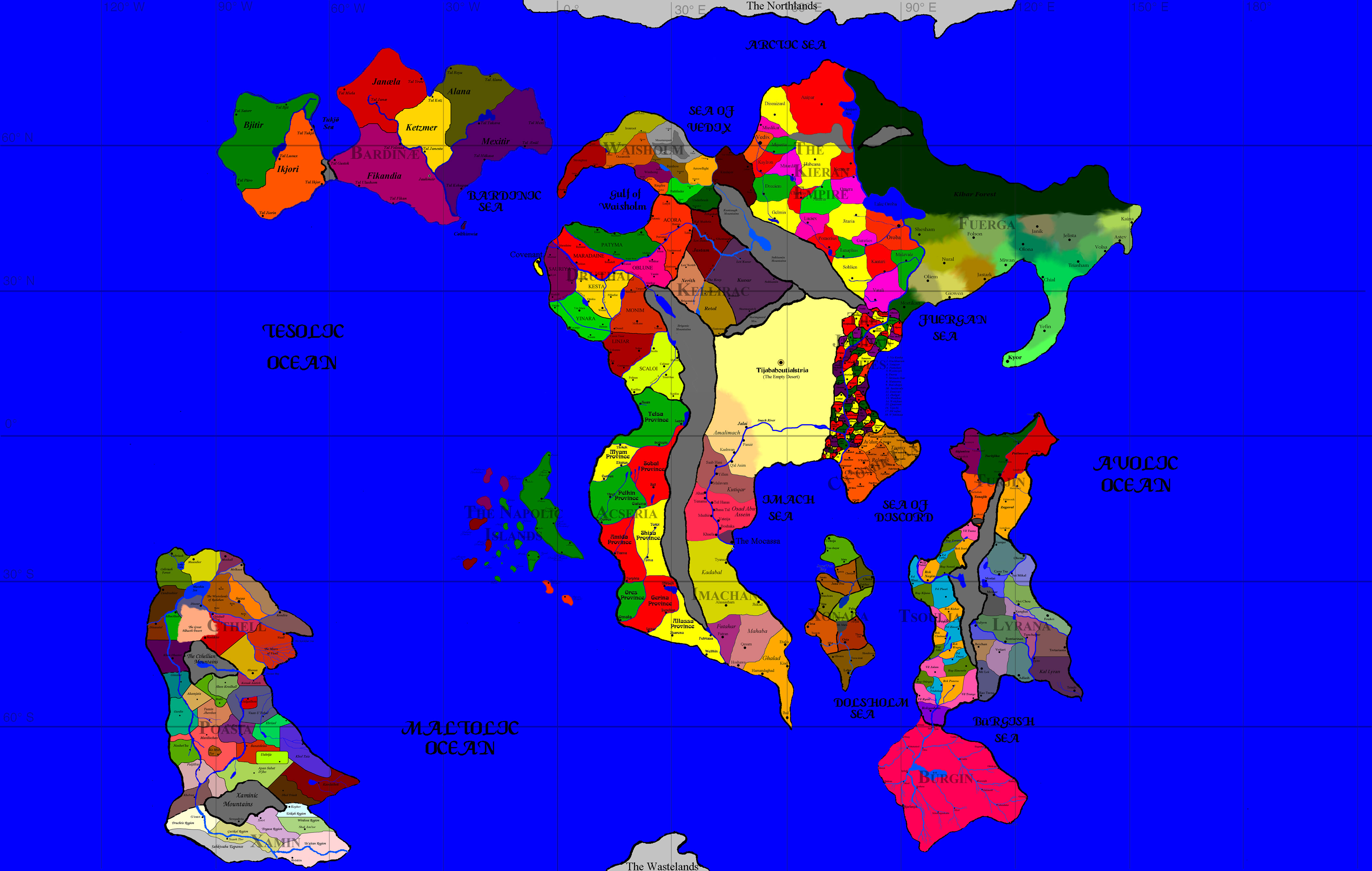
The Archduchy of Maradaine, in northwestern Druthal, lies between the Maradaine River and the Patyma river, with the Itasan Canal marking its eastern border.
The Archduchy of Maradaine has three regions: the coastal lowlands called the Sharain, the rolling hill country of Toren, and the wide plains of Itasa. This archduchy might be considered the standard of Druthal from which the others deviate. The terrain consists of mostly wide, rolling plains of fertile land. The biggest use of the land is for sheep ranching, as well as farms, which are primarily devoted to wheat. Wool from these sheep are greatly valued commodities, as it is of the highest quality. The people of the archduchy of Maradaine are, for the most part, friendly, open and honest, and somewhat conservative in their concern for propriety.
The city of Maradaine is officially in this archduchy, although the south half of would be in Sauriya. As it is the capital of Druthal, Maradaine is a city of tremendous activity, being the last major city on the Maradaine River before it reaches the ocean.
The largest city in Sharain is Ressinar, which is also the official seat of power for the Archduke of Maradaine*. The primary industry of Sharain is sheep ranching, with Sharain wool being a valued good throughout Druthal and the rest of the world. Sharain is also known for its vineyards, one of the few regions in all of Druthal to produce quality vintages.
Key foods in Sharain, besides lamb, are potatoes, onions and white beans, and wheat to a lesser degree. Duck is very popular as well, as they are plentiful in the region. The most common seasonings of the region are rosemary and mustard. A wide variety of mustard seeds are cultivated in Sharain, and many towns have their own special blends.
Traditional dishes include Lamb Sharain, stewed with potatoes, seasoned with wine, onions, rosemary and mustard, or Lamb Sausages and Crisp-- potatoes and onions fried in duck fat.
To the east, in Toren, there are less sheep ranches and more farms, growing wheat, barley and other grains. Ducks and other game birds are favored there, and bird hunting is a noted sport in the country around the city of Delikan. Toren wines are uncommon and unremarkable, but Toren beers are spectacular.
In Toren, neither onions or potatoes are popular, though they can grow well in the region. Cabbages and mustards are the preferred secondary crops. Thus any Torenite dish will typically be stewed in cabbage and beer, with lamb-and-duck sausages being one of the most common choices.
Further east in Itasa, the true "bread basket" region of the Archduchy. Here most of the wheat the supplies the city of Maradaine is grown. While Itasan breads are known to be hearty and yeasty, most of the rest of their cuisine is not noteworthy. Lamb stews with barley, or roasted birds with bread (chickens or ducks, mostly) are the common traditional dishes in Itasa.
--
*- Archduke Kellen Hare, Eleventh Archduke of Maradaine. The Hares of Ressinar claim to be one of the oldest noble lines in Druthal.
Showing posts with label Druthal. Show all posts
Thursday, May 8, 2014
Monday, April 7, 2014
Worldbuilding: The Broad Strokes and the Fine Details
I've made little secret of the fact that I'm a worldbuilding completist, though even I have a limit of what "completist"would actually mean. For example, in my Banshee setting, that meant having a strong sense of what was going on within 30ly of Earth, a solid framework of 100ly from Earth, and a rough sense of 150ly from Earth.
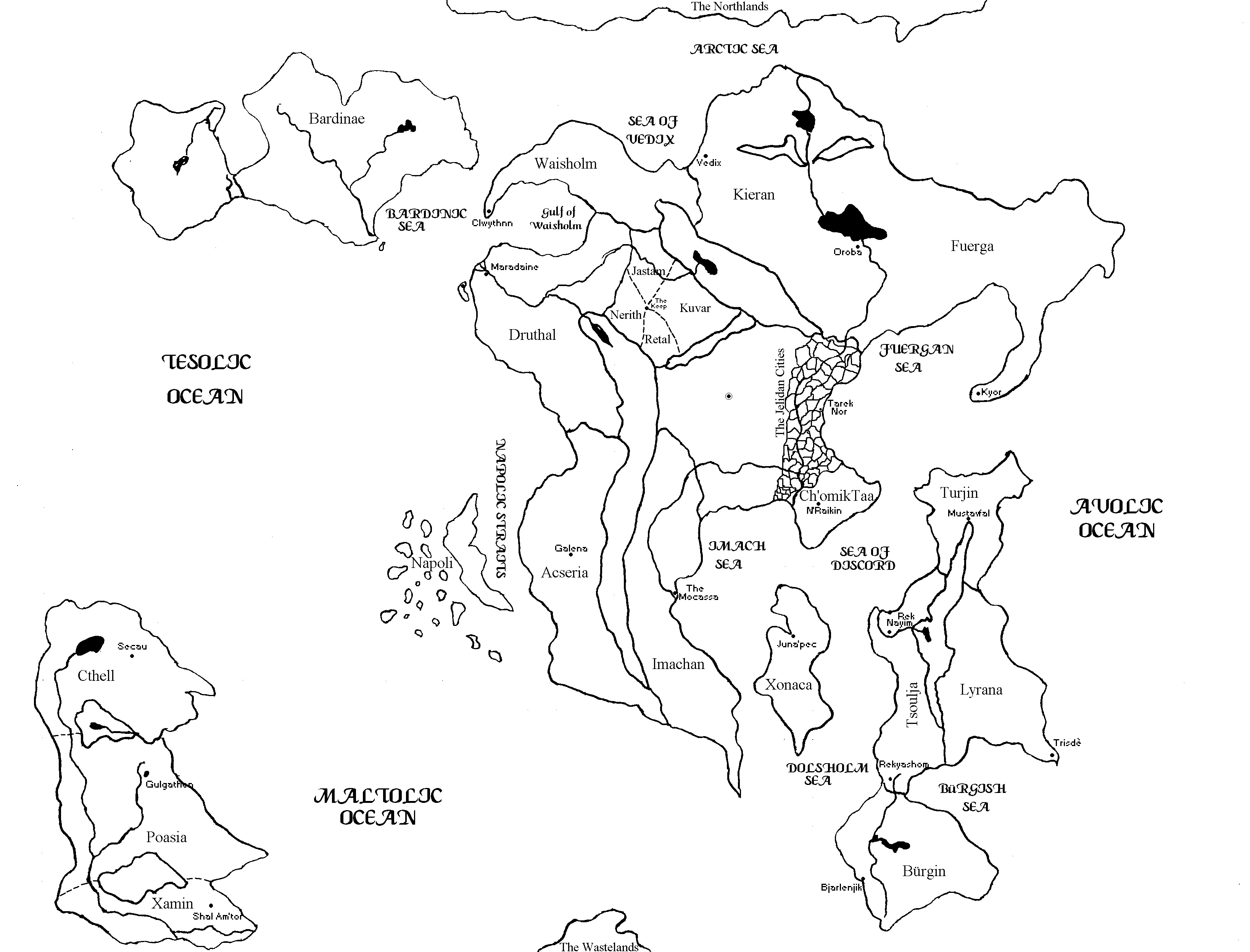
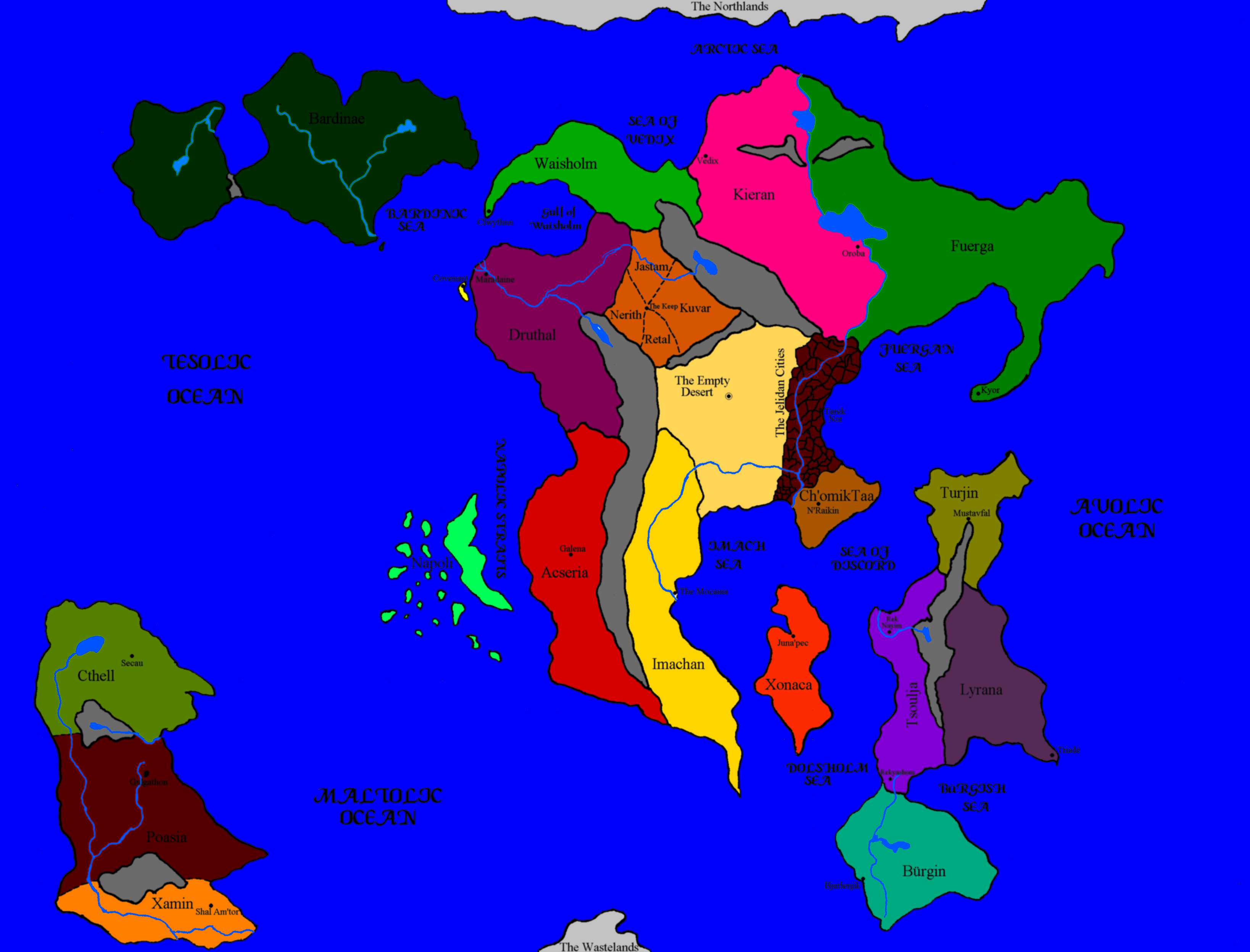
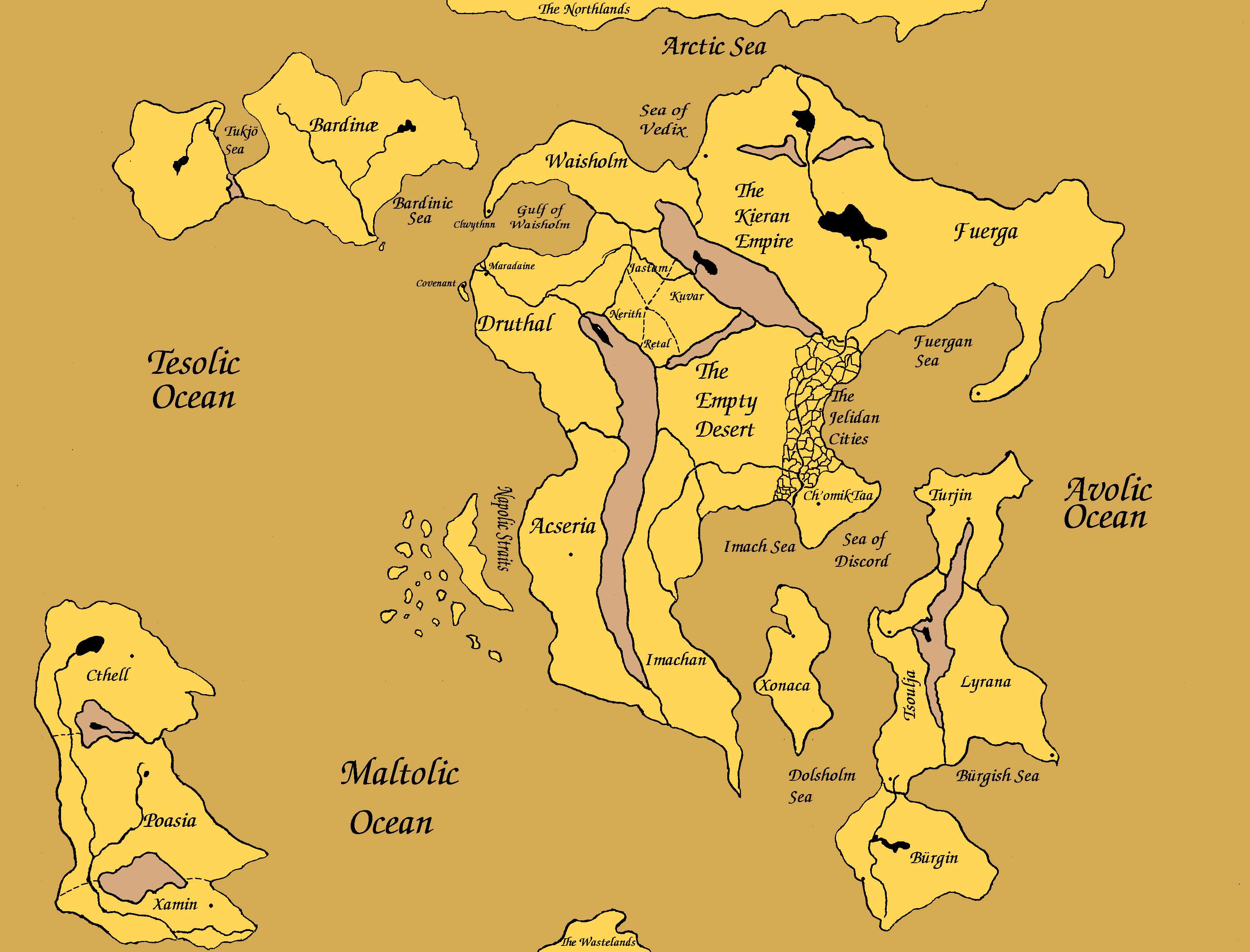
In the world of Thorn of Dentonhill, I at least don't have to deal with the infinite vastness of space. One planet is a simple enough limitation, at least in terms of continents and oceans. Draw out a world map, and you've defined the scope, and then place the cultures in them.
On this level, I've worked out the general concepts behind each nation and culture, and on a map level, the breakdown of districts/provinces and cities. However, for a lot of the areas that aren't Druthal, that's the limit of what I've done.
For example, while the history of Druthal is a 25,000 word document*, over in the eastern areas of Xonaca or the Tyzanian continent, I have just a bullet-point outline of the history. Can I delve into greater details there? If I need it. Right now, at the very least, I don't need that at all, and at a certain point that degree of worldbuilding is more distraction that purposeful.
After all the stories I'm writing, at least right now, take place in Druthal, specifically in the city of Maradaine. Now, I've built Maradaine as a cosmopolitan city, a place where people from all over the nation, as well as the world as a whole, might end up. So it was important to have a sense of the whole country, and how the finer details could affect the city. This was especially true in the case of Way of the Shield, which deals with Maradaine as a capitol city. With Parliament members from Acora, Monim or Linjar, I need a strong sense of what being from those places mean.
But even knowing all that, the thing I really needed to know was the city of Maradaine itself. Just as you wouldn't try to write a book about New York City without having a sense of what you were really saying when you mention Soho or the Upper West Side, I needed to know the city itself, and understand what it would mean to live in Aventil or Dentonhill or Seleth or High River. Every neighborhood has its own sense, and to a degree, its own minute history. I wouldn't work out other major Druth cities like Fencal, Yoleanne or Lacanja with the same level of detail, because, again, I don't need that at this point in time. Maybe I will never need it. So, again, even for a worldbuilding completist, it would be more a waste of time a distraction from the writing itself.
Now, of course, what I really needed to do-- what all stories need from the worldbuilding-- is how it works on a personal level. Some of this is micro-managing the geography, which is a level I personally felt I needed to do. I have to admit, I've got a certain pet peeve in fantasy books where cities-- sprawling metropolises-- are little more than towns with no street names, and districts that are more on-the-nose descriptions than actual names. Honestly, when I see that sort of thing, it highlights that the writer simply didn't do their worldbuilding work, which makes me feel like the work as a whole is going to be sloppy. As I said, there are plenty of details that don't need to be done, but the ones closest to the story itself should feel full, vibrant and detailed. That way, the story you write in it feels like it's in a living place, rather than a vague template of a generic setting.
Because, after all, who would be interested in reading about that?
---
*- For my own sense of verisimilitude. In no way will the reading of Thorn or Murder of Mages make you feel like there will be a quiz at the end.
In the world of Thorn of Dentonhill, I at least don't have to deal with the infinite vastness of space. One planet is a simple enough limitation, at least in terms of continents and oceans. Draw out a world map, and you've defined the scope, and then place the cultures in them.
On this level, I've worked out the general concepts behind each nation and culture, and on a map level, the breakdown of districts/provinces and cities. However, for a lot of the areas that aren't Druthal, that's the limit of what I've done.
For example, while the history of Druthal is a 25,000 word document*, over in the eastern areas of Xonaca or the Tyzanian continent, I have just a bullet-point outline of the history. Can I delve into greater details there? If I need it. Right now, at the very least, I don't need that at all, and at a certain point that degree of worldbuilding is more distraction that purposeful.
After all the stories I'm writing, at least right now, take place in Druthal, specifically in the city of Maradaine. Now, I've built Maradaine as a cosmopolitan city, a place where people from all over the nation, as well as the world as a whole, might end up. So it was important to have a sense of the whole country, and how the finer details could affect the city. This was especially true in the case of Way of the Shield, which deals with Maradaine as a capitol city. With Parliament members from Acora, Monim or Linjar, I need a strong sense of what being from those places mean.
But even knowing all that, the thing I really needed to know was the city of Maradaine itself. Just as you wouldn't try to write a book about New York City without having a sense of what you were really saying when you mention Soho or the Upper West Side, I needed to know the city itself, and understand what it would mean to live in Aventil or Dentonhill or Seleth or High River. Every neighborhood has its own sense, and to a degree, its own minute history. I wouldn't work out other major Druth cities like Fencal, Yoleanne or Lacanja with the same level of detail, because, again, I don't need that at this point in time. Maybe I will never need it. So, again, even for a worldbuilding completist, it would be more a waste of time a distraction from the writing itself.
Now, of course, what I really needed to do-- what all stories need from the worldbuilding-- is how it works on a personal level. Some of this is micro-managing the geography, which is a level I personally felt I needed to do. I have to admit, I've got a certain pet peeve in fantasy books where cities-- sprawling metropolises-- are little more than towns with no street names, and districts that are more on-the-nose descriptions than actual names. Honestly, when I see that sort of thing, it highlights that the writer simply didn't do their worldbuilding work, which makes me feel like the work as a whole is going to be sloppy. As I said, there are plenty of details that don't need to be done, but the ones closest to the story itself should feel full, vibrant and detailed. That way, the story you write in it feels like it's in a living place, rather than a vague template of a generic setting.
Because, after all, who would be interested in reading about that?
---
*- For my own sense of verisimilitude. In no way will the reading of Thorn or Murder of Mages make you feel like there will be a quiz at the end.
Labels:
A Murder of Mages,
Druthal,
maps,
Maradaine,
Thorn of Dentonhill,
worldbuilding
Thursday, December 26, 2013
Way of the Shield, and the Geena Davis Rule: 2013 in Review, Part Two
The next big milestone of accomplishments in 2013 as finishing the draft of Way of the Shield, cleaning it up and sending it off to the agent. He just recently sent it back to me, so now I've got a last round of tweaks and polishes to put on it before sending it back to him to put out into the world.
Long time readers will be aware that Way of the Shield was something of an albatross around my neck for much of 2012. I was working on it and it simply wasn't coming together at all. I had actually decided to put it to the side and focus on other things early this year, but it kept poking at me until I cracked the problem I had been having with the antagonists. It actually came together when my beta reader/sounding board guy asked me a simple question regarding Way of the Shield, and that brought about a breakthrough in writing out a long and complicated response. Doing that brought me from a manuscript languishing at around a third of the way done to complete in two months.
Breakthroughs can work like that.
The other thing I did with Shield, both in the original draft and again in the current clean-up, was confound the gender expectations of the old knightly orders that Dayne is a part of. Druthal and Maradaine are hardly a paradise of gender equality, but I wanted the Orders to reflect the idea that anyone who gets through the training process is considered an equal.
But my first chapter had no female characters.
Then I was thinking about this bit of advice Geena Davis recently gave regarding female characters in Hollywood movies, advice I think can easily apply to genre fiction as well:
And it stuck me, if I've already established this idea that the Orders have more gender equality than the culture at large, then why not just have Dayne's chapterhouse master in Lacanja (the city Way of the Shield starts in before Dayne returns to Maradaine) be a woman? I never gave Master Thall a given name, male or female, to begin with, so rewriting the scene involved little more than some pronoun switching. But, I think, it will have a strong effect on the worldbuilding of the Orders, which will ripple through the rest of the book-- which already has many female characters in a variety of roles.
Regardless, as I mentioned back in May when I finally finished the draft, it felt very good to get this particular project out of its long, slow, "work-in-progress" state.
Long time readers will be aware that Way of the Shield was something of an albatross around my neck for much of 2012. I was working on it and it simply wasn't coming together at all. I had actually decided to put it to the side and focus on other things early this year, but it kept poking at me until I cracked the problem I had been having with the antagonists. It actually came together when my beta reader/sounding board guy asked me a simple question regarding Way of the Shield, and that brought about a breakthrough in writing out a long and complicated response. Doing that brought me from a manuscript languishing at around a third of the way done to complete in two months.
Breakthroughs can work like that.
The other thing I did with Shield, both in the original draft and again in the current clean-up, was confound the gender expectations of the old knightly orders that Dayne is a part of. Druthal and Maradaine are hardly a paradise of gender equality, but I wanted the Orders to reflect the idea that anyone who gets through the training process is considered an equal.
But my first chapter had no female characters.
Then I was thinking about this bit of advice Geena Davis recently gave regarding female characters in Hollywood movies, advice I think can easily apply to genre fiction as well:
Go through the projects you're already working on and change a bunch of the characters' first names to women's names. With one stroke you've created some colorful unstereotypical female characters that might turn out to be even more interesting now that they've had a gender switch. What if the plumber or pilot or construction foreman is a woman? What if the taxi driver or the scheming politician is a woman? What if both police officers that arrive on the scene are women — and it's not a big deal?
And it stuck me, if I've already established this idea that the Orders have more gender equality than the culture at large, then why not just have Dayne's chapterhouse master in Lacanja (the city Way of the Shield starts in before Dayne returns to Maradaine) be a woman? I never gave Master Thall a given name, male or female, to begin with, so rewriting the scene involved little more than some pronoun switching. But, I think, it will have a strong effect on the worldbuilding of the Orders, which will ripple through the rest of the book-- which already has many female characters in a variety of roles.
Regardless, as I mentioned back in May when I finally finished the draft, it felt very good to get this particular project out of its long, slow, "work-in-progress" state.
Labels:
2013,
Druthal,
gender,
state of the writer,
Way of the Shield,
writing
Monday, June 3, 2013
Fantasy Worldbuilding: Tour continues to Fuerga
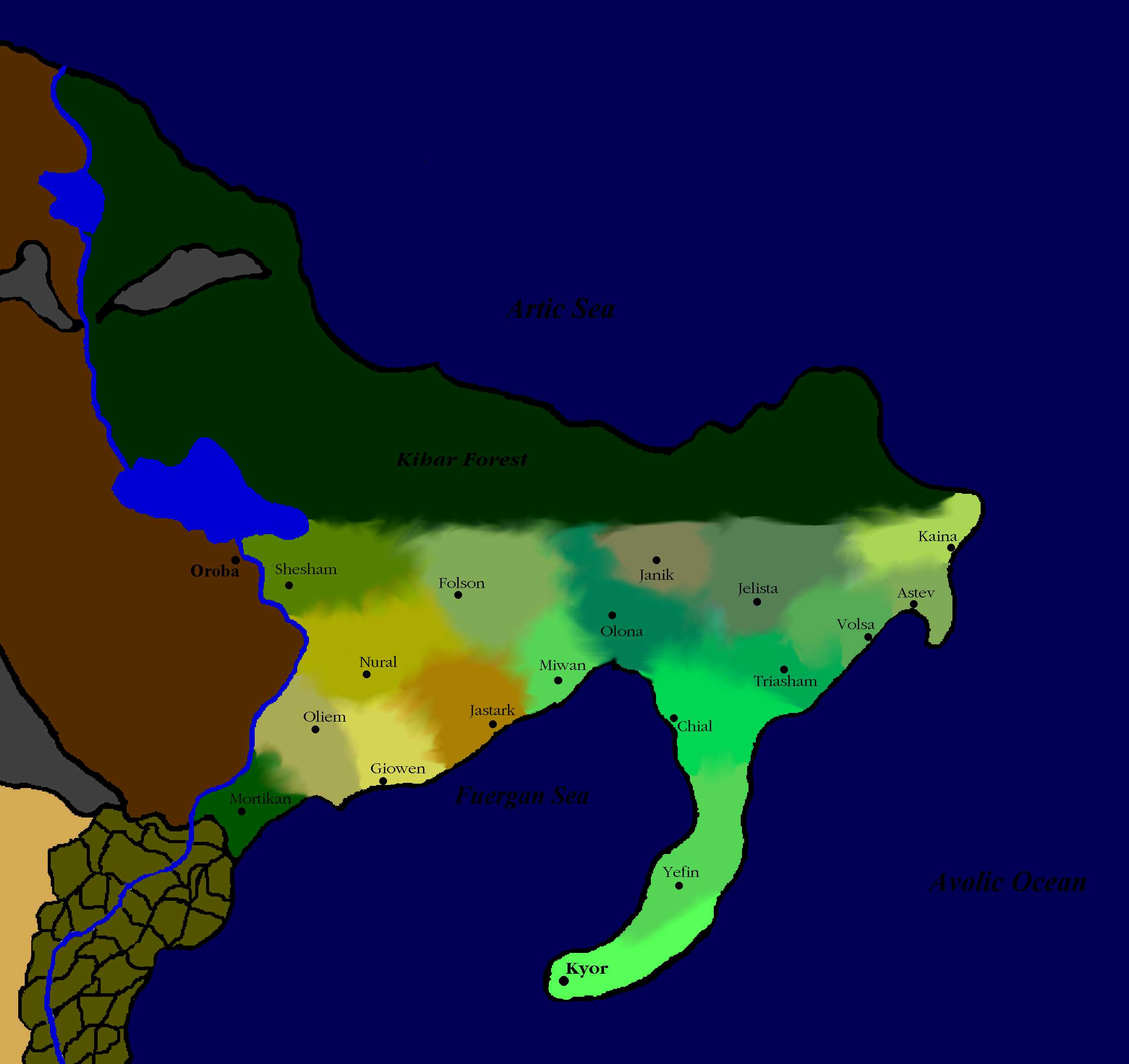
As we continue to go around the continent, past the Kieran Empire to the east: Fuerga. Now we're also out of the Empire's direct influence on culture.
---
"The three biggest things about being in Fuerga. Always be polite, never strike your horse, and never think that you got the better deal." -- Ian Talsen, Druth Trader
"The Fuergans are the most downright decent and moral people you could meet. Of course, it's their own set of morals, but they do stick to them." -Kieran Statesman Polonus Kenix
"On the surface, Fuerga seems like a wonderful culture, filled with commerce, art, and the most generous of people. However, there is a frightening, uncivilized reality beneath that. If someone disagrees with your business, or you cannot fulfill your debts, they can assault you, beat you within an inch of your life, lock you in a cell or leave you dead in a ditch. And not only are there no legal ramifications, their leaders encourage and participate in this. There is a line not to cross in Fuerga." -Kahngzhei Dzana, Lyranan Foreign Attaché
"Goods taken without agreement are not property.
All prices are negotiable.
Never leave town with debts behind you.
Great profit rarely results from minimal effort.
A man's horse says everything about him.
Family is always more important than profit. "
-Excerpted from the Fuergan Tenets
Fuerga is a nation unified more by a common mindset of lifestyle, philosophy and business rather than unified by a governing body. From an outside perspective, it is often said that Fuerga is about three things: Family, Trade and Horses.
The Family unit, and allegiance to one’s family, is the central aspect of the Fuergan culture. In is through the families that Fuerga is run.
Trade is what the families live for. Increasing trade, improving the family’s financial status, improving one’s personal financial status is the key to power in Fuerga.
Horses are what they love: they take great pride in their stock and breeding of horses and in their unparalleled skills in the riding and handling of horses.
The only real government in Fuerga is the Fuergan Syndicate. The Syndicate consists of the heads of the most powerful families in Fuerga. Its number varies, as there is no set amount of representation. Every year, families can become members of the Syndicate by “buying” a chair on it. If a current member cannot pay this yearly fee, they lose their chair. On the whole, the flow of commerce keeps a balance so that most of the time, there are about twenty chairs on the Syndicate. In boom periods, this has raised as high as fifty, but shortly afterwards the market balance back out and many new chairs are lost again. Although each member has an equal voice, the chairs are ranked, based on how long it has been held by a family. The family Kyoran has maintained its chair since the formation of the Syndicate, so it holds the First Chair. The First Chair controls the Syndicate meeting, hosts the location, and calls it to order and to close.
The Syndicate has direct, absolute, control over two things: Road tolls and import fees. They have influence, however, on almost all aspects of commerce, including effecting base prices, since most goods are, directly or indirectly, controlled by the members of the Syndicate.
The Syndicate Families have influence most of the other families in Fuerga. Lesser families may be Allied or Sworn to a Syndicate family, or Allied or Sworn to a family that is connected to a Syndicate family. Some families are in Endebtment, which means its members must provide labor and service to the family to whom they are indebted.
A few families are independent, thus having no voice or ally in the Syndicate, and are reliant upon only their own resources.
Every Fuergan has a Caste Rank, or krai, which is a direct measure of his or her personal wealth. As krai is personal, ranks within one family or home can vary. The highest ranked member of a family is the head of the family, called the natrilka. If there is a problem within a family, it is ultimately the natrilka’s responsibility to take care of it.
The krai are as follows: Jorchal, the highest rank, is reserved for the natrilka of a Syndicate family, as it represents the wealth needed to purchase a Syndicate chair. The ranks continue, in descending wealth with Niklan, Lavark, Malreth, Heina, Veir, Taf, Ona, Kaln, Deln, Ni and Va. Kaln, Deln, Ni and Va all represent levels of Endebtment. A family or home is often referred to as being the same as the Caste rank of its natrilka. Thus, for example, a wealthy family, but not extremely wealthy, would be a Lavark family. An entire family of Endebted may be a Ni family.
There are no true laws in Fuerga, but there are the Tenets, a set of philosophical rules regarding trading ethics. If one does not live by these rules, his family will usually deal with him. If a whole family acts untenetially, other families, even the Syndicate, will deal with them. This usually takes the form of a polite but stern warning at the first occasion, beatings and other physical assaults in further instances, and eventually someone will be considered beyond reproach and is killed.
An important part of the Tenets have to do with debt, and being responsible for one’s debt. There is no shame in being in Endebtment, but failure to take on the responsibilities it entails will usually be beaten or killed. An Endebted man is essentially property until his debt is paid off.
A family member who has brought dishonor on the family through some form of crime will either be ousted from the family, or killed by the family in extreme cases. An ousted man will usually fall into Endebtment. A whole family found to be untenetial would be decried as being so. Once such information is public, that family will find doing any business nearly impossible, and will also usually fall into Endebtment.
There is no official military per se in Fuerga. Wealthy families, especially the Syndicate members, will have some form of small army they control, as well as ships that are both merchant and naval in nature. Soldiers and sailors are usually from the Endebted, officers from one’s own family.
Typically, a soldier is both a light footman and light cavalry. He has a horse, which is his right to care for. He wears leather armor, or occasionally (if the family spends the extra money) scale or chain. They are usually trained and armed with a sabre (in Fuergan, the hrana) and a bolo (kiaset), traditional Fuergan weapons. Lassos and knives are often carried as well. Bows, crossbows and long polearms are almost never used by Fuergans. Sailors will just wear leather vests and carry a sabre.
There are a number of Fuergans who are of mixed Fuergan and Turjin descent, who are called turfien. Turfein are presumed to have less of a sense for trade, and usually are encouraged to become soldiers.
Unless one is from a wealthy family, there isn’t much opportunity for education. Technically, each Syndicate family is the sponsor of a private university, but only a few take this duty seriously. All the universities have a tuition, which is typically paid through a sponsorship of some sort. The student, however, will have to repay the sponsorship one way or another.
Of these, only the University of Kyor is a very organized university. The rest are little more than a well kept library with a single scholar caring for it.
Fuerga has made an effort to maintain neutral to friendly relations with all other nations, in order to improve and enhance international trade. There is some tension with both Turjin and Bürgin, having had some open conflicts with them in the past. Fuergan and Bürgish ships will attack each other sometimes, but there is no official declaration of hostilities between the two. They are on friendly terms with Druthal, but have no true allies. During the wars of the 12th Century, Fuerga stayed pointedly neutral, selling weapons and armor to all sides of the conflicts.
Within Fuerga’s structure, there is more conflict, as some families will make covert or overt war on each other.
Family is, of course, the center of the Fuergan culture. Fuergan families are complex, and unlike any other in the world, so it is very difficult for non-Fuergans to understand all the relations between family members.
Each family is broken into homes, and each home is essentially its own independent unit, although the most parental home (the natir) is in charge of the rest. The natir only interferes with the lower or "children" homes (mokorr and nelmokorr) in important matters. Which home is the natir of the family depends not on seniority, however, but on krai. If the krai of a head of a mokorr or nelmokorr becomes higher than the head of the natir, than that home becomes the natir, he becomes the family’s natrilka and the old natir becomes a mokorr.
Fuergan families are polygamous, in which anywhere from two to twelve men and women are all married to each other. All children born to the family is the responsibility of all the adults, although there is, of course, special affinity to the birth mother. When children become adults, they are still part of that family branch as hlesta, single adults, until they marry into another family, or start a new mokorr or nelmokorr. Hlesta are expected, however, to earn their own life and way, as the shizaram (a gift given upon reaching adulthood) is the last money they will receive from their parents. They still would warmly receive Fuergan hospitality from them, though.
Fuergan names are long and complex, yet very important to them. They follow a precise pattern:
ab mik lek (dai ) vil sim . For most occasions, one will be referred to merely as ab , especially when dealing with foreigners. When speaking formally to each other, Caste rank is used as a title, followed by family name, as in Malreth Chial.
Houses are important to Fuergans, as they are an immediate sign of wealth and family size. Houses are actually whole compounds, whose grounds may take up several buildings of a city, even whole blocks. In the country, whole villages and communities are essentially one house of a wealthy family.
A house is expected to give every member of the family, including the children, their own quarters, as well as having ample space for guests. In addition, all the servants, soldiers, and other Endebted workers are housed somewhere on the compound, although they are usually not given single rooms, instead the live barrack style. The main house for a family can be four or five stories tall, and with the very wealthy (such as Syndicate families) nine or ten story houses are common.
Most families of stature try and maintain a city house and a country house.
Fuergans are noted for their immense hospitality. A friend or guest of good standing will happily be put up in a house for a couple of months with very little asked in return.
The city Fuergans, known as sikar, have a very basic day-to-day life. In the morning, the streets are filled with traders. Deals are made with each other, with travelers, and so on, all through the streets. Because the streets are crowded and noisy, much business is done here using the capathla, the hand gesture language of the Fuergans. This is a system used only for business deals, and involves large, wide gestures that allow one to make a deal with someone a block away. This allows an adept trader to act as a bridge between a buyer and seller who cannot see each other, and make a profit as an intermediary. Doing well in the street trading requires sharp eyes, fast hands and quick thinking. Food vendors also move through the streets selling their wares.
By late morning, the deals have been made, and the streets clear out. The city cleaners (who are employed by the Family who has greatest influence in the city—they are considered the ones responsible for maintaining the city) come out and sweep the streets, and make the city look presentable. Traders go and make their preparations for the deals made on the streets that morning. In the streets, no money or goods exchanges hands, only deals are made.
There is then a family lunch, and a rest period. In the afternoon, all the exchanges are made to fulfill the deals made that morning. Unless special arrangements were made with the deal, all exchanges are to be made that same day. Being unable to fulfill one’s deals in the afternoon will hurt one’s reputation and status, and may cause retribution to occur. This is the danger in being an intermediary- both parties made a deal with you, and if one of them does not fulfill their obligation, then you cannot either, and your reputation suffers.
In the evening, there is dinner with the family, and then usually some form of evening entertainment.
There are three kinds of country life. The sinar, who live in the country communities, are the ones who handle most of the farming and actual crafting of goods for trade. This work is usually done by the endebted families who live under the grace of the family they work for.
The kanar are the nomadic Fuergans who move from community to city to city. The kanar are equal members of whatever family they are a part of, but they are usually not involved with daily business. Instead, they are on the road, delivering goods from place to place in caravans. Many Fuergans crave this lifestyle. Usually kanar arrive in a city, make deals with the goods they have, make trade and move on. The kanar are the true lifeblood of the Fuergan economy.
Lastly, there are the kihari, who are usually loners or small groups who live in the northern Kihar forests. They live a life of mostly trapping and lumberjacking, trading their goods with visiting kanar for supplies, and keeping to themselves.
---
"The three biggest things about being in Fuerga. Always be polite, never strike your horse, and never think that you got the better deal." -- Ian Talsen, Druth Trader
"The Fuergans are the most downright decent and moral people you could meet. Of course, it's their own set of morals, but they do stick to them." -Kieran Statesman Polonus Kenix
"On the surface, Fuerga seems like a wonderful culture, filled with commerce, art, and the most generous of people. However, there is a frightening, uncivilized reality beneath that. If someone disagrees with your business, or you cannot fulfill your debts, they can assault you, beat you within an inch of your life, lock you in a cell or leave you dead in a ditch. And not only are there no legal ramifications, their leaders encourage and participate in this. There is a line not to cross in Fuerga." -Kahngzhei Dzana, Lyranan Foreign Attaché
"Goods taken without agreement are not property.
All prices are negotiable.
Never leave town with debts behind you.
Great profit rarely results from minimal effort.
A man's horse says everything about him.
Family is always more important than profit. "
-Excerpted from the Fuergan Tenets
Fuerga is a nation unified more by a common mindset of lifestyle, philosophy and business rather than unified by a governing body. From an outside perspective, it is often said that Fuerga is about three things: Family, Trade and Horses.
The Family unit, and allegiance to one’s family, is the central aspect of the Fuergan culture. In is through the families that Fuerga is run.
Trade is what the families live for. Increasing trade, improving the family’s financial status, improving one’s personal financial status is the key to power in Fuerga.
Horses are what they love: they take great pride in their stock and breeding of horses and in their unparalleled skills in the riding and handling of horses.
The only real government in Fuerga is the Fuergan Syndicate. The Syndicate consists of the heads of the most powerful families in Fuerga. Its number varies, as there is no set amount of representation. Every year, families can become members of the Syndicate by “buying” a chair on it. If a current member cannot pay this yearly fee, they lose their chair. On the whole, the flow of commerce keeps a balance so that most of the time, there are about twenty chairs on the Syndicate. In boom periods, this has raised as high as fifty, but shortly afterwards the market balance back out and many new chairs are lost again. Although each member has an equal voice, the chairs are ranked, based on how long it has been held by a family. The family Kyoran has maintained its chair since the formation of the Syndicate, so it holds the First Chair. The First Chair controls the Syndicate meeting, hosts the location, and calls it to order and to close.
The Syndicate has direct, absolute, control over two things: Road tolls and import fees. They have influence, however, on almost all aspects of commerce, including effecting base prices, since most goods are, directly or indirectly, controlled by the members of the Syndicate.
The Syndicate Families have influence most of the other families in Fuerga. Lesser families may be Allied or Sworn to a Syndicate family, or Allied or Sworn to a family that is connected to a Syndicate family. Some families are in Endebtment, which means its members must provide labor and service to the family to whom they are indebted.
A few families are independent, thus having no voice or ally in the Syndicate, and are reliant upon only their own resources.
Every Fuergan has a Caste Rank, or krai, which is a direct measure of his or her personal wealth. As krai is personal, ranks within one family or home can vary. The highest ranked member of a family is the head of the family, called the natrilka. If there is a problem within a family, it is ultimately the natrilka’s responsibility to take care of it.
The krai are as follows: Jorchal, the highest rank, is reserved for the natrilka of a Syndicate family, as it represents the wealth needed to purchase a Syndicate chair. The ranks continue, in descending wealth with Niklan, Lavark, Malreth, Heina, Veir, Taf, Ona, Kaln, Deln, Ni and Va. Kaln, Deln, Ni and Va all represent levels of Endebtment. A family or home is often referred to as being the same as the Caste rank of its natrilka. Thus, for example, a wealthy family, but not extremely wealthy, would be a Lavark family. An entire family of Endebted may be a Ni family.
There are no true laws in Fuerga, but there are the Tenets, a set of philosophical rules regarding trading ethics. If one does not live by these rules, his family will usually deal with him. If a whole family acts untenetially, other families, even the Syndicate, will deal with them. This usually takes the form of a polite but stern warning at the first occasion, beatings and other physical assaults in further instances, and eventually someone will be considered beyond reproach and is killed.
An important part of the Tenets have to do with debt, and being responsible for one’s debt. There is no shame in being in Endebtment, but failure to take on the responsibilities it entails will usually be beaten or killed. An Endebted man is essentially property until his debt is paid off.
A family member who has brought dishonor on the family through some form of crime will either be ousted from the family, or killed by the family in extreme cases. An ousted man will usually fall into Endebtment. A whole family found to be untenetial would be decried as being so. Once such information is public, that family will find doing any business nearly impossible, and will also usually fall into Endebtment.
There is no official military per se in Fuerga. Wealthy families, especially the Syndicate members, will have some form of small army they control, as well as ships that are both merchant and naval in nature. Soldiers and sailors are usually from the Endebted, officers from one’s own family.
Typically, a soldier is both a light footman and light cavalry. He has a horse, which is his right to care for. He wears leather armor, or occasionally (if the family spends the extra money) scale or chain. They are usually trained and armed with a sabre (in Fuergan, the hrana) and a bolo (kiaset), traditional Fuergan weapons. Lassos and knives are often carried as well. Bows, crossbows and long polearms are almost never used by Fuergans. Sailors will just wear leather vests and carry a sabre.
There are a number of Fuergans who are of mixed Fuergan and Turjin descent, who are called turfien. Turfein are presumed to have less of a sense for trade, and usually are encouraged to become soldiers.
Unless one is from a wealthy family, there isn’t much opportunity for education. Technically, each Syndicate family is the sponsor of a private university, but only a few take this duty seriously. All the universities have a tuition, which is typically paid through a sponsorship of some sort. The student, however, will have to repay the sponsorship one way or another.
Of these, only the University of Kyor is a very organized university. The rest are little more than a well kept library with a single scholar caring for it.
Fuerga has made an effort to maintain neutral to friendly relations with all other nations, in order to improve and enhance international trade. There is some tension with both Turjin and Bürgin, having had some open conflicts with them in the past. Fuergan and Bürgish ships will attack each other sometimes, but there is no official declaration of hostilities between the two. They are on friendly terms with Druthal, but have no true allies. During the wars of the 12th Century, Fuerga stayed pointedly neutral, selling weapons and armor to all sides of the conflicts.
Within Fuerga’s structure, there is more conflict, as some families will make covert or overt war on each other.
Family is, of course, the center of the Fuergan culture. Fuergan families are complex, and unlike any other in the world, so it is very difficult for non-Fuergans to understand all the relations between family members.
Each family is broken into homes, and each home is essentially its own independent unit, although the most parental home (the natir) is in charge of the rest. The natir only interferes with the lower or "children" homes (mokorr and nelmokorr) in important matters. Which home is the natir of the family depends not on seniority, however, but on krai. If the krai of a head of a mokorr or nelmokorr becomes higher than the head of the natir, than that home becomes the natir, he becomes the family’s natrilka and the old natir becomes a mokorr.
Fuergan families are polygamous, in which anywhere from two to twelve men and women are all married to each other. All children born to the family is the responsibility of all the adults, although there is, of course, special affinity to the birth mother. When children become adults, they are still part of that family branch as hlesta, single adults, until they marry into another family, or start a new mokorr or nelmokorr. Hlesta are expected, however, to earn their own life and way, as the shizaram (a gift given upon reaching adulthood) is the last money they will receive from their parents. They still would warmly receive Fuergan hospitality from them, though.
Fuergan names are long and complex, yet very important to them. They follow a precise pattern:
Houses are important to Fuergans, as they are an immediate sign of wealth and family size. Houses are actually whole compounds, whose grounds may take up several buildings of a city, even whole blocks. In the country, whole villages and communities are essentially one house of a wealthy family.
A house is expected to give every member of the family, including the children, their own quarters, as well as having ample space for guests. In addition, all the servants, soldiers, and other Endebted workers are housed somewhere on the compound, although they are usually not given single rooms, instead the live barrack style. The main house for a family can be four or five stories tall, and with the very wealthy (such as Syndicate families) nine or ten story houses are common.
Most families of stature try and maintain a city house and a country house.
Fuergans are noted for their immense hospitality. A friend or guest of good standing will happily be put up in a house for a couple of months with very little asked in return.
The city Fuergans, known as sikar, have a very basic day-to-day life. In the morning, the streets are filled with traders. Deals are made with each other, with travelers, and so on, all through the streets. Because the streets are crowded and noisy, much business is done here using the capathla, the hand gesture language of the Fuergans. This is a system used only for business deals, and involves large, wide gestures that allow one to make a deal with someone a block away. This allows an adept trader to act as a bridge between a buyer and seller who cannot see each other, and make a profit as an intermediary. Doing well in the street trading requires sharp eyes, fast hands and quick thinking. Food vendors also move through the streets selling their wares.
By late morning, the deals have been made, and the streets clear out. The city cleaners (who are employed by the Family who has greatest influence in the city—they are considered the ones responsible for maintaining the city) come out and sweep the streets, and make the city look presentable. Traders go and make their preparations for the deals made on the streets that morning. In the streets, no money or goods exchanges hands, only deals are made.
There is then a family lunch, and a rest period. In the afternoon, all the exchanges are made to fulfill the deals made that morning. Unless special arrangements were made with the deal, all exchanges are to be made that same day. Being unable to fulfill one’s deals in the afternoon will hurt one’s reputation and status, and may cause retribution to occur. This is the danger in being an intermediary- both parties made a deal with you, and if one of them does not fulfill their obligation, then you cannot either, and your reputation suffers.
In the evening, there is dinner with the family, and then usually some form of evening entertainment.
There are three kinds of country life. The sinar, who live in the country communities, are the ones who handle most of the farming and actual crafting of goods for trade. This work is usually done by the endebted families who live under the grace of the family they work for.
The kanar are the nomadic Fuergans who move from community to city to city. The kanar are equal members of whatever family they are a part of, but they are usually not involved with daily business. Instead, they are on the road, delivering goods from place to place in caravans. Many Fuergans crave this lifestyle. Usually kanar arrive in a city, make deals with the goods they have, make trade and move on. The kanar are the true lifeblood of the Fuergan economy.
Lastly, there are the kihari, who are usually loners or small groups who live in the northern Kihar forests. They live a life of mostly trapping and lumberjacking, trading their goods with visiting kanar for supplies, and keeping to themselves.
Labels:
Druthal,
fantasy,
Fuerga,
process of writing,
sff,
worldbuilding
Monday, May 20, 2013
Worldbuilding: The Tour Continues to the Kieran Empire
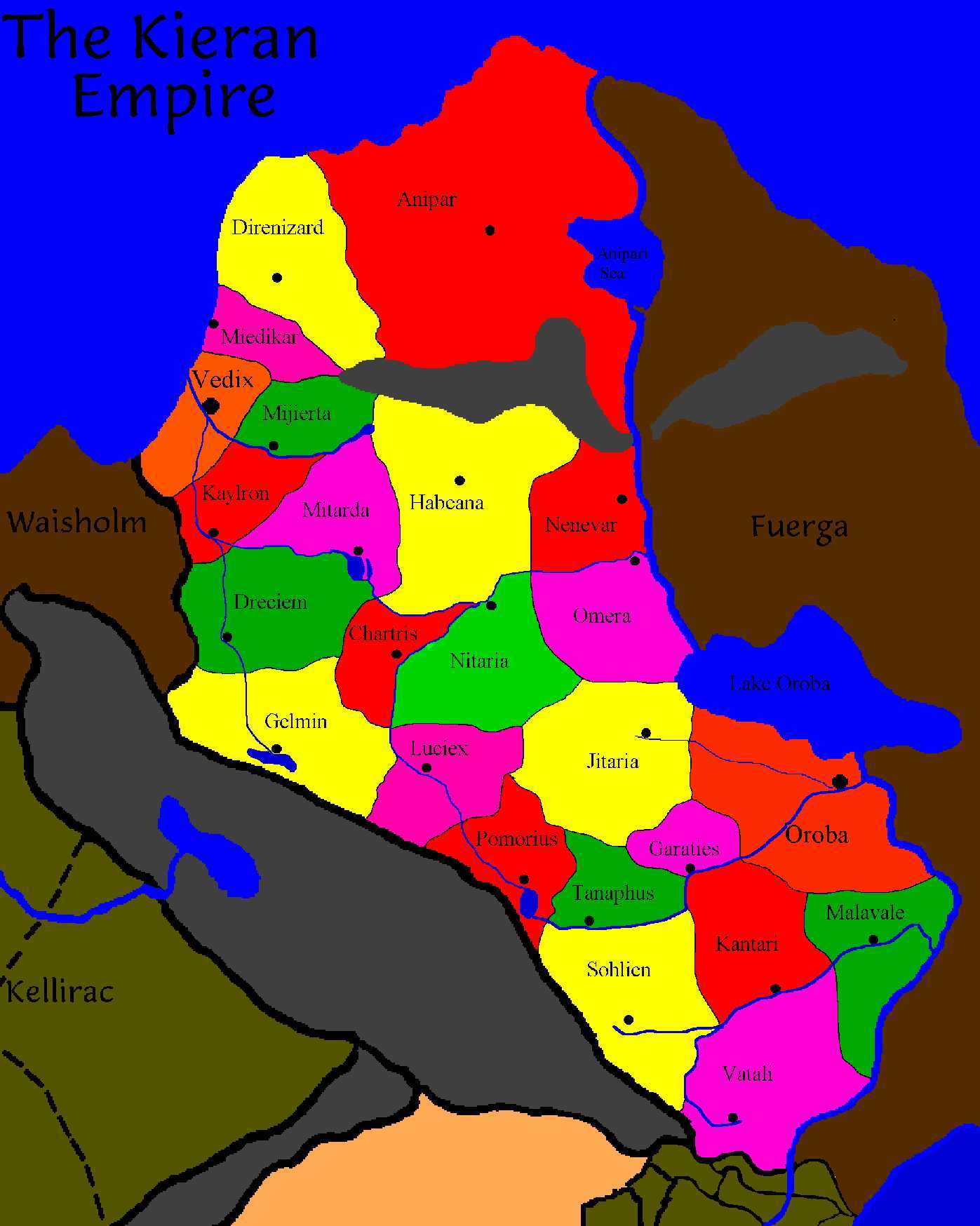
As I'm nearly on the 26-mile line on the marathon that is Way of the Shield, we'll do another stop on the Worldbuilding tour: The Kieran Empire, which doesn't border Druthal, but was a major influence on its history.
---
“Although all appearance are that the Kieran system is strong and has withstood the test of time, it is obvious that it has been surviving on the momentum of tradition for countless generations. It may take a few more centuries, but the Kieran Empire is eventually doomed.” -Official Report, Tsouljan Cultural Society
“Every aspect of civilization in the Trade Nations stems back to us. Governmental structures? Kieran. Roads and irrigation? Kieran. Astronomy, mathematics, science? Kieran. The very language they speak. Kieran. Without us they would be an uncountable slew of warring, petty little kingdoms. At the very least, they could be grateful.” -Senator Cimmeleaus, Kieran Assembly
“In almost three thousand years, the Kieran Empire has never broken a treaty. Bent it, twisted it, or utterly violated the spirit in which it was written? Absolutely. But broken? Never.” -Ian Callun, Druth Parliamentarian
The Kieran Empire stands as one of the oldest civilizations in history. It was founded in 1717 BFE, and has remained for nearly three thousand years. At its height, the Empire controlled all of what is now The Trade Nations. In fact, their cultural similarities all stem from having been a part of the Kieran Empire.
The Empire, while still strong, is now only a shadow of what it once was. Some say that now the Kierans are living in the past. Some think they are planning to recapture what they once were. And some feel the Kierans are slipping into their own decadence, and will someday completely fall apart.
The government of the Kieran empire is, theoretically, broken into three groups, who have a balance of power: The Senate Assembly, the Nobles and the Military. In practice, however, the Senate Assembly is in charge of the Empire. Nobles have no actual authority, merely title and money. They are able to use their title and money to influence members of the Senate, but most nobles content themselves with “courtly life”—being social with other nobles and enjoying creature comforts. The Military also has no authority of its own anymore, as the Assembly has used its powers of foreign and domestic treaty to create a situation where the military is unable to make any action without Senatorial approval.
The Senate Assembly has 240 members, ten from each district in the empire. Each one, theoretically, is an elected official who serves a ten-year term. The election process is so corrupted, however, that just about every Senator sits for life, or at least until he chooses to retire. And when a seat does open due to death or retirement, it is usually filled by a handpicked successor.
All laws, enactments, treaties and so forth (called “proposals” before they are passed) are decided by the senate with a vote. In order for a proposal to pass, the vote must succeed by a simple majority. However, if the proposal is deemed to be “Of Consequence” (something which is decided by a Senator declaring the proposal to be so, and another Senator seconding), then a two-thirds majority is necessary to pass it. A proposal could also be deemed to be of “Dire Consequence” (which requires a majority vote to determine), and therefore needs three-quarters of the Senate supporting to pass. Finally, if the proposal is deemed of “Most Dire Consequence”, a decision which itself is of Consequence, nine-tenths of the Senate must support it to pass it. In the history of the empire, only eleven proposals were ever deemed to have “Most Dire Consequence.”
Much debate always occurs before a vote, and it is common for there also to be a fair amount of bribery, back-scratching, threatening, blackmailing and other forms of corruption.
Each district is presided over by a Military Governor, who is the Commander in Chief of all the legions in that district. The Military Governor is appointed by the Senate, and the Senate can also revoke his position and replace him, and his not required to give cause.
The Kieran Legal code is incredibly complex and detailed, but written with numerous conditionals and loopholes. This allows for skillful lawyers (and Kieran has more lawyers than all the other nations combined) to manipulate the law to make almost anything legal, and almost anything illegal.
Kieran citizens are guaranteed certain rights and freedoms by the law, but these are equally bendable. Most citizens go through life not having any problems, but one can easily get himself in trouble and find himself trapped in the system with his rights removed by a whim.
Any crime, if one is found guilty, will be punished with a fine. If the criminal cannot pay his fine, he can have it paid by joining a labor camp, or by selling himself into slavery. As slaves have no rights at all, most will choose the camps. Going to a camp does not forfeit one’s citizenship. The labor camps are how most of the farming, ranching and mining in Kieran gets done.
The Kieran military has a discipline and internal structure that is only rivaled by the Poasians and Lyranans. They have a distinct chain of command, but the military does not have branches, like the Druth Army and Navy. Rather, naval and ground troops are part of the same structure. Organizationally, the military is broken down by districts, and each district’s Military Governor is at the top of the chain. Below him are generals, colonels, majors, captains, lieutenants and soldiers.
Within each district are several legions, about twenty to fifty per district. The size of a legion will vary, but each legion maintains its own home base, and has the manpower to operate the base or go on a march without support from other legions.
While the Kierans do break their units into specialized soldiers, with each unit performing a specific function (swordsmen, bowmen, cavalry and so on), they will cross train all their soldiers in multiple weapons, as well as operation of siege machines and ships. This allows them the freedom to move soldiers to different positions, and into different units, allowing them for flexibility in their tactics.
Within the cities, most children of free citizens are able to get basic education. All over the cities are several free, open schools where, during the day, teachers will instruct writing, reading, history and so forth. These teachers are actually university students, who must spend one year doing this teaching in order to graduate.
Every city also has at least one university. The universities are all supported by the government, but require tuition to be paid in order to attend. Usually the only students are from rich families or ones who are able to get a sponsor, but there is a way to get the government to fund one’s education, in return for a promise of service in the government or military. Outside of the cities, there is almost no opportunity to be educated.
Any practitioner of magic or mysticism must register as such. The easiest way to do so is to join the “1001st Legion” (the name a holdover from when all the legions were under the emperor and only numbered), which is a special group of the military, under the Senate, comprised entirely of mystics. If one does not wish to do that, they can join an official Circle of Mystics in the Trade Nations. Citizens of other Trade Nations who are members of Circles and are mystics are not hassled. Other foreign mystics must have proper paperwork to travel freely in Kieran.
One can register as a Civilian Mystic, without joining any group, but the process is very difficult.
It is rumored that the Kierans have a special prison for mystics hidden away in the mountains, and anyone caught practicing who is not registered is brought there.
---
“Although all appearance are that the Kieran system is strong and has withstood the test of time, it is obvious that it has been surviving on the momentum of tradition for countless generations. It may take a few more centuries, but the Kieran Empire is eventually doomed.” -Official Report, Tsouljan Cultural Society
“Every aspect of civilization in the Trade Nations stems back to us. Governmental structures? Kieran. Roads and irrigation? Kieran. Astronomy, mathematics, science? Kieran. The very language they speak. Kieran. Without us they would be an uncountable slew of warring, petty little kingdoms. At the very least, they could be grateful.” -Senator Cimmeleaus, Kieran Assembly
“In almost three thousand years, the Kieran Empire has never broken a treaty. Bent it, twisted it, or utterly violated the spirit in which it was written? Absolutely. But broken? Never.” -Ian Callun, Druth Parliamentarian
The Kieran Empire stands as one of the oldest civilizations in history. It was founded in 1717 BFE, and has remained for nearly three thousand years. At its height, the Empire controlled all of what is now The Trade Nations. In fact, their cultural similarities all stem from having been a part of the Kieran Empire.
The Empire, while still strong, is now only a shadow of what it once was. Some say that now the Kierans are living in the past. Some think they are planning to recapture what they once were. And some feel the Kierans are slipping into their own decadence, and will someday completely fall apart.
The government of the Kieran empire is, theoretically, broken into three groups, who have a balance of power: The Senate Assembly, the Nobles and the Military. In practice, however, the Senate Assembly is in charge of the Empire. Nobles have no actual authority, merely title and money. They are able to use their title and money to influence members of the Senate, but most nobles content themselves with “courtly life”—being social with other nobles and enjoying creature comforts. The Military also has no authority of its own anymore, as the Assembly has used its powers of foreign and domestic treaty to create a situation where the military is unable to make any action without Senatorial approval.
The Senate Assembly has 240 members, ten from each district in the empire. Each one, theoretically, is an elected official who serves a ten-year term. The election process is so corrupted, however, that just about every Senator sits for life, or at least until he chooses to retire. And when a seat does open due to death or retirement, it is usually filled by a handpicked successor.
All laws, enactments, treaties and so forth (called “proposals” before they are passed) are decided by the senate with a vote. In order for a proposal to pass, the vote must succeed by a simple majority. However, if the proposal is deemed to be “Of Consequence” (something which is decided by a Senator declaring the proposal to be so, and another Senator seconding), then a two-thirds majority is necessary to pass it. A proposal could also be deemed to be of “Dire Consequence” (which requires a majority vote to determine), and therefore needs three-quarters of the Senate supporting to pass. Finally, if the proposal is deemed of “Most Dire Consequence”, a decision which itself is of Consequence, nine-tenths of the Senate must support it to pass it. In the history of the empire, only eleven proposals were ever deemed to have “Most Dire Consequence.”
Much debate always occurs before a vote, and it is common for there also to be a fair amount of bribery, back-scratching, threatening, blackmailing and other forms of corruption.
Each district is presided over by a Military Governor, who is the Commander in Chief of all the legions in that district. The Military Governor is appointed by the Senate, and the Senate can also revoke his position and replace him, and his not required to give cause.
The Kieran Legal code is incredibly complex and detailed, but written with numerous conditionals and loopholes. This allows for skillful lawyers (and Kieran has more lawyers than all the other nations combined) to manipulate the law to make almost anything legal, and almost anything illegal.
Kieran citizens are guaranteed certain rights and freedoms by the law, but these are equally bendable. Most citizens go through life not having any problems, but one can easily get himself in trouble and find himself trapped in the system with his rights removed by a whim.
Any crime, if one is found guilty, will be punished with a fine. If the criminal cannot pay his fine, he can have it paid by joining a labor camp, or by selling himself into slavery. As slaves have no rights at all, most will choose the camps. Going to a camp does not forfeit one’s citizenship. The labor camps are how most of the farming, ranching and mining in Kieran gets done.
The Kieran military has a discipline and internal structure that is only rivaled by the Poasians and Lyranans. They have a distinct chain of command, but the military does not have branches, like the Druth Army and Navy. Rather, naval and ground troops are part of the same structure. Organizationally, the military is broken down by districts, and each district’s Military Governor is at the top of the chain. Below him are generals, colonels, majors, captains, lieutenants and soldiers.
Within each district are several legions, about twenty to fifty per district. The size of a legion will vary, but each legion maintains its own home base, and has the manpower to operate the base or go on a march without support from other legions.
While the Kierans do break their units into specialized soldiers, with each unit performing a specific function (swordsmen, bowmen, cavalry and so on), they will cross train all their soldiers in multiple weapons, as well as operation of siege machines and ships. This allows them the freedom to move soldiers to different positions, and into different units, allowing them for flexibility in their tactics.
Within the cities, most children of free citizens are able to get basic education. All over the cities are several free, open schools where, during the day, teachers will instruct writing, reading, history and so forth. These teachers are actually university students, who must spend one year doing this teaching in order to graduate.
Every city also has at least one university. The universities are all supported by the government, but require tuition to be paid in order to attend. Usually the only students are from rich families or ones who are able to get a sponsor, but there is a way to get the government to fund one’s education, in return for a promise of service in the government or military. Outside of the cities, there is almost no opportunity to be educated.
Any practitioner of magic or mysticism must register as such. The easiest way to do so is to join the “1001st Legion” (the name a holdover from when all the legions were under the emperor and only numbered), which is a special group of the military, under the Senate, comprised entirely of mystics. If one does not wish to do that, they can join an official Circle of Mystics in the Trade Nations. Citizens of other Trade Nations who are members of Circles and are mystics are not hassled. Other foreign mystics must have proper paperwork to travel freely in Kieran.
One can register as a Civilian Mystic, without joining any group, but the process is very difficult.
It is rumored that the Kierans have a special prison for mystics hidden away in the mountains, and anyone caught practicing who is not registered is brought there.
Labels:
Druthal,
fantasy,
Kieran Empire,
process of writing,
sff,
Way of the Shield,
worldbuilding,
writing
Monday, May 13, 2013
Fantasy Worldbuilding: Kellirac
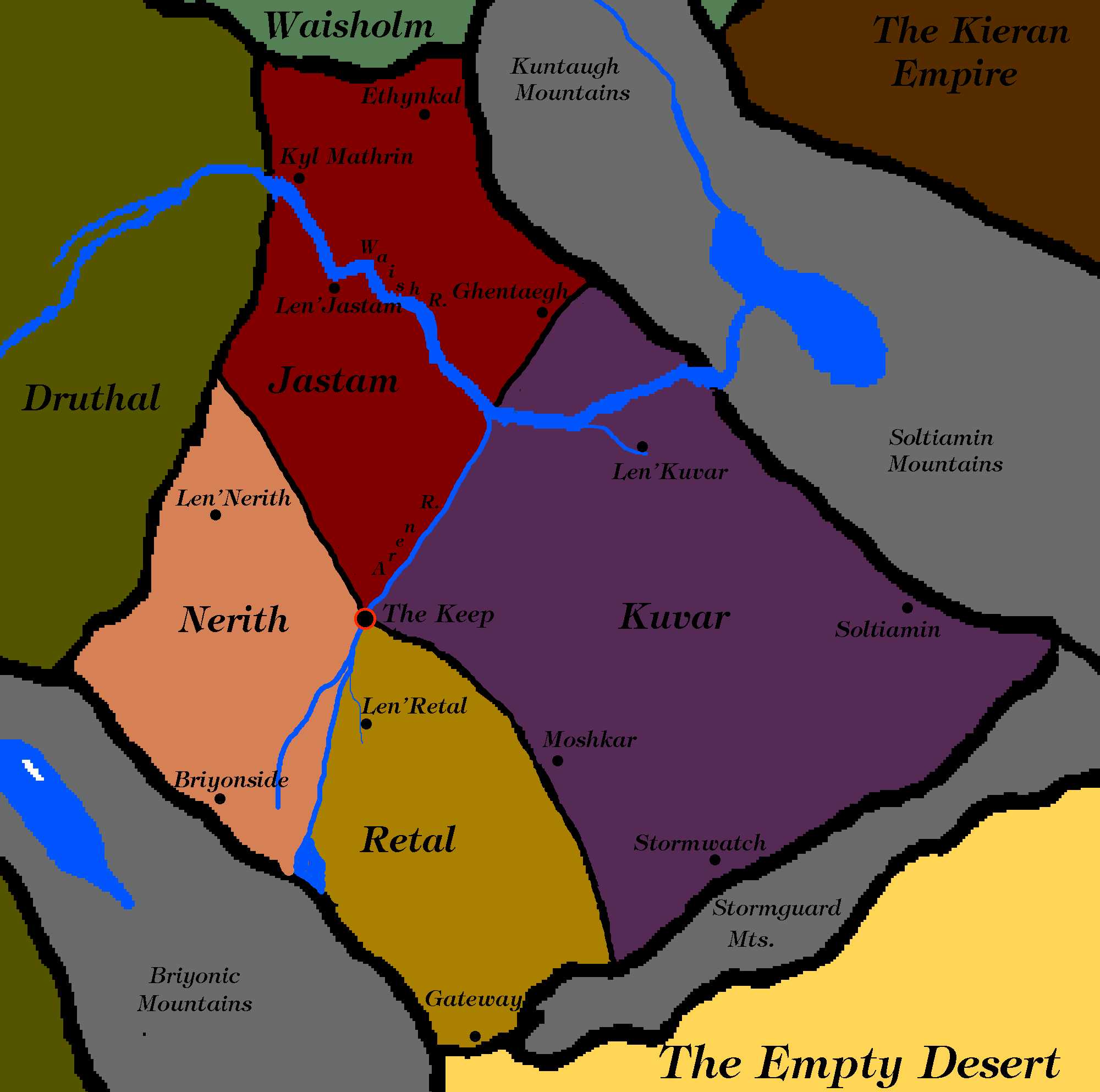
The tour around Druthal continues, with map and write-up on the eastern neighbor, Kellirac.
---
"Kellirac is not as dangerous as they say. But when I see the bonfires, I make sure my boots are on and my sword is sharp." -Desenánderez, Acserian missionary
"I'd rather have them as an ally than an enemy. Never make an enemy of people who eat their own dead." -Darius Estinian, Kieran Senator
"Magic is like flowing water, and in most of the world it is a mighty river, coursing with strength and dependability. In Kellirac, it is a dry creekbed, churning rapids and a waterfall, all at once." –Xaveem Alassam, Imach Warlock
"You cannot kill the fire. You cannot kill the storm. You cannot even kill my army. The dead never leave us.” -Kellirac Warlord Luten Torgsed
The nation of Kellirac is thought by most other nations to be full of primitive, almost animalistic people. The mere mention of Kellirac bonfires is enough to scare children in Acora and Oblune, and the sight of Kellirac troops on the field of battle can terrify most western armies.
There is talk of wild magic, impossible beasts, cannibalism and even the dead walking and speaking.
This attitude is mostly based on misunderstandings, rumors, and half-truths. The truth is Kellirac has much in common with where Druthal and Waisholm were a few centuries ago. But while Kellirac is harsh and unforgiving, it is more than fierce warriors and terrifying folk customs. Kellirac is a region of rich history.
Kellirac is not a unified nation, but four: Jastam, Nerith, Retal, and Kuvar. Over the centuries the Kelliracqui people have repeated the cycle of coming together under a single strong ruler, and then broken back up into the four regions. Each of the four provinces is governed by a feudal Lord, and all four Lords make decisions regarding their region. Any small degree of unity depends on the moods and alliances of the four Lords, but typically they all agree that none of them may take the Unworthy Throne in the Keep. The Keep was originally a fortress built by the Kierans during their occupation of the region. It has stood for centuries, and has become the center of Kellirac political life.
Each local warlord has men (and sometimes women) in his official employ that act as a local law authority. This office is called Meeschun, and enforces the property rights, tax levies, and other decrees of the nobility.
In theory, Kellirac obeys the Kieran legal code that was established during the Empire's highest days. In reality, crime in Kellirac is handled personally. The wronged party regularly takes revenge as he or she sees fit. "Kellirac Justice" is an often-used phrase to mean bloody revenge.
This leaves the office of the Meeschun with little to do but arrest poachers and collect taxes. However, crime is not much of a problem in Kellirac, as life is too much of a daily struggle to worry about who stole from whom. For many communities, if an entire day has gone by with no injuries, illnesses, or deaths, a celebration is held. In this environment, theft is a rare occurrence. Adding to this fact, there is little to steal, and few well defined laws. As a result, Kellirac tends to have little need for an organized system of punishment.
Criminal activity in Kellirac is an affair best left to those involved. In general, disagreements and disputes are settled simply, either by gathering up one's brothers to beat the offending party senseless, or asking the Meeschun to deputize the offended party, who then gathers his brothers to beat the offending party senseless. In more extreme cases, the offended party can challenge the other to a duel. Duels in Kellirac are far less formal and ritualized than they are in the rest of the world. They consist of a challenge, two swords, and one person dying.
One tradition that stands in many of the smaller, more remote communities is “Sticking.” Sticking occurs after a crime that offends the sensibilities of the community, such as impregnating a young girl then refusing to marry her. In this punishment, the strongest males in the community form two lines, and each one carries a heavy cudgel. The offender must walk, not run, between these two lines, and each man takes as many hard swings as he wishes at the offender’s head and upper body. If the offender makes it to the end of the line alive, he is forgiven by the community. Few people survive Sticking.
Kellirac does not have a standing army. Instead, the feudal system of responsibility in Kellirac allows a Lord or noble to gather his warriors and vassals at any time. Refusal to serve a noble is considered a crime in some areas, but not in others, and the severity depends on the noble involved. However, few men refuse the call to arms when it has been made.
Desertion, on the other hand, is common. Many men who are conscripted for a prolonged battle fear for the well being of their families, and desert to return home for planting and harvest. This has led to the aphorism “The Kellirac fight with the seasons.” Desertion for reasons of cowardice is punishable by death, but desertion to return for harvest or planting is often forgiven. In one recent engagement on the Druth border, a battle between the Kellirac and the Druth waged for several weeks, but ended abruptly when the early onset of harvest season took the Kellirac by surprise. In the morning, after Druth battle lines had been re-drawn, the Druth cavalry discovered that the Kellirac had gone home, leaving only one small unit behind who delivered the message “We shall come again after harvest.”
The Kellirac armies are considered formidable despite their technological disadvantage, partly as a result of their reputation for savage fearlessness. During the Rebellion, as Kellirac fought on the side of the Empire, many Druth and Waish warriors told stories of atrocities, such as the dismembering of dead enemies to keep as trophies, and the ritual eating of the slain. While cannibalism is a fairly well documented historical practice in specific, ritualized circumstances, there is no proof that cannibalism has been a part of Kellirac military practice since the days of Arengi.
Kellirac soldiers are reckless and wild by the standards of the other Trade Nations. They have few skilled archers, and virtually no cavalry, as there is little call for it in mountainous Kellirac. But what the Kellirac lack in formalized training, they make up for in passion, ferocity, cunning, and reputation. The sight of naked or fur-clad Kellirac, waving axes and picks, shouting bloody war cries as stag horned trumpeters blow horns from the hilltops and javelin wielding troops appear from the hills and melt back into the mists have routed more than one line of Druth cavalry.
Despite their large deposits of precious metals, Kellirac is relatively poor in metals that are useful for weapons and armor. As a result, most Kellirac warriors are equipped with simple leather armor, spears, and wooden shields. Swords are expensive, and are almost exclusively used by knights and lords.
There is no formal system of education in Kellirac. Those young people (men and women) who show intellectual aptitude early are sent to one of the many Acserian missions in the region to study, or on rare occasions sent to Druthal. On the other hand, Kellirac children are taught by their parents to hunt, track, forge, sew, and perform many other tasks necessary for their culture and survival. While Trade is spoken throughout Kellirac, the traditional language of Sechiall (pronounced sake-hi-ell) is spoken by far more people, particularly those in more isolated settings. In fact, given a choice between raising a child to speak Trade or Sechiall, Kellirac mothers will choose Sechiall first. In the eyes of a Kellirac, Trade is a fine language for describing politics and economics, but fails miserably when trying to describe the intricacies of day-to-day life of the Kell character. However, many subtle intricacies of the Kellirac language are lost in translation, making Kelliracs sound stilted and confused when speaking Trade.
Only a small minority of Kelliracs can read the Trade language, and that is mostly restricted to the nobles and richer families.
Although a Trade Nation, Kellirac has poor relations with the other members in general. Kellirac has a long history of attacking Waisholm and Druthal. For the last several decades, relations have been antagonistic, but rarely openly hostile. The Kellirac still harbor bitterness over several crushing defeats at the hands of the Druth and Waish armies.
Many Kellirac have fled their own country, living as wanderers or as an outskirter subculture in Druthal. These Racquin mostly keep to themselves, and hold on to elements of Kell culture and language.
The Kellirac are a superstitious people, and the constant numinic storms and magic flares do nothing to ease these feelings. The Kellirac are very suspicious about magic, and as they see it, its connection to the dead. Many Kellirac consult diviners and necromancers regularly. But as much as the people of Kellirac respect magic, they fear it as well. Kellirac know that magic is a volatile, often unpredictable force, and treat mages with respect, awe, and fear combined. The Kellirac are more likely to practice ritualized magic than any other people are. Bonfires, ritual effigy burning, and (according to Acserian rumor) human sacrifices are part of Kellirac ritual observances, and have developed an unfairly negative reputation among outsiders.
In the minds of most outsiders, particularly the Acserian missionaries, the bonfires and cannibalism are the most frightening and the vilest of Kellirac superstitions. According to Kellirac folklore, some of The Wretched (see below) entice human followers with promises of wealth, power, and glorious battles. Those Kellirac who agree to follow The Wretched set bonfires at the waning Blood Moon, and chant ancient, forbidden death chants. These people then become vessels for The Wretched, who feed on the flesh of the living as a source of their power. After nine nights of bonfires, ritual sex and dancing, and preparations for battle, these groups of Human Wretched will attach the nearest village. Many Kellirac villages have taken to launching surprise raids on the bonfire encampments, as the Human Wretched require the full nine nights in order to fully transform.
The religion is based upon the dead. The goal is to die honorably, and be reunited with one's ancestors in the next world. Those who die dishonorably, particularly by an act of cowardice in a lost battle, become "The Wretched," spirits who are tainted, not allowed passage beyond. Those who die in a losing battle but die with honor or those who do not die in battle become The Wanderers, undead spirits who aid humanity in hopes of being allowed to move on.
When Acserianism came to Kellirac, attempts were made to "civilize and educate" the Kellirac. However, the new religion never supplanted the original pagan beliefs. While some Kellirac have become Acserians, most notably Valsam Du Retal, one of the Kellirac Lords, most are either still pagans, or have become part of a splinter faith of Acserianism. This religion, called Samacheriai, is a blend of traditional Kell beliefs and somewhat obscure Acserian beliefs. Samacheriai believes that there is one all-powerful God, and that he sends prophets to the world to help humanity understand his ways. However, it also assumes that the Wretched, spirits and creatures of supernatural power represent aspects of God that can be petitioned for help and knowledge.
The major Kellirac holiday is Hultachia, which means "Death Walk." On this day, all Kellirac prepare for sunset by making as much food as they can, which they will eat some of in a giant meal right before nightfall. The leftovers will be left for the dead. They set candles at the doors and windows, and let the fireplace burn all day. The belief is that at sundown, the borders between this world and the next fall, and any Wanderers who have been deemed worthy will come to visit their loved ones once more before passing into the next world. However, the Wretched will do everything they can to keep the Wanderers from crossing over.
Another major holiday is the Straw Bear Festival, which is a strange development from an Arengish festival that drives out evil. While the specifics of the Arengish traditional festival have been lost, the modern version is a day long festival where a boy who is nearing adulthood dresses in a suit of straw, branches, and greenery. He travels from house to house, howling and dancing. At each home, the woman of the house comes outside with a broom and pantomimes beating the “bear” away. At sundown, the entire town comes out, and all of the village children tear the suit away from the boy within. The suit is burned, and the boy is given gifts, cakes, and small trinkets. This festival is more for the children, who spend the day singing and playing games. Often, groups of children follow the “bear” from house to house, jeering and making fun of the “bear” as he is driven away by the women of the village.
The Kellirac have many ceremonies, but one stands out in importance. After death in battle, the surviving relatives of a slain warrior will place candles at the slain's bedposts. At sundown, the spirit of the slain warrior is believed to return to rest, and to learn the outcome of the battle. If the slain warrior's side won, he is released into the next world. If his side lost, he becomes one of The Wanderers. If he died dishonorably, he becomes one of The Wretched.
Once a year like clockwork, an enormous storm, both magical and natural in make, erupts over Eastern Kellirac. It has become a badge of honor to "Ride the Storm," which means that the warrior in question plants his sword into the ground, and stands in place as the storm buffets him. Most "Storm Riders" do not survive the attempt.
---
"Kellirac is not as dangerous as they say. But when I see the bonfires, I make sure my boots are on and my sword is sharp." -Desenánderez, Acserian missionary
"I'd rather have them as an ally than an enemy. Never make an enemy of people who eat their own dead." -Darius Estinian, Kieran Senator
"Magic is like flowing water, and in most of the world it is a mighty river, coursing with strength and dependability. In Kellirac, it is a dry creekbed, churning rapids and a waterfall, all at once." –Xaveem Alassam, Imach Warlock
"You cannot kill the fire. You cannot kill the storm. You cannot even kill my army. The dead never leave us.” -Kellirac Warlord Luten Torgsed
The nation of Kellirac is thought by most other nations to be full of primitive, almost animalistic people. The mere mention of Kellirac bonfires is enough to scare children in Acora and Oblune, and the sight of Kellirac troops on the field of battle can terrify most western armies.
There is talk of wild magic, impossible beasts, cannibalism and even the dead walking and speaking.
This attitude is mostly based on misunderstandings, rumors, and half-truths. The truth is Kellirac has much in common with where Druthal and Waisholm were a few centuries ago. But while Kellirac is harsh and unforgiving, it is more than fierce warriors and terrifying folk customs. Kellirac is a region of rich history.
Kellirac is not a unified nation, but four: Jastam, Nerith, Retal, and Kuvar. Over the centuries the Kelliracqui people have repeated the cycle of coming together under a single strong ruler, and then broken back up into the four regions. Each of the four provinces is governed by a feudal Lord, and all four Lords make decisions regarding their region. Any small degree of unity depends on the moods and alliances of the four Lords, but typically they all agree that none of them may take the Unworthy Throne in the Keep. The Keep was originally a fortress built by the Kierans during their occupation of the region. It has stood for centuries, and has become the center of Kellirac political life.
Each local warlord has men (and sometimes women) in his official employ that act as a local law authority. This office is called Meeschun, and enforces the property rights, tax levies, and other decrees of the nobility.
In theory, Kellirac obeys the Kieran legal code that was established during the Empire's highest days. In reality, crime in Kellirac is handled personally. The wronged party regularly takes revenge as he or she sees fit. "Kellirac Justice" is an often-used phrase to mean bloody revenge.
This leaves the office of the Meeschun with little to do but arrest poachers and collect taxes. However, crime is not much of a problem in Kellirac, as life is too much of a daily struggle to worry about who stole from whom. For many communities, if an entire day has gone by with no injuries, illnesses, or deaths, a celebration is held. In this environment, theft is a rare occurrence. Adding to this fact, there is little to steal, and few well defined laws. As a result, Kellirac tends to have little need for an organized system of punishment.
Criminal activity in Kellirac is an affair best left to those involved. In general, disagreements and disputes are settled simply, either by gathering up one's brothers to beat the offending party senseless, or asking the Meeschun to deputize the offended party, who then gathers his brothers to beat the offending party senseless. In more extreme cases, the offended party can challenge the other to a duel. Duels in Kellirac are far less formal and ritualized than they are in the rest of the world. They consist of a challenge, two swords, and one person dying.
One tradition that stands in many of the smaller, more remote communities is “Sticking.” Sticking occurs after a crime that offends the sensibilities of the community, such as impregnating a young girl then refusing to marry her. In this punishment, the strongest males in the community form two lines, and each one carries a heavy cudgel. The offender must walk, not run, between these two lines, and each man takes as many hard swings as he wishes at the offender’s head and upper body. If the offender makes it to the end of the line alive, he is forgiven by the community. Few people survive Sticking.
Kellirac does not have a standing army. Instead, the feudal system of responsibility in Kellirac allows a Lord or noble to gather his warriors and vassals at any time. Refusal to serve a noble is considered a crime in some areas, but not in others, and the severity depends on the noble involved. However, few men refuse the call to arms when it has been made.
Desertion, on the other hand, is common. Many men who are conscripted for a prolonged battle fear for the well being of their families, and desert to return home for planting and harvest. This has led to the aphorism “The Kellirac fight with the seasons.” Desertion for reasons of cowardice is punishable by death, but desertion to return for harvest or planting is often forgiven. In one recent engagement on the Druth border, a battle between the Kellirac and the Druth waged for several weeks, but ended abruptly when the early onset of harvest season took the Kellirac by surprise. In the morning, after Druth battle lines had been re-drawn, the Druth cavalry discovered that the Kellirac had gone home, leaving only one small unit behind who delivered the message “We shall come again after harvest.”
The Kellirac armies are considered formidable despite their technological disadvantage, partly as a result of their reputation for savage fearlessness. During the Rebellion, as Kellirac fought on the side of the Empire, many Druth and Waish warriors told stories of atrocities, such as the dismembering of dead enemies to keep as trophies, and the ritual eating of the slain. While cannibalism is a fairly well documented historical practice in specific, ritualized circumstances, there is no proof that cannibalism has been a part of Kellirac military practice since the days of Arengi.
Kellirac soldiers are reckless and wild by the standards of the other Trade Nations. They have few skilled archers, and virtually no cavalry, as there is little call for it in mountainous Kellirac. But what the Kellirac lack in formalized training, they make up for in passion, ferocity, cunning, and reputation. The sight of naked or fur-clad Kellirac, waving axes and picks, shouting bloody war cries as stag horned trumpeters blow horns from the hilltops and javelin wielding troops appear from the hills and melt back into the mists have routed more than one line of Druth cavalry.
Despite their large deposits of precious metals, Kellirac is relatively poor in metals that are useful for weapons and armor. As a result, most Kellirac warriors are equipped with simple leather armor, spears, and wooden shields. Swords are expensive, and are almost exclusively used by knights and lords.
There is no formal system of education in Kellirac. Those young people (men and women) who show intellectual aptitude early are sent to one of the many Acserian missions in the region to study, or on rare occasions sent to Druthal. On the other hand, Kellirac children are taught by their parents to hunt, track, forge, sew, and perform many other tasks necessary for their culture and survival. While Trade is spoken throughout Kellirac, the traditional language of Sechiall (pronounced sake-hi-ell) is spoken by far more people, particularly those in more isolated settings. In fact, given a choice between raising a child to speak Trade or Sechiall, Kellirac mothers will choose Sechiall first. In the eyes of a Kellirac, Trade is a fine language for describing politics and economics, but fails miserably when trying to describe the intricacies of day-to-day life of the Kell character. However, many subtle intricacies of the Kellirac language are lost in translation, making Kelliracs sound stilted and confused when speaking Trade.
Only a small minority of Kelliracs can read the Trade language, and that is mostly restricted to the nobles and richer families.
Although a Trade Nation, Kellirac has poor relations with the other members in general. Kellirac has a long history of attacking Waisholm and Druthal. For the last several decades, relations have been antagonistic, but rarely openly hostile. The Kellirac still harbor bitterness over several crushing defeats at the hands of the Druth and Waish armies.
Many Kellirac have fled their own country, living as wanderers or as an outskirter subculture in Druthal. These Racquin mostly keep to themselves, and hold on to elements of Kell culture and language.
The Kellirac are a superstitious people, and the constant numinic storms and magic flares do nothing to ease these feelings. The Kellirac are very suspicious about magic, and as they see it, its connection to the dead. Many Kellirac consult diviners and necromancers regularly. But as much as the people of Kellirac respect magic, they fear it as well. Kellirac know that magic is a volatile, often unpredictable force, and treat mages with respect, awe, and fear combined. The Kellirac are more likely to practice ritualized magic than any other people are. Bonfires, ritual effigy burning, and (according to Acserian rumor) human sacrifices are part of Kellirac ritual observances, and have developed an unfairly negative reputation among outsiders.
In the minds of most outsiders, particularly the Acserian missionaries, the bonfires and cannibalism are the most frightening and the vilest of Kellirac superstitions. According to Kellirac folklore, some of The Wretched (see below) entice human followers with promises of wealth, power, and glorious battles. Those Kellirac who agree to follow The Wretched set bonfires at the waning Blood Moon, and chant ancient, forbidden death chants. These people then become vessels for The Wretched, who feed on the flesh of the living as a source of their power. After nine nights of bonfires, ritual sex and dancing, and preparations for battle, these groups of Human Wretched will attach the nearest village. Many Kellirac villages have taken to launching surprise raids on the bonfire encampments, as the Human Wretched require the full nine nights in order to fully transform.
The religion is based upon the dead. The goal is to die honorably, and be reunited with one's ancestors in the next world. Those who die dishonorably, particularly by an act of cowardice in a lost battle, become "The Wretched," spirits who are tainted, not allowed passage beyond. Those who die in a losing battle but die with honor or those who do not die in battle become The Wanderers, undead spirits who aid humanity in hopes of being allowed to move on.
When Acserianism came to Kellirac, attempts were made to "civilize and educate" the Kellirac. However, the new religion never supplanted the original pagan beliefs. While some Kellirac have become Acserians, most notably Valsam Du Retal, one of the Kellirac Lords, most are either still pagans, or have become part of a splinter faith of Acserianism. This religion, called Samacheriai, is a blend of traditional Kell beliefs and somewhat obscure Acserian beliefs. Samacheriai believes that there is one all-powerful God, and that he sends prophets to the world to help humanity understand his ways. However, it also assumes that the Wretched, spirits and creatures of supernatural power represent aspects of God that can be petitioned for help and knowledge.
The major Kellirac holiday is Hultachia, which means "Death Walk." On this day, all Kellirac prepare for sunset by making as much food as they can, which they will eat some of in a giant meal right before nightfall. The leftovers will be left for the dead. They set candles at the doors and windows, and let the fireplace burn all day. The belief is that at sundown, the borders between this world and the next fall, and any Wanderers who have been deemed worthy will come to visit their loved ones once more before passing into the next world. However, the Wretched will do everything they can to keep the Wanderers from crossing over.
Another major holiday is the Straw Bear Festival, which is a strange development from an Arengish festival that drives out evil. While the specifics of the Arengish traditional festival have been lost, the modern version is a day long festival where a boy who is nearing adulthood dresses in a suit of straw, branches, and greenery. He travels from house to house, howling and dancing. At each home, the woman of the house comes outside with a broom and pantomimes beating the “bear” away. At sundown, the entire town comes out, and all of the village children tear the suit away from the boy within. The suit is burned, and the boy is given gifts, cakes, and small trinkets. This festival is more for the children, who spend the day singing and playing games. Often, groups of children follow the “bear” from house to house, jeering and making fun of the “bear” as he is driven away by the women of the village.
The Kellirac have many ceremonies, but one stands out in importance. After death in battle, the surviving relatives of a slain warrior will place candles at the slain's bedposts. At sundown, the spirit of the slain warrior is believed to return to rest, and to learn the outcome of the battle. If the slain warrior's side won, he is released into the next world. If his side lost, he becomes one of The Wanderers. If he died dishonorably, he becomes one of The Wretched.
Once a year like clockwork, an enormous storm, both magical and natural in make, erupts over Eastern Kellirac. It has become a badge of honor to "Ride the Storm," which means that the warrior in question plants his sword into the ground, and stands in place as the storm buffets him. Most "Storm Riders" do not survive the attempt.
Labels:
Druthal,
fantasy,
Kellirac,
sff,
tools of the writers,
worldbuilding
Monday, May 6, 2013
Fantasy Worldbuilding: Acseria, maps and worldbuilding
Another busy day here- the rough draft of Way of the Shield has almost reached the point of going over the top of the hill, so it's now a matter of getting all the pieces in place before the drop*. So I'll share another bit of worldbuilding: Druthal's southern neighbor, Acseria.
--
“And a new nation will stand. A nation of God, by God and for God. And such a nation, built on principles of faith, shall be like to none before seen.” -The Book of Galena, The Acseram
“There must be a God, for no man could make that happen.” –Clwythnn Strongtree, after seeing Acserian zealots storm the bridge at Fencal.
“I have no quarrel with their God. I just fail to see why he must dabble in politics.” -Archduke Louis Gauchon of Linjar
“They are a decent people, but I cannot fathom a man who would rather eat a horse than a chicken.” –Olona ab Calisien, Ninth Chair of the Fuergan SyndicateAcseria is a nation centered on their religion and their church. The church rules the nation. The rest of the Trade Nations have felt the church’s influence, as the faith has spread, to a varying degree, throughout them. The church as some very strict tenets and scripture, but the rigidity with which they are followed can vary.
Acseria is a theocracy, ruled by the Acserian church. The titles in the church stem from the old Futralian titles, and the hierarchy of the church is as follows.
In addition to the church leadership, each of the nine provinces (Telsa, Myam, Sobal, Pelkin, Amida, Shisa, Ores, Gerina and Allassa) has a Prince who has ruling authority, as long as that prince stays in good standing with the church. This is a hereditary title, unless the church sees fit to remove one line of Princes and replace it with another. The Prince is at the top of the feudal system, with nobles below him, who are simply called Lords. Princes live a challenging life, since each one has twenty Kanna and DaiKanna who each feel they have authority over him, and each one will have their own agenda.
Law in Acseria is specifically church law, edicts handed down from the Kannan Assembly, all (presumably) based on interpretation of the and other sacred documents. Over the centuries, laws change due interpretation of the scripture and the prevailing attitudes of those in charge.
The Code of Life is a primary component of the law. These are handed down from old Futralian codes, and the translation and interpretation of them is the cornerstone of Acserian debate. Fundamentalists feel they mean “One must not,” while Reformists think they mean, “One should not.” As it stands, the Code of Life (in the Reformist standard) includes:
Magic fluctuates in acceptance in Acseria. Currently, the official standpoint is that magic is useful and acceptable to God, but it had often in the past been considered heresy and sacrilege. Many Acserians still hold this opinion, and react badly to displays of magic.
When accused of a crime, be it against man or God, one is brought before a church leader (usually one of the Chosen, sometimes someone higher) for trial. If guilt is determined, then the criminal is given an Act of Penance, which can range from a series of prayers, to self-flagellation to taking on some form of vow or missionary work. The criminal has the right to volunteer an act for the priest to approve, or else the priest will assign one. Failure to do the Penance Act is High Sacrilege.
Any form of High Sacrilege (which requires a Manall to determine) can be punished by Excommunication. Someone who is excommunicated is not part of the community and has no rights. If they aren’t executed shortly after the excommunication (which used to be the fashion, but is currently frowned upon), then they will typically flee to Druthal or another nation.
The Acserian military is not strongly organized, but when they lack in structure they make up for in devotion. They are essentially a militia of faithfuls with informal training in how to use their weapons. However, they have been known to fight with fearless abandon. These ordinary soldiers are usually referred to as zealots.
These militias are under the authority of the Princes, who use their Lords and vassals to bring it together. The Princes only can call them together with a call to arms from the Rei or the Kannan Assembly.
The centerpiece of the Acserian life is their religion. It is a monotheistic relgion, in which their God (referred to simply as God), has a plan for the faithful to follow. In order to help follow the plan, they must act according to his wishes (such as live by the Code of Life), for which they will be rewarded by their souls joining God in the next life.
God lets his plan be known to them through signs and omens, as well as use of his divine servants and nine Prophets who are to help guide them. As of 1215, six of the Prophets have come, and three more are expected. The most important Prophet is the second, Acser.
In Acser’s time, Acseria was a number of protecterate provinces of the Kieran Empire, and the people living there were somewhat lost in terms of spiritual and cultural identity. Acser started preaching to them about the God and spreading his word, recreating their hope and identity. Acser also brought an end to a conflict with the Imachs that the Kierans were ignoring, and then confronted the Kierans about their hypocrisy. The Kieran legions publicly killed him for this. They then tried to stop his followers and his message, but it instead thrived and spread.
Acserians believe that mankind, at least the faithful, have a soul which is separate from the body. The soul is the important, eternal part of the person, and the body is merely a flawed physical expression of the soul. Life on this world is about the triumph of the soul over the body—living in a good and correct manner despite the flaws of the body bringing incorrect urges.
They also consider birds, especially hawks, to be sacred creatures—messengers of God and carriers of souls. Most Acserians will wear a talisman of a hawk to show their faith.
While the church itself has several orders and sects, the primary division is between the Reformists and the Fundamentalists. They each control a large amount of Kannan Assembly, and essential represent liberal and conservative views of Acserian politics and theology.
MAJOR FACTIONS OF THE ACSERIAN CHURCH
The following is in no way a complete list of all the factions, orders and sects of the Acserian church. Rather, these are the major factions, the ones that have the most influence in the Acserian church. There are dozens of lesser orders and sects throughout Acseria.
---
*- That was a mixed metaphor, wasn't it?
--
“And a new nation will stand. A nation of God, by God and for God. And such a nation, built on principles of faith, shall be like to none before seen.” -The Book of Galena, The Acseram“There must be a God, for no man could make that happen.” –Clwythnn Strongtree, after seeing Acserian zealots storm the bridge at Fencal.
“I have no quarrel with their God. I just fail to see why he must dabble in politics.” -Archduke Louis Gauchon of Linjar
“They are a decent people, but I cannot fathom a man who would rather eat a horse than a chicken.” –Olona ab Calisien, Ninth Chair of the Fuergan SyndicateAcseria is a nation centered on their religion and their church. The church rules the nation. The rest of the Trade Nations have felt the church’s influence, as the faith has spread, to a varying degree, throughout them. The church as some very strict tenets and scripture, but the rigidity with which they are followed can vary.
Acseria is a theocracy, ruled by the Acserian church. The titles in the church stem from the old Futralian titles, and the hierarchy of the church is as follows.
- Rei- The highest authority of Acseria-- the Rei has the ear of God, and God has his. When he makes an official proclamation it is law (although it must pass through the Kannan Assembly to confirm that the Rei has not wavered from his faith), and all of Acseria will move at his word. He also votes with the Kannan Assembly, with his vote counting as twenty.
- DaiKanna-There are eighteen DaiKanna, two for each province of Acseria. They comprise the upper echelon of the Kannan Assembly. Only a DaiKanna can call for a vote. Some matters, such as the elevation of someone to the rank of Kanna, can be voted on only by DaiKanna.
- Kanna- The main body of the Kannan Assembly, with their being 162 Kanna (18 for every province). The Kanna, like the DaiKanna, are only representatives of their province. While they may bear affiliation for a certain sect or order of the church, they do not specifically represent them.
- Manall- This is the rank of the leaders of most sects and orders, as well as the central figure religious figure of cities and communities.
- Shannar- The Shannar is the lowest rank of fully ordained priest, and is the one that the common man has close contact to.
- Chosen- The Chosen are ministers who lead services and give spiritual comfort and leadership to the people, but the are not ordained, and cannot perform some ceremonies.
In addition to the church leadership, each of the nine provinces (Telsa, Myam, Sobal, Pelkin, Amida, Shisa, Ores, Gerina and Allassa) has a Prince who has ruling authority, as long as that prince stays in good standing with the church. This is a hereditary title, unless the church sees fit to remove one line of Princes and replace it with another. The Prince is at the top of the feudal system, with nobles below him, who are simply called Lords. Princes live a challenging life, since each one has twenty Kanna and DaiKanna who each feel they have authority over him, and each one will have their own agenda.
Law in Acseria is specifically church law, edicts handed down from the Kannan Assembly, all (presumably) based on interpretation of the and other sacred documents. Over the centuries, laws change due interpretation of the scripture and the prevailing attitudes of those in charge.
The Code of Life is a primary component of the law. These are handed down from old Futralian codes, and the translation and interpretation of them is the cornerstone of Acserian debate. Fundamentalists feel they mean “One must not,” while Reformists think they mean, “One should not.” As it stands, the Code of Life (in the Reformist standard) includes:
- One should not touch one’s brother or sister, parent or child, in the manner one touches one’s wife.
- One should not eat that which is not blessed and properly prepared.
- One should not take that which they do not own.
- One should not separate soul from body.
- One should respect their betters. One should not speak that which is untrue.
- One should not touch another man’s wife in the manner they touch their own, nor any who is not their wife.
- One should not drink that which is impure or intoxicating.
- One should not take more food than is needed when another is hungry.
- One should not desire that which is not theirs, nor that cannot be had.
- One should not take credit for work of God or another man.
- One should not commit an act borne from anger
- One should not make one’s rest force another to work, nor rest to leave the work to fallow.
Magic fluctuates in acceptance in Acseria. Currently, the official standpoint is that magic is useful and acceptable to God, but it had often in the past been considered heresy and sacrilege. Many Acserians still hold this opinion, and react badly to displays of magic.
When accused of a crime, be it against man or God, one is brought before a church leader (usually one of the Chosen, sometimes someone higher) for trial. If guilt is determined, then the criminal is given an Act of Penance, which can range from a series of prayers, to self-flagellation to taking on some form of vow or missionary work. The criminal has the right to volunteer an act for the priest to approve, or else the priest will assign one. Failure to do the Penance Act is High Sacrilege.
Any form of High Sacrilege (which requires a Manall to determine) can be punished by Excommunication. Someone who is excommunicated is not part of the community and has no rights. If they aren’t executed shortly after the excommunication (which used to be the fashion, but is currently frowned upon), then they will typically flee to Druthal or another nation.
The Acserian military is not strongly organized, but when they lack in structure they make up for in devotion. They are essentially a militia of faithfuls with informal training in how to use their weapons. However, they have been known to fight with fearless abandon. These ordinary soldiers are usually referred to as zealots.
These militias are under the authority of the Princes, who use their Lords and vassals to bring it together. The Princes only can call them together with a call to arms from the Rei or the Kannan Assembly.
The centerpiece of the Acserian life is their religion. It is a monotheistic relgion, in which their God (referred to simply as God), has a plan for the faithful to follow. In order to help follow the plan, they must act according to his wishes (such as live by the Code of Life), for which they will be rewarded by their souls joining God in the next life.
God lets his plan be known to them through signs and omens, as well as use of his divine servants and nine Prophets who are to help guide them. As of 1215, six of the Prophets have come, and three more are expected. The most important Prophet is the second, Acser.
In Acser’s time, Acseria was a number of protecterate provinces of the Kieran Empire, and the people living there were somewhat lost in terms of spiritual and cultural identity. Acser started preaching to them about the God and spreading his word, recreating their hope and identity. Acser also brought an end to a conflict with the Imachs that the Kierans were ignoring, and then confronted the Kierans about their hypocrisy. The Kieran legions publicly killed him for this. They then tried to stop his followers and his message, but it instead thrived and spread.
Acserians believe that mankind, at least the faithful, have a soul which is separate from the body. The soul is the important, eternal part of the person, and the body is merely a flawed physical expression of the soul. Life on this world is about the triumph of the soul over the body—living in a good and correct manner despite the flaws of the body bringing incorrect urges.
They also consider birds, especially hawks, to be sacred creatures—messengers of God and carriers of souls. Most Acserians will wear a talisman of a hawk to show their faith.
While the church itself has several orders and sects, the primary division is between the Reformists and the Fundamentalists. They each control a large amount of Kannan Assembly, and essential represent liberal and conservative views of Acserian politics and theology.
MAJOR FACTIONS OF THE ACSERIAN CHURCH
The following is in no way a complete list of all the factions, orders and sects of the Acserian church. Rather, these are the major factions, the ones that have the most influence in the Acserian church. There are dozens of lesser orders and sects throughout Acseria.
- FUNDAMENTALISTS- The Fundamentalists believe in returning to the core values of the Acserian faith as outlined by the old Futralian. Morality, to the Fundamentalists, is not a matter of debate, but rather has already been strictly defined by Meliphol and Acser, and therefore by God. The Code of Life centers around how one must live their life. Service to God (and the Acserian community, by extension) must be the primary goal of one’s life. There are further sub-factions of the Fundamentalists, broken down into which book of the Acseriad in the Acseram is most important—the larger sub-factions prefer Ansom, Chedrik and Zanik.
- REFORMISTS- They believe in following the spirit of faith over the letter of it. The texts of old Futralian (and to an extent, the writings of Meliphol) should be looked at as parable and example, not utter truth. They interpret the Code of Life as being a guideline to what one should do. Sin and transgression are forgivable, and one should be tolerant of new ideas and debate. Sub-factions based on which book is more important exist, but they are more casual, usually just used as points of debate rather than true disagreement. They tend to favor Nalesta, Clienthis and Hiedrovik.
- PURISTS- Similar to the Fundamentalists, but even more orthodox. They trying and live life as exactly as possible as how the Futralians would. Devoting their lives to service to God, believing that any tolerance of sin is equivalent to the act of sin itself. They also believe that all elements of the texts of the Acseram, even the apocrypha, are sacred and holy, and should be adhered to.
- LUMINARIES- This order focuses on learning and saving knowledge. Monks of the order are the primary instructors and teaching missionaries. It is the Luminaries who copy, save and archive sacred texts and other writings.
- THE CIRCLE- This group centers around the idea of God as a more abstract concept, shying away from strict adherence to text and dogma. They tend to be extremely tolerant of sin, transgression and other religions, as they believe that God, in his infiniteness, intends for such things to exist.
- THE ORDER OF THE HAWK- This is a semi-militaristic order of proselytizers. Members tend to work in or with the armies of Acseria, as officers, chaplain or elite soldiers. They will also do much missionary work in dangerous territories. They do study some fighting and mystical skills, but they focus more on preaching and spreading the good word of the Acseram, with views that lean to the Fundamentalist side.
- OVALSHANS- This is a smaller sect who have dedicated themselves to the study and care of the Citadel, the architectural masterwork of the prophet Ovalsha. They will be the first to proclaim any event at the Citadel as a miraculous message of Ovalsha, and feel that he is second only to Acser in importance.
- THE BROTHERHOOD OF THE FEATHER- This order focuses on the Acser presented within the book of Nalesta—Acser as pacifist. The Brotherhood is opposed to the use of violence, and will always work to achieve peaceful solutions. Study of mystical arts is well known to the Brotherhood.
- EASTERN ACSERIANS- This group is more often referred to as a “cult” by the larger factions, but it has a strong block of followers in the province of Allassa. Eastern Acserianism blends Acserian belief with Imach mindset. Like the Purists, this leads to a stricter lifestyle, intolerant of deviation, and the views of the Eastern Acserians lean toward the Fundamentalist. Fundamentalists, however, tend to eschew the Eastern Acserians, except when it is politically convenient not to.
---
*- That was a mixed metaphor, wasn't it?
Labels:
Acseria,
Druthal,
fantasy,
tools of the writers,
worldbuilding,
writing
Thursday, May 2, 2013
Worldbulding: Nation/Culture Building Template
Way back when I first started the Serious Worldbuilding Process for the world Druthal is in, the internet was still in its toddlerhood. So when I first cooked up the National Documents, I didn't have a lot of precedent to build from. In retrospect, I was essentially building a proto-wiki template for worldbuilding. I was also less well-read, less researched and less-practiced at the time. As a result, what the National Document was became something I was unsatisfied with.
So I've made some changes to the template-- using how many actual nations are broken now on Wikipedia as a basis-- and have come up with something that I find... stronger. Like all things, it's a work in progress. But you might find it useful.
NATION
Basic description*
Politics
Key People
So, if this is useful for you: have at it. If you have suggestions, I'm happy to hear them.
---
*- As you can see from my post on Waisholm, I enjoy putting a few in-world quotes about the culture from both insider and outsider perspectives. For me, it's a good way to get into the mindset.
So I've made some changes to the template-- using how many actual nations are broken now on Wikipedia as a basis-- and have come up with something that I find... stronger. Like all things, it's a work in progress. But you might find it useful.
NATION
Basic description*
Politics
- Government
- Laws
- Military
- Foreign Relations
- Internal Relations
- Notable Natural Landmarks
- Notable Flora/Fauna
- Languages
- Religion
- Familial Units
- Social Rituals
- Clothing and Hairstyles
- Cuisine
- Entertainment/Games/Sports
- Art and Other Great Works
- Notable Subcultures
Key People
- Current
- Historical
So, if this is useful for you: have at it. If you have suggestions, I'm happy to hear them.
---
*- As you can see from my post on Waisholm, I enjoy putting a few in-world quotes about the culture from both insider and outsider perspectives. For me, it's a good way to get into the mindset.
Labels:
Druthal,
fantasy,
process of writing,
sci-fi,
sff,
tools of the writers,
worldbuilding,
writing
Monday, April 29, 2013
Worldbuilding: A Glance Under the Hood
So, last week, I shared a map and some worldbuilding details for one of the nations in the world I've been building, and opened the floor for questions. The questions I got were more about process than the world itself, which is just fine with me.
So, in this case, I've been particular blessed to have a worldbuild/brainstorm partner, in Dan Fawcett. Dan is far more of an academic than I am, and while I'm pretty good at the research side of worldbuilding, he's really the master. He's the one who first turned me on to Jared Diamond's works Guns, Germs & Steel and Collapse, both of which I consider required reading for worldbuilders.
As to the process itself: Dan and I hashed out the real broad-brushstrokes, soft-import, high-concept stuff of each nation/cultural area. Then we came up with tour National Document template-- something I want to rework to a degree, but that's neither here nor there-- which I would use to write up each nation*, and then pass it off to him. He'd tear into it, usual with questions about specifics, which would help us drag each culture away from its broad-brushstrokes, soft-import, high-concept origins and give it something unique.
In the case of Waisholm, a big aspect was making it something that Druthal wasn't. Druthal is a parliamentary monarchy, a relative enlightened state for a fantasy/renaissance type of culture, and I wanted Waisholm to be... not so much harsher, but further back on that path. And more to the point, a place where small-group insularity and in-fighting was the main thing holding them back. So this required the throne to be a weak title compared to the local lords, and a place where "civil wars" are a relatively common part of their history. So this required creating a government system where fealty and identity function strongest at the local level.

The question was about achieving that level of detail, which I attribute to the national document, which is relatively comprehensive (what I posted came from sections on government, military, law and criminal activity, for example), and it went through that question-and-respond process to make it stronger.
The maps have had a long history-- the initial map started nearly twenty years ago, hand-drawn of the whole world. I eventually got that scanned (and this was in the 90s, where "getting something scanned" meant going to Kinkos and giving them your 3.5" disk to put the scan on), and started making more detailed maps of each respective part. Over the course of time, as the capabilities of the computers and drawing programs I had access to improved, so did the details of the maps.

So maps that had their origins in hand-drawn, followed by MS Paint, have now been worked over in PhotoShop 6. There are some that I haven't updated as much as others, of course-- Druthal itself has had the most evolution-- but on the whole it's a far more advanced and detailed work. And, more to the point, more advanced and detailed than it could have been back then. Somewhere in the house I still have the 3.5" floppies that have zipped-up files of the maps-- i.e. it took multiple disks and compression to carry it all. Now I have map files that would have made the old computer explode.
--
*- There are a few nations he did the initial write-up of, though I don't recall which ones off the top of my head.
I loved the level of detail that you spent on the government. Do you have a process that you use? Perhaps you can write it down and share it with your peers?
So, in this case, I've been particular blessed to have a worldbuild/brainstorm partner, in Dan Fawcett. Dan is far more of an academic than I am, and while I'm pretty good at the research side of worldbuilding, he's really the master. He's the one who first turned me on to Jared Diamond's works Guns, Germs & Steel and Collapse, both of which I consider required reading for worldbuilders.
As to the process itself: Dan and I hashed out the real broad-brushstrokes, soft-import, high-concept stuff of each nation/cultural area. Then we came up with tour National Document template-- something I want to rework to a degree, but that's neither here nor there-- which I would use to write up each nation*, and then pass it off to him. He'd tear into it, usual with questions about specifics, which would help us drag each culture away from its broad-brushstrokes, soft-import, high-concept origins and give it something unique.In the case of Waisholm, a big aspect was making it something that Druthal wasn't. Druthal is a parliamentary monarchy, a relative enlightened state for a fantasy/renaissance type of culture, and I wanted Waisholm to be... not so much harsher, but further back on that path. And more to the point, a place where small-group insularity and in-fighting was the main thing holding them back. So this required the throne to be a weak title compared to the local lords, and a place where "civil wars" are a relatively common part of their history. So this required creating a government system where fealty and identity function strongest at the local level.

The question was about achieving that level of detail, which I attribute to the national document, which is relatively comprehensive (what I posted came from sections on government, military, law and criminal activity, for example), and it went through that question-and-respond process to make it stronger.
How did you create the actual map?
The maps have had a long history-- the initial map started nearly twenty years ago, hand-drawn of the whole world. I eventually got that scanned (and this was in the 90s, where "getting something scanned" meant going to Kinkos and giving them your 3.5" disk to put the scan on), and started making more detailed maps of each respective part. Over the course of time, as the capabilities of the computers and drawing programs I had access to improved, so did the details of the maps.

So maps that had their origins in hand-drawn, followed by MS Paint, have now been worked over in PhotoShop 6. There are some that I haven't updated as much as others, of course-- Druthal itself has had the most evolution-- but on the whole it's a far more advanced and detailed work. And, more to the point, more advanced and detailed than it could have been back then. Somewhere in the house I still have the 3.5" floppies that have zipped-up files of the maps-- i.e. it took multiple disks and compression to carry it all. Now I have map files that would have made the old computer explode.
--
*- There are a few nations he did the initial write-up of, though I don't recall which ones off the top of my head.
Labels:
culture,
Druthal,
fantasy,
maps,
tools of the writers,
Waisholm,
worldbuilding,
writing
Monday, April 22, 2013
Worldbuilding: Maps and thoughts on Waisholm
It's a busy day and a busy week here, so: here's a glance at one of the nations that shares a border with Druthal. I still need to re-work my various "national documents" to a format that suits me, so this is still somewhat provisional. Of course, this sort of worldbuilding writing is usually only personal and provisional; you'll not see another book that starts with "Concerning Hobbits". But I'll share. This is just the tip of the iceberg, of course. If you want to know more, let's have a little Ask Me Anything About Waisholm. Challenge me.
----
"Waisholm has a quality that I
cannot put my finger on. When you're
there, the sun seems brighter, the air crisper.
The whole world seems… better. An
overly romantic notion, of course, given that the average Waish must break his
back to put food on the table. But yet,
Waisholm seems to evoke the romantic in all men's hearts." -Duke
Auren Dale of Acora
----
"Waisholm has a quality that I
cannot put my finger on. When you're
there, the sun seems brighter, the air crisper.
The whole world seems… better. An
overly romantic notion, of course, given that the average Waish must break his
back to put food on the table. But yet,
Waisholm seems to evoke the romantic in all men's hearts." -Duke
Auren Dale of Acora
"We have often observed in families
a second son, desperate to prove to both father and brother that he is as much
of a man as they." -Tsouljan Cultural Report
"The Waish have held on to
some traditions of their culture that date back to before the Empire ever
encountered them, which is commendable.
However, they have held on to some things with such blind devotion that
they fail to realize that it is what holds them behind as a nation." -Kieran
Senator Polimanitix
"So you want to know about
Waisholm, do you? Very well. You best sit down, because this could take a
bit of time. And we ought to get your
glass filled as well. And mine, for my
throat is apt to get quite parched in the telling. Barman, two beers for my friend and I! Make it four, so we don't have to bother you
later. Now, before I start, what you
ought to know…" --Calthinn Ringfire, eminent Waish historian
The government of Waisholm is a monarchy, however in the Waish system the king, despite being called the Chief of the Clans, is not truly above the rest. Each of the clans are led by the Clan Lord (who is sometimes given the Druth/Kieran title of Duke), and the King of Waisholm (who is also a Clan Lord) is considered first of his peers. However, at the Clan Council (as this group of Clan Lords is called), ancient tradition gives control of the proceedings to the Clan Lords of the Strongtree, Ironroot and Kinslayer clans. Therefore, if the king is not the Clan Lord of one of these clans (which is often the case), he starts out as an inherently weak king. Thus, Waisholm has a decentralized, clan-based rule.
Within each clan are a number of septs, and the leader of each sept (given the title of Thane) pledges fealty to his Clan Lord.
The general Waish character includes immense pride in one's group. When interacting with someone from another sept, one will be fiercely loyal in defending his sept. With another clan, they will defend their clan, and against other nations, they will defend Waisholm. There is an almost tangible sense that all the clans are together and united against the rest of the world. They view each other as an extended family, and fights within the family are acceptable, but if someone from outside the family starts a fight with one, he will have to fight them all. A traditional story is told in which a Druth traveler enters an alehouse in Strongtree country, where the patrons were all exchanging insults about the Ironroots. When the man joined in with the insults, however, the Strongtrees all proceeded to physically eject him from the establishment.
Most law in Waisholm is a combination of new concepts handed down from the Kierans and the Druth mixed with traditional Old Waish Clan Laws. It reads similar to the Druth Rights of Man, with some additions. These additional laws primarily concern two things: respect to the sept and clan, and ensuring personal freedoms. One freedom that is strangely unique to Waisholm is the Right to Quarrel, which gives one the freedom to start a brawl (in other words, a non-lethal fight), if one feels they have been sufficiently provoked. This law is put in tandem with the Right of Provocation, which gives one the right to say or do something that would provoke another to fight, since you choose and accept the consequences thereof.
Any crime done in Waisholm will usually cause one to be imprisoned for five to fifty days. The length of this imprisonment is at the discretion of the Thane in whose territory the crime occurred. The Thane usually appoints a Sentencer, whose job it is to lay out punishments, so the Thane does not have to deal with it directly.
Each Thane, and through them, each Clan Lord, is responsible for assembling the men under them into a fighting force. This mostly takes the form of a rough militia in which the Thane is General. Other men of noble birth take the role of officers in the militia.
Thursday, April 18, 2013
Worldbuilding: Cultural Rituals and Coming of Age
I just turned 40, and my son just turned 13, which has me thinking of significant milestones and coming of age. We make a big deal out of turning 40, of course, and 13 is considered at least a gateway into adulthood.
When I was 13, I went to several bar- and bat-mitzvahs (and one b'nai mitzvah), and I always found the highly ritualized element of "and now you are an adult" fascinating. Of course, in that case, it was partly fascinating because, on many levels, it was just about the ritual. My friends weren't expected to get their own apartments and get jobs, after all: they were only 13.
How a culture deals with that transition into adulthood can be a fun bit of worldbuilding. It can be something very specialized and ritualized, or it can be a casual observance. Here in North America, the tradition of a Sweet Sixteen/Quinceñera party is more the latter, but it says the same thing: you are (nominally) an adult now.
In Druthal, it's not much of an observance at all. Druths tend to be a practical, unsentimental people, so it's mostly understood that at 15 you start some sort of work or higher schooling. In Thorn, Veranix is 17 and is in his third year at the University of Maradaine. In Maradaine Constabulary, one of Minox's younger brothers is 15, and he's just started as page in the constabulary-- the traditional form of apprenticeship before becoming a proper patrolman.
Other cultures on that world have more specialized methods of marking their coming of age. In Acseria, a theocratic state, there is the Rite of Declaration, where a young adult commits themselves to one of the specific sects of the church, as well as claiming their "adult" name. These two choices are, of course, deeply personal, and represent the child's readiness to be their own adult person.
Another culture with a highly ritualized coming-of-age process is the Bardinæ, who are divided into clans. Clan affiliation is not finalized until the age of thirteen, when children and their clan-guardians take a pilgrimage to the holy city of Jaukmeira, and each child is allowed-- for the only time in their life-- to touch the Jaukmeir, the great sacrosanct obelisk in the center of the city. From touching the Jaukmeir, they then declare to either join their clan or be one of the Yja, the clanless holy men. If they choose their clan, then the mark of that clan is tattooed onto their face.*
However, my favorite tradition comes from the Bürgin, a culture of loose city-states. Bürgin is the farther southern part of its continent, close to the antarctic circle, and it's filled with nearly-frozen rivers. These rivers are the life-blood of the culture: the source of food, trade and power. So if you're a child the community believes is ready to be considered an adult, the ritual is very simple: they throw you in the river.
If you manage to survive and swim to shore: congratulations. You're an adult. If not, you weren't ready. Too bad.
--
*- Since children aren't marked as being in a clan, it is a tradition amongst the Bardinæ to kidnap children from rival clans, and then deliver them to the Jaukmeir as their own.
When I was 13, I went to several bar- and bat-mitzvahs (and one b'nai mitzvah), and I always found the highly ritualized element of "and now you are an adult" fascinating. Of course, in that case, it was partly fascinating because, on many levels, it was just about the ritual. My friends weren't expected to get their own apartments and get jobs, after all: they were only 13.
How a culture deals with that transition into adulthood can be a fun bit of worldbuilding. It can be something very specialized and ritualized, or it can be a casual observance. Here in North America, the tradition of a Sweet Sixteen/Quinceñera party is more the latter, but it says the same thing: you are (nominally) an adult now.
In Druthal, it's not much of an observance at all. Druths tend to be a practical, unsentimental people, so it's mostly understood that at 15 you start some sort of work or higher schooling. In Thorn, Veranix is 17 and is in his third year at the University of Maradaine. In Maradaine Constabulary, one of Minox's younger brothers is 15, and he's just started as page in the constabulary-- the traditional form of apprenticeship before becoming a proper patrolman.
Other cultures on that world have more specialized methods of marking their coming of age. In Acseria, a theocratic state, there is the Rite of Declaration, where a young adult commits themselves to one of the specific sects of the church, as well as claiming their "adult" name. These two choices are, of course, deeply personal, and represent the child's readiness to be their own adult person.
Another culture with a highly ritualized coming-of-age process is the Bardinæ, who are divided into clans. Clan affiliation is not finalized until the age of thirteen, when children and their clan-guardians take a pilgrimage to the holy city of Jaukmeira, and each child is allowed-- for the only time in their life-- to touch the Jaukmeir, the great sacrosanct obelisk in the center of the city. From touching the Jaukmeir, they then declare to either join their clan or be one of the Yja, the clanless holy men. If they choose their clan, then the mark of that clan is tattooed onto their face.*
However, my favorite tradition comes from the Bürgin, a culture of loose city-states. Bürgin is the farther southern part of its continent, close to the antarctic circle, and it's filled with nearly-frozen rivers. These rivers are the life-blood of the culture: the source of food, trade and power. So if you're a child the community believes is ready to be considered an adult, the ritual is very simple: they throw you in the river.If you manage to survive and swim to shore: congratulations. You're an adult. If not, you weren't ready. Too bad.
--
*- Since children aren't marked as being in a clan, it is a tradition amongst the Bardinæ to kidnap children from rival clans, and then deliver them to the Jaukmeir as their own.
Labels:
culture,
Druthal,
fantasy,
Maradaine,
Maradaine Constabulary,
sff,
Thorn of Dentonhill,
worldbuilding,
writing
Thursday, March 28, 2013
The Long Journey of the Writer
My thirties are coming to a close, officially this Sunday. So, needless to say, I'm getting a little introspective. But when I think about what my thirties were to me, in the big picture, it was about the process of becoming a novelist.
I mean, I had been writing before that, of course. In my twenties I had written a few plays, and made several false starts on novels, done a lot of worldbuilding work... but it was all still just dabbling.
So, we come to 2003. Oddly enough, what flipped the switch in 2003 was NaNoWriMo. Now, as I've said before, NaNoWriMo is a great way to learn how to write a novel, but it's not a good way to get a novel written. NaNoWriMo, is, in essence, your Trunk Novel Workshop. And for me, in 2003, it was Fifty Year War. Of course, I didn't realize that at the time. One never realizes they're writing a trunk novel when they're writing it.
I "finished" Fifty Year War by the end of 2003, if you can call a 57,000 word plotless meander with no protagonist a finished novel. I kept working on drafts of it, trying to send it out, somewhat clueless to its pointlessness. Then in 2004 I tried another novel- a non-genre one called Long Night of the Pieman. This didn't really come together at all.
In 2005 I tried my first (failed) attempt at USS Banshee, which was a mess. Mostly because this attempt to write it was semi-public, in that I was posting 3-5K chunks online every week, like it was a serial. While that worked nicely on a motivational level, it again was a failure in terms of actually writing something good. Over the years, I've kept coming back to that space-opera verse, trying to find the story... and I think I finally have. But, along the way, everything except the main character and, tangentially, the name of the ship has been scuttled. It's a completely different story than the first one I was doing. And that's good, because again: plotless meander.
Also in 2005 I took my first shot at Crown of Druthal, which was, I was convinced at the time, going to be the Real Deal. I even took the fist chapter of Crown to the ArmadilloCon Writers Workshop, my first time attending it. It was shredded. At the time, I was all, "What do these people know?", thinking they were fools. In retrospect, they were right on the money, but I wasn't in a place to hear that at the time.
2006 didn't see much progress in any of these projects-- all of them, as well as a few other vague ideas, didn't ever coalesce into anything. Frankly, it was a terrible year for me as a writer. Nothing was coming together. Not coincidentally, my day job at the time utterly depressed me, and my health and weight were probably at the worst in my life.
In 2007, I turned that around: I left that job, dropped 35 pounds, and put my nose to the grindstone, finishing the draft of Crown. I also came up with the initial ideas that would evolve into Thorn of Dentonhill, Holver Alley Crew, Maradaine Constabulary and Way of the Shield.
In 2008, I worked on a new draft of Crown, and started attending SlugTribe meetings, bringing chapters of Crown with me. I also wrote the first draft of Thorn, the first chapter of which I brought to ArmadilloCon. This was the year when things started coming together.
In '09, I rewrote Thorn and wrote the first draft of Holver Alley. I also started shopping Thorn to agents. Now, one thing to note: this draft of Thorn was 70,000 words long. I didn't think this was a problem, though most of my queries were getting form rejected or ignored.
But then there was one, at the end of the year-- an agent who said, in essence: I love this, but I can't sell it at this length. Rewrite it to 90K and get back to me.
So 2010 was, in no small part, about adding 20,000 words to a novel that was already pretty tight, as well as cleaning up Holver Alley to a respectable draft. I also wrote My Name Is Avenger Girl, which I sold to Paige Ewing's The Protectors, as well as selling my piece to the Hint Fiction anthology. I also started the rough draft of Maradaine Constabulary.
In 2011, that same agent who advised me on Thorn loved the re-write, and agreed to represent me. I then sent him Holver Alley as well, while getting the rough draft of Constabulary finished. I also started being on the Teacher's side of the ArmadilloCon Writers' Workshop.
Bringing us to last year. Finished Constabulary and send it to the agent. Started the rough draft of Way of the Shield. Did another round of re-writes on Thorn, Holver Alley and Constabulary by my agent's request, which also helped me strengthen the worldbuilding ties between them all. Wrote and sold Jump the Black to Rayguns Over Texas. OK, technically, the Rayguns sale came in on January 1st. Making a great start to 2013.
So where will 2013-- and with it my forties-- take me? With three novels out there shopping, and a fourth one (and fifth, really) in process... I hopeful that this year will be a Big Year for me as a writer.
Cross your fingers.
I mean, I had been writing before that, of course. In my twenties I had written a few plays, and made several false starts on novels, done a lot of worldbuilding work... but it was all still just dabbling.
So, we come to 2003. Oddly enough, what flipped the switch in 2003 was NaNoWriMo. Now, as I've said before, NaNoWriMo is a great way to learn how to write a novel, but it's not a good way to get a novel written. NaNoWriMo, is, in essence, your Trunk Novel Workshop. And for me, in 2003, it was Fifty Year War. Of course, I didn't realize that at the time. One never realizes they're writing a trunk novel when they're writing it.
I "finished" Fifty Year War by the end of 2003, if you can call a 57,000 word plotless meander with no protagonist a finished novel. I kept working on drafts of it, trying to send it out, somewhat clueless to its pointlessness. Then in 2004 I tried another novel- a non-genre one called Long Night of the Pieman. This didn't really come together at all.
In 2005 I tried my first (failed) attempt at USS Banshee, which was a mess. Mostly because this attempt to write it was semi-public, in that I was posting 3-5K chunks online every week, like it was a serial. While that worked nicely on a motivational level, it again was a failure in terms of actually writing something good. Over the years, I've kept coming back to that space-opera verse, trying to find the story... and I think I finally have. But, along the way, everything except the main character and, tangentially, the name of the ship has been scuttled. It's a completely different story than the first one I was doing. And that's good, because again: plotless meander.
Also in 2005 I took my first shot at Crown of Druthal, which was, I was convinced at the time, going to be the Real Deal. I even took the fist chapter of Crown to the ArmadilloCon Writers Workshop, my first time attending it. It was shredded. At the time, I was all, "What do these people know?", thinking they were fools. In retrospect, they were right on the money, but I wasn't in a place to hear that at the time.
2006 didn't see much progress in any of these projects-- all of them, as well as a few other vague ideas, didn't ever coalesce into anything. Frankly, it was a terrible year for me as a writer. Nothing was coming together. Not coincidentally, my day job at the time utterly depressed me, and my health and weight were probably at the worst in my life.
In 2007, I turned that around: I left that job, dropped 35 pounds, and put my nose to the grindstone, finishing the draft of Crown. I also came up with the initial ideas that would evolve into Thorn of Dentonhill, Holver Alley Crew, Maradaine Constabulary and Way of the Shield.
In 2008, I worked on a new draft of Crown, and started attending SlugTribe meetings, bringing chapters of Crown with me. I also wrote the first draft of Thorn, the first chapter of which I brought to ArmadilloCon. This was the year when things started coming together.
In '09, I rewrote Thorn and wrote the first draft of Holver Alley. I also started shopping Thorn to agents. Now, one thing to note: this draft of Thorn was 70,000 words long. I didn't think this was a problem, though most of my queries were getting form rejected or ignored.
But then there was one, at the end of the year-- an agent who said, in essence: I love this, but I can't sell it at this length. Rewrite it to 90K and get back to me.
So 2010 was, in no small part, about adding 20,000 words to a novel that was already pretty tight, as well as cleaning up Holver Alley to a respectable draft. I also wrote My Name Is Avenger Girl, which I sold to Paige Ewing's The Protectors, as well as selling my piece to the Hint Fiction anthology. I also started the rough draft of Maradaine Constabulary.
In 2011, that same agent who advised me on Thorn loved the re-write, and agreed to represent me. I then sent him Holver Alley as well, while getting the rough draft of Constabulary finished. I also started being on the Teacher's side of the ArmadilloCon Writers' Workshop.
Bringing us to last year. Finished Constabulary and send it to the agent. Started the rough draft of Way of the Shield. Did another round of re-writes on Thorn, Holver Alley and Constabulary by my agent's request, which also helped me strengthen the worldbuilding ties between them all. Wrote and sold Jump the Black to Rayguns Over Texas. OK, technically, the Rayguns sale came in on January 1st. Making a great start to 2013.
So where will 2013-- and with it my forties-- take me? With three novels out there shopping, and a fourth one (and fifth, really) in process... I hopeful that this year will be a Big Year for me as a writer.
Cross your fingers.
Monday, March 25, 2013
Perils of the Writer: Balancing the Gender Imbalance
So, in the past month I finally got around to reading the Hunger Games trilogy. As I've said before, I don't read as much as I should, or more to the point, I don't get a chance to sit down and read for long stretches as much as I would like. But once I finished, I went digging around on the internet for commentary that I had been avoiding for the past several years, and stumbled across this gem of a reviewlet:
Especially in sci-fi and fantasy, writing female characters can be a minefield. I honestly don't know if it's more of one for male writers or female writers. However, I do know when female writers write books with female leads, there are bound to be accusations that what they are really writing is a Romance. And you get reactions like the one above-- that essentially a book by a woman that is about a woman is only for women. But a book by a man about a man is for everyone.
For male writers, the minefield is very different. Here, it's a matter of doing it wrong, if it's done at all. On one hand-- especially in fantasy-- there's the danger of having one's female characters be little more than wives or prostitutes. I'll confess, when I first wrote out the outline for Holver Alley Crew, I didn't have any female characters, save Verci's wife. This was problematic, to say the least. So when I was actually writing it, I made several of the main characters female. Hopefully, I did a good job in making them dynamic and interesting.
The other minefield is, of course, overcorrecting. By which I mean writing fantasy, set in some sort of pseudo-Renaissance or such, but with enlightened, modern attitudes regarding women's roles in society, or sexuality, or equality. Enlightened attitudes that are hardly universal or mastered today. So then you have an idealized fantasy world where such issues just plain don't exist. I'm not one for writing fantasy all grim-and-gritty, but I think a degree of reality along those lines makes for more interesting reading.
What I attempted to do with Maradaine Constabulary was find that balance. Here I had my heroine, Satrine, joining the constabulary force as an inspector. She's not the only woman on the force, she's not even the first one to make inspector. But these changes in Druth society are still in their nascent stages. So Satrine faces several challenges.
Did I get it right? Again, I hope so. We'll have to see what the critics say.
I would have liked it if I was a girl, but since I'm not a girl, it just made me mad.I just stared at this for fifteen minutes in shock. Like, what does that even mean? Because the more I look at it, the more astounded I am. The most charitable parsing of this that I can think of is, "If Katniss had been a boy, I would have liked it more."
Especially in sci-fi and fantasy, writing female characters can be a minefield. I honestly don't know if it's more of one for male writers or female writers. However, I do know when female writers write books with female leads, there are bound to be accusations that what they are really writing is a Romance. And you get reactions like the one above-- that essentially a book by a woman that is about a woman is only for women. But a book by a man about a man is for everyone.
For male writers, the minefield is very different. Here, it's a matter of doing it wrong, if it's done at all. On one hand-- especially in fantasy-- there's the danger of having one's female characters be little more than wives or prostitutes. I'll confess, when I first wrote out the outline for Holver Alley Crew, I didn't have any female characters, save Verci's wife. This was problematic, to say the least. So when I was actually writing it, I made several of the main characters female. Hopefully, I did a good job in making them dynamic and interesting.
The other minefield is, of course, overcorrecting. By which I mean writing fantasy, set in some sort of pseudo-Renaissance or such, but with enlightened, modern attitudes regarding women's roles in society, or sexuality, or equality. Enlightened attitudes that are hardly universal or mastered today. So then you have an idealized fantasy world where such issues just plain don't exist. I'm not one for writing fantasy all grim-and-gritty, but I think a degree of reality along those lines makes for more interesting reading.
What I attempted to do with Maradaine Constabulary was find that balance. Here I had my heroine, Satrine, joining the constabulary force as an inspector. She's not the only woman on the force, she's not even the first one to make inspector. But these changes in Druth society are still in their nascent stages. So Satrine faces several challenges.
Did I get it right? Again, I hope so. We'll have to see what the critics say.
Thursday, February 7, 2013
Everything You Wanted To Know About Worldbuilding
Some time ago, I posted links to my various Worldbuilding posts. I've written quite a lot more of them since then, so it was high time to reorganize. It occurs to me this could add up to a whole course. I might have to start teaching a class...
Food and Regionalism
Setting Limits
Fantasy and Sports
Constructed Languages
Calendars and Holidays
You Are Who Your Neighbors Make You
Language: Idioms and Slang
Cultural Perception Filters
Elves and Originality
Uncommon Questions in Worldbuilding
Organization of Worldbuilding
Adding a Hint of Mustard
Further Small Steps for Man
Unfolding the Future
Geography of the Interstellar
New Life, New Civilizations, and the Mos Eisley Cantina
My Love of Spreadsheets and Map Tools
Stellar Maps
Aliens: Form Follows Function
Good and Bad Neighbors
Mapping in 4-D
Fantasy Fiction and Democracy
Worldbuilding, Psychohistory and the Power of Numbers
Religious Texts
Alien Perspectives and Communication
Space Opera and the Future of Food
Complexity in Political Landscapes
Great Forces in History
Building the Non-Humanocentric Universe
Art and Culture in the Fantasy World
History of Druthal:
Part One
Part Two
Part Three
Part Four
Old links:
Subscribe to:
Posts (Atom)