I like to use my "go down into the word mines" analogy about writing, as if it presents this image of me as this lonely old prospector, heading down into the depths with pick-axe over my shoulder.
Of course, that's not how it really works. You can't do this without people having your back.
I've got a lot of people, but if I had to narrow it down to the inner circle, I'd have four names.
1. Dan Fawcett -- Dan's been my friend since seventh grade, and has been my constant sounding board for story ideas, worldbuilding concepts, and generally putting up with my ramblings. He would probably hesitate to take any credit, but Thorn of Dentonhill and the rest of the books in Maradaine wouldn't be what they are without his influence. Heck, I'm pretty sure he's the one who suggested "Maradaine" as the city's name.
2. Mike Kabongo-- my agent, who has stood with this work in the time it took us to sell it, who encouraged continued projects while Thorn and others were out shopping, and who read a manuscript that wasn't ready, but saw enough potential in it that he was hooked.
3. Sheila Gilbert -- my editor at DAW. There are plenty of other people at DAW as well, half of whom I don't even know their name, who are all doing things for me and my work. But Sheila is front and center, making Thorn be the best it can be when it hits the shelves in February.
4. Deidre Kateri Aragon -- my wife. Of course she's on this list, because it would have been impossible for me to achieve this without her. She's the one who kicked my butt so I stopped being the person saying, "Yeah, I'd like to be writing books" and made me actually write books. And just as I'm working every day on writing, she's working every day so I'm able to. But we both work from home, so we get to sit across from each other at our big table. So it's the best of all things; I get the space I need to work, but I have my favorite person in the world right there with me.
Are there more people? Yes. Tons. I could go on, but that's what acknowledgement pages in books are for, right? And even there, I probably missed a few.
That said, it's time to make the most of their support. Off to the word mines.
Showing posts with label agents. Show all posts
Showing posts with label agents. Show all posts
Thursday, October 9, 2014


Monday, May 19, 2014
Perils of the Writer: All the "Rules" with a Grain of Salt
Every fledgling writer hears all sorts of "dos and don'ts", rules that you NEED to follow if you want to have ANY CHANCE of getting published. Most of these things are nonsense, essentially trying to quantify something that is more gut-feeling than hard and fast rule. Case in point:
But more to the point, there are only three punctuation marks that can end a sentence. Why avoid one-third of them completely? How is that lazy writing? I don't know. It's a fundamental part of punctuation. It would be as if someone said, "I never like seeing quotation marks. There must be some other way to show a character is speaking."
The advice, as a reading rule itself, I find almost obscene. It's a step away from saying, "If I see a sentence with two words that start with a 'k', I stop reading." I shudder to think of fledgling writers running to their manuscripts and slashing out exclamation points. Because THEY! MUST! GO!
I'm so glad neither my agent nor my editor follow such a silly rule.*
--
*- The first sentence of Thorn of Dentonhill is "Thief!"
I was just at a conference, where in the opening pages agent-author seminar, the agents stopped reading a participant's opener as soon as they hit an exclamation point, and stressed that shows lazy writing. There must be some other way to show the emphasis, or else don't emphasize the point where it is used.I have to admit, this one, in particular, strikes me as especially arbitrary. Exclamation points show lazy writing? Incorrect usage of exclamation points can certainly be problematic, but to exclude their usage altogether? Absurd. I'll say again with emphasis: Absurd! (Especially considering one of the events at that conference was titled, "The Power of Positive Writing!” Yes, with the exclamation point.)
But more to the point, there are only three punctuation marks that can end a sentence. Why avoid one-third of them completely? How is that lazy writing? I don't know. It's a fundamental part of punctuation. It would be as if someone said, "I never like seeing quotation marks. There must be some other way to show a character is speaking."
The advice, as a reading rule itself, I find almost obscene. It's a step away from saying, "If I see a sentence with two words that start with a 'k', I stop reading." I shudder to think of fledgling writers running to their manuscripts and slashing out exclamation points. Because THEY! MUST! GO!
I'm so glad neither my agent nor my editor follow such a silly rule.*
--
*- The first sentence of Thorn of Dentonhill is "Thief!"
Thursday, February 13, 2014
Path to Publication, Part VIII: The Art of Patience
This process involves a lot of waiting. And doing more while waiting. The waiting is not a bug, it's a feature. The slowness of the industry gives you time to work and get better.
When I rail against self-publishing, it's not because self-publishing is, by definition, bad. It's because most people do it out of impatience, and thus do it badly. This series has been loaded with stories of doing work that wasn't good enough and striving to do better.
A friend from my theatre days would say, "Any problem can be solved with money or time." Time is your friend in this business. Use it.
This is all my way of saying that my re-write of Thorn didn't immediately lead to my agent signing me on. It took him a while to get back to it, and he waived his claim to exclusivity in the process. I explored other agents, had a few other full-requests, and walked pretty far down the road with one before she passed.
I even went to a conference to pitch to agents. This was a great experience, which I recommend if you can swing it, and here's why: just about everyone attending is in the same place as you. At a lot of genre conventions, you've got fans who are there to be fans, and pros who are there to promote... and there's not a lot for the aspiring writer. Pitch conferences are for the aspiring writer, so you find a lot of camaraderie.
In fact-- at this point I was querying both Thorn and Holver Alley, and had finished a draft of Murder of Mages. Like I said, use the time, keep working. My scheduled pitch was for Sunday morning, and after some vacillating I had decided to pitch Thorn. Saturday at around 5pm, I checked my email and saw I had received a form-letter rejection to my query for Holver Alley.
From the very agent I was pitching to the next morning.
Needless to say, I was a mess. And this is where the camaraderie comes into play. One of the volunteers, who was also pitching her own project, spotted me and immediately realized Something Is Very Wrong. She more or less dragged me over to her table, pried the problem out of me, and then proceeded to shove me in a secluded corner with another agent.
Now, neither said corner shoving nor the following morning's perfectly fine scheduled pitch resulted in me getting signed-- that happened a couple months later with Mike, so it all worked out well in the end-- but in that moment, it was exactly what I needed.
And, hey, two months later I had an agent. So that meant I had made it, right?
Yeah... still a ways to go.
IF I HAD SELF-PUBLISHED AT THIS POINT: Both Thorn and Holver Alley would have been decent, even moderately successful books on the growing Amazon-Kindle market, I bet. But would that have really given me what I wanted? Especially since I would have had to have paid for an artist to make a good cover or something. At this point it wouldn't have been bad, but it wouldn't have been right.
BUT DID I LEARN ANYTHING BY NOW?: To ride it out, because good things did come with patience.
When I rail against self-publishing, it's not because self-publishing is, by definition, bad. It's because most people do it out of impatience, and thus do it badly. This series has been loaded with stories of doing work that wasn't good enough and striving to do better.
A friend from my theatre days would say, "Any problem can be solved with money or time." Time is your friend in this business. Use it.
This is all my way of saying that my re-write of Thorn didn't immediately lead to my agent signing me on. It took him a while to get back to it, and he waived his claim to exclusivity in the process. I explored other agents, had a few other full-requests, and walked pretty far down the road with one before she passed.
I even went to a conference to pitch to agents. This was a great experience, which I recommend if you can swing it, and here's why: just about everyone attending is in the same place as you. At a lot of genre conventions, you've got fans who are there to be fans, and pros who are there to promote... and there's not a lot for the aspiring writer. Pitch conferences are for the aspiring writer, so you find a lot of camaraderie.
In fact-- at this point I was querying both Thorn and Holver Alley, and had finished a draft of Murder of Mages. Like I said, use the time, keep working. My scheduled pitch was for Sunday morning, and after some vacillating I had decided to pitch Thorn. Saturday at around 5pm, I checked my email and saw I had received a form-letter rejection to my query for Holver Alley.
From the very agent I was pitching to the next morning.
Needless to say, I was a mess. And this is where the camaraderie comes into play. One of the volunteers, who was also pitching her own project, spotted me and immediately realized Something Is Very Wrong. She more or less dragged me over to her table, pried the problem out of me, and then proceeded to shove me in a secluded corner with another agent.
Now, neither said corner shoving nor the following morning's perfectly fine scheduled pitch resulted in me getting signed-- that happened a couple months later with Mike, so it all worked out well in the end-- but in that moment, it was exactly what I needed.
And, hey, two months later I had an agent. So that meant I had made it, right?
Yeah... still a ways to go.
IF I HAD SELF-PUBLISHED AT THIS POINT: Both Thorn and Holver Alley would have been decent, even moderately successful books on the growing Amazon-Kindle market, I bet. But would that have really given me what I wanted? Especially since I would have had to have paid for an artist to make a good cover or something. At this point it wouldn't have been bad, but it wouldn't have been right.
BUT DID I LEARN ANYTHING BY NOW?: To ride it out, because good things did come with patience.
Monday, October 28, 2013
Dueling Query Letters!
This time around we have two variant query letters for the same project, courtesy of Amy Judd. Let's see what we can do for her:
Version One:
Version 2:
In both cases, I think that first sentence is doing you more harm than good. That sentence is almost a cliché, and even if your story is following that trope, announcing it right off the bat will probably shut more agents down. Plus you should consider using that first space for a more personalized greeting of the agent in question.
FIRST PARAGRAPH (both versions) : I think you're trying to overpack a lot of concepts in here, that may go above an beyond what you ought to do in a query letter. It's loaded with high-concept key words: Marked, gift, benefactor, sky pirates, Resistance, All-Knowing Spirit, etc. It's a bit overwhelming. Remember that you don't have to explain everything in the query. However, while at the same time, there's a certain vagueness which can make the whole thing sound generic.
Generic is the last thing you want.
Case in point: "her city-state". Does it have a name? "Her gift", "her power". Is this about magic, or something else? "Resistance"-- who are they resisting, and why would Genieve find that useful? Are they resisting "The Council", who are similarly vague in their nomenclature? "A terrible act"-- what, exactly? "All-knowing Spirit"-- what is that?
The second version is stronger-- "falsely accused" is a bit better than "wrongfully accused", for example (the former implies malignant intent, while the latter merely a mistake). Same with "middle of a civil war".
Also, "who’s her friend and who’s her foe" is a bulkier way of saying "who she can trust".
SECOND PARAGRAPH- The way you've put this together, I'm getting the impression that you're going to be doing some sort of alternating-POV in this book: a chapter of Genieve, a chapter of Aleister, and back to Genieve. That's what I infer when I see two separate paragraphs about two different characters. However, their stories are clearly intertwined, so you might consider dropping this format.
In general, consider the merits of integrating the two paragraphs to represent the narrative flow a bit better.
OVERALL: I think the thing that's hurting this query letter the most is you're going for breadth over depth. You hit a lot of elements in a generic way as opposed to a few in a specific way, and I think the latter will present a stronger hook. From my read, these are the points you should focus on, as they represent the drive of the narrative:
Anyone else have a query letter they want an opinion on? Send it my way.
Version One:
Genieve Hart is about to grow up –but not in a way she expected.
Born one of the Marked, Genieve expected to learn about her gift in her home city-state. That was until a benefactor betrayed her to the Council. Wrongfully accused, Genieve faces incarceration or a fantastical escape with the help of sky pirates. Getting in contact with the Resistance was easy, as easy as falling face first into the middle of an uprising war. Haunted by strange dreams, and an all-knowing spirit Genieve begins to understand exactly what her Mark’s power is. In the meantime discovering who’s her friend and who’s her foe, but not before it’s too late.
Aleister Malakim is willing to sacrifice anything – or anyone to conquer the City-States. Even if that means kidnapping, using his own Mark, or filling the atmosphere with falling air ship, all trying to cash-in on the bounty on Genieve’s head. All he needs to make the Malakim Regime’s rise to power absolute is Genieve’s cooperation.
MECHANICS OF FATE is a Steampunk Fantasy novel, complete at 109,000 words. Thank you for your time and consideration.
Sincerely,
Amy Judd
Version 2:
Dear Mr. Maresca,
Genieve Hart is about to grow up---but not in the way she expected.
Born one of the Marked, she expected to learn about her gift in her home city-state. That is until one of her supposed benefactors betrayed her unusual talents to the Council. Falsely accused of a terrible act, Genieve faces incarceration. She chooses instead to make an escape with the help of sky pirates. Getting in contact with the Resistance was easy, so easy that she fell face first into the middle of a civil war. As Genevieve is haunted by strange dreams and an All-Knowing Spirit, she becomes fully aware of her power designated by the Mark. Discovering who’s her friend and who’s her foe is important but it’s too late…
Aleister Malakim is willing to use anything or anyone to conquer the City-States even if that means kidnapping or using the power of his Mark. His ambition succeeds in filling the sky with air ships all trying to cash in on the excessive bounty on Genieve’s head. What he needs to make the Malakim Regimes’ rise to power absolute is her cooperation.
Mechanics of Fate is a steampunk fantasy novel, complete at 109,000 words.
Thank you for your time and consideration.
Sincerely,
Amy Judd
In both cases, I think that first sentence is doing you more harm than good. That sentence is almost a cliché, and even if your story is following that trope, announcing it right off the bat will probably shut more agents down. Plus you should consider using that first space for a more personalized greeting of the agent in question.
FIRST PARAGRAPH (both versions) : I think you're trying to overpack a lot of concepts in here, that may go above an beyond what you ought to do in a query letter. It's loaded with high-concept key words: Marked, gift, benefactor, sky pirates, Resistance, All-Knowing Spirit, etc. It's a bit overwhelming. Remember that you don't have to explain everything in the query. However, while at the same time, there's a certain vagueness which can make the whole thing sound generic.
Generic is the last thing you want.
Case in point: "her city-state". Does it have a name? "Her gift", "her power". Is this about magic, or something else? "Resistance"-- who are they resisting, and why would Genieve find that useful? Are they resisting "The Council", who are similarly vague in their nomenclature? "A terrible act"-- what, exactly? "All-knowing Spirit"-- what is that?
The second version is stronger-- "falsely accused" is a bit better than "wrongfully accused", for example (the former implies malignant intent, while the latter merely a mistake). Same with "middle of a civil war".
Also, "who’s her friend and who’s her foe" is a bulkier way of saying "who she can trust".
SECOND PARAGRAPH- The way you've put this together, I'm getting the impression that you're going to be doing some sort of alternating-POV in this book: a chapter of Genieve, a chapter of Aleister, and back to Genieve. That's what I infer when I see two separate paragraphs about two different characters. However, their stories are clearly intertwined, so you might consider dropping this format.
In general, consider the merits of integrating the two paragraphs to represent the narrative flow a bit better.
OVERALL: I think the thing that's hurting this query letter the most is you're going for breadth over depth. You hit a lot of elements in a generic way as opposed to a few in a specific way, and I think the latter will present a stronger hook. From my read, these are the points you should focus on, as they represent the drive of the narrative:
- falsely accused
- escapes with sky pirates
- face-first into civil war
- price on her head
- haunted dreams
- who can she trust?
Anyone else have a query letter they want an opinion on? Send it my way.
Thursday, October 24, 2013
Analysis of a SF/F Query Letter
This week we have a brave soul who is willing to have his query letter given a public critique. And there's a good lesson in here about the overall challenges genre writers face with queries. It's kind of the same problem we have with first chapters. Let's take a look.
---
First, here's the letter as I received it:
OK, Matt, the first thing that jumps out at me is how this is formatted, with a lot of extra lines between paragraphs. It's a minor thing, easily fixable, but even a little thing like that, hitting the eye "wrong" can have a negative impact. Of course, if the query letter really sells, something like that shouldn't matter. That's not the same as doesn't, though.
Greeting and First Paragraph: This is pretty solid: it shows personalization, and he's researched enough into me (or rather, me-as-hypothetical-agent, but the premise stands) that I know he's not just blasting out to the world. That was an especially good touch for this exercise-- keep that up for the actual queries. My only real complaint here is "I have chosen to submit to you..." is a bit indirect. Perhaps "I am submitting to you" or other phrase that hits with a straight line.
Second Paragraph: It strikes me this is giving me an overview of the book that you are essentially repeating in the third paragraph. This is not a strong use of your limited space here, especially since the way you tell me in the third paragraph is far more dynamic.
Third Paragraph: Here's the real meat of the query. The thing that has my attention is the twist on the "portal" story-- more on that in a moment-- in that the initial portal adventure already happened, and Elizabeth doesn't remember it. Not only doesn't she remember, but there were real consequences to going. Her brother stayed behind. I really like that because it subverts one of the "rules" of portal stories: that the adventurers return home, with no tangible evidence of their journey. Since that's impossible with him staying behind, "our" universe bends to accommodate, and hides that he ever existed. This is a fantastic hook.
However, I don't think you're communicating it quite as efficiently as you could. So, first off, kill the second paragraph as is-- you're giving away your big reveal a bit too soon-- and break the third into two. The first paragraph should hit the set-up points: Strange attacks, fragments of memory, discovery of the "missing" room and Grim. The second paragraph should be the reveal: Elizabeth going to Edge, hinting at her power and her legend... and that the tyrant she must defeat is the brother she can't remember.
Here's the things to keep in mind: "Portals happen", as I once heard an agent put quite succinctly. So you don't have to overexplain it, as your target audience (an agent who reps fantasy) knows the tropes. You can presume a certain degree of genre-savvy, and you don't have to front-load your query letter to pre-explain it. I think this is the same sort of problem genre writers have in their opening chapters-- they approach their audience like an overcautious tour guide, making sure that everyone is clear about what's happening and what the rules are, rather than jumping in an trusting that your audience knows the sort of thing they are in for. They know, and they (hopefully) want to see how you're going to play with it.
Detail points:
Thanks for sharing, Matt!
---
First, here's the letter as I received it:
Dear Mr. Maresca,
I have chosen to submit to you due to your interest in fantasy and young adult novels. I am a frequent reader of your blog and appreciate all of your advice to aspiring writers.
In my novel Eliza of Edge, a teenage girl discovers that her world and her memory have been altered to remove all evidence of a younger brother, a boy who has grown to become the fanatical tyrant of a magical land.
Alone during a summer storm, Elizabeth finds her home under attack by mysterious assailants who disappear as quickly as they arrived. Things only get stranger when she stumbles into a room that shouldn't exist, the bedroom of a younger brother her world has been made to forget. Within this room hides a mysterious stranger named Grim, a traveler from a mystical land. He has come to seek help in defeating Silas the Pretender, the tyrant who rules over the land of Edge...the tyrant who was once Elizabeth's little brother. Eliza of Edge is the story of a girl who is forced to confront not only a powerful magical ruler, but her own forgotten adventures in a world where her name lives within legend.
Eliza of Edge is a 132,000-word novel of the young adult/fantasy genre. It is the first novel that I have written.
Thank you in advance for your time.
Sincerely,
Matthew Brown
OK, Matt, the first thing that jumps out at me is how this is formatted, with a lot of extra lines between paragraphs. It's a minor thing, easily fixable, but even a little thing like that, hitting the eye "wrong" can have a negative impact. Of course, if the query letter really sells, something like that shouldn't matter. That's not the same as doesn't, though.
Greeting and First Paragraph: This is pretty solid: it shows personalization, and he's researched enough into me (or rather, me-as-hypothetical-agent, but the premise stands) that I know he's not just blasting out to the world. That was an especially good touch for this exercise-- keep that up for the actual queries. My only real complaint here is "I have chosen to submit to you..." is a bit indirect. Perhaps "I am submitting to you" or other phrase that hits with a straight line.
Second Paragraph: It strikes me this is giving me an overview of the book that you are essentially repeating in the third paragraph. This is not a strong use of your limited space here, especially since the way you tell me in the third paragraph is far more dynamic.
Third Paragraph: Here's the real meat of the query. The thing that has my attention is the twist on the "portal" story-- more on that in a moment-- in that the initial portal adventure already happened, and Elizabeth doesn't remember it. Not only doesn't she remember, but there were real consequences to going. Her brother stayed behind. I really like that because it subverts one of the "rules" of portal stories: that the adventurers return home, with no tangible evidence of their journey. Since that's impossible with him staying behind, "our" universe bends to accommodate, and hides that he ever existed. This is a fantastic hook.
However, I don't think you're communicating it quite as efficiently as you could. So, first off, kill the second paragraph as is-- you're giving away your big reveal a bit too soon-- and break the third into two. The first paragraph should hit the set-up points: Strange attacks, fragments of memory, discovery of the "missing" room and Grim. The second paragraph should be the reveal: Elizabeth going to Edge, hinting at her power and her legend... and that the tyrant she must defeat is the brother she can't remember.
Here's the things to keep in mind: "Portals happen", as I once heard an agent put quite succinctly. So you don't have to overexplain it, as your target audience (an agent who reps fantasy) knows the tropes. You can presume a certain degree of genre-savvy, and you don't have to front-load your query letter to pre-explain it. I think this is the same sort of problem genre writers have in their opening chapters-- they approach their audience like an overcautious tour guide, making sure that everyone is clear about what's happening and what the rules are, rather than jumping in an trusting that your audience knows the sort of thing they are in for. They know, and they (hopefully) want to see how you're going to play with it.
Detail points:
- I'm not too keen on the repeated use of "her world" here. It's a bit too twee for my taste. It's her memory and life, keep it more focused on how the removal of her brother affects her.
- Why is a "summer" storm relevant? It's not necessarily a bad detail, but you tell us that before you tell us Elizabeth's name, it gives that point heavy importance. Something to think about.
- "Eliza of Edge is the story of a girl who..." We already know it's a story about something. Get rid of the extra couching terms, and tell it directly. "Elizabeth is forced to confront..."
Thanks for sharing, Matt!
Monday, September 9, 2013
Life on Step 18
A few weeks ago Chuck Wendig published a guest post on 25 Steps to Being a Traditionally Published Author. It's a good read, go check it out.
Back?
OK, the thing that the article doesn't tell you, and it doesn't tell you it for a very good reason, is this: how long each step takes. Because for every writer, every step is a different process, and every step takes a different length of time for everyone involved. I read somewhere that Stephanie Myers wrote Twilight in three weeks. This might be apocryphal, I don't know, but if it isn't, regardless of what you think about Twilight, writing something novel-length and coherent enough that you can edit it into a best-seller three weeks is pretty impressive.
Anyhow, Steps One Through Eight are pretty much about actually writing a manuscript and getting it to the point where you can query/submit/publish it. And that can be a grueling process that can take years. I mean, I spent three years working on Crown of Druthal and that's a horrid trunk novel that deserves to sit in a drawer forever. I don't regret having done it, it was a necessary learning process, and I couldn't have written Thorn/Holver Alley/Constabulary/Shield without having done it. But that doesn't mean it isn't a marathon of a process that people drop out from before they finish Step Eight.
Then Steps Nine through Seventeen are about getting an agent, and keeping your head above water while you go through this process.*
And then you're on Step 18.
Step 18 is a place you can live for a long time, and it's a very strange place to live. On one hand, it's excellent, because you've conquered gatekeepers, and you've received acknowledgement that, yes, this is good work that you've done. And that's real, professional-grade acknowledgement, not just your mom or college friend telling you that it's really cool you wrote a book. That means something.
And yet, it also doesn't mean much of anything, because you have nothing tangible. Wow, you wrote a book, that's awesome! Can I read it? Oh, no, because it's not sold yet. I imagine it's not unlike, say, an actor who got their SAG card for a pilot that didn't get picked up. Yes, you're a professional; yes, you've received acknowledgement of your talent; no, no one's seen your work.
Don't get me wrong, I am thrilled-- thrilled-- to have gotten this far. I do feel like I've accomplished a lot. And Step 18 not rest-on-laurels time: you go back and do Steps One through Eight again, this time knowing a bit more, and knowing that Steps Nine through Seventeen are already done. I just sent a fourth manuscript to my agent, and I'm getting a new rough draft underway.
Step Nineteen is just over the horizon. I just have to keep pedaling until I reach it.
---
*- Because the whole process of getting a book published isn't a marathon, it's an Iron Man. Querying is the swimming portion.
Back?
OK, the thing that the article doesn't tell you, and it doesn't tell you it for a very good reason, is this: how long each step takes. Because for every writer, every step is a different process, and every step takes a different length of time for everyone involved. I read somewhere that Stephanie Myers wrote Twilight in three weeks. This might be apocryphal, I don't know, but if it isn't, regardless of what you think about Twilight, writing something novel-length and coherent enough that you can edit it into a best-seller three weeks is pretty impressive.
Anyhow, Steps One Through Eight are pretty much about actually writing a manuscript and getting it to the point where you can query/submit/publish it. And that can be a grueling process that can take years. I mean, I spent three years working on Crown of Druthal and that's a horrid trunk novel that deserves to sit in a drawer forever. I don't regret having done it, it was a necessary learning process, and I couldn't have written Thorn/Holver Alley/Constabulary/Shield without having done it. But that doesn't mean it isn't a marathon of a process that people drop out from before they finish Step Eight.
Then Steps Nine through Seventeen are about getting an agent, and keeping your head above water while you go through this process.*
And then you're on Step 18.
Step 18 is a place you can live for a long time, and it's a very strange place to live. On one hand, it's excellent, because you've conquered gatekeepers, and you've received acknowledgement that, yes, this is good work that you've done. And that's real, professional-grade acknowledgement, not just your mom or college friend telling you that it's really cool you wrote a book. That means something.
And yet, it also doesn't mean much of anything, because you have nothing tangible. Wow, you wrote a book, that's awesome! Can I read it? Oh, no, because it's not sold yet. I imagine it's not unlike, say, an actor who got their SAG card for a pilot that didn't get picked up. Yes, you're a professional; yes, you've received acknowledgement of your talent; no, no one's seen your work.
Don't get me wrong, I am thrilled-- thrilled-- to have gotten this far. I do feel like I've accomplished a lot. And Step 18 not rest-on-laurels time: you go back and do Steps One through Eight again, this time knowing a bit more, and knowing that Steps Nine through Seventeen are already done. I just sent a fourth manuscript to my agent, and I'm getting a new rough draft underway.
Step Nineteen is just over the horizon. I just have to keep pedaling until I reach it.
---
*- Because the whole process of getting a book published isn't a marathon, it's an Iron Man. Querying is the swimming portion.
Thursday, March 28, 2013
The Long Journey of the Writer
My thirties are coming to a close, officially this Sunday. So, needless to say, I'm getting a little introspective. But when I think about what my thirties were to me, in the big picture, it was about the process of becoming a novelist.
I mean, I had been writing before that, of course. In my twenties I had written a few plays, and made several false starts on novels, done a lot of worldbuilding work... but it was all still just dabbling.
So, we come to 2003. Oddly enough, what flipped the switch in 2003 was NaNoWriMo. Now, as I've said before, NaNoWriMo is a great way to learn how to write a novel, but it's not a good way to get a novel written. NaNoWriMo, is, in essence, your Trunk Novel Workshop. And for me, in 2003, it was Fifty Year War. Of course, I didn't realize that at the time. One never realizes they're writing a trunk novel when they're writing it.
I "finished" Fifty Year War by the end of 2003, if you can call a 57,000 word plotless meander with no protagonist a finished novel. I kept working on drafts of it, trying to send it out, somewhat clueless to its pointlessness. Then in 2004 I tried another novel- a non-genre one called Long Night of the Pieman. This didn't really come together at all.
In 2005 I tried my first (failed) attempt at USS Banshee, which was a mess. Mostly because this attempt to write it was semi-public, in that I was posting 3-5K chunks online every week, like it was a serial. While that worked nicely on a motivational level, it again was a failure in terms of actually writing something good. Over the years, I've kept coming back to that space-opera verse, trying to find the story... and I think I finally have. But, along the way, everything except the main character and, tangentially, the name of the ship has been scuttled. It's a completely different story than the first one I was doing. And that's good, because again: plotless meander.
Also in 2005 I took my first shot at Crown of Druthal, which was, I was convinced at the time, going to be the Real Deal. I even took the fist chapter of Crown to the ArmadilloCon Writers Workshop, my first time attending it. It was shredded. At the time, I was all, "What do these people know?", thinking they were fools. In retrospect, they were right on the money, but I wasn't in a place to hear that at the time.
2006 didn't see much progress in any of these projects-- all of them, as well as a few other vague ideas, didn't ever coalesce into anything. Frankly, it was a terrible year for me as a writer. Nothing was coming together. Not coincidentally, my day job at the time utterly depressed me, and my health and weight were probably at the worst in my life.
In 2007, I turned that around: I left that job, dropped 35 pounds, and put my nose to the grindstone, finishing the draft of Crown. I also came up with the initial ideas that would evolve into Thorn of Dentonhill, Holver Alley Crew, Maradaine Constabulary and Way of the Shield.
In 2008, I worked on a new draft of Crown, and started attending SlugTribe meetings, bringing chapters of Crown with me. I also wrote the first draft of Thorn, the first chapter of which I brought to ArmadilloCon. This was the year when things started coming together.
In '09, I rewrote Thorn and wrote the first draft of Holver Alley. I also started shopping Thorn to agents. Now, one thing to note: this draft of Thorn was 70,000 words long. I didn't think this was a problem, though most of my queries were getting form rejected or ignored.
But then there was one, at the end of the year-- an agent who said, in essence: I love this, but I can't sell it at this length. Rewrite it to 90K and get back to me.
So 2010 was, in no small part, about adding 20,000 words to a novel that was already pretty tight, as well as cleaning up Holver Alley to a respectable draft. I also wrote My Name Is Avenger Girl, which I sold to Paige Ewing's The Protectors, as well as selling my piece to the Hint Fiction anthology. I also started the rough draft of Maradaine Constabulary.
In 2011, that same agent who advised me on Thorn loved the re-write, and agreed to represent me. I then sent him Holver Alley as well, while getting the rough draft of Constabulary finished. I also started being on the Teacher's side of the ArmadilloCon Writers' Workshop.
Bringing us to last year. Finished Constabulary and send it to the agent. Started the rough draft of Way of the Shield. Did another round of re-writes on Thorn, Holver Alley and Constabulary by my agent's request, which also helped me strengthen the worldbuilding ties between them all. Wrote and sold Jump the Black to Rayguns Over Texas. OK, technically, the Rayguns sale came in on January 1st. Making a great start to 2013.
So where will 2013-- and with it my forties-- take me? With three novels out there shopping, and a fourth one (and fifth, really) in process... I hopeful that this year will be a Big Year for me as a writer.
Cross your fingers.
I mean, I had been writing before that, of course. In my twenties I had written a few plays, and made several false starts on novels, done a lot of worldbuilding work... but it was all still just dabbling.
So, we come to 2003. Oddly enough, what flipped the switch in 2003 was NaNoWriMo. Now, as I've said before, NaNoWriMo is a great way to learn how to write a novel, but it's not a good way to get a novel written. NaNoWriMo, is, in essence, your Trunk Novel Workshop. And for me, in 2003, it was Fifty Year War. Of course, I didn't realize that at the time. One never realizes they're writing a trunk novel when they're writing it.
I "finished" Fifty Year War by the end of 2003, if you can call a 57,000 word plotless meander with no protagonist a finished novel. I kept working on drafts of it, trying to send it out, somewhat clueless to its pointlessness. Then in 2004 I tried another novel- a non-genre one called Long Night of the Pieman. This didn't really come together at all.
In 2005 I tried my first (failed) attempt at USS Banshee, which was a mess. Mostly because this attempt to write it was semi-public, in that I was posting 3-5K chunks online every week, like it was a serial. While that worked nicely on a motivational level, it again was a failure in terms of actually writing something good. Over the years, I've kept coming back to that space-opera verse, trying to find the story... and I think I finally have. But, along the way, everything except the main character and, tangentially, the name of the ship has been scuttled. It's a completely different story than the first one I was doing. And that's good, because again: plotless meander.
Also in 2005 I took my first shot at Crown of Druthal, which was, I was convinced at the time, going to be the Real Deal. I even took the fist chapter of Crown to the ArmadilloCon Writers Workshop, my first time attending it. It was shredded. At the time, I was all, "What do these people know?", thinking they were fools. In retrospect, they were right on the money, but I wasn't in a place to hear that at the time.
2006 didn't see much progress in any of these projects-- all of them, as well as a few other vague ideas, didn't ever coalesce into anything. Frankly, it was a terrible year for me as a writer. Nothing was coming together. Not coincidentally, my day job at the time utterly depressed me, and my health and weight were probably at the worst in my life.
In 2007, I turned that around: I left that job, dropped 35 pounds, and put my nose to the grindstone, finishing the draft of Crown. I also came up with the initial ideas that would evolve into Thorn of Dentonhill, Holver Alley Crew, Maradaine Constabulary and Way of the Shield.
In 2008, I worked on a new draft of Crown, and started attending SlugTribe meetings, bringing chapters of Crown with me. I also wrote the first draft of Thorn, the first chapter of which I brought to ArmadilloCon. This was the year when things started coming together.
In '09, I rewrote Thorn and wrote the first draft of Holver Alley. I also started shopping Thorn to agents. Now, one thing to note: this draft of Thorn was 70,000 words long. I didn't think this was a problem, though most of my queries were getting form rejected or ignored.
But then there was one, at the end of the year-- an agent who said, in essence: I love this, but I can't sell it at this length. Rewrite it to 90K and get back to me.
So 2010 was, in no small part, about adding 20,000 words to a novel that was already pretty tight, as well as cleaning up Holver Alley to a respectable draft. I also wrote My Name Is Avenger Girl, which I sold to Paige Ewing's The Protectors, as well as selling my piece to the Hint Fiction anthology. I also started the rough draft of Maradaine Constabulary.
In 2011, that same agent who advised me on Thorn loved the re-write, and agreed to represent me. I then sent him Holver Alley as well, while getting the rough draft of Constabulary finished. I also started being on the Teacher's side of the ArmadilloCon Writers' Workshop.
Bringing us to last year. Finished Constabulary and send it to the agent. Started the rough draft of Way of the Shield. Did another round of re-writes on Thorn, Holver Alley and Constabulary by my agent's request, which also helped me strengthen the worldbuilding ties between them all. Wrote and sold Jump the Black to Rayguns Over Texas. OK, technically, the Rayguns sale came in on January 1st. Making a great start to 2013.
So where will 2013-- and with it my forties-- take me? With three novels out there shopping, and a fourth one (and fifth, really) in process... I hopeful that this year will be a Big Year for me as a writer.
Cross your fingers.
Thursday, November 22, 2012
Thanksgiving Quick Post
Happy Thanksgiving, all. I've got pies and stuffing and turkey to make*, so I won't go on for too long on this post**. I had considered just linking to some past posts, like on worldbuilding holidays or food details. But I didn't want to be quite that lazy.
So: state of the writer, thankfulness version.
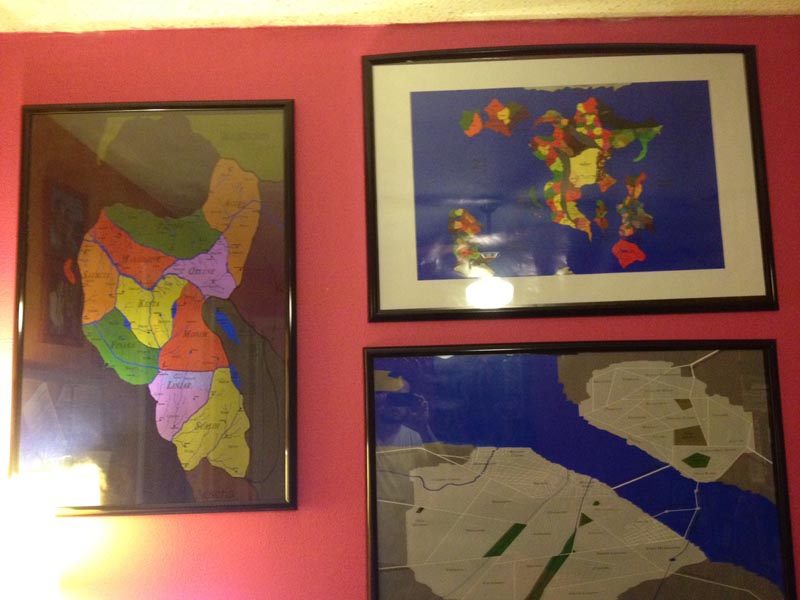
First and foremost, I'm thankful for by amazing wife, whose love and support have kept me going through this journey. She's put up with the many, many times I've stayed awake into the wee hours or sequestered myself with headphones on and nose in the computer, accepted the fact that my head is quite literally in some other world half the time, and has kept the fire under my feet when I get distracted. She's willing for me to not only have giant maps printed, but to have them framed and hung in our studio. Thanks to her I've got three novels*** in my agent's hands, and more on the way.
Second, my agent. It's hard to quantify what an agent does for someone, but in the time we've been together, he's been a source of support, as well as inspiration. He's pushed those three books into being better than they were without him. He's regularly plugged this very blog. He's working for me, and he doesn't make a dime from me until we have a sale. And when we do, you damn well better believe he's earned his percentage. I sure do.
I'm thankful for my health and my energy, and that I've had the ability and freedom to keep working like I have been. I'm thankful that I've just finished a draft of a short story, and wrote another short play last week. I'm thankful that I have more ideas than I know what to do with. Novels are cooking and brewing in this brain, and I have every intention of continuing to crank them out.
I'm thankful for all the people who've given help and advice over the past year and more-- from my mentor and friend Stina Leicht to my worldbuilding brainstorming partner Dan Fawcett to the café manager who doesn't charge me every once in a while because she likes supporting writers. Too many people to name. Besides, that's what the acknowledgement page of books are for, right?
All right, time to hit the kitchen, folks. Have a good one.
___
*- I'm a traditionalist, but that ties to my roots as a worldbuilder and an amateur food historian. Turkey, potatoes & corn are all native foods to the Americas. That's important, in my mind. That's why desert is a chocolate pecan pie.
**- I swear, half the times I say that, I end up writing twice as much as a normal post.
***- And two trunked ones. I don't think anything tests the patience of a writer's spouse quite like a trunk novel.
So: state of the writer, thankfulness version.
First and foremost, I'm thankful for by amazing wife, whose love and support have kept me going through this journey. She's put up with the many, many times I've stayed awake into the wee hours or sequestered myself with headphones on and nose in the computer, accepted the fact that my head is quite literally in some other world half the time, and has kept the fire under my feet when I get distracted. She's willing for me to not only have giant maps printed, but to have them framed and hung in our studio. Thanks to her I've got three novels*** in my agent's hands, and more on the way.
Second, my agent. It's hard to quantify what an agent does for someone, but in the time we've been together, he's been a source of support, as well as inspiration. He's pushed those three books into being better than they were without him. He's regularly plugged this very blog. He's working for me, and he doesn't make a dime from me until we have a sale. And when we do, you damn well better believe he's earned his percentage. I sure do.
I'm thankful for my health and my energy, and that I've had the ability and freedom to keep working like I have been. I'm thankful that I've just finished a draft of a short story, and wrote another short play last week. I'm thankful that I have more ideas than I know what to do with. Novels are cooking and brewing in this brain, and I have every intention of continuing to crank them out.
I'm thankful for all the people who've given help and advice over the past year and more-- from my mentor and friend Stina Leicht to my worldbuilding brainstorming partner Dan Fawcett to the café manager who doesn't charge me every once in a while because she likes supporting writers. Too many people to name. Besides, that's what the acknowledgement page of books are for, right?
All right, time to hit the kitchen, folks. Have a good one.
___
*- I'm a traditionalist, but that ties to my roots as a worldbuilder and an amateur food historian. Turkey, potatoes & corn are all native foods to the Americas. That's important, in my mind. That's why desert is a chocolate pecan pie.
**- I swear, half the times I say that, I end up writing twice as much as a normal post.
***- And two trunked ones. I don't think anything tests the patience of a writer's spouse quite like a trunk novel.
Monday, February 20, 2012
Post-Con Report
So, I spent the weekend up in Boston for Boskone, and the whole weekend was something of an up-and-down experience for me.
Of the good: Boston is a gorgeous city, and this weekend was perfect walking-around weather. As much as I love Austin, it's not a city that's visually inspiring on an architectural level. Boston-- there are parts of Boston that look almost exactly how Maradaine looks in my head. (If you take out the cars and traffic lights and such). We got to visit with my sister and her family, and my parents came up as well, so that was nice. I live 2000 miles away, so everyone being in the same place for something that's neither wedding nor funeral is a rarity.
Also of the good: I met my agent face-to-face for the first time, which I was quite pleased with. Especially since one of the first things he said was, "By the way, I absolutely loved the Holver Alley Crew rewrite you did." So that's making its way out in the world. Hopefully Maradaine Constabulary will follow shortly. Also, he highly praised my beta-reading people, and I can't help but agree. They're an awesome group. Another bright spot, connected to meeting with my agent, is when the editor from Baen saw my nametag and said, "Oh, yes, you're his new guy." Editors recognizing your name are rarely a bad thing.
Of the not-as-good: This is more my own issue, but being at a con where I don't really know people is something of a challenge for me. Yes, my agent was there, and he introduced me to people, and that was great. And Elizabeth Bear, whom I've met before, was very friendly. But I didn't have people, if you catch my meaning. I didn't have comfort-zone-familiar-faces to gravitate towards. It was a different experience for me last year at DFWWriterCon. I mean, there, I knew NO ONE, but at the same time, EVERYONE there was in the same boat: we had books written, and we were there to pitch to agents. We were kindred spirits, and it was simple to bond. I'm sure there were people in the same agented-but-not-sold position as me, but there was no badge color or hand signal to recognize fellow travelers in the last miles of the marathon.
But, like I said, this is probably more my own imposter-syndrome issues above and beyond anything else.
Of the REALLY-not-good: My laptop died. Horribly. Fortunately, I backed up ALL my writing stuff the night before I left, AND the machine is still under warranty, but it was still annoying. I feel kind of hobbled, writing-wise, until I get it back up and running. Even though I could use the desktop I'm writing this on. I'm strange like that.
Of the good: Boston is a gorgeous city, and this weekend was perfect walking-around weather. As much as I love Austin, it's not a city that's visually inspiring on an architectural level. Boston-- there are parts of Boston that look almost exactly how Maradaine looks in my head. (If you take out the cars and traffic lights and such). We got to visit with my sister and her family, and my parents came up as well, so that was nice. I live 2000 miles away, so everyone being in the same place for something that's neither wedding nor funeral is a rarity.
Also of the good: I met my agent face-to-face for the first time, which I was quite pleased with. Especially since one of the first things he said was, "By the way, I absolutely loved the Holver Alley Crew rewrite you did." So that's making its way out in the world. Hopefully Maradaine Constabulary will follow shortly. Also, he highly praised my beta-reading people, and I can't help but agree. They're an awesome group. Another bright spot, connected to meeting with my agent, is when the editor from Baen saw my nametag and said, "Oh, yes, you're his new guy." Editors recognizing your name are rarely a bad thing.
Of the not-as-good: This is more my own issue, but being at a con where I don't really know people is something of a challenge for me. Yes, my agent was there, and he introduced me to people, and that was great. And Elizabeth Bear, whom I've met before, was very friendly. But I didn't have people, if you catch my meaning. I didn't have comfort-zone-familiar-faces to gravitate towards. It was a different experience for me last year at DFWWriterCon. I mean, there, I knew NO ONE, but at the same time, EVERYONE there was in the same boat: we had books written, and we were there to pitch to agents. We were kindred spirits, and it was simple to bond. I'm sure there were people in the same agented-but-not-sold position as me, but there was no badge color or hand signal to recognize fellow travelers in the last miles of the marathon.
But, like I said, this is probably more my own imposter-syndrome issues above and beyond anything else.
Of the REALLY-not-good: My laptop died. Horribly. Fortunately, I backed up ALL my writing stuff the night before I left, AND the machine is still under warranty, but it was still annoying. I feel kind of hobbled, writing-wise, until I get it back up and running. Even though I could use the desktop I'm writing this on. I'm strange like that.
Monday, December 26, 2011
2011 in Review
This has been a good year for me, in terms of growing as a writer. Honestly, I think every year since 2007 (which is probably the year I knocked the training wheels off an got serious about I'm Going To Be A Writer) has been an improvement. But 2011 was a year with a few notable highlights:
First and foremost, there's acquiring Mike as my agent. This has been such a joy and relief in my life this year. I really am quite happy to have him in my corner. Getting an agent has become such a huge (and sometimes insurmountable-seeming) step in the path to publication, I really can't express how glad I am to have moved up to the next step.
And while I did have an excellent time attending the DFW Writers Con this past year (and would recommend the experience to those seeking agents), I'm glad I don't have to do that again.
This year is also when I decided to be diligent and post here on the blog every Monday and Thursday. It's a project that's sometimes challenged me (I almost forgot that today was a Monday), but I've been pleased with the results. It's built the regular readership, and driven traffic to my blog. So that's been a good thing.
This was also my first year at ArmadilloCon in a panelist/professional capacity, as well as a coordinator and teacher for the Writers' Workshop. This was a fantastic experience, and I do owe a lot of it to Stina Leicht. She's been a fantastic source of moral support on this journey.
What else? This year I have Thorn finished and shopping, Holver Alley Crew redrafted and (hopefully) ready to shop. This year I also finished the draft of Maradaine Constabulary and will hope to have the revision ready to send to Mike in just a few weeks. I wrote a couple short plays, including Entropy, produced by Austin Scriptworks.
So it's been a pretty good year. Fingers crossed for 2012 being even better.
First and foremost, there's acquiring Mike as my agent. This has been such a joy and relief in my life this year. I really am quite happy to have him in my corner. Getting an agent has become such a huge (and sometimes insurmountable-seeming) step in the path to publication, I really can't express how glad I am to have moved up to the next step.
And while I did have an excellent time attending the DFW Writers Con this past year (and would recommend the experience to those seeking agents), I'm glad I don't have to do that again.
This year is also when I decided to be diligent and post here on the blog every Monday and Thursday. It's a project that's sometimes challenged me (I almost forgot that today was a Monday), but I've been pleased with the results. It's built the regular readership, and driven traffic to my blog. So that's been a good thing.
This was also my first year at ArmadilloCon in a panelist/professional capacity, as well as a coordinator and teacher for the Writers' Workshop. This was a fantastic experience, and I do owe a lot of it to Stina Leicht. She's been a fantastic source of moral support on this journey.
What else? This year I have Thorn finished and shopping, Holver Alley Crew redrafted and (hopefully) ready to shop. This year I also finished the draft of Maradaine Constabulary and will hope to have the revision ready to send to Mike in just a few weeks. I wrote a couple short plays, including Entropy, produced by Austin Scriptworks.
So it's been a pretty good year. Fingers crossed for 2012 being even better.
Thursday, May 19, 2011
Short and Sweet
I don't have a lot of time right now, so I'll make this post brief. Just a bit of news.
I'm now represented by Mike Kabongo of the Onyxhawke Agency.
This is awesome, and I am thrilled. But it means I've got some work I have to get to RIGHT NOW.
I'm now represented by Mike Kabongo of the Onyxhawke Agency.
This is awesome, and I am thrilled. But it means I've got some work I have to get to RIGHT NOW.
Monday, February 28, 2011
DFW Writer Con Report
So, this past weekend I went to DFW Writer Con. It was my first time at this con, and my first time at this type of con, where there are a lot of agents and pitch sessions with the agents. There is a con of that nature in Austin every year, but it has always been sparse when it comes to agents who represent Fantasy. DFW Con had a wealth of such agents, so I felt it was time to take the chance. I figured it would be, at the very least, a learning experience, even if what I learned was, "Don't do that again."
I'm happy to say that wasn't what I learned, and the experience was well worth it.
First of all, it was somewhat refreshing to be at an event where everyone is a writer, but being a fantasy and sci-fi writer was an uncommon minority. I think sometimes I can get a bit tunnel-visioned-- pretty much all the professional writers I know are genre-writers, so it was cool to meet people who write radically different things than me. Especially non-fiction stuff that I wouldn't even THINK of. I witnessed one impromptu pitch of a non-fiction idea that caused the agent in question to almost squeal, "I need that book myself! Send it to me!" And it was a brilliant idea, but it was something that I would never think of. That kind of wide-net exposure was fun.
Plus when I said I write fantasy, I'd often get the excited, "That's what I read, but not what I write" response. That felt good.
(It does help that I've beaten out my old attitude of saying, "I write fantasy and sci-fi" with an almost shameful, half-apologetic tone. I wear my genre brand with pride now.)
I went to some good workshops on structure and character, which were very helpful. I also adored Kristen Lamb's discussions on using social media, blogging and platform building, and how important it is for authors today. I was pleased to find out I hadn't fallen into many of the common mistakes she noted. Admittedly, that was partly out of inaction. But you should all check her out.
One of the best panels was the "Query Gong Show", in which queries were (anonymously) read out loud, and the panel of agents would hit the gong whenever they would stop reading said query, and then talk about why they would. Really funny, and really educational. I couldn't do justice to summing up everything that happened at the Query Gong Show. Fortunately, Roni Loren has already done a fantastic job. Check it out.
All in all, a great weekend, and I heartily recommend it.
I'm happy to say that wasn't what I learned, and the experience was well worth it.
First of all, it was somewhat refreshing to be at an event where everyone is a writer, but being a fantasy and sci-fi writer was an uncommon minority. I think sometimes I can get a bit tunnel-visioned-- pretty much all the professional writers I know are genre-writers, so it was cool to meet people who write radically different things than me. Especially non-fiction stuff that I wouldn't even THINK of. I witnessed one impromptu pitch of a non-fiction idea that caused the agent in question to almost squeal, "I need that book myself! Send it to me!" And it was a brilliant idea, but it was something that I would never think of. That kind of wide-net exposure was fun.
Plus when I said I write fantasy, I'd often get the excited, "That's what I read, but not what I write" response. That felt good.
(It does help that I've beaten out my old attitude of saying, "I write fantasy and sci-fi" with an almost shameful, half-apologetic tone. I wear my genre brand with pride now.)
I went to some good workshops on structure and character, which were very helpful. I also adored Kristen Lamb's discussions on using social media, blogging and platform building, and how important it is for authors today. I was pleased to find out I hadn't fallen into many of the common mistakes she noted. Admittedly, that was partly out of inaction. But you should all check her out.
One of the best panels was the "Query Gong Show", in which queries were (anonymously) read out loud, and the panel of agents would hit the gong whenever they would stop reading said query, and then talk about why they would. Really funny, and really educational. I couldn't do justice to summing up everything that happened at the Query Gong Show. Fortunately, Roni Loren has already done a fantastic job. Check it out.
All in all, a great weekend, and I heartily recommend it.
Tuesday, September 21, 2010
I'm not sure who's Teddy Roosevelt in this metaphor.
It is said that a school of piranha can skeletonize a cow in minutes. This bit of trivia is apparently based on something of a deception-- some South American officials had intentionally starved a school of piranha so they would be in an eating frenzy when they threw the cow in, all as a ploy to impress Teddy Roosevelt-- but it is technically true.
Authors querying agents are trying to impress said agents, but given the market out there, they start to feel like those starved piranha. And I can see how for the agents, they can feel a lot less like Teddy Roosevelt, and more like the cow.
While we, the querying authors, don't really see the level of electronic assault I'm sure most authors get, one easy way to get a sense of it is to look at Nathan Bransford's blog today. To celebrate his 1000th post, he offered a query + 5 page critique to the 1000th comment on the post. Nathan is probably one of the bigger agents out there in the agenting-blogosphere, so this offer was widely read and amongst the querying, a highly coveted prize.
How coveted? Said 1000 posts took less than two hours. The last 250 posts of that thousand? Six minutes. And that's probably not even counting the attempts (like myself-- I'm not claiming I'm any different) that tried to post in that window and got hit with some sort of server-crashing error.
What's my point? I'm not completely sure, other than while it really sucks to be one of a swarm of hungry fish... it's important to remember that it's pretty tough on the cow, too.
Authors querying agents are trying to impress said agents, but given the market out there, they start to feel like those starved piranha. And I can see how for the agents, they can feel a lot less like Teddy Roosevelt, and more like the cow.
While we, the querying authors, don't really see the level of electronic assault I'm sure most authors get, one easy way to get a sense of it is to look at Nathan Bransford's blog today. To celebrate his 1000th post, he offered a query + 5 page critique to the 1000th comment on the post. Nathan is probably one of the bigger agents out there in the agenting-blogosphere, so this offer was widely read and amongst the querying, a highly coveted prize.
How coveted? Said 1000 posts took less than two hours. The last 250 posts of that thousand? Six minutes. And that's probably not even counting the attempts (like myself-- I'm not claiming I'm any different) that tried to post in that window and got hit with some sort of server-crashing error.
What's my point? I'm not completely sure, other than while it really sucks to be one of a swarm of hungry fish... it's important to remember that it's pretty tough on the cow, too.
Tuesday, July 27, 2010
Querying etiquette?
So today I attended a writing seminar, or at least part of it... namely the section on "getting your work out to other people", and naturally a part of that was talking about agents.
A question came up about sending to multiple agents, and the response was in no uncertain terms, NO. We were told that sending to multiple agents was a huge faux pas, not to be done, a mark of unprofessionalism, etc., etc.
Now, this didn't sound right to me, but I held my tongue.
So I put it out here: unless an agent asks for exclusivity, they don't expect it, right? A query isn't a commitment, it's... just a query. You can send them out to five or ten or a hundred agents at once (smartly, of course... no "Dear Insert Agent Name Here"), and it's not a big deal.
Or am I wrong? I'm perfectly willing to admit I could be. I'd love some insight here.
A question came up about sending to multiple agents, and the response was in no uncertain terms, NO. We were told that sending to multiple agents was a huge faux pas, not to be done, a mark of unprofessionalism, etc., etc.
Now, this didn't sound right to me, but I held my tongue.
So I put it out here: unless an agent asks for exclusivity, they don't expect it, right? A query isn't a commitment, it's... just a query. You can send them out to five or ten or a hundred agents at once (smartly, of course... no "Dear Insert Agent Name Here"), and it's not a big deal.
Or am I wrong? I'm perfectly willing to admit I could be. I'd love some insight here.
Monday, July 19, 2010
Querying in the summertime?
Is July typically a month in which agents take vacation?
I just send out another round of queries last week, and, oddly, I haven't heard any responses yet. I mean, many agents take several weeks to respond, of course, that's normal. But typically, in any batch of ten or so, there are a couple who turn it around in 48 hours, though usually with a rejection.
Not that I'm in a big hurry to get rejections, mind you.
Of the queries I have out there, there are three who are currently closed to new queries; a planned, temporary closure from July to September in all three cases. I find this fascinating. Is summer the unusually heavy time for querying? Or is it that three months of closure is necessary to be able to take a mere two weeks of vacation?
I just send out another round of queries last week, and, oddly, I haven't heard any responses yet. I mean, many agents take several weeks to respond, of course, that's normal. But typically, in any batch of ten or so, there are a couple who turn it around in 48 hours, though usually with a rejection.
Not that I'm in a big hurry to get rejections, mind you.
Of the queries I have out there, there are three who are currently closed to new queries; a planned, temporary closure from July to September in all three cases. I find this fascinating. Is summer the unusually heavy time for querying? Or is it that three months of closure is necessary to be able to take a mere two weeks of vacation?
Subscribe to:
Posts (Atom)