Some more experienced writers have told me that writing the second book is much harder than the first.
So far, with Thorn of Dentonhill II (new working title: Elements of Aventil), that hasn't been the case.
Not to say I haven't had my challenges. It's gone steady, but around the 2/3 point, my writing output has slowed down. Not stopped, but gone from 5-6K a week to 3-4K. But that's not uncommon. Every book I've written has had some sort of mid-point quagmire, and frankly, this has been the least troubling one to date. I mean, Way of the Shield spent months in around 30,000 words where I just couldn't figure it out. So spending a week longer to hit 70K on Elements is hardly cause for alarm.
But why do writers have trouble with second books? Mostly this comes from the fact that first books usually have years of midwifing, where writers work at their own pace. Polishing and perfecting. So once that finally sells, the pair of questions "Great, what's next? And can you have it done in six months?" can certainly seem daunting.
Now, perhaps why it's less daunting for me is because I kept working on rough drafts of new material while shopping Thorn-- a tactic which paid off, since I sold Thorn and Murder of Mages at the same time-- so the process of "Now how do I write another novel?" was demystified. I worked out a process of outlining. I've been coming at Elements with this solid outline-- which has, for the most part, survived intact, though there are plenty of aspects finding their way in that had nothing to do with the outline.
Of course, part of this has been to address the question, mostly imposed on myself: now that I'm "a professional", can I grind out the work at the pace I need to? Part of the reason why Way of the Shield could sit and do nothing for so long is that no one was really asking for it. In theory Elements of Aventil is going to have people asking for it, and having it done, proving I can do it as fast as I need to-- especially now, when we aren't at "quit your day job" money yet-- is an important next step.
So, in brief: yeah, writing the sequel is hard. But, fortunately, it hasn't been as hard as I feared it could be.
Showing posts with label Way of the Shield. Show all posts
Showing posts with label Way of the Shield. Show all posts
Monday, May 12, 2014


Monday, April 21, 2014
Worldbuilding: History is a Process of Change
One thing I've noticed reading fantasy fiction is the notion of stability: that people or nations stay more or less locked for centuries, if not millennia. This is, of course, patently absurd. You can easily see how borders and nations in Europe were in constant flux.
This is not the sort of thing you typically see in fantasy, though part of it is because readers do not need that level of detail. And, of course, how much detail do you, as the writer, really need to work out for the history?
The answer remains: as much as you really need. But I think it's important to note the difference between simplicity and stability. It's one thing to not go into the details of how a region has shifted hands and borders of the years. It's another to make those lack of details translate into a lack of change.
People don't work that way.
The same could be applied to the "lost king" trope. I can't imagine a civilization would run on the premise that their government is permanently in 'regent' mode, on the hope that the person who really is the ruler might show up and claim their right at any time. That the system is designed with this premise in mind.
I mean, has that ever actually happened in history?
Now, I admit, in the history of Druthal, I do make a little play off the "lost king" trope, in that a group discovers that one of their number is a direct descendent of the first King of Druthal. But they don't use that as proof of divine right, but rather as the spurious grounds to depose a horrible king that they already wanted to depose.* It wasn't destiny, but the sugar they used to coat the bitter pill of revolution they wanted the populace to swallow.
So, it might be valuable to check through your worldbuilding and ask yourself: do I simply not go into detail about the past here, or have I built something that is far too static to be realistic?
----
*- Druth history is actually filled with bad kings-- either incompetent or malicious-- and people who plot to get rid of them. This is something I used as a general plot point in Way of the Shield.
This is not the sort of thing you typically see in fantasy, though part of it is because readers do not need that level of detail. And, of course, how much detail do you, as the writer, really need to work out for the history?
The answer remains: as much as you really need. But I think it's important to note the difference between simplicity and stability. It's one thing to not go into the details of how a region has shifted hands and borders of the years. It's another to make those lack of details translate into a lack of change.
People don't work that way.
The same could be applied to the "lost king" trope. I can't imagine a civilization would run on the premise that their government is permanently in 'regent' mode, on the hope that the person who really is the ruler might show up and claim their right at any time. That the system is designed with this premise in mind.
I mean, has that ever actually happened in history?
Now, I admit, in the history of Druthal, I do make a little play off the "lost king" trope, in that a group discovers that one of their number is a direct descendent of the first King of Druthal. But they don't use that as proof of divine right, but rather as the spurious grounds to depose a horrible king that they already wanted to depose.* It wasn't destiny, but the sugar they used to coat the bitter pill of revolution they wanted the populace to swallow.
So, it might be valuable to check through your worldbuilding and ask yourself: do I simply not go into detail about the past here, or have I built something that is far too static to be realistic?
----
*- Druth history is actually filled with bad kings-- either incompetent or malicious-- and people who plot to get rid of them. This is something I used as a general plot point in Way of the Shield.
Monday, March 31, 2014
That Was 40: A Pretty Good Trip Around the Sun
So, today is my 41st birthday. And in the end, 40 was a pretty good year. A quick recap:
It's definitely the year in which I've transitioned from how I feel about writing, from being someone who took writing seriously, devoting much of my energy and time to it, to being a professional writer.
It's been a good year for me, and I'm looking forward to the next one. More writing, ArmadilloCon Writers' Workshop, and Thorn and Murder coming out. And who knows what else.
- "Jump the Black" was published in Rayguns Over Texas.
- With the sale of "Jump the Black", I'm eligible for the Campbell. And, you know, nominations for that end today. In case you were curious.
- I finished the long-suffering Way of the Shield, a book that just tasked me for the longest time before I figured out how to crack it.
- I attended my first WorldCon.
- I finally started properly writing Banshee, having now put in 70,000 words in it. The idea of Banshee had been bouncing around in my head for YEARS, so getting real traction on it was quite a victory.
- I SOLD TWO BOOKS TO DAW: Thorn of Dentonhill and A Murder of Mages. Yeah, this was definitely the highlight of the year.
- Got underway on Thorn II so there is minimal turnaround between those two books coming out and the next ones. And now I'm halfway done.
It's definitely the year in which I've transitioned from how I feel about writing, from being someone who took writing seriously, devoting much of my energy and time to it, to being a professional writer.
It's been a good year for me, and I'm looking forward to the next one. More writing, ArmadilloCon Writers' Workshop, and Thorn and Murder coming out. And who knows what else.
Thursday, January 2, 2014
A New Year and a New Horizon
At this point I usually like to talk about What's To Come in my intended year. But first, let's look at what my goals were last year at this time:
1. Book deals for Thorn of Dentonhill, Holver Alley Crew, and Maradaine Constabulary. Well, I did not get book deals for all three. So the highest goal I set did not come to pass. But who knows what tomorrow will bring?
2. Finish Rough Draft of Way of the Shield. Done.
3. Finish Rough Draft of Banshee. About 2/3 to 3/4 done. Not too shabby.
4. Attend my first Worldcon. Which I did, and in being part of the presentation for Rayguns, I had a good reason to be there. So: Done.
5. Have a good reason to start second books of Thorn, Holver Alley or Constabulary. See point 1, as before. I do have them well planned, should that good reason arise in the near future.
6. Hash out some of these random ideas into usable outlines. I actually have done this. I've parsed out characters, worldbuilding, and structure for a piece-- as well as knocking out a few thousand words to start it out-- of a potential future project.
7. Never give up. Yup.
So for 2014? Everything about that isn't done, keep doing.
Also: I'll be running the Writer's Workshop for ArmadilloCon this year. Expect me to be talking more about that in the coming days.
Happy New Year! Good luck in the word mines!
1. Book deals for Thorn of Dentonhill, Holver Alley Crew, and Maradaine Constabulary. Well, I did not get book deals for all three. So the highest goal I set did not come to pass. But who knows what tomorrow will bring?
2. Finish Rough Draft of Way of the Shield. Done.
3. Finish Rough Draft of Banshee. About 2/3 to 3/4 done. Not too shabby.
4. Attend my first Worldcon. Which I did, and in being part of the presentation for Rayguns, I had a good reason to be there. So: Done.
5. Have a good reason to start second books of Thorn, Holver Alley or Constabulary. See point 1, as before. I do have them well planned, should that good reason arise in the near future.
6. Hash out some of these random ideas into usable outlines. I actually have done this. I've parsed out characters, worldbuilding, and structure for a piece-- as well as knocking out a few thousand words to start it out-- of a potential future project.
7. Never give up. Yup.
So for 2014? Everything about that isn't done, keep doing.
Also: I'll be running the Writer's Workshop for ArmadilloCon this year. Expect me to be talking more about that in the coming days.
Happy New Year! Good luck in the word mines!
Thursday, December 26, 2013
Way of the Shield, and the Geena Davis Rule: 2013 in Review, Part Two
The next big milestone of accomplishments in 2013 as finishing the draft of Way of the Shield, cleaning it up and sending it off to the agent. He just recently sent it back to me, so now I've got a last round of tweaks and polishes to put on it before sending it back to him to put out into the world.
Long time readers will be aware that Way of the Shield was something of an albatross around my neck for much of 2012. I was working on it and it simply wasn't coming together at all. I had actually decided to put it to the side and focus on other things early this year, but it kept poking at me until I cracked the problem I had been having with the antagonists. It actually came together when my beta reader/sounding board guy asked me a simple question regarding Way of the Shield, and that brought about a breakthrough in writing out a long and complicated response. Doing that brought me from a manuscript languishing at around a third of the way done to complete in two months.
Breakthroughs can work like that.
The other thing I did with Shield, both in the original draft and again in the current clean-up, was confound the gender expectations of the old knightly orders that Dayne is a part of. Druthal and Maradaine are hardly a paradise of gender equality, but I wanted the Orders to reflect the idea that anyone who gets through the training process is considered an equal.
But my first chapter had no female characters.
Then I was thinking about this bit of advice Geena Davis recently gave regarding female characters in Hollywood movies, advice I think can easily apply to genre fiction as well:
And it stuck me, if I've already established this idea that the Orders have more gender equality than the culture at large, then why not just have Dayne's chapterhouse master in Lacanja (the city Way of the Shield starts in before Dayne returns to Maradaine) be a woman? I never gave Master Thall a given name, male or female, to begin with, so rewriting the scene involved little more than some pronoun switching. But, I think, it will have a strong effect on the worldbuilding of the Orders, which will ripple through the rest of the book-- which already has many female characters in a variety of roles.
Regardless, as I mentioned back in May when I finally finished the draft, it felt very good to get this particular project out of its long, slow, "work-in-progress" state.
Long time readers will be aware that Way of the Shield was something of an albatross around my neck for much of 2012. I was working on it and it simply wasn't coming together at all. I had actually decided to put it to the side and focus on other things early this year, but it kept poking at me until I cracked the problem I had been having with the antagonists. It actually came together when my beta reader/sounding board guy asked me a simple question regarding Way of the Shield, and that brought about a breakthrough in writing out a long and complicated response. Doing that brought me from a manuscript languishing at around a third of the way done to complete in two months.
Breakthroughs can work like that.
The other thing I did with Shield, both in the original draft and again in the current clean-up, was confound the gender expectations of the old knightly orders that Dayne is a part of. Druthal and Maradaine are hardly a paradise of gender equality, but I wanted the Orders to reflect the idea that anyone who gets through the training process is considered an equal.
But my first chapter had no female characters.
Then I was thinking about this bit of advice Geena Davis recently gave regarding female characters in Hollywood movies, advice I think can easily apply to genre fiction as well:
Go through the projects you're already working on and change a bunch of the characters' first names to women's names. With one stroke you've created some colorful unstereotypical female characters that might turn out to be even more interesting now that they've had a gender switch. What if the plumber or pilot or construction foreman is a woman? What if the taxi driver or the scheming politician is a woman? What if both police officers that arrive on the scene are women — and it's not a big deal?
And it stuck me, if I've already established this idea that the Orders have more gender equality than the culture at large, then why not just have Dayne's chapterhouse master in Lacanja (the city Way of the Shield starts in before Dayne returns to Maradaine) be a woman? I never gave Master Thall a given name, male or female, to begin with, so rewriting the scene involved little more than some pronoun switching. But, I think, it will have a strong effect on the worldbuilding of the Orders, which will ripple through the rest of the book-- which already has many female characters in a variety of roles.
Regardless, as I mentioned back in May when I finally finished the draft, it felt very good to get this particular project out of its long, slow, "work-in-progress" state.
Thursday, August 29, 2013
WorldCon Bound and other milestones
WorldCon / LoneStarCon starts today. I won't be going down until tomorrow afternoon, unfortunately, but I'm very excited. A little nervous, as this is my first "big" con, but I think it's important to keep stepping things up. I made myself a little pledge a few years ago to keep doing new things-- convention and career-wise-- that scare me a little. Two years ago that was being on panels and a Writers' Workshop teacher at ArmadilloCon. Last year it was giving a reading. This year, I think WorldCon, in and of itself, is sufficient.
I'm not an official participant, which is fine, given my current status as a writer. I will be an unofficial participant in one thing, however:
Furthermore, with Rayguns now released, I believe my eligibility for the Campbell Award starts today. If I'm wrong about that, someone let me know.
In other news, I've now sent a polished draft of Way of the Shield to my esteemed agent. I've also updated the excerpt over on my webpage, so go and check that out. This novel was particularly challenging to write, certainly more so than the other three books set in Maradaine. It definitely was the one where the original outline survived the least in the writing process. My original concept was more of a mystery/thriller, with a plot involving figuring out who was killing members of Parliament. That didn't really fit the themes I was working with, and also made things feel a bit too close to what I had already done with Maradaine Constabulary. The end result is much stronger, I think. We'll see if the agent agrees.
I'm not an official participant, which is fine, given my current status as a writer. I will be an unofficial participant in one thing, however:
Rayguns Over Texas Group Reading/SigningEven though I've mentioned it before, it bears repeating that I am immensely pleased to be included in Rayguns. From what I've seen of the preview excerpts, everything in it is great.
Saturday 1700-1900
007A (Convention Center)
Furthermore, with Rayguns now released, I believe my eligibility for the Campbell Award starts today. If I'm wrong about that, someone let me know.
In other news, I've now sent a polished draft of Way of the Shield to my esteemed agent. I've also updated the excerpt over on my webpage, so go and check that out. This novel was particularly challenging to write, certainly more so than the other three books set in Maradaine. It definitely was the one where the original outline survived the least in the writing process. My original concept was more of a mystery/thriller, with a plot involving figuring out who was killing members of Parliament. That didn't really fit the themes I was working with, and also made things feel a bit too close to what I had already done with Maradaine Constabulary. The end result is much stronger, I think. We'll see if the agent agrees.
Thursday, August 22, 2013
Worldbuilding And Overdecription
So, when I talked earlier this week about the perils of overdescribing, of course some of the chatter I heard came back to worldbuilding. Specifically about walking that balance between taking all that wonderful, glorious worldbuilding work that you've done and therefore must share, and not boring the hell out of your reader with things that don't advance the story.
I've used a few different metaphors for the best relationship between worldbuilding and descriptive narrative, but this one strikes me as most apt:
If you've built a clock, most people have no interest in seeing how all the gears work. They just want to know what time it is. But if you haven't made the gears work properly, then the clock isn't going to tell you the right time.
And that's what it boils down to: telling the reader what they're going to want to know in order to understand the story, not what you think they need to know in order to understand everything.
I'm just about finished up (finally) with Way of the Shield, where I struggled with this balance, especially with the historical elements. Part of it involved having the main character go places where the discussion or examination of Druth history was a natural thing: attending a museum opening, or seeing a play that was the equivalent to Richard III. But I made sure to temper my desire to share EVERYTHING.
--
Other news: Rayguns Over Texas is coming, of course, and Rick Klaw has been posting excerpts from each author's story over the past couple weeks. Here's the one for mine, Jump the Black. Enjoy!
I've used a few different metaphors for the best relationship between worldbuilding and descriptive narrative, but this one strikes me as most apt:
If you've built a clock, most people have no interest in seeing how all the gears work. They just want to know what time it is. But if you haven't made the gears work properly, then the clock isn't going to tell you the right time.
And that's what it boils down to: telling the reader what they're going to want to know in order to understand the story, not what you think they need to know in order to understand everything.
I'm just about finished up (finally) with Way of the Shield, where I struggled with this balance, especially with the historical elements. Part of it involved having the main character go places where the discussion or examination of Druth history was a natural thing: attending a museum opening, or seeing a play that was the equivalent to Richard III. But I made sure to temper my desire to share EVERYTHING.
--
Other news: Rayguns Over Texas is coming, of course, and Rick Klaw has been posting excerpts from each author's story over the past couple weeks. Here's the one for mine, Jump the Black. Enjoy!
Thursday, June 27, 2013
State of the Writer: Summer 2013
A writer is at a party where he meets a neurosurgeon. "So you write books," the surgeon said. "I've always thought about taking a summer off to write a book." "That's funny," said the writer. "I've thought about taking a summer off to do some brain surgery."
So, we're knee-deep in summer now, and for me it's always more of a challenge to maintain my writing discipline, but I've been pretty good so far. The main thing I've been working on is editing, and that's a bit harder to put a metric on. When you're writing, you can use daily word count to track your progress. That doesn't quite work with editing.
Given that, here's where things stand, and where I plan things to go for the rest of 2013.
Thorn of Dentonhill, Holver Alley Crew and Maradaine Constabulary are, of course, out in the world shopping. I try not to dwell too much on the details of this process. That's what agents are for.
Way of the Shield is finally finished as a rough draft. Editing it to a fine, clean draft that is worth sending to my agent is my current "main" project. Part of that is also outlining summaries for the planned Books Two and Three of Way of the Shield. Knock on wood, that stuff should all be send to the Agent by the end of July. Should.
Secondary project is fine-tuning the outline for Banshee, which has gone through a lot of permutations over the years. However, I've found a new angle that really excites me, and I look forward to tackling that once I send out Shield.
Beyond that, I've got a handful of loose ideas that haven't quite coalesced into a plan. Of course, with any luck, someone will be wanting the Book Two for Thorn, Holver Alley, Maradaine Constabulary or Way of the Shield. I might even write a first chapter for each as a warm up. I'm thinking of also trying my hand at novelette/novella length works. We'll see. I've had some Secret Projects that I've intentionally kept back-burnered until I finished the quartet. So something may beat its way into the forefront of my brain.
Also: Rayguns Over Texas will be an actual, printed book that you can hold in your hands in two months. Isn't that exciting? I mostly consider it a small reward, a reminder that this hard work will be worth it. And it will. And as another reminder of that, here's Macklemore to play you out.
So, we're knee-deep in summer now, and for me it's always more of a challenge to maintain my writing discipline, but I've been pretty good so far. The main thing I've been working on is editing, and that's a bit harder to put a metric on. When you're writing, you can use daily word count to track your progress. That doesn't quite work with editing.
Given that, here's where things stand, and where I plan things to go for the rest of 2013.
Thorn of Dentonhill, Holver Alley Crew and Maradaine Constabulary are, of course, out in the world shopping. I try not to dwell too much on the details of this process. That's what agents are for.
Way of the Shield is finally finished as a rough draft. Editing it to a fine, clean draft that is worth sending to my agent is my current "main" project. Part of that is also outlining summaries for the planned Books Two and Three of Way of the Shield. Knock on wood, that stuff should all be send to the Agent by the end of July. Should.
Secondary project is fine-tuning the outline for Banshee, which has gone through a lot of permutations over the years. However, I've found a new angle that really excites me, and I look forward to tackling that once I send out Shield.
Beyond that, I've got a handful of loose ideas that haven't quite coalesced into a plan. Of course, with any luck, someone will be wanting the Book Two for Thorn, Holver Alley, Maradaine Constabulary or Way of the Shield. I might even write a first chapter for each as a warm up. I'm thinking of also trying my hand at novelette/novella length works. We'll see. I've had some Secret Projects that I've intentionally kept back-burnered until I finished the quartet. So something may beat its way into the forefront of my brain.
Also: Rayguns Over Texas will be an actual, printed book that you can hold in your hands in two months. Isn't that exciting? I mostly consider it a small reward, a reminder that this hard work will be worth it. And it will. And as another reminder of that, here's Macklemore to play you out.
Thursday, June 13, 2013
Perils of the Writer: The Editing Process
After taking a couple weeks away from Way of the Shield, it's time to dive into the editing process.
For me, the first step in editing a rough draft is that time away. One friend of mine said, "Forty days and forty nights." I think that's a bit much, especially if one is under a deadline.* But you need to freshen your eyes on the project. So, step away, read something completely different, cleanse the palate. I took two weeks, which is plenty.
Also during this time: get other eyes on it. Preferably someone who isn't going to just be all gushy and, "Oh, you wrote a book, wonderful!" You need someone who will throw a critical eye on it, but also not just be mean. Critiquing is an art, telling the writer what they need to hear without drowning their baby. Though some baby killing will come into it. But good, reliable beta-readers are like gold, and you should treasure them if you find them.
Next for me: change the font you wrote in, and print a hard copy. This gives you a editing/reading experience that is an utterly different from the writing experience. You'd be amazed how much that makes those little mistakes pop out. So many tense/typo/spelling problems show themselves in reading through the hard copy. The other big thing to do at this stage is figure out when I've tangled up my phrasings, using twenty words when fifteen would do. I go through with a red pen** and mark the manuscript all to hell. Here's where I figure out my chapter breaks. I never do that in the actual writing. I'm not sure why, it just doesn't feel organic at that stage.
Then next, I go back to Scrivener, and implement the red-pen changes, as well as any new changes I've worked out on going through it there. That usually catches everything. I also add any new scenes or tweak existing scenes, based on the notes I get from my beta.
In theory, that's when it's time to send to the agent. Then he'll usually have notes for another go-round.
And so, time to get to it. See you all Monday.
---
*- I'm not technically under a deadline for Way of the Shield, but by my own standards it's overdue. Sometimes the only way to get a project done is to behave as if it is under deadline.
**- Actually, it's purple, but the principle is the same.
For me, the first step in editing a rough draft is that time away. One friend of mine said, "Forty days and forty nights." I think that's a bit much, especially if one is under a deadline.* But you need to freshen your eyes on the project. So, step away, read something completely different, cleanse the palate. I took two weeks, which is plenty.
Also during this time: get other eyes on it. Preferably someone who isn't going to just be all gushy and, "Oh, you wrote a book, wonderful!" You need someone who will throw a critical eye on it, but also not just be mean. Critiquing is an art, telling the writer what they need to hear without drowning their baby. Though some baby killing will come into it. But good, reliable beta-readers are like gold, and you should treasure them if you find them.
Next for me: change the font you wrote in, and print a hard copy. This gives you a editing/reading experience that is an utterly different from the writing experience. You'd be amazed how much that makes those little mistakes pop out. So many tense/typo/spelling problems show themselves in reading through the hard copy. The other big thing to do at this stage is figure out when I've tangled up my phrasings, using twenty words when fifteen would do. I go through with a red pen** and mark the manuscript all to hell. Here's where I figure out my chapter breaks. I never do that in the actual writing. I'm not sure why, it just doesn't feel organic at that stage.
Then next, I go back to Scrivener, and implement the red-pen changes, as well as any new changes I've worked out on going through it there. That usually catches everything. I also add any new scenes or tweak existing scenes, based on the notes I get from my beta.
In theory, that's when it's time to send to the agent. Then he'll usually have notes for another go-round.
And so, time to get to it. See you all Monday.
---
*- I'm not technically under a deadline for Way of the Shield, but by my own standards it's overdue. Sometimes the only way to get a project done is to behave as if it is under deadline.
**- Actually, it's purple, but the principle is the same.
Monday, May 27, 2013
Finishing a Rough Draft
So, as of today, I have finished the rough draft of Way of the Shield.
Just being able to say this is a huge weight off my shoulders. This particular novel has been harder to midwife into existence than any other. But with it done-- at least in rough draft-- I actually feel like its easier to breathe.
So you understand: I conceived, in broad brushstrokes, all four Heroes of Maradaine series at essentially the same time. That shortly led to me drafting out the outlines of what would become Thorn of Dentonhill, Holver Alley Crew, Maradaine Consabulary and Way of the Shield. If you had asked me at the time what my writing order was going to be, I would have told you: Thorn, Shield, Holver Alley, Constabulary.
Thorn was first, of course, but when I finished with that, and turned to Shield, I found myself gravitating to Holver Alley Crew instead. And then, when that was done, Shield was not coming to me, and Constabulary came about instead.
What was so hard about this one? Well, for one, there were key elements of the main character that hadn't gelled for me originally. In the original outline, Dayne really had no stake or personal goals. He didn't even really have a mandate to be involved in the events of the story. He essentially just involved himself because he felt like it. Also, the events of the story were, in the original outline, somewhat weak. Without going into a lot of details, the plan was more of a mystery-thriller, where people were being killed, and there was someone mysterious in the shadows doing it. Dayne was working hard to figure out who was doing it and why. And here's where the process of writing changes an outline, because that wasn't working at all. The project evolved, and Dayne became someone who had stakes, and who I understood where he was coming from better. And I grew to understand where the antagonists were coming from as well, which is critical.
So, now what? Well, I'll take a couple weeks to cleanse the palate-- re-read Thorn, Holver Alley and Constabulary-- as well as take care of some non-writing things I've been neglecting. Then I'll make a cleaning pass through Shield, and send it over to the agent for his opinion.
And then... well, we'll see what's next. Probably writing Banshee. But that could change, depending on what's asked of me.
Just being able to say this is a huge weight off my shoulders. This particular novel has been harder to midwife into existence than any other. But with it done-- at least in rough draft-- I actually feel like its easier to breathe.
So you understand: I conceived, in broad brushstrokes, all four Heroes of Maradaine series at essentially the same time. That shortly led to me drafting out the outlines of what would become Thorn of Dentonhill, Holver Alley Crew, Maradaine Consabulary and Way of the Shield. If you had asked me at the time what my writing order was going to be, I would have told you: Thorn, Shield, Holver Alley, Constabulary.
Thorn was first, of course, but when I finished with that, and turned to Shield, I found myself gravitating to Holver Alley Crew instead. And then, when that was done, Shield was not coming to me, and Constabulary came about instead.
What was so hard about this one? Well, for one, there were key elements of the main character that hadn't gelled for me originally. In the original outline, Dayne really had no stake or personal goals. He didn't even really have a mandate to be involved in the events of the story. He essentially just involved himself because he felt like it. Also, the events of the story were, in the original outline, somewhat weak. Without going into a lot of details, the plan was more of a mystery-thriller, where people were being killed, and there was someone mysterious in the shadows doing it. Dayne was working hard to figure out who was doing it and why. And here's where the process of writing changes an outline, because that wasn't working at all. The project evolved, and Dayne became someone who had stakes, and who I understood where he was coming from better. And I grew to understand where the antagonists were coming from as well, which is critical.
So, now what? Well, I'll take a couple weeks to cleanse the palate-- re-read Thorn, Holver Alley and Constabulary-- as well as take care of some non-writing things I've been neglecting. Then I'll make a cleaning pass through Shield, and send it over to the agent for his opinion.
And then... well, we'll see what's next. Probably writing Banshee. But that could change, depending on what's asked of me.
Monday, May 20, 2013
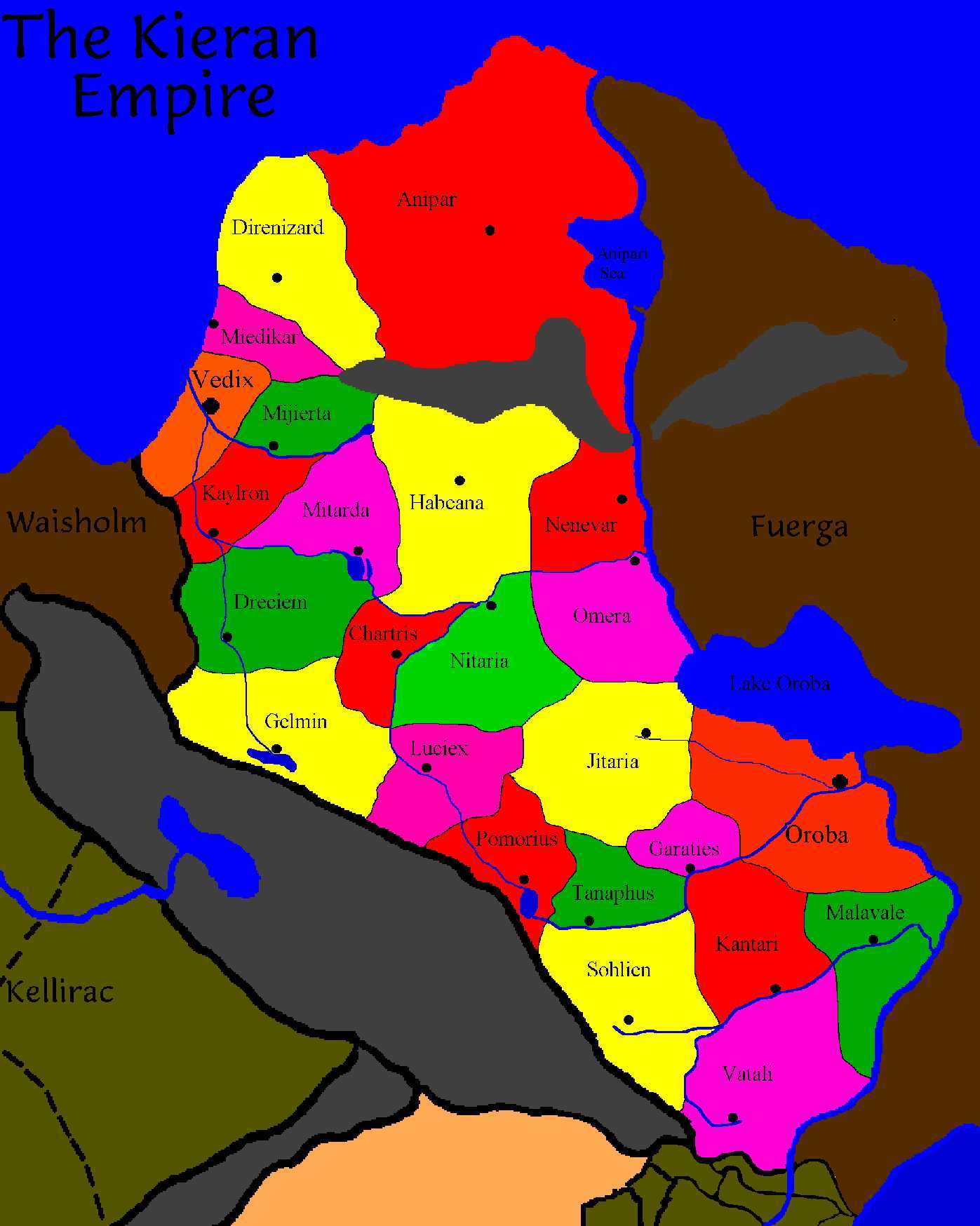
Worldbuilding: The Tour Continues to the Kieran Empire
As I'm nearly on the 26-mile line on the marathon that is Way of the Shield, we'll do another stop on the Worldbuilding tour: The Kieran Empire, which doesn't border Druthal, but was a major influence on its history.
---
 “Although all appearance are that the Kieran system is strong and has withstood the test of time, it is obvious that it has been surviving on the momentum of tradition for countless generations. It may take a few more centuries, but the Kieran Empire is eventually doomed.” -Official Report, Tsouljan Cultural Society
“Every aspect of civilization in the Trade Nations stems back to us. Governmental structures? Kieran. Roads and irrigation? Kieran. Astronomy, mathematics, science? Kieran. The very language they speak. Kieran. Without us they would be an uncountable slew of warring, petty little kingdoms. At the very least, they could be grateful.” -Senator Cimmeleaus, Kieran Assembly
“In almost three thousand years, the Kieran Empire has never broken a treaty. Bent it, twisted it, or utterly violated the spirit in which it was written? Absolutely. But broken? Never.” -Ian Callun, Druth Parliamentarian
The Kieran Empire stands as one of the oldest civilizations in history. It was founded in 1717 BFE, and has remained for nearly three thousand years. At its height, the Empire controlled all of what is now The Trade Nations. In fact, their cultural similarities all stem from having been a part of the Kieran Empire.
The Empire, while still strong, is now only a shadow of what it once was. Some say that now the Kierans are living in the past. Some think they are planning to recapture what they once were. And some feel the Kierans are slipping into their own decadence, and will someday completely fall apart.
The government of the Kieran empire is, theoretically, broken into three groups, who have a balance of power: The Senate Assembly, the Nobles and the Military. In practice, however, the Senate Assembly is in charge of the Empire. Nobles have no actual authority, merely title and money. They are able to use their title and money to influence members of the Senate, but most nobles content themselves with “courtly life”—being social with other nobles and enjoying creature comforts. The Military also has no authority of its own anymore, as the Assembly has used its powers of foreign and domestic treaty to create a situation where the military is unable to make any action without Senatorial approval.
The Senate Assembly has 240 members, ten from each district in the empire. Each one, theoretically, is an elected official who serves a ten-year term. The election process is so corrupted, however, that just about every Senator sits for life, or at least until he chooses to retire. And when a seat does open due to death or retirement, it is usually filled by a handpicked successor.
All laws, enactments, treaties and so forth (called “proposals” before they are passed) are decided by the senate with a vote. In order for a proposal to pass, the vote must succeed by a simple majority. However, if the proposal is deemed to be “Of Consequence” (something which is decided by a Senator declaring the proposal to be so, and another Senator seconding), then a two-thirds majority is necessary to pass it. A proposal could also be deemed to be of “Dire Consequence” (which requires a majority vote to determine), and therefore needs three-quarters of the Senate supporting to pass. Finally, if the proposal is deemed of “Most Dire Consequence”, a decision which itself is of Consequence, nine-tenths of the Senate must support it to pass it. In the history of the empire, only eleven proposals were ever deemed to have “Most Dire Consequence.”
Much debate always occurs before a vote, and it is common for there also to be a fair amount of bribery, back-scratching, threatening, blackmailing and other forms of corruption.
Each district is presided over by a Military Governor, who is the Commander in Chief of all the legions in that district. The Military Governor is appointed by the Senate, and the Senate can also revoke his position and replace him, and his not required to give cause.
The Kieran Legal code is incredibly complex and detailed, but written with numerous conditionals and loopholes. This allows for skillful lawyers (and Kieran has more lawyers than all the other nations combined) to manipulate the law to make almost anything legal, and almost anything illegal.
Kieran citizens are guaranteed certain rights and freedoms by the law, but these are equally bendable. Most citizens go through life not having any problems, but one can easily get himself in trouble and find himself trapped in the system with his rights removed by a whim.
Any crime, if one is found guilty, will be punished with a fine. If the criminal cannot pay his fine, he can have it paid by joining a labor camp, or by selling himself into slavery. As slaves have no rights at all, most will choose the camps. Going to a camp does not forfeit one’s citizenship. The labor camps are how most of the farming, ranching and mining in Kieran gets done.
The Kieran military has a discipline and internal structure that is only rivaled by the Poasians and Lyranans. They have a distinct chain of command, but the military does not have branches, like the Druth Army and Navy. Rather, naval and ground troops are part of the same structure. Organizationally, the military is broken down by districts, and each district’s Military Governor is at the top of the chain. Below him are generals, colonels, majors, captains, lieutenants and soldiers.
Within each district are several legions, about twenty to fifty per district. The size of a legion will vary, but each legion maintains its own home base, and has the manpower to operate the base or go on a march without support from other legions.
While the Kierans do break their units into specialized soldiers, with each unit performing a specific function (swordsmen, bowmen, cavalry and so on), they will cross train all their soldiers in multiple weapons, as well as operation of siege machines and ships. This allows them the freedom to move soldiers to different positions, and into different units, allowing them for flexibility in their tactics.
Within the cities, most children of free citizens are able to get basic education. All over the cities are several free, open schools where, during the day, teachers will instruct writing, reading, history and so forth. These teachers are actually university students, who must spend one year doing this teaching in order to graduate.
Every city also has at least one university. The universities are all supported by the government, but require tuition to be paid in order to attend. Usually the only students are from rich families or ones who are able to get a sponsor, but there is a way to get the government to fund one’s education, in return for a promise of service in the government or military. Outside of the cities, there is almost no opportunity to be educated.
Any practitioner of magic or mysticism must register as such. The easiest way to do so is to join the “1001st Legion” (the name a holdover from when all the legions were under the emperor and only numbered), which is a special group of the military, under the Senate, comprised entirely of mystics. If one does not wish to do that, they can join an official Circle of Mystics in the Trade Nations. Citizens of other Trade Nations who are members of Circles and are mystics are not hassled. Other foreign mystics must have proper paperwork to travel freely in Kieran.
One can register as a Civilian Mystic, without joining any group, but the process is very difficult.
It is rumored that the Kierans have a special prison for mystics hidden away in the mountains, and anyone caught practicing who is not registered is brought there.
---
“Every aspect of civilization in the Trade Nations stems back to us. Governmental structures? Kieran. Roads and irrigation? Kieran. Astronomy, mathematics, science? Kieran. The very language they speak. Kieran. Without us they would be an uncountable slew of warring, petty little kingdoms. At the very least, they could be grateful.” -Senator Cimmeleaus, Kieran Assembly
“In almost three thousand years, the Kieran Empire has never broken a treaty. Bent it, twisted it, or utterly violated the spirit in which it was written? Absolutely. But broken? Never.” -Ian Callun, Druth Parliamentarian
The Kieran Empire stands as one of the oldest civilizations in history. It was founded in 1717 BFE, and has remained for nearly three thousand years. At its height, the Empire controlled all of what is now The Trade Nations. In fact, their cultural similarities all stem from having been a part of the Kieran Empire.
The Empire, while still strong, is now only a shadow of what it once was. Some say that now the Kierans are living in the past. Some think they are planning to recapture what they once were. And some feel the Kierans are slipping into their own decadence, and will someday completely fall apart.
The government of the Kieran empire is, theoretically, broken into three groups, who have a balance of power: The Senate Assembly, the Nobles and the Military. In practice, however, the Senate Assembly is in charge of the Empire. Nobles have no actual authority, merely title and money. They are able to use their title and money to influence members of the Senate, but most nobles content themselves with “courtly life”—being social with other nobles and enjoying creature comforts. The Military also has no authority of its own anymore, as the Assembly has used its powers of foreign and domestic treaty to create a situation where the military is unable to make any action without Senatorial approval.
The Senate Assembly has 240 members, ten from each district in the empire. Each one, theoretically, is an elected official who serves a ten-year term. The election process is so corrupted, however, that just about every Senator sits for life, or at least until he chooses to retire. And when a seat does open due to death or retirement, it is usually filled by a handpicked successor.
All laws, enactments, treaties and so forth (called “proposals” before they are passed) are decided by the senate with a vote. In order for a proposal to pass, the vote must succeed by a simple majority. However, if the proposal is deemed to be “Of Consequence” (something which is decided by a Senator declaring the proposal to be so, and another Senator seconding), then a two-thirds majority is necessary to pass it. A proposal could also be deemed to be of “Dire Consequence” (which requires a majority vote to determine), and therefore needs three-quarters of the Senate supporting to pass. Finally, if the proposal is deemed of “Most Dire Consequence”, a decision which itself is of Consequence, nine-tenths of the Senate must support it to pass it. In the history of the empire, only eleven proposals were ever deemed to have “Most Dire Consequence.”
Much debate always occurs before a vote, and it is common for there also to be a fair amount of bribery, back-scratching, threatening, blackmailing and other forms of corruption.
Each district is presided over by a Military Governor, who is the Commander in Chief of all the legions in that district. The Military Governor is appointed by the Senate, and the Senate can also revoke his position and replace him, and his not required to give cause.
The Kieran Legal code is incredibly complex and detailed, but written with numerous conditionals and loopholes. This allows for skillful lawyers (and Kieran has more lawyers than all the other nations combined) to manipulate the law to make almost anything legal, and almost anything illegal.
Kieran citizens are guaranteed certain rights and freedoms by the law, but these are equally bendable. Most citizens go through life not having any problems, but one can easily get himself in trouble and find himself trapped in the system with his rights removed by a whim.
Any crime, if one is found guilty, will be punished with a fine. If the criminal cannot pay his fine, he can have it paid by joining a labor camp, or by selling himself into slavery. As slaves have no rights at all, most will choose the camps. Going to a camp does not forfeit one’s citizenship. The labor camps are how most of the farming, ranching and mining in Kieran gets done.
The Kieran military has a discipline and internal structure that is only rivaled by the Poasians and Lyranans. They have a distinct chain of command, but the military does not have branches, like the Druth Army and Navy. Rather, naval and ground troops are part of the same structure. Organizationally, the military is broken down by districts, and each district’s Military Governor is at the top of the chain. Below him are generals, colonels, majors, captains, lieutenants and soldiers.
Within each district are several legions, about twenty to fifty per district. The size of a legion will vary, but each legion maintains its own home base, and has the manpower to operate the base or go on a march without support from other legions.
While the Kierans do break their units into specialized soldiers, with each unit performing a specific function (swordsmen, bowmen, cavalry and so on), they will cross train all their soldiers in multiple weapons, as well as operation of siege machines and ships. This allows them the freedom to move soldiers to different positions, and into different units, allowing them for flexibility in their tactics.
Within the cities, most children of free citizens are able to get basic education. All over the cities are several free, open schools where, during the day, teachers will instruct writing, reading, history and so forth. These teachers are actually university students, who must spend one year doing this teaching in order to graduate.
Every city also has at least one university. The universities are all supported by the government, but require tuition to be paid in order to attend. Usually the only students are from rich families or ones who are able to get a sponsor, but there is a way to get the government to fund one’s education, in return for a promise of service in the government or military. Outside of the cities, there is almost no opportunity to be educated.
Any practitioner of magic or mysticism must register as such. The easiest way to do so is to join the “1001st Legion” (the name a holdover from when all the legions were under the emperor and only numbered), which is a special group of the military, under the Senate, comprised entirely of mystics. If one does not wish to do that, they can join an official Circle of Mystics in the Trade Nations. Citizens of other Trade Nations who are members of Circles and are mystics are not hassled. Other foreign mystics must have proper paperwork to travel freely in Kieran.
One can register as a Civilian Mystic, without joining any group, but the process is very difficult.
It is rumored that the Kierans have a special prison for mystics hidden away in the mountains, and anyone caught practicing who is not registered is brought there.
Thursday, May 16, 2013
Tools of the Writer: POV and Trust
Point-of-View is one of those funny things writers get very worked up about. And I've noticed, reading through some older* books I have, making concrete POV choices is a relatively recent development. I mean, yes, certainly, the distinction between first-person and third-person was always clear. But third-person was often more of a muddled third-person-omniscient instead of the discrete multi-person third-person-limited, where individual scenes have a clear POV character. Even the idea of a "POV Violation" as a writing mistake seems to be a relatively new thing.
Because, let me tell you, a lot of classics are just loaded with POV Violations.
However, the standard today is for clear, discrete definition of whose head your in for any given scene or chapter. George R. R. Martin's Song of Fire and Ice books do this explicitly, telling you who the POV character is instead of a chapter title.
There are a lot of "rules" of how to do a POV character, who can be one in your book and when you can let them be one. I'm of the opinion that who can be one and when is whoever you need it to be for the scene, whenever you need that scene to be.
My big thing with POV is trust. Unless the Unreliable Narrator is a technique you're utilizing, then you have to present your POV character in an honest way. You have to trust that character and what his engagement in the plot is.
Now, that doesn't mean the POV is limited to the "good guys". I love my antagonist POVs, as long as they are antagonists that I can trust are being honest with how they engage in the plot. If I have a character who is against the hero privately, but acts as his friend, and I don't want the reader to know that... then that character can't be a POV character. But if I want that betrayal clear, then that's exactly who I want as POV.
This was especially hard for me in Maradaine Constabulary, which is probably my most constrained work, POV-wise, in that I only have Satrine and Minox as POV characters. This is because, at its core, it's a murder mystery, and if you go into the head of murderer, then the mystery is given up. By limiting the POV to my two Inspectors, then the reader has the same set of data that they do.
On my current work-in-progress, Way of the Shield, it's more complicated than that, but similar rules of not using a character for POV apply. There are people whose motivation and trustworthiness I want the reader to keep in question, even in a subconscious way. Ideally, when their truths come to light, it will hit the reader like a hammer, because they might not have even suspected it.
We'll see if I pull it off.
---
*- Of course, when I say "older", I'm mostly talking about from the 80s. But, of course, older than that as well.
Because, let me tell you, a lot of classics are just loaded with POV Violations.
However, the standard today is for clear, discrete definition of whose head your in for any given scene or chapter. George R. R. Martin's Song of Fire and Ice books do this explicitly, telling you who the POV character is instead of a chapter title.
There are a lot of "rules" of how to do a POV character, who can be one in your book and when you can let them be one. I'm of the opinion that who can be one and when is whoever you need it to be for the scene, whenever you need that scene to be.
My big thing with POV is trust. Unless the Unreliable Narrator is a technique you're utilizing, then you have to present your POV character in an honest way. You have to trust that character and what his engagement in the plot is.
Now, that doesn't mean the POV is limited to the "good guys". I love my antagonist POVs, as long as they are antagonists that I can trust are being honest with how they engage in the plot. If I have a character who is against the hero privately, but acts as his friend, and I don't want the reader to know that... then that character can't be a POV character. But if I want that betrayal clear, then that's exactly who I want as POV.
This was especially hard for me in Maradaine Constabulary, which is probably my most constrained work, POV-wise, in that I only have Satrine and Minox as POV characters. This is because, at its core, it's a murder mystery, and if you go into the head of murderer, then the mystery is given up. By limiting the POV to my two Inspectors, then the reader has the same set of data that they do.
On my current work-in-progress, Way of the Shield, it's more complicated than that, but similar rules of not using a character for POV apply. There are people whose motivation and trustworthiness I want the reader to keep in question, even in a subconscious way. Ideally, when their truths come to light, it will hit the reader like a hammer, because they might not have even suspected it.
We'll see if I pull it off.
---
*- Of course, when I say "older", I'm mostly talking about from the 80s. But, of course, older than that as well.
Thursday, March 28, 2013
The Long Journey of the Writer
My thirties are coming to a close, officially this Sunday. So, needless to say, I'm getting a little introspective. But when I think about what my thirties were to me, in the big picture, it was about the process of becoming a novelist.
I mean, I had been writing before that, of course. In my twenties I had written a few plays, and made several false starts on novels, done a lot of worldbuilding work... but it was all still just dabbling.
So, we come to 2003. Oddly enough, what flipped the switch in 2003 was NaNoWriMo. Now, as I've said before, NaNoWriMo is a great way to learn how to write a novel, but it's not a good way to get a novel written. NaNoWriMo, is, in essence, your Trunk Novel Workshop. And for me, in 2003, it was Fifty Year War. Of course, I didn't realize that at the time. One never realizes they're writing a trunk novel when they're writing it.
I "finished" Fifty Year War by the end of 2003, if you can call a 57,000 word plotless meander with no protagonist a finished novel. I kept working on drafts of it, trying to send it out, somewhat clueless to its pointlessness. Then in 2004 I tried another novel- a non-genre one called Long Night of the Pieman. This didn't really come together at all.
In 2005 I tried my first (failed) attempt at USS Banshee, which was a mess. Mostly because this attempt to write it was semi-public, in that I was posting 3-5K chunks online every week, like it was a serial. While that worked nicely on a motivational level, it again was a failure in terms of actually writing something good. Over the years, I've kept coming back to that space-opera verse, trying to find the story... and I think I finally have. But, along the way, everything except the main character and, tangentially, the name of the ship has been scuttled. It's a completely different story than the first one I was doing. And that's good, because again: plotless meander.
Also in 2005 I took my first shot at Crown of Druthal, which was, I was convinced at the time, going to be the Real Deal. I even took the fist chapter of Crown to the ArmadilloCon Writers Workshop, my first time attending it. It was shredded. At the time, I was all, "What do these people know?", thinking they were fools. In retrospect, they were right on the money, but I wasn't in a place to hear that at the time.
2006 didn't see much progress in any of these projects-- all of them, as well as a few other vague ideas, didn't ever coalesce into anything. Frankly, it was a terrible year for me as a writer. Nothing was coming together. Not coincidentally, my day job at the time utterly depressed me, and my health and weight were probably at the worst in my life.
In 2007, I turned that around: I left that job, dropped 35 pounds, and put my nose to the grindstone, finishing the draft of Crown. I also came up with the initial ideas that would evolve into Thorn of Dentonhill, Holver Alley Crew, Maradaine Constabulary and Way of the Shield.
In 2008, I worked on a new draft of Crown, and started attending SlugTribe meetings, bringing chapters of Crown with me. I also wrote the first draft of Thorn, the first chapter of which I brought to ArmadilloCon. This was the year when things started coming together.
In '09, I rewrote Thorn and wrote the first draft of Holver Alley. I also started shopping Thorn to agents. Now, one thing to note: this draft of Thorn was 70,000 words long. I didn't think this was a problem, though most of my queries were getting form rejected or ignored.
But then there was one, at the end of the year-- an agent who said, in essence: I love this, but I can't sell it at this length. Rewrite it to 90K and get back to me.
So 2010 was, in no small part, about adding 20,000 words to a novel that was already pretty tight, as well as cleaning up Holver Alley to a respectable draft. I also wrote My Name Is Avenger Girl, which I sold to Paige Ewing's The Protectors, as well as selling my piece to the Hint Fiction anthology. I also started the rough draft of Maradaine Constabulary.
In 2011, that same agent who advised me on Thorn loved the re-write, and agreed to represent me. I then sent him Holver Alley as well, while getting the rough draft of Constabulary finished. I also started being on the Teacher's side of the ArmadilloCon Writers' Workshop.
Bringing us to last year. Finished Constabulary and send it to the agent. Started the rough draft of Way of the Shield. Did another round of re-writes on Thorn, Holver Alley and Constabulary by my agent's request, which also helped me strengthen the worldbuilding ties between them all. Wrote and sold Jump the Black to Rayguns Over Texas. OK, technically, the Rayguns sale came in on January 1st. Making a great start to 2013.
So where will 2013-- and with it my forties-- take me? With three novels out there shopping, and a fourth one (and fifth, really) in process... I hopeful that this year will be a Big Year for me as a writer.
Cross your fingers.
I mean, I had been writing before that, of course. In my twenties I had written a few plays, and made several false starts on novels, done a lot of worldbuilding work... but it was all still just dabbling.
So, we come to 2003. Oddly enough, what flipped the switch in 2003 was NaNoWriMo. Now, as I've said before, NaNoWriMo is a great way to learn how to write a novel, but it's not a good way to get a novel written. NaNoWriMo, is, in essence, your Trunk Novel Workshop. And for me, in 2003, it was Fifty Year War. Of course, I didn't realize that at the time. One never realizes they're writing a trunk novel when they're writing it.
I "finished" Fifty Year War by the end of 2003, if you can call a 57,000 word plotless meander with no protagonist a finished novel. I kept working on drafts of it, trying to send it out, somewhat clueless to its pointlessness. Then in 2004 I tried another novel- a non-genre one called Long Night of the Pieman. This didn't really come together at all.
In 2005 I tried my first (failed) attempt at USS Banshee, which was a mess. Mostly because this attempt to write it was semi-public, in that I was posting 3-5K chunks online every week, like it was a serial. While that worked nicely on a motivational level, it again was a failure in terms of actually writing something good. Over the years, I've kept coming back to that space-opera verse, trying to find the story... and I think I finally have. But, along the way, everything except the main character and, tangentially, the name of the ship has been scuttled. It's a completely different story than the first one I was doing. And that's good, because again: plotless meander.
Also in 2005 I took my first shot at Crown of Druthal, which was, I was convinced at the time, going to be the Real Deal. I even took the fist chapter of Crown to the ArmadilloCon Writers Workshop, my first time attending it. It was shredded. At the time, I was all, "What do these people know?", thinking they were fools. In retrospect, they were right on the money, but I wasn't in a place to hear that at the time.
2006 didn't see much progress in any of these projects-- all of them, as well as a few other vague ideas, didn't ever coalesce into anything. Frankly, it was a terrible year for me as a writer. Nothing was coming together. Not coincidentally, my day job at the time utterly depressed me, and my health and weight were probably at the worst in my life.
In 2007, I turned that around: I left that job, dropped 35 pounds, and put my nose to the grindstone, finishing the draft of Crown. I also came up with the initial ideas that would evolve into Thorn of Dentonhill, Holver Alley Crew, Maradaine Constabulary and Way of the Shield.
In 2008, I worked on a new draft of Crown, and started attending SlugTribe meetings, bringing chapters of Crown with me. I also wrote the first draft of Thorn, the first chapter of which I brought to ArmadilloCon. This was the year when things started coming together.
In '09, I rewrote Thorn and wrote the first draft of Holver Alley. I also started shopping Thorn to agents. Now, one thing to note: this draft of Thorn was 70,000 words long. I didn't think this was a problem, though most of my queries were getting form rejected or ignored.
But then there was one, at the end of the year-- an agent who said, in essence: I love this, but I can't sell it at this length. Rewrite it to 90K and get back to me.
So 2010 was, in no small part, about adding 20,000 words to a novel that was already pretty tight, as well as cleaning up Holver Alley to a respectable draft. I also wrote My Name Is Avenger Girl, which I sold to Paige Ewing's The Protectors, as well as selling my piece to the Hint Fiction anthology. I also started the rough draft of Maradaine Constabulary.
In 2011, that same agent who advised me on Thorn loved the re-write, and agreed to represent me. I then sent him Holver Alley as well, while getting the rough draft of Constabulary finished. I also started being on the Teacher's side of the ArmadilloCon Writers' Workshop.
Bringing us to last year. Finished Constabulary and send it to the agent. Started the rough draft of Way of the Shield. Did another round of re-writes on Thorn, Holver Alley and Constabulary by my agent's request, which also helped me strengthen the worldbuilding ties between them all. Wrote and sold Jump the Black to Rayguns Over Texas. OK, technically, the Rayguns sale came in on January 1st. Making a great start to 2013.
So where will 2013-- and with it my forties-- take me? With three novels out there shopping, and a fourth one (and fifth, really) in process... I hopeful that this year will be a Big Year for me as a writer.
Cross your fingers.
Monday, February 11, 2013
Perils of the Writer: Plotting and Crafting Action Scenes
So, I'm a planner and an outliner. I've made this pretty clear. Without plotting out a clear path of where I'm going to go in a story, I'm going to get lost in the weeds.
This is doubly true for action sequences. I can't just know who the players are, who fights or runs away, who wins, who loses, who dies and who is captured. If I try and write the scene with only that laid out, I'm going to freeze up. Before I can really write the scene, I need to work it out, beat for beat.
I think this is partly because I approach action scenes, as a writer, from three different angles, all of which are detail oriented.
Having done that, now I know what I need, in terms of terrain, and in terms of who does exactly what, and when. Which made achieving the end-result I needed, storywise, much easier. Now that i have that plan in hand, the actual writing of the sequence is coming together very well.
---
*- The director I had for one show prefaced our fight-training, telling us, "Don't tell me, 'I can't do that.' This is your instrument." He pointed to his body. "When you're on stage, you need to know how to play it, or I can't use you."
This is doubly true for action sequences. I can't just know who the players are, who fights or runs away, who wins, who loses, who dies and who is captured. If I try and write the scene with only that laid out, I'm going to freeze up. Before I can really write the scene, I need to work it out, beat for beat.
I think this is partly because I approach action scenes, as a writer, from three different angles, all of which are detail oriented.
- As an RPG Player. I played a lot of D&D and GURPS back in my youth, and my group was totally that group, that kept adding more and more of the optional rules to make combat more complex. I never wanted those parts of the game to be just a collection of dice rolls and stats. I was always of the mind frame that clever choices, playing with the terrain. A dynamic trick or atypical use of an object was a winner in my book.
- As a film student. If you have any familiarity with the process of filmmaking, you know it is a meticulous process, at least if you want to do it well. Each shot has to be planned, practiced and set up before it's shot, and then edited together into something clean and exciting. Even with a gifted fighter like Gina Carano, you can't just turn the camera on and let them do their thing.
- As a stage actor. In my time on stage, I was in more than my share of stage fights. I actually had a degree of infamy for being able to take a hit and fall to the ground. But that was never out of control-- every move was explicitly laid out, step-by-step. Each performance would be prefaced with a fight rehearsal-- first at half-speed, then three-quarters speed, finally at performance speed. Get sloppy with that, someone goes to the E/R before the end of the night. This also gave me a certain amount of practical experience in what one can actually do with their body*, what it feels like to hold a weapon in your hand, the jar on your arm when you block a blow. Is it true fighting experience? No, but it's controlled experience, made to look as good as possible.
Having done that, now I know what I need, in terms of terrain, and in terms of who does exactly what, and when. Which made achieving the end-result I needed, storywise, much easier. Now that i have that plan in hand, the actual writing of the sequence is coming together very well.
---
*- The director I had for one show prefaced our fight-training, telling us, "Don't tell me, 'I can't do that.' This is your instrument." He pointed to his body. "When you're on stage, you need to know how to play it, or I can't use you."
Monday, February 4, 2013
Worldbuilding: Art and Culture in the Fantasy World
The most fundamental way to define a culture is through its art. Geography, food, religion, technology and government are critical as well, of course, but none of those quite get to the soul of a people in the same way. With fantasy fiction, we're mostly dealing with forms of art of limited technology: painting, sculpture, architecture, music, poetry, literature and theater.
Music tends to be the way many fantasy writers go, to the point of cliché. Especially with songs. This is probably one of the quirks of genre that we inherited from Tolkien. Let's face it, Tolkien loved his songs. Personally, when I was reading him, whenever I saw indented, italicized text, I knew it was time to skip ahead a bit. The same thing with poetry. Now, part of the reason why these parts of a book seem so disposable is because the writers are not the poets/songsmiths of the ages that the work purports them to be. It's one thing to say that a poem is a soulcrushing work of rhyme and meter that drives men to tears; it's another to actually write it. I could do without it, personally. I could also do without mention of lutes or mandolins.*
Painting, sculpture and architecture, I'll admit, are a little out of my ken. Especially architecture. For painting and sculpture, I tend to go in the direction of what they depict, rather than how they're depicted. That's a nice way to drop a little worldbuilding history into the mix without it being as much of an infodump. At the very least, having your characters seeing a painting or statue of a former king gives a slightly more organic way to drop in some background.
Literature and theater are my favorite, though I tend to again go for what such pieces are about (and what that says about the culture) over trying to come up with excerpts. In Thorn of Dentonhill, I have a snippet of dialogue from Three Men and Two Wives, which is going on in the background while Veranix is searching for someone in the public square. Three Men and Two Wives is one of the ribald comedies of Darren Whit, a playwright from the previous century that I occasionally mention that is the Druth equivalent of Shakespeare**. At a different point, I have Kaiana quoting from one of Whit's history plays, Queen Mara. But, again, only snippets. And in Holver Alley Crew, there's mention of the banned play The Marriage of the Jester, which is being performed in an especially shabby part of town. While Three Men and Two Wives is a lusty, romantic farce (filled with crossdressing and confused identity), The Marriage of the Jester is little more than smut, presented to give the audience a cheap thrill, or for a little more coin, the opportunity to join in.
I have to admit, I have fun just brainstorming potential play titles.
I intend to include a little bit of loftier theatre in Way of the Shield-- perhaps even an opera, if I can make it work. Amanda Downum's The Bone Palace has a nice bit where her main characters go to the opera, and it's the blood-soaked tragedy kind.
The other element I'm interested in adding to the mix is the use of magic in creating art. I've hinted around that in Way of the Shield as well. Still pondering that. It's something I'd like to do, but at the same time, I don't want to stop the story dead in its tracks just to include it.
---
*- Yes, historical, but they also come off as Fantasy Clichés.
**- I also have some equivalents to Jonson, Marlowe and Webster. Definitely Webster. The Druth do so love a blood-soaked tragedy. Especially since Whit was rarely a tragedist.
Music tends to be the way many fantasy writers go, to the point of cliché. Especially with songs. This is probably one of the quirks of genre that we inherited from Tolkien. Let's face it, Tolkien loved his songs. Personally, when I was reading him, whenever I saw indented, italicized text, I knew it was time to skip ahead a bit. The same thing with poetry. Now, part of the reason why these parts of a book seem so disposable is because the writers are not the poets/songsmiths of the ages that the work purports them to be. It's one thing to say that a poem is a soulcrushing work of rhyme and meter that drives men to tears; it's another to actually write it. I could do without it, personally. I could also do without mention of lutes or mandolins.*
Painting, sculpture and architecture, I'll admit, are a little out of my ken. Especially architecture. For painting and sculpture, I tend to go in the direction of what they depict, rather than how they're depicted. That's a nice way to drop a little worldbuilding history into the mix without it being as much of an infodump. At the very least, having your characters seeing a painting or statue of a former king gives a slightly more organic way to drop in some background.
Literature and theater are my favorite, though I tend to again go for what such pieces are about (and what that says about the culture) over trying to come up with excerpts. In Thorn of Dentonhill, I have a snippet of dialogue from Three Men and Two Wives, which is going on in the background while Veranix is searching for someone in the public square. Three Men and Two Wives is one of the ribald comedies of Darren Whit, a playwright from the previous century that I occasionally mention that is the Druth equivalent of Shakespeare**. At a different point, I have Kaiana quoting from one of Whit's history plays, Queen Mara. But, again, only snippets. And in Holver Alley Crew, there's mention of the banned play The Marriage of the Jester, which is being performed in an especially shabby part of town. While Three Men and Two Wives is a lusty, romantic farce (filled with crossdressing and confused identity), The Marriage of the Jester is little more than smut, presented to give the audience a cheap thrill, or for a little more coin, the opportunity to join in.
I have to admit, I have fun just brainstorming potential play titles.
I intend to include a little bit of loftier theatre in Way of the Shield-- perhaps even an opera, if I can make it work. Amanda Downum's The Bone Palace has a nice bit where her main characters go to the opera, and it's the blood-soaked tragedy kind.
The other element I'm interested in adding to the mix is the use of magic in creating art. I've hinted around that in Way of the Shield as well. Still pondering that. It's something I'd like to do, but at the same time, I don't want to stop the story dead in its tracks just to include it.
---
*- Yes, historical, but they also come off as Fantasy Clichés.
**- I also have some equivalents to Jonson, Marlowe and Webster. Definitely Webster. The Druth do so love a blood-soaked tragedy. Especially since Whit was rarely a tragedist.
Thursday, January 31, 2013
A Deep Bench of Tertiary Characters
I have to confess, there's a small part of me that cringes whenever I realize I need another character. Or characters. Especially a character with a name. Because I know, each named character adds a new dimension of complexity, and with that, the risk of losing a reader who doesn't want to keep track of too many characters.
Usually, such a character first comes into the story on a purely functional basis: I need someone for Colin to talk to in this scene. I need Jeric to have a peer group among the Tarian initiates. I need Lesk to be building up his own crew of neighborhood flunkies. Serving the mechanical needs of the story, keeping the gears moving. This is fine, of course, but in and of itself, rarely dynamic.
So I put myself in the frame of mind of my theatre roots: make every role interesting. Think in terms of casting: what would a great character actor do with this part?* How can I make it more than just functional, but without going off on a tangent that has little to do with the rest of the story?
On top of that, it's often in these tertiary characters that the biggest surprises of the writing process is born. Something that starts as functional blossoms into a more crucial role.
One of my favorite examples of this comes from Deep Space Nine**: Damar. Damar first shows up in the 4th season episode "Return to Grace", and his purpose is entirely functional. He's the guy on the bridge of Dukat's ship who speaks, so someone can say those "Target at four hundred thousand, sir" and "Phasers ready" lines. He's the personification of Dukat's whole crew, and little else. But over the course of the series, he stayed at Dukat's right hand as Dukat became the de jure leader of Cardassia under Dominion rule. And once Dukat's madness removed him from that position, there was Damar: now the puppet in charge, and the slow cost that had on his soul became a key storyline in the final season.
Not too shabby for a character that starts out as purely functional.
And that, I think, is the key aspect when bringing any new named character into the mix: investing them with the potential to become something so much more. I can't even begin to tell you how many times I've started a new scene and realized that the best choice of POV character for that scene is someone I hadn't even considered existing when I drafted the outline.
The other key aspect? Keep the names dynamic. I know when I'm reading a book-- especially a sci-fi or fantasy book-- and there's some minor character named Vesslin and another one named Vettlan I am going to mix up which one is which. Heck, when I was twelve and tried to reader Lord of the Rings for the first time, I couldn't keep Sauron and Saruman straight. They were both bad guys with S-r-n name constructions.***
Right now on Way of the Shield I'm working on a scene where a functional character exists to bring a main character from Point A to Point B-- in a literal, "get him on a carriage and deliver him somewhere" way. In writing the scene, I asked myself, "Who is this guy, and how did he get this job?", and in asking that, I found a common thread between him and the main character in the scene, which then helps build his story, and does a bit of worldbuilding work in the process.
Again, not too shabby for a character that starts out as purely functional.
---
*- An interesting effect of the success of the Harry Potter movies is how it managed to get some of Britain's greatest actors to do little more than oddly-dressed cameos.
**- I do use Star Trek examples a lot, don't I?
***- Tolkien's habit of giving the same character multiple names didn't help me much either.
Usually, such a character first comes into the story on a purely functional basis: I need someone for Colin to talk to in this scene. I need Jeric to have a peer group among the Tarian initiates. I need Lesk to be building up his own crew of neighborhood flunkies. Serving the mechanical needs of the story, keeping the gears moving. This is fine, of course, but in and of itself, rarely dynamic.
So I put myself in the frame of mind of my theatre roots: make every role interesting. Think in terms of casting: what would a great character actor do with this part?* How can I make it more than just functional, but without going off on a tangent that has little to do with the rest of the story?
On top of that, it's often in these tertiary characters that the biggest surprises of the writing process is born. Something that starts as functional blossoms into a more crucial role.
One of my favorite examples of this comes from Deep Space Nine**: Damar. Damar first shows up in the 4th season episode "Return to Grace", and his purpose is entirely functional. He's the guy on the bridge of Dukat's ship who speaks, so someone can say those "Target at four hundred thousand, sir" and "Phasers ready" lines. He's the personification of Dukat's whole crew, and little else. But over the course of the series, he stayed at Dukat's right hand as Dukat became the de jure leader of Cardassia under Dominion rule. And once Dukat's madness removed him from that position, there was Damar: now the puppet in charge, and the slow cost that had on his soul became a key storyline in the final season.
Not too shabby for a character that starts out as purely functional.
And that, I think, is the key aspect when bringing any new named character into the mix: investing them with the potential to become something so much more. I can't even begin to tell you how many times I've started a new scene and realized that the best choice of POV character for that scene is someone I hadn't even considered existing when I drafted the outline.
The other key aspect? Keep the names dynamic. I know when I'm reading a book-- especially a sci-fi or fantasy book-- and there's some minor character named Vesslin and another one named Vettlan I am going to mix up which one is which. Heck, when I was twelve and tried to reader Lord of the Rings for the first time, I couldn't keep Sauron and Saruman straight. They were both bad guys with S-r-n name constructions.***
Right now on Way of the Shield I'm working on a scene where a functional character exists to bring a main character from Point A to Point B-- in a literal, "get him on a carriage and deliver him somewhere" way. In writing the scene, I asked myself, "Who is this guy, and how did he get this job?", and in asking that, I found a common thread between him and the main character in the scene, which then helps build his story, and does a bit of worldbuilding work in the process.
Again, not too shabby for a character that starts out as purely functional.
---
*- An interesting effect of the success of the Harry Potter movies is how it managed to get some of Britain's greatest actors to do little more than oddly-dressed cameos.
**- I do use Star Trek examples a lot, don't I?
***- Tolkien's habit of giving the same character multiple names didn't help me much either.
Monday, January 21, 2013
Worldbuilding: Great Forces of History
We present the following not as a matter of law, to be debated by a council of lords or ignored by a monarch, but as a matter of truth: the rights enumerated here are not granted by government or ratification. They are intrinsic to every man, ever person, be they born on Druth soil, traveled from the far edges of the world, or dragged to our shores in chains. They are immutable, given to any infant from the moment breath is drawn. They cannot be denied or removed or decreed away, either by the whim of nobility, or by the tyranny of popular ignorance.
Preamble to "Rights of Man"Geophry Haltom, Maradaine, 1011
In my first pass of the history of Druthal, I establish 1009 as a key year, equivalent to 1776 or 1066 in terms of critical importance-- but at that point, I didn't give it significant details. The set-up was that, for three centuries, Druthal had shattered into many separate kingdoms, and the whole area was plagued with war, inquisition and tyrrany. By the beginning of the eleventh century, things were at their darkest. A conqueror known only as The Black Mage* swept across the petty kingdoms, eventually marching on Maradaine in 1009. He immediately executes the elderly king (Maradaine IX), placing Maradaine X on the throne as his puppet. For two months of brutal oppression, the Black Mage held the city, until he was finally ousted by a combined effort of rebellion. With Maradaine X also dead by the end of this period, his young son was named Maradaine XI, and with the help of his various advisers, he reunified Druthal as a Parliamentary Monarchy.
That was the rough draft; "various advisers" was something I needed to flesh out. You can give an elementary school understanding of the American Revolution with just the Declaration of Independence, 1776 and George Washington, and that was pretty much the level of detail I had worked out. But that wasn't going to be enough for what I needed.
I needed to rebuild Druthal, and of course that wasn't something that could just happen with the snap of someone's fingers in 1009. Changing from a handful of weak monarchies to an elected body in conjunction with a monarchy would require great minds, and not a small amount of painful midwifing. Messy and real.
This is where Geophry Haltom comes in: a city alderman who raised up a rebellion within the city to throw off the Black Mage’s occupation, and then encouraged the newly enthroned King Maradaine XI to form the Parliament, to ensure that the rights of the people would stay in the hands of the people. In addition, he wrote "The Rights of Man", as noted in the preamble above.
Now, I know that I don't write with the eloquence of, say, a Jefferson, Hamilton or Madison: but in any worldbuilding one does, it's important to realize that beyond just the kings and wars, history is made by the thinkers, philosophers and scientists.
Since Way of the Shield is a political thriller, knowing those details about not only Druthal's politics, but its political origins is crucial. Druthal didn't have Washington, Hamilton, Jefferson or Madison. It did have Mikarum, Haltom, Jethiah and Inton, though. It doesn't have the Declaration of Independence or the Constitution, but it does have the Rights of Man and the Articles of Reunification. Understanding what those are, and more importantly, what those mean to the Druth people, gives me insight into the Druth political character.
--
*- A name I'm kind of torn on now. On one hand, I like the simplicity of it; on the other, it's kind of on-the-nose Evil Overlord. I'm open to changing it.
Thursday, January 17, 2013
Worldbuilding: Complexity in the Political Landscapes
As part of Way of the Shield, I've been delving deeper into the politics of Druthal. In doing so, I'm taking into account the same thing I said about strawmen villains, but taking that to a macro scale. Sure, it would be easy to break the Parliament into two sides, and say, "This side are the right-thinking heroes, and this side are the villainous morons". But then you don't have a story, you have a screed. If a screed is what you want to write, go for it. Didn't hurt Ayn Rand's sales. But that doesn't interest me.
Druthal is a Parliamentary Monarchy, in which I've played some mix-and-match with aspects from traditional monarchies, parliamentary systems and healthy dose of US-style democracy. It's not a perfect system. It's not supposed to be. It's a messy, flawed sausage grind, and that's what I like about it.
The Druth Parliament probably has more in common with the US Senate than, say, the British Parliament.* There are 100 members (Chairs) to the august body, 10 from each of the archduchies. Each Chair serves a 5-year term, with no term limits. Elections are staggered, so every year there are two chairs per archduchy up for re-election. Chairs are ranked by seniority, so the 1st Chair of Acora is the longest-serving member from that archduchy, 2nd Chair of Acora is second-longest, and so on to 10th Chair for the newest member.
Elections are not winner-take-all, since two Chairs are available in any given election. Once votes are counted and illegitimate ones are tossed**, the top two candidates receive the Chairs. Since no candidate needs an actual majority to win a Chair, there are more than two political parties holding Chairs in the Parliament. In fact, there are six.***
Now, in designing these six, it was very important to give each party a valid platform that people can believe in. No one is "wrong".
All of this, of course, is mostly the under-the-surface part of Way of the Shield; I've gotten more infodumpish here than I do in the actual text. The important part, for me, is the shades of grey. There is no these-people-are-right-these-people-are-wrong dichotomies. I have heroes on both sides of the aisle, as it were, and villains as well.
And for me, that makes for a more interesting story.
---
*- This is mostly because I am American, and I'm far more familiar with our government than anyone else's.
**- Most common form of this tends to be people voting for someone ineligible; namely, someone who is already serving and isn't actually up for re-election in that cycle.
***- At least, six that have members in the Parliament.
Druthal is a Parliamentary Monarchy, in which I've played some mix-and-match with aspects from traditional monarchies, parliamentary systems and healthy dose of US-style democracy. It's not a perfect system. It's not supposed to be. It's a messy, flawed sausage grind, and that's what I like about it.
The Druth Parliament probably has more in common with the US Senate than, say, the British Parliament.* There are 100 members (Chairs) to the august body, 10 from each of the archduchies. Each Chair serves a 5-year term, with no term limits. Elections are staggered, so every year there are two chairs per archduchy up for re-election. Chairs are ranked by seniority, so the 1st Chair of Acora is the longest-serving member from that archduchy, 2nd Chair of Acora is second-longest, and so on to 10th Chair for the newest member.
Elections are not winner-take-all, since two Chairs are available in any given election. Once votes are counted and illegitimate ones are tossed**, the top two candidates receive the Chairs. Since no candidate needs an actual majority to win a Chair, there are more than two political parties holding Chairs in the Parliament. In fact, there are six.***
Now, in designing these six, it was very important to give each party a valid platform that people can believe in. No one is "wrong".
- Traditionalists (or "Dishers", colloquially) believe in the fundamental necessity of archduchies (and below that, duchies and baronies) understanding their own needs. They want to maintain and strengthen the local authority of minor nobility; a baron knows his own barony better than anyone else, after all.
- Loyalists ("Crownies") believe that Druthal needs to stand as a united nation, that a strong center, where everyone is given access to the same infrastructure, rights and opportunity raises the whole nation up.
- Free Commerce ("Minties") believe that Druthal grows by trade and business, and by providing the means for commerce to thrive (including secure, easily traveled roads, well-protected sea-routes and minimal taxes and tariffs), the average Druth has the opportunity to succeed on their own merits.
- Ecclesials ("Books") believe in the fundamentals of community and moral centers, and that the grounding the church gives serves the needs of the people, on a local level, far more than any well-meaning directive from the capitol.
- Functionalists ("Frikes") do not hold to specific ideologies of "what is good for Druthal"-- what's good is what works; if it doesn't work, you don't keep grinding at it. They do tend to believe that simple, small steps work better in the long run than grand, sweeping gestures, and that moderation is the key to functionality.
- Populists ("Salties") believe that the people themselves are the backbone of Druthal, and that the core industries of day-to-day living (farming, ranching, mining, fishing, etc.) are the true center that everything is built off of. By helping the people who do those things, all of Druthal is helped.
All of this, of course, is mostly the under-the-surface part of Way of the Shield; I've gotten more infodumpish here than I do in the actual text. The important part, for me, is the shades of grey. There is no these-people-are-right-these-people-are-wrong dichotomies. I have heroes on both sides of the aisle, as it were, and villains as well.
And for me, that makes for a more interesting story.
---
*- This is mostly because I am American, and I'm far more familiar with our government than anyone else's.
**- Most common form of this tends to be people voting for someone ineligible; namely, someone who is already serving and isn't actually up for re-election in that cycle.
***- At least, six that have members in the Parliament.
Monday, December 31, 2012
Goals for the Coming Year
So, from my clock, 2012 has a mere 13 hours and change left to it. 2013 is coming, so its high time to set some unrealistic goals for the year:
1. Book deals for Thorn of Dentonhill, Holver Alley Crew, and Maradaine Constabulary. If we're really aiming pie-in-the-sky, this deal will involve the same publisher and all three at once. That would be very nice, indeed, Universe. But in the case of all three, I think I've really done what I can do, and it's past time to be focused on the Next Project.
2. Finish Rough Draft of Way of the Shield. I should have finished this last year, but between various rewrites of the other three, a hectic summer and a few other things on my plate, it didn't come together. Part of that was due to a flawed outline, which I think I've got a handle on now. I understand why it wasn't working, which is a big hurdle to clear. Time to drive it forward.
3. Finish Rough Draft of Banshee. This is a project that's gone through significant conceptual changes over the years (you may notice that it's no longer USS Banshee, which is one major shift), but I've finally found an angle that combines character, plot and worldbuilding in a way that works pretty well, at least so far.
4. Attend my first Worldcon. It's in San Antonio, it's literally taking the place of ArmadilloCon this year, so it's what I'm doing. Hopefully I'll have something good to do there. (See point 1)
5. Have a good reason to start second books of Thorn, Holver Alley or Constabulary. See point 1.
6. Hash out some of these random ideas into usable outlines. Because if I accomplish 2 & 3 before I accomplish 1, I'll have no good reason to do 5. So I'll need a new "new project", as it were.
7. Never give up. But this one's a given.
1. Book deals for Thorn of Dentonhill, Holver Alley Crew, and Maradaine Constabulary. If we're really aiming pie-in-the-sky, this deal will involve the same publisher and all three at once. That would be very nice, indeed, Universe. But in the case of all three, I think I've really done what I can do, and it's past time to be focused on the Next Project.
2. Finish Rough Draft of Way of the Shield. I should have finished this last year, but between various rewrites of the other three, a hectic summer and a few other things on my plate, it didn't come together. Part of that was due to a flawed outline, which I think I've got a handle on now. I understand why it wasn't working, which is a big hurdle to clear. Time to drive it forward.
3. Finish Rough Draft of Banshee. This is a project that's gone through significant conceptual changes over the years (you may notice that it's no longer USS Banshee, which is one major shift), but I've finally found an angle that combines character, plot and worldbuilding in a way that works pretty well, at least so far.
4. Attend my first Worldcon. It's in San Antonio, it's literally taking the place of ArmadilloCon this year, so it's what I'm doing. Hopefully I'll have something good to do there. (See point 1)
5. Have a good reason to start second books of Thorn, Holver Alley or Constabulary. See point 1.
6. Hash out some of these random ideas into usable outlines. Because if I accomplish 2 & 3 before I accomplish 1, I'll have no good reason to do 5. So I'll need a new "new project", as it were.
7. Never give up. But this one's a given.
Thursday, December 27, 2012
2012 In Review
So, a year ago I put out my goals for 2012, for which I can say: some came to pass, some not so much. I still don't have a book deal, for Thorn, Holver Alley or Maradaine Constabulary. However, I can honestly say I feel like I'm a lot closer on those. All three of those were re-drafted or fine-tuned, so this year I have finished-until-a-paying-editor-tells-me-otherwise levels of drafts for all three. I got a really excellent rejection letter for Thorn. So for the first three goals, I'm still a bit short of the line.
Number 4: Finish Rough Draft of Way of the Shield, did not come together. I see now that my initial outline for it was woefully flawed. In outline, it was a politically-themed murder mystery, but that was far too thin. It needed scope, grandeur, and more antagonists who had a clue. I need to get back in there and work out the details. I've had recent epiphanies that made things gel in my head. Now I need to get them onto the page.
I did do more outlining and worldbuilding-- and some scene writing-- for what Banshee has morphed into. I feel good about how this is coming together. The bits that I have written, I really like. But I need to solidify the outline before it really starts to live and breathe as a novel. The finale is still something of a mystery to me.
Also, had Out of Ink produce one short play, wrote another for this year's. I wrote an actual short story that I feel pretty good about. ArmadilloCon and the Writers' Workshop went very well.
All in all, 2012 went strongly. Not as well as I would have liked, but still: progression on the writers' path. That's good, though. It serves as a humbling reminder that I can always do better.
Number 4: Finish Rough Draft of Way of the Shield, did not come together. I see now that my initial outline for it was woefully flawed. In outline, it was a politically-themed murder mystery, but that was far too thin. It needed scope, grandeur, and more antagonists who had a clue. I need to get back in there and work out the details. I've had recent epiphanies that made things gel in my head. Now I need to get them onto the page.
I did do more outlining and worldbuilding-- and some scene writing-- for what Banshee has morphed into. I feel good about how this is coming together. The bits that I have written, I really like. But I need to solidify the outline before it really starts to live and breathe as a novel. The finale is still something of a mystery to me.
Also, had Out of Ink produce one short play, wrote another for this year's. I wrote an actual short story that I feel pretty good about. ArmadilloCon and the Writers' Workshop went very well.
All in all, 2012 went strongly. Not as well as I would have liked, but still: progression on the writers' path. That's good, though. It serves as a humbling reminder that I can always do better.
Subscribe to:
Posts (Atom)