So, the other day I was at physical therapy for my broken foot*, and at the next table the patient was trying to explain Game of Thrones to his therapist. And, it was clear listening to them that the therapist just plain didn't understand it, and the guy explaining it also didn't fully understand it. Phrases like "So, it's like Lord of the Rings?" and "So, it's in medieval times?" were often repeated, usually with the tone of voice reserved for discussing unsavory things.
That's not that surprising.
I mean, I'm glad that fantasy, as a genre, has become mainstream enough that Lord of the Rings, Harry Potter and Game of Thrones are legitimate pop-culture phenomena. Captain America is the top movie for three weeks running, and if you had told me that twenty years ago, when the best we had done for that character was the Matt Salenger atrocity**, I would have fainted dead away.
I think it's important to remember that we're still on the fringes here. Yeah, George RR Martin will now get on legitimate talk shows, but the rest of our rock stars don't get much notice outside of our own circles. Most of what we do and write stays in our circles, and it's easy to get lost in the sense of how big that really is. The things that cause twitter-sphere and blog explosions tend not to make much of a dent beyond the SF/F community.
More beyond that, a lot of the things about our genre as a whole don't make of a dent beyond the community itself. Despite it being at an all-time high in popularity, despite it being one of the top selling genres in literature-- it's still on the fringes.
Which is fine. I'm comfortable with being on the fringes, being part of this community. But it's good to have these little moments to put the things that seem like a Very Big Deal back in perspective.
---
*- It's pretty much healed and I'm back to normal, thanks for asking.
**- I could rant for a while about that movie.
Showing posts with label genre. Show all posts
Showing posts with label genre. Show all posts
Thursday, April 24, 2014


Monday, April 14, 2014
ArmadilloCon Writers Workshop 2014
ArmadilloCon is now three months away, so I figured it was high time to turn up the signal on this year's workshop. If you are a genre writer looking to get to the next level in your writing, this is a wonderful workshop. Check it out.
----
The $70 fee includes lunch on Friday, group sessions, and panels or presentations throughout the day about the craft and profession of writing as well as printing costs. You also recieve admission to all three days of the convention. You can purchase your entry to the workshop on the membership page.
Deadline for Manuscript Submissions will be June 15, 2014.
For further information, check out the webpage.
----
Writers' Workshop
Sign up for the ArmadilloCon 34 Writers' Workshop and receive invaluable feedback on your unpublished Sci-fi, Fantasy or Horror story from two SF/F professionals (writers and/or editors), plus critiques from your fellow attendees.The $70 fee includes lunch on Friday, group sessions, and panels or presentations throughout the day about the craft and profession of writing as well as printing costs. You also recieve admission to all three days of the convention. You can purchase your entry to the workshop on the membership page.
Instructors
Ian McDonald, Ted Chiang, Nicky Drayden, Jacob Weisman, Mario Acevedo, Stina Leicht, Marshall Ryan Maresca and Skyler White. More to be added in the future.Deadline for Manuscript Submissions will be June 15, 2014.
About the Workshop
The ArmadilloCon Writers' Workshop has become a major event for aspiring SF/F writers. It meets before the convention on Friday morning at 9am and runs until about 4:30pm. Workshop curriculum is designed for beginning and intermediate students. Workshop participants are given the opportunity to have their work critiqued by major professional editors and/or writers. The workshop will cover craft, markets, the dos and don'ts of preparing your work for professional publication, and more. Discussions range from the basics of style to plot, theme, character, and setting. Within the breakout session, students receive an in-depth critique of their work from both instructors and peers. At the workshp, students receive a personal, in-depth critique of their work from instructors and peers, utilizing the Milford style. This roundtable style critique session is invaluable for learning what works, what doesn't, and how to edit your work.For further information, check out the webpage.
Thursday, February 27, 2014
Genre Writing and Honesty
So let me talk a bit about Arrow, which is probably my favorite show currently airing on network television. And it's certainly the best superhero-genre show, well, ever. A big part of why it is lands on how it handles its subject matter.
Usually when superheroes go to TV or the movies, there are two ways it gets played: one is the Dark And Gritty method, launched with Batman Begins. Everything is played with as much gritty realism as possible. It isn't a terrible approach, but it doesn't always work. Case in point, the recent interesting failure that was Man of Steel. It treats its subject matter seriously, but does so by attempting to undercut the source.
The other way is to go full out, but with a bit cynicism. It's as if the project knowingly winks at the audience and says, "Yeah, this is dumb, but roll with us here." And, again, you're undercutting the source. A prime example would be when the show Smallville first started. The producers went on record saying, "No flights, no tights". This was an explicit promise: don't worry, we won't be doing that stupid stuff as part of our Superman story.
What Arrow does is own its source material with honesty. This isn't the same as being grimly realistic. Hell, it has a WWII-era Japanese experiment called "mirakuru" that gives its recipients super strength and healing, but at the expense of their sanity. It has introduced Barry Allen, including the accident that will give him his super-speed as The Flash. But it does all this as if these elements are simply part of their reality. Taken seriously, fully owned.
And that's part of the secret of strong genre writing. Write every element as if it's simply part of the reality the characters live with. It's not fantastical or science-fiction to them, even when they learn about some element for the first time.
Approach it with honesty instead of apology.
And so we're clear, I do think writing a exposition-heavy beginning, or even a prologue, can be a form of apologetic weak writing. When done poorly, it becomes something like, "OK, I know this is silly, but here's a bunch of stuff you need to know to understand what's going on, and I'm sorry, but let's get through this bit, and then stuff will get good around, like, chapter five or so."
Screw that. Write it real, write it honest, and you won't need to do that. Trust your reader, that they're willing to get on board with you, and hit the ground running.
Usually when superheroes go to TV or the movies, there are two ways it gets played: one is the Dark And Gritty method, launched with Batman Begins. Everything is played with as much gritty realism as possible. It isn't a terrible approach, but it doesn't always work. Case in point, the recent interesting failure that was Man of Steel. It treats its subject matter seriously, but does so by attempting to undercut the source.
The other way is to go full out, but with a bit cynicism. It's as if the project knowingly winks at the audience and says, "Yeah, this is dumb, but roll with us here." And, again, you're undercutting the source. A prime example would be when the show Smallville first started. The producers went on record saying, "No flights, no tights". This was an explicit promise: don't worry, we won't be doing that stupid stuff as part of our Superman story.
What Arrow does is own its source material with honesty. This isn't the same as being grimly realistic. Hell, it has a WWII-era Japanese experiment called "mirakuru" that gives its recipients super strength and healing, but at the expense of their sanity. It has introduced Barry Allen, including the accident that will give him his super-speed as The Flash. But it does all this as if these elements are simply part of their reality. Taken seriously, fully owned.
And that's part of the secret of strong genre writing. Write every element as if it's simply part of the reality the characters live with. It's not fantastical or science-fiction to them, even when they learn about some element for the first time.
Approach it with honesty instead of apology.
And so we're clear, I do think writing a exposition-heavy beginning, or even a prologue, can be a form of apologetic weak writing. When done poorly, it becomes something like, "OK, I know this is silly, but here's a bunch of stuff you need to know to understand what's going on, and I'm sorry, but let's get through this bit, and then stuff will get good around, like, chapter five or so."
Screw that. Write it real, write it honest, and you won't need to do that. Trust your reader, that they're willing to get on board with you, and hit the ground running.
Monday, February 3, 2014
Path to Publication, Part V: Crash and Epiphany
By 2007, I had attended the ArmadilloCon Writers' Workshop twice. I have my "finished" novel The Fifty Year War, and a handful of fits and starts, including Crown of Druthal, which had been moving forward with a snail-like pace.
Because I wasn't working with diligence. Hell, there were many days in which even the act of opening the Word document was more than I could manage.
I was miserable.
I won't go so far as to say I was clinically or chemically depressed. I don't think I was, in any sort of official diagnosis. But I was unhappy, mostly with the fact that I was working a job that felt utterly pointless, and couldn't muster up the energy to do something more pointy with myself.
I had to make a change.
I made some investigations about changing jobs, but I began to realize that was really just trying to put a band-aid over a gaping chest wound. Something more radical needed to be done, and I had to really interrogate myself of what I wanted and what I was going to do to make it happen.
So I quit the job.
Radical. And fortunately I have a wife who, after her initial shock, was very supportive of working out a new plan. You know how most acknowledgements in books thank their spouses? Truth to the infinite power in my case. She backed me then and continues to back me out of a faith that this was something I really could do. But part of that meant I had to stop being a dilettante about the idea of writing and treat it like real work that I was striving to be better at.
This involved really starting to investigate how I wrote. I realized I couldn't just sit and jot out whatever came to mind and see where it went. That might work for some writers, and if it does for you, great, but it definitely does not work for me. So I sat down and really worked out the outline of where Crown of Druthal was supposed to go.
My last day of work at that job was August 2nd, 2007. The rough draft of Crown was finished by the end of that month.
And it was a hot mess, of course, but I was fired up now. I was going to clean it up and sell this, no matter what.
You notice how my announced sale is not for Crown of Druthal? And how that was almost seven years ago? Yeah, this is a story of patience, persistence and self-awareness.
Crown of Druthal has some really good bits to it. It shows a certain degree of burgeoning talent that, in the John-Campbell-at-Astounding era of SF writing, might have found a mentor figure to shepherd it-- or me as a writer-- to the next level.
I did do my research on agents and publishers, and despite it not being ready (which I didn't realize at the time), I started querying Crown. My query letter was probably as not-ready, as I didn't get a single response.
But I was fired up, and not about to stop. Because already at this point, I had realized I needed to think long game. I needed to think with breadth.
IF I HAD SELF-PUBLISHED AT THIS POINT: I would have put Crown directly to market. I was even tempted, looking at services like Lulu or Xlibris. And given that the responses of both my query attempts at the beta-readers I sought were so tepid, it's best that I did nothing of the sort. Crown has some good bits, but it's mostly a plotless meander, a travelogue novel where what happens is dictated by where I wanted to take the characters on their tour of the worldbuilding work I did. A self-published Crown of Druthal would have been a disaster, and I'm glad I trusted those voices (internal and external) that told me not to do it.
BUT DID I LEARN ANYTHING BY NOW?: I was finally getting a handle on how I wrote. I had dropped any romantic notions of "just sit and write and see where it takes me." It took me nowhere. I learned that I needed to come up with an outline, and more than that, started to get the idea that a novel structure with a plot was crucial to writing something dynamic.
Because I wasn't working with diligence. Hell, there were many days in which even the act of opening the Word document was more than I could manage.
I was miserable.
I won't go so far as to say I was clinically or chemically depressed. I don't think I was, in any sort of official diagnosis. But I was unhappy, mostly with the fact that I was working a job that felt utterly pointless, and couldn't muster up the energy to do something more pointy with myself.
I had to make a change.
I made some investigations about changing jobs, but I began to realize that was really just trying to put a band-aid over a gaping chest wound. Something more radical needed to be done, and I had to really interrogate myself of what I wanted and what I was going to do to make it happen.
So I quit the job.
Radical. And fortunately I have a wife who, after her initial shock, was very supportive of working out a new plan. You know how most acknowledgements in books thank their spouses? Truth to the infinite power in my case. She backed me then and continues to back me out of a faith that this was something I really could do. But part of that meant I had to stop being a dilettante about the idea of writing and treat it like real work that I was striving to be better at.
This involved really starting to investigate how I wrote. I realized I couldn't just sit and jot out whatever came to mind and see where it went. That might work for some writers, and if it does for you, great, but it definitely does not work for me. So I sat down and really worked out the outline of where Crown of Druthal was supposed to go.
My last day of work at that job was August 2nd, 2007. The rough draft of Crown was finished by the end of that month.
And it was a hot mess, of course, but I was fired up now. I was going to clean it up and sell this, no matter what.
You notice how my announced sale is not for Crown of Druthal? And how that was almost seven years ago? Yeah, this is a story of patience, persistence and self-awareness.
Crown of Druthal has some really good bits to it. It shows a certain degree of burgeoning talent that, in the John-Campbell-at-Astounding era of SF writing, might have found a mentor figure to shepherd it-- or me as a writer-- to the next level.
I did do my research on agents and publishers, and despite it not being ready (which I didn't realize at the time), I started querying Crown. My query letter was probably as not-ready, as I didn't get a single response.
But I was fired up, and not about to stop. Because already at this point, I had realized I needed to think long game. I needed to think with breadth.
IF I HAD SELF-PUBLISHED AT THIS POINT: I would have put Crown directly to market. I was even tempted, looking at services like Lulu or Xlibris. And given that the responses of both my query attempts at the beta-readers I sought were so tepid, it's best that I did nothing of the sort. Crown has some good bits, but it's mostly a plotless meander, a travelogue novel where what happens is dictated by where I wanted to take the characters on their tour of the worldbuilding work I did. A self-published Crown of Druthal would have been a disaster, and I'm glad I trusted those voices (internal and external) that told me not to do it.
BUT DID I LEARN ANYTHING BY NOW?: I was finally getting a handle on how I wrote. I had dropped any romantic notions of "just sit and write and see where it takes me." It took me nowhere. I learned that I needed to come up with an outline, and more than that, started to get the idea that a novel structure with a plot was crucial to writing something dynamic.
Thursday, December 5, 2013
Perils of the Writer: Hooks and Investment
Let's talk for a moment about Marvel's Agents of SHIELD, possibly the biggest disappointment of the current season of television. And it was the biggest disappointment because the expectations were set high: take the biggest hit of big screen of 2012, a movie which successfully integrated the worlds of multiple movies to create a mega-star movie, and have the acclaimed and beloved writer/director of that movie helm a new show to explore the deeper nooks and crannies of the greater Marvel cinematic universe that a movie couldn't take the screen time to do.
How could it fail?
If I may be so bold, I'd suggest that it failed with its hooks. Namely, it treats its characters as its biggest hooks, when those characters are not hooking the audience at all. And it feels like it considers it's big hook-- its setting-- as more of an albatross than advantage. One of the executive producers was even quoted saying something like, "You shouldn't be looking for easter eggs".
Now half a season in, its somewhat clear that what we are seeing is not the "growing pains" of a genre show finding its feet. Rather, we're seeing the very show the creators want to do: in essence, a brighter, less skeptical* X-Files.
And that isn't hooking.
Now that's always the challenge a writer faces: that the characters that you love, these hooks that fascinate you... well, that it's just you. No one else is going to invest in it like you do.
And this is especially true with genre writers. We spent hours upon hours drawing maps and hashing out centuries of history. We are deeply, deeply invested in our work, even if the quality of the work itself doesn't match the passion behind it. I can't tell you how many manuscripts I've read for critiquing purposes that, while the writing didn't hold up, the love was practically pouring off the page.
I didn't get into the story, but I knew that the writer was utterly in love with it.
And, frankly, the craft can be improved, if the love is there.
---
*- By "less skeptical", I mean when they're investigating hovering bodies or apparent telekinesis, they approach it as you would in a world where superheroes beat off an alien invasion in downtown New York: as the sort of thing you have to accept happens now.
How could it fail?
If I may be so bold, I'd suggest that it failed with its hooks. Namely, it treats its characters as its biggest hooks, when those characters are not hooking the audience at all. And it feels like it considers it's big hook-- its setting-- as more of an albatross than advantage. One of the executive producers was even quoted saying something like, "You shouldn't be looking for easter eggs".
Now half a season in, its somewhat clear that what we are seeing is not the "growing pains" of a genre show finding its feet. Rather, we're seeing the very show the creators want to do: in essence, a brighter, less skeptical* X-Files.
And that isn't hooking.
Now that's always the challenge a writer faces: that the characters that you love, these hooks that fascinate you... well, that it's just you. No one else is going to invest in it like you do.
And this is especially true with genre writers. We spent hours upon hours drawing maps and hashing out centuries of history. We are deeply, deeply invested in our work, even if the quality of the work itself doesn't match the passion behind it. I can't tell you how many manuscripts I've read for critiquing purposes that, while the writing didn't hold up, the love was practically pouring off the page.
I didn't get into the story, but I knew that the writer was utterly in love with it.
And, frankly, the craft can be improved, if the love is there.
---
*- By "less skeptical", I mean when they're investigating hovering bodies or apparent telekinesis, they approach it as you would in a world where superheroes beat off an alien invasion in downtown New York: as the sort of thing you have to accept happens now.
Thursday, November 28, 2013
Worldbuilding: Rituals for the Dead
I've gone over this before, but it bears repeating: cultures have rituals to mark almost every important occasion: marking adulthood or marriage, for example. Or, it the case of the Minbari of Babylon 5, every single thing possible.
And then, of course, there are the rituals of death.
I've been thinking about this as something of a necessity for Banshee. Without going into spoilers, various aliens die, and treating their bodies in a respectful manner for their cultures is important to the survivors.
In coming up with rituals for the dead, be they for secondary-world human cultures, demi-human cultures, or alien cultures, you need to consider the purpose they serve. On some level, you should address three elements of purpose.
Practical: The body itself must be dealt with. Preserved, interred, cremated, otherwise kept from rotting on the floor. It can be as simple as burial, as complicated as mummification, or somewhere in between.
Spiritual: On some level, the ritual should consider the intangible element of the deceased, matching the faith of the culture. Does the lack of a proper burial mean the dead's spirit wanders the Earth, unable to reach the afterlife?
Emotional: Ultimately, rituals of the dead are for the bereaved. They are how grief is processed, either publicly or privately.
Ideally, your rituals address all three elements, or even better, integrate them into a unique whole.
Consider, for example, the mummification rituals for the kings of ancient Egypt. The actual mummification itself preserved the body, and it was interred in a tomb, designed for the purpose of giving the king everything he would need for the afterlife, allowing the people to process the death of a person they worshiped as a god, knowing that his time on earth was only part of his journey.
This is a pretty heavy-duty one, though. You might want to come up with something simpler for the average person.
How do your cultures deal with their dead?
And then, of course, there are the rituals of death.
I've been thinking about this as something of a necessity for Banshee. Without going into spoilers, various aliens die, and treating their bodies in a respectful manner for their cultures is important to the survivors.
In coming up with rituals for the dead, be they for secondary-world human cultures, demi-human cultures, or alien cultures, you need to consider the purpose they serve. On some level, you should address three elements of purpose.
Practical: The body itself must be dealt with. Preserved, interred, cremated, otherwise kept from rotting on the floor. It can be as simple as burial, as complicated as mummification, or somewhere in between.
Spiritual: On some level, the ritual should consider the intangible element of the deceased, matching the faith of the culture. Does the lack of a proper burial mean the dead's spirit wanders the Earth, unable to reach the afterlife?
Emotional: Ultimately, rituals of the dead are for the bereaved. They are how grief is processed, either publicly or privately.
Ideally, your rituals address all three elements, or even better, integrate them into a unique whole.
Consider, for example, the mummification rituals for the kings of ancient Egypt. The actual mummification itself preserved the body, and it was interred in a tomb, designed for the purpose of giving the king everything he would need for the afterlife, allowing the people to process the death of a person they worshiped as a god, knowing that his time on earth was only part of his journey.
This is a pretty heavy-duty one, though. You might want to come up with something simpler for the average person.
How do your cultures deal with their dead?
Monday, November 4, 2013
Perils of the Genre Writer: Prophecy and Inevitability
Given my frequent mentions of Edding as, if not an influence, at least an inspiration, it’s no surprise that I think about prophecy as a tool in the fantasy writers' box. It's a troubling and challenging tool to use, of course. Make prophecy too obscure, and you're filling the page with strange semi-poetic rambling which doesn't make much sense, often followed by a post-game debriefing where characters thread the needle of explaining how the prophecy made perfect sense, or otherwise telling the audience what the symbolism meant.* Make it too direct, and you're just dragging the characters by the nose from point to point, with very little tension or doubt.
Some of my earlier storytelling attempts followed the latter approach. To bad effect.
Prophecy can serve a lot of purposes, especially in a story where the relationship with the divine is more direct. It can be as literal as the gods themselves serving the Wise Mentor role, telling the protagonists what they need to do. Or it can be a test from the gods, to see if the characters can figure out what they are supposed to do.
Now, being a bit of a classicist, I'm quite fond of the misunderstood prophecy. Now, the most traditional form of this is one where someone hears a prophecy, and their actions to avoid it cause it to happen. Oedipus's father leaving baby Oedipus in the forest to die being the most famous example.
But the other form of it is the one I really love, where the prophecy seems to be telling the protagonist the thing they want to hear; for example, Macbeth believes he cannot be defeated once he hears that "no man of woman born can harm Macbeth".
Of course, Macbeth wasn't being told he couldn't be defeated. He was being told the explicit circumstances of his defeat:
Whoops. Walked into that one.
Of course, the big questions you should ask yourself is, does your story need prophecies? Or are you using it because it is an expected trope in fantasy?
---
*- While the third season of Babylon 5 is largely excellent, there probably was no scene more awkward or painful than the bit in "Shadow Dancing" when a few characters hash out the imagery of Sheridan's dream, scene by scene.
Some of my earlier storytelling attempts followed the latter approach. To bad effect.
Prophecy can serve a lot of purposes, especially in a story where the relationship with the divine is more direct. It can be as literal as the gods themselves serving the Wise Mentor role, telling the protagonists what they need to do. Or it can be a test from the gods, to see if the characters can figure out what they are supposed to do.
Now, being a bit of a classicist, I'm quite fond of the misunderstood prophecy. Now, the most traditional form of this is one where someone hears a prophecy, and their actions to avoid it cause it to happen. Oedipus's father leaving baby Oedipus in the forest to die being the most famous example.
But the other form of it is the one I really love, where the prophecy seems to be telling the protagonist the thing they want to hear; for example, Macbeth believes he cannot be defeated once he hears that "no man of woman born can harm Macbeth".
Of course, Macbeth wasn't being told he couldn't be defeated. He was being told the explicit circumstances of his defeat:
MACBETH
Thou losest labour.
As easy mayst thou the intrenchant air
With thy keen sword impress as make me bleed.
Let fall thy blade on vulnerable crests;
I bear a charmed life, which must not yield
To one of woman born.
MACDUFF
Despair thy charm,
And let the angel whom thou still hast served
Tell thee, Macduff was from his mother's womb
Untimely ripp'd.
Whoops. Walked into that one.
Of course, the big questions you should ask yourself is, does your story need prophecies? Or are you using it because it is an expected trope in fantasy?
---
*- While the third season of Babylon 5 is largely excellent, there probably was no scene more awkward or painful than the bit in "Shadow Dancing" when a few characters hash out the imagery of Sheridan's dream, scene by scene.
Thursday, October 31, 2013
Worldbuilding: Shortcuts for Language Building
When it comes to worldbuilding, especially fantasy worldbuilding, constructing a language is the sort of thing you sometimes feel you ought to do, especially since Tolkien set the standard by not only building several languages, but their historical evolution.
That's hardcore linguist stuff, and you shouldn't go there unless you've got love for it.
And let's face it, the bulk of the constructed language stuff only exists for small percentage of purists in your audience.
But, let's say you wanted to have that hint of the larger language-- just that hint of verisimilitude, so when you drop an "othered" word in your manuscript it doesn't feel like you threw a handful of Alpha-Bits on your desk to get your word.
So, the easiest way to accomplish this is not to worry too much about grammar and vocabulary. If you don't need to construct complete sentences on a regular basis in your manuscript, there's no need for it. But what you can do, without too much work, is figure out what the building blocks of the words are, and use that to create a sense that the language has a consistent framework.
One way is to familiarize yourself with the International Phonetic Alphabet, which is a simple, codified way to express about every sound the human mouth can make. You don't have to memorize or master it (I certainly haven't), but get a sense of it.
From there, you can figure out what phonemes and morphemes can exist in the language. You don't need to come up with an alphabet, or even if the language is alphabetic (like English and Romance languages), syllabic (like Japanese) or logographic (like Chinese). You just need to know what sounds are allowed.
Now, devise a consistent way to express these allowed sounds. In a way, this is creating the alphabet, but specifically you're creating the transliteration of your language, using the symbols you can readily type. (You could just use the IPA, but that might frustrate readers.) But it's important to make it consistent. English can be a maddening language in that sense: "straight", "wait', "weight" and "late" all rhyme, but express the same vowel sound four different ways. This can also minimize your own confusion when you go to make a new word.
This will also prevent you from making typical "fantasy language" errors-- namely, throwing in accent marks or apostrophes or excessive use of the letters "æ"or "y" to make it seems like a Fantasy Language word. I'm not saying you can't use accent marks or apostrophes or the letters "æ"or "y", but if you create a clear set of transliteration rules, then they won't come off as random. They'll be a consistent feature of the words of that language.
And that will make it feel more real, without having to invent the whole thing.
That's hardcore linguist stuff, and you shouldn't go there unless you've got love for it.
And let's face it, the bulk of the constructed language stuff only exists for small percentage of purists in your audience.
But, let's say you wanted to have that hint of the larger language-- just that hint of verisimilitude, so when you drop an "othered" word in your manuscript it doesn't feel like you threw a handful of Alpha-Bits on your desk to get your word.
So, the easiest way to accomplish this is not to worry too much about grammar and vocabulary. If you don't need to construct complete sentences on a regular basis in your manuscript, there's no need for it. But what you can do, without too much work, is figure out what the building blocks of the words are, and use that to create a sense that the language has a consistent framework.
One way is to familiarize yourself with the International Phonetic Alphabet, which is a simple, codified way to express about every sound the human mouth can make. You don't have to memorize or master it (I certainly haven't), but get a sense of it.
From there, you can figure out what phonemes and morphemes can exist in the language. You don't need to come up with an alphabet, or even if the language is alphabetic (like English and Romance languages), syllabic (like Japanese) or logographic (like Chinese). You just need to know what sounds are allowed.
Now, devise a consistent way to express these allowed sounds. In a way, this is creating the alphabet, but specifically you're creating the transliteration of your language, using the symbols you can readily type. (You could just use the IPA, but that might frustrate readers.) But it's important to make it consistent. English can be a maddening language in that sense: "straight", "wait', "weight" and "late" all rhyme, but express the same vowel sound four different ways. This can also minimize your own confusion when you go to make a new word.
This will also prevent you from making typical "fantasy language" errors-- namely, throwing in accent marks or apostrophes or excessive use of the letters "æ"or "y" to make it seems like a Fantasy Language word. I'm not saying you can't use accent marks or apostrophes or the letters "æ"or "y", but if you create a clear set of transliteration rules, then they won't come off as random. They'll be a consistent feature of the words of that language.
And that will make it feel more real, without having to invent the whole thing.
Monday, October 28, 2013
Dueling Query Letters!
This time around we have two variant query letters for the same project, courtesy of Amy Judd. Let's see what we can do for her:
Version One:
Version 2:
In both cases, I think that first sentence is doing you more harm than good. That sentence is almost a cliché, and even if your story is following that trope, announcing it right off the bat will probably shut more agents down. Plus you should consider using that first space for a more personalized greeting of the agent in question.
FIRST PARAGRAPH (both versions) : I think you're trying to overpack a lot of concepts in here, that may go above an beyond what you ought to do in a query letter. It's loaded with high-concept key words: Marked, gift, benefactor, sky pirates, Resistance, All-Knowing Spirit, etc. It's a bit overwhelming. Remember that you don't have to explain everything in the query. However, while at the same time, there's a certain vagueness which can make the whole thing sound generic.
Generic is the last thing you want.
Case in point: "her city-state". Does it have a name? "Her gift", "her power". Is this about magic, or something else? "Resistance"-- who are they resisting, and why would Genieve find that useful? Are they resisting "The Council", who are similarly vague in their nomenclature? "A terrible act"-- what, exactly? "All-knowing Spirit"-- what is that?
The second version is stronger-- "falsely accused" is a bit better than "wrongfully accused", for example (the former implies malignant intent, while the latter merely a mistake). Same with "middle of a civil war".
Also, "who’s her friend and who’s her foe" is a bulkier way of saying "who she can trust".
SECOND PARAGRAPH- The way you've put this together, I'm getting the impression that you're going to be doing some sort of alternating-POV in this book: a chapter of Genieve, a chapter of Aleister, and back to Genieve. That's what I infer when I see two separate paragraphs about two different characters. However, their stories are clearly intertwined, so you might consider dropping this format.
In general, consider the merits of integrating the two paragraphs to represent the narrative flow a bit better.
OVERALL: I think the thing that's hurting this query letter the most is you're going for breadth over depth. You hit a lot of elements in a generic way as opposed to a few in a specific way, and I think the latter will present a stronger hook. From my read, these are the points you should focus on, as they represent the drive of the narrative:
Anyone else have a query letter they want an opinion on? Send it my way.
Version One:
Genieve Hart is about to grow up –but not in a way she expected.
Born one of the Marked, Genieve expected to learn about her gift in her home city-state. That was until a benefactor betrayed her to the Council. Wrongfully accused, Genieve faces incarceration or a fantastical escape with the help of sky pirates. Getting in contact with the Resistance was easy, as easy as falling face first into the middle of an uprising war. Haunted by strange dreams, and an all-knowing spirit Genieve begins to understand exactly what her Mark’s power is. In the meantime discovering who’s her friend and who’s her foe, but not before it’s too late.
Aleister Malakim is willing to sacrifice anything – or anyone to conquer the City-States. Even if that means kidnapping, using his own Mark, or filling the atmosphere with falling air ship, all trying to cash-in on the bounty on Genieve’s head. All he needs to make the Malakim Regime’s rise to power absolute is Genieve’s cooperation.
MECHANICS OF FATE is a Steampunk Fantasy novel, complete at 109,000 words. Thank you for your time and consideration.
Sincerely,
Amy Judd
Version 2:
Dear Mr. Maresca,
Genieve Hart is about to grow up---but not in the way she expected.
Born one of the Marked, she expected to learn about her gift in her home city-state. That is until one of her supposed benefactors betrayed her unusual talents to the Council. Falsely accused of a terrible act, Genieve faces incarceration. She chooses instead to make an escape with the help of sky pirates. Getting in contact with the Resistance was easy, so easy that she fell face first into the middle of a civil war. As Genevieve is haunted by strange dreams and an All-Knowing Spirit, she becomes fully aware of her power designated by the Mark. Discovering who’s her friend and who’s her foe is important but it’s too late…
Aleister Malakim is willing to use anything or anyone to conquer the City-States even if that means kidnapping or using the power of his Mark. His ambition succeeds in filling the sky with air ships all trying to cash in on the excessive bounty on Genieve’s head. What he needs to make the Malakim Regimes’ rise to power absolute is her cooperation.
Mechanics of Fate is a steampunk fantasy novel, complete at 109,000 words.
Thank you for your time and consideration.
Sincerely,
Amy Judd
In both cases, I think that first sentence is doing you more harm than good. That sentence is almost a cliché, and even if your story is following that trope, announcing it right off the bat will probably shut more agents down. Plus you should consider using that first space for a more personalized greeting of the agent in question.
FIRST PARAGRAPH (both versions) : I think you're trying to overpack a lot of concepts in here, that may go above an beyond what you ought to do in a query letter. It's loaded with high-concept key words: Marked, gift, benefactor, sky pirates, Resistance, All-Knowing Spirit, etc. It's a bit overwhelming. Remember that you don't have to explain everything in the query. However, while at the same time, there's a certain vagueness which can make the whole thing sound generic.
Generic is the last thing you want.
Case in point: "her city-state". Does it have a name? "Her gift", "her power". Is this about magic, or something else? "Resistance"-- who are they resisting, and why would Genieve find that useful? Are they resisting "The Council", who are similarly vague in their nomenclature? "A terrible act"-- what, exactly? "All-knowing Spirit"-- what is that?
The second version is stronger-- "falsely accused" is a bit better than "wrongfully accused", for example (the former implies malignant intent, while the latter merely a mistake). Same with "middle of a civil war".
Also, "who’s her friend and who’s her foe" is a bulkier way of saying "who she can trust".
SECOND PARAGRAPH- The way you've put this together, I'm getting the impression that you're going to be doing some sort of alternating-POV in this book: a chapter of Genieve, a chapter of Aleister, and back to Genieve. That's what I infer when I see two separate paragraphs about two different characters. However, their stories are clearly intertwined, so you might consider dropping this format.
In general, consider the merits of integrating the two paragraphs to represent the narrative flow a bit better.
OVERALL: I think the thing that's hurting this query letter the most is you're going for breadth over depth. You hit a lot of elements in a generic way as opposed to a few in a specific way, and I think the latter will present a stronger hook. From my read, these are the points you should focus on, as they represent the drive of the narrative:
- falsely accused
- escapes with sky pirates
- face-first into civil war
- price on her head
- haunted dreams
- who can she trust?
Anyone else have a query letter they want an opinion on? Send it my way.
Thursday, October 24, 2013
Analysis of a SF/F Query Letter
This week we have a brave soul who is willing to have his query letter given a public critique. And there's a good lesson in here about the overall challenges genre writers face with queries. It's kind of the same problem we have with first chapters. Let's take a look.
---
First, here's the letter as I received it:
OK, Matt, the first thing that jumps out at me is how this is formatted, with a lot of extra lines between paragraphs. It's a minor thing, easily fixable, but even a little thing like that, hitting the eye "wrong" can have a negative impact. Of course, if the query letter really sells, something like that shouldn't matter. That's not the same as doesn't, though.
Greeting and First Paragraph: This is pretty solid: it shows personalization, and he's researched enough into me (or rather, me-as-hypothetical-agent, but the premise stands) that I know he's not just blasting out to the world. That was an especially good touch for this exercise-- keep that up for the actual queries. My only real complaint here is "I have chosen to submit to you..." is a bit indirect. Perhaps "I am submitting to you" or other phrase that hits with a straight line.
Second Paragraph: It strikes me this is giving me an overview of the book that you are essentially repeating in the third paragraph. This is not a strong use of your limited space here, especially since the way you tell me in the third paragraph is far more dynamic.
Third Paragraph: Here's the real meat of the query. The thing that has my attention is the twist on the "portal" story-- more on that in a moment-- in that the initial portal adventure already happened, and Elizabeth doesn't remember it. Not only doesn't she remember, but there were real consequences to going. Her brother stayed behind. I really like that because it subverts one of the "rules" of portal stories: that the adventurers return home, with no tangible evidence of their journey. Since that's impossible with him staying behind, "our" universe bends to accommodate, and hides that he ever existed. This is a fantastic hook.
However, I don't think you're communicating it quite as efficiently as you could. So, first off, kill the second paragraph as is-- you're giving away your big reveal a bit too soon-- and break the third into two. The first paragraph should hit the set-up points: Strange attacks, fragments of memory, discovery of the "missing" room and Grim. The second paragraph should be the reveal: Elizabeth going to Edge, hinting at her power and her legend... and that the tyrant she must defeat is the brother she can't remember.
Here's the things to keep in mind: "Portals happen", as I once heard an agent put quite succinctly. So you don't have to overexplain it, as your target audience (an agent who reps fantasy) knows the tropes. You can presume a certain degree of genre-savvy, and you don't have to front-load your query letter to pre-explain it. I think this is the same sort of problem genre writers have in their opening chapters-- they approach their audience like an overcautious tour guide, making sure that everyone is clear about what's happening and what the rules are, rather than jumping in an trusting that your audience knows the sort of thing they are in for. They know, and they (hopefully) want to see how you're going to play with it.
Detail points:
Thanks for sharing, Matt!
---
First, here's the letter as I received it:
Dear Mr. Maresca,
I have chosen to submit to you due to your interest in fantasy and young adult novels. I am a frequent reader of your blog and appreciate all of your advice to aspiring writers.
In my novel Eliza of Edge, a teenage girl discovers that her world and her memory have been altered to remove all evidence of a younger brother, a boy who has grown to become the fanatical tyrant of a magical land.
Alone during a summer storm, Elizabeth finds her home under attack by mysterious assailants who disappear as quickly as they arrived. Things only get stranger when she stumbles into a room that shouldn't exist, the bedroom of a younger brother her world has been made to forget. Within this room hides a mysterious stranger named Grim, a traveler from a mystical land. He has come to seek help in defeating Silas the Pretender, the tyrant who rules over the land of Edge...the tyrant who was once Elizabeth's little brother. Eliza of Edge is the story of a girl who is forced to confront not only a powerful magical ruler, but her own forgotten adventures in a world where her name lives within legend.
Eliza of Edge is a 132,000-word novel of the young adult/fantasy genre. It is the first novel that I have written.
Thank you in advance for your time.
Sincerely,
Matthew Brown
OK, Matt, the first thing that jumps out at me is how this is formatted, with a lot of extra lines between paragraphs. It's a minor thing, easily fixable, but even a little thing like that, hitting the eye "wrong" can have a negative impact. Of course, if the query letter really sells, something like that shouldn't matter. That's not the same as doesn't, though.
Greeting and First Paragraph: This is pretty solid: it shows personalization, and he's researched enough into me (or rather, me-as-hypothetical-agent, but the premise stands) that I know he's not just blasting out to the world. That was an especially good touch for this exercise-- keep that up for the actual queries. My only real complaint here is "I have chosen to submit to you..." is a bit indirect. Perhaps "I am submitting to you" or other phrase that hits with a straight line.
Second Paragraph: It strikes me this is giving me an overview of the book that you are essentially repeating in the third paragraph. This is not a strong use of your limited space here, especially since the way you tell me in the third paragraph is far more dynamic.
Third Paragraph: Here's the real meat of the query. The thing that has my attention is the twist on the "portal" story-- more on that in a moment-- in that the initial portal adventure already happened, and Elizabeth doesn't remember it. Not only doesn't she remember, but there were real consequences to going. Her brother stayed behind. I really like that because it subverts one of the "rules" of portal stories: that the adventurers return home, with no tangible evidence of their journey. Since that's impossible with him staying behind, "our" universe bends to accommodate, and hides that he ever existed. This is a fantastic hook.
However, I don't think you're communicating it quite as efficiently as you could. So, first off, kill the second paragraph as is-- you're giving away your big reveal a bit too soon-- and break the third into two. The first paragraph should hit the set-up points: Strange attacks, fragments of memory, discovery of the "missing" room and Grim. The second paragraph should be the reveal: Elizabeth going to Edge, hinting at her power and her legend... and that the tyrant she must defeat is the brother she can't remember.
Here's the things to keep in mind: "Portals happen", as I once heard an agent put quite succinctly. So you don't have to overexplain it, as your target audience (an agent who reps fantasy) knows the tropes. You can presume a certain degree of genre-savvy, and you don't have to front-load your query letter to pre-explain it. I think this is the same sort of problem genre writers have in their opening chapters-- they approach their audience like an overcautious tour guide, making sure that everyone is clear about what's happening and what the rules are, rather than jumping in an trusting that your audience knows the sort of thing they are in for. They know, and they (hopefully) want to see how you're going to play with it.
Detail points:
- I'm not too keen on the repeated use of "her world" here. It's a bit too twee for my taste. It's her memory and life, keep it more focused on how the removal of her brother affects her.
- Why is a "summer" storm relevant? It's not necessarily a bad detail, but you tell us that before you tell us Elizabeth's name, it gives that point heavy importance. Something to think about.
- "Eliza of Edge is the story of a girl who..." We already know it's a story about something. Get rid of the extra couching terms, and tell it directly. "Elizabeth is forced to confront..."
Thanks for sharing, Matt!
Monday, August 26, 2013
Worldbuilding/Perils of the Writer: One-Story Worlds vs. Many-Story Worlds
There are pretty much two ways a sf/fantasy writer can go about writing and worldbuilding: come up with a story, and build a world for it to be in; or build a world, and come up with stories to put in it.
One way to think of this is the difference between Star Wars and Star Trek. The Star Wars universe is really only about telling one story: the rise and fall of the Empire, and the concurrent fall and rise of the Jedi. I would argue that part of the problem with the Star Wars prequels is all they do-- all they really can do-- is set up the board for the story the universe has been built to tell. Star Trek, on the other hand built its universe out of telling many different stories, and has the ability to telling many, many different kinds of stories. Of course, with the Star Trek universe, you've got a lot of patchwork worldbuilding, held together by spackle, baling wire and wishful thinking.
There's no right or wrong in this, mind you. Like plotting/pantsing, whichever method works best for your own particular style is the right way to go. However, both methods have their challenges.
Personally, I'm a Method Two guy: I start with crafting and detailing the world, and the process of doing that opens up the avenues for stories. The challenge behind that is narrowing things down to figure out what, actually, you need to write in that world. With a whole wide world of grand and epic scope, you want to treat the whole thing like an enormous brood of children. No one gets neglected. So a world that has the potential for many, many stories might not yield any stories, because no singular story you write can be as grand and far-reaching as the worldbuilding work you've done.
This was exactly my problem with my trunked project Crown of Druthal. It was nothing but a travelogue, going from place to place with no through-plot and little purpose. And why was that? Because I had made EVERYWHERE and therefore I had to go EVERYWHERE. It wasn't until after realizing the flaws with that mindset that I was able to narrow my focus to one city, and let the rest of the world only brush up to it, as the rest of the world would in a cosmopolitan city. I had a similar problem in the space opera setting for Banshee-- I had defined so much, I had to force myself to narrow the focus of what the story actually was going to be.
So why not do it the other way, and build the world to suit your story? Of course you can, like I said, nothing wrong with that. The challenge there comes from when you need or want to do more beyond that story. I've mentioned this before with David Eddings. Everything in The Belgariad was set up to tell that story, as the ultimate, saving-the-world, fulfill-the-prophecy, make-everything-right story. And then a sequel series was asked for. So they had to undercut The Belgariad by essentially saying, "Yeah, that was the dress rehearsal. Here's the REAL event." Of course, building the world to fit the story you've come up with doesn't have to have this problem. Sometimes doing it that way can open all sorts of avenues to new stories that you hadn't imagined to begin with.
One way to think of this is the difference between Star Wars and Star Trek. The Star Wars universe is really only about telling one story: the rise and fall of the Empire, and the concurrent fall and rise of the Jedi. I would argue that part of the problem with the Star Wars prequels is all they do-- all they really can do-- is set up the board for the story the universe has been built to tell. Star Trek, on the other hand built its universe out of telling many different stories, and has the ability to telling many, many different kinds of stories. Of course, with the Star Trek universe, you've got a lot of patchwork worldbuilding, held together by spackle, baling wire and wishful thinking.
There's no right or wrong in this, mind you. Like plotting/pantsing, whichever method works best for your own particular style is the right way to go. However, both methods have their challenges.
Personally, I'm a Method Two guy: I start with crafting and detailing the world, and the process of doing that opens up the avenues for stories. The challenge behind that is narrowing things down to figure out what, actually, you need to write in that world. With a whole wide world of grand and epic scope, you want to treat the whole thing like an enormous brood of children. No one gets neglected. So a world that has the potential for many, many stories might not yield any stories, because no singular story you write can be as grand and far-reaching as the worldbuilding work you've done.
This was exactly my problem with my trunked project Crown of Druthal. It was nothing but a travelogue, going from place to place with no through-plot and little purpose. And why was that? Because I had made EVERYWHERE and therefore I had to go EVERYWHERE. It wasn't until after realizing the flaws with that mindset that I was able to narrow my focus to one city, and let the rest of the world only brush up to it, as the rest of the world would in a cosmopolitan city. I had a similar problem in the space opera setting for Banshee-- I had defined so much, I had to force myself to narrow the focus of what the story actually was going to be.
So why not do it the other way, and build the world to suit your story? Of course you can, like I said, nothing wrong with that. The challenge there comes from when you need or want to do more beyond that story. I've mentioned this before with David Eddings. Everything in The Belgariad was set up to tell that story, as the ultimate, saving-the-world, fulfill-the-prophecy, make-everything-right story. And then a sequel series was asked for. So they had to undercut The Belgariad by essentially saying, "Yeah, that was the dress rehearsal. Here's the REAL event." Of course, building the world to fit the story you've come up with doesn't have to have this problem. Sometimes doing it that way can open all sorts of avenues to new stories that you hadn't imagined to begin with.
Monday, August 19, 2013
Perils of the Writer: The Overexplanation of Genre
I recently discovered a little gem of satire: How David Weber Orders a Pizza. Go check it out. I'll wait.
Back?
I'll admit, I laughed a lot there, because it was a pitch-perfect satire of Weber's style-- highly technical, and expanding upon every possible detail as if the reader had very little cultural or historical context to comprehend what is going on. Even the most mundane aspects of daily life can become detailed and analyzed to an absurd level:
Now, part of this is the worldbuilding: the author has done the work, and it must be shared, right? But moderation is key. Does the reader NEED to know this? Does not knowing impede their understanding of what is going on?
Sometimes a good infodump is entertaining and exciting-- Scott Lynch is good at this, for example, putting as much storytelling as possible into it. But more often than not, it's exactly like what this story satires: overcomplicated and absurd in chronicling the details that would be commonplace.
Here's an exercise for you: modern life is pretty much the stuff of science fiction from 20 or 30 years ago. How would you accurately describe the commonplace of today in the voice of someone writing in 1993 or 1983?
Back?
I'll admit, I laughed a lot there, because it was a pitch-perfect satire of Weber's style-- highly technical, and expanding upon every possible detail as if the reader had very little cultural or historical context to comprehend what is going on. Even the most mundane aspects of daily life can become detailed and analyzed to an absurd level:
120 meters later, he pressed the central pedal on his floorboard and the vehicle slowed smootly to a zero-zero intercept with the pavement. A signpost stuck out of the concrete outside, in front of and slightly to the right of his vehicle. It bore a large red octagon, with the word "STOP" emblazoned upon its center in white sans-serif lettering. The sign was a way of establishing right-of-way rules at this intersection of two streets. The vehicles going his direction, and going the opposite direction on the same street, would both see these "stop signs", and would thus be required by law to stop before proceeding. Vehicles following the street that crossed this one, on the other hand, would not see any "stop signs." They would be allowed to continue across the intersection without changing their velocity. If neither street had displayed any "stop signs", then vehicles following either street could legally cross the intersection at constant speed, resulting in disaster should two vehicles from each street be converging on the intersection at the same time. With the stop signs, the vehicles following the stop-signed street would be required to stop and wait for any such "cross traffic", thus ensuring that both they and the crossing vehicles would emerge from the intersection safely.While this is sublimely ridiculous, would a description or explanation of something in sci-fi or fantasy along these lines be that out of place? Weber is far from the only genre author guilty of this sort of thing.
Now, part of this is the worldbuilding: the author has done the work, and it must be shared, right? But moderation is key. Does the reader NEED to know this? Does not knowing impede their understanding of what is going on?
Sometimes a good infodump is entertaining and exciting-- Scott Lynch is good at this, for example, putting as much storytelling as possible into it. But more often than not, it's exactly like what this story satires: overcomplicated and absurd in chronicling the details that would be commonplace.
Here's an exercise for you: modern life is pretty much the stuff of science fiction from 20 or 30 years ago. How would you accurately describe the commonplace of today in the voice of someone writing in 1993 or 1983?
Thursday, August 15, 2013
LoneStarCon and the Amazing People in this Industry
So, I will attending WorldCon in San Antonio at the end of the month, though I won't be appearing on any panels. Given the size and scope of this thing, I am absolutely fine with that. There will be a reading for Rayguns Over Texas on Saturday, followed by a signing for the anthology, and I intend to be on hand for that. But that's not anything official. I am happy-- thrilled-- to simply attend and drink up the atmosphere and see fellow writers and meet new people.
A big part of that is due to the simple fact that most of the people in this industry are fantastic people, both the ones that I've met and become friends with, and the ones I've only had minimal interaction with.
For example, a college friend of mine, who is in the process of medical school right now, also was accepted to Clarion West this past summer. He had applied to Clarion mostly as a hail-Mary, and was pleasantly surprised to be accepted. The problem, though, was he wasn't sure if he could swing both it and his academic duties. He contacted me, worried that if he had to turn it down, he'd be blackballed. This, apparently, was what he had experienced in medical school-- if you were accepted into a sub-internship, turning it down was career suicide. I was pretty sure it would be fine, of course the Clarion people knew that taking six weeks off from the other responsibilities of life was something few people could manage. But I wanted to confirm, and I asked around, asking writers who I knew had been involved in Clarion, even if my own interaction with them had been minimal. And every one responded quickly and courteously. And, of course, they all agreed: everyone involved in Clarion would understand perfectly.
Here's another example. A few months ago, after I finished reading Boneshaker, I did a small amount of research on Cherie Priest, which made me realize that I had had an inside-baseball-business-of-writing question that she might have some insight on. So I emailed her with my random-yet-rather-specific question. In less than 24 hours, she not only responded, but with a long and well-considered answer. Did she have to do such a thing? Of course not, but she did, even though such a response would have easily taken a half an hour out of her day. Why? Because she's good people.
The list could go on. I have sung praises of Stina Leicht to the sky, of course. There's plenty more I could name. Julie Kenner and Kimberly Frost, for example, who both read multiple drafts of query letters for me. Matthew Bey, who dropped my name when invites were going around for Rayguns, and Rick Klaw, who was open to that despite having only met me in passing.*
I bet you every single one of those people have some story of someone who paid forward to them. And I have every intention to do the same.
So, if you spot me at WorldCon, come say hello. Promise I won't bite.
---
*- Not to mention, you know, accepting my story into the anthology.
A big part of that is due to the simple fact that most of the people in this industry are fantastic people, both the ones that I've met and become friends with, and the ones I've only had minimal interaction with.
For example, a college friend of mine, who is in the process of medical school right now, also was accepted to Clarion West this past summer. He had applied to Clarion mostly as a hail-Mary, and was pleasantly surprised to be accepted. The problem, though, was he wasn't sure if he could swing both it and his academic duties. He contacted me, worried that if he had to turn it down, he'd be blackballed. This, apparently, was what he had experienced in medical school-- if you were accepted into a sub-internship, turning it down was career suicide. I was pretty sure it would be fine, of course the Clarion people knew that taking six weeks off from the other responsibilities of life was something few people could manage. But I wanted to confirm, and I asked around, asking writers who I knew had been involved in Clarion, even if my own interaction with them had been minimal. And every one responded quickly and courteously. And, of course, they all agreed: everyone involved in Clarion would understand perfectly.
Here's another example. A few months ago, after I finished reading Boneshaker, I did a small amount of research on Cherie Priest, which made me realize that I had had an inside-baseball-business-of-writing question that she might have some insight on. So I emailed her with my random-yet-rather-specific question. In less than 24 hours, she not only responded, but with a long and well-considered answer. Did she have to do such a thing? Of course not, but she did, even though such a response would have easily taken a half an hour out of her day. Why? Because she's good people.
The list could go on. I have sung praises of Stina Leicht to the sky, of course. There's plenty more I could name. Julie Kenner and Kimberly Frost, for example, who both read multiple drafts of query letters for me. Matthew Bey, who dropped my name when invites were going around for Rayguns, and Rick Klaw, who was open to that despite having only met me in passing.*
I bet you every single one of those people have some story of someone who paid forward to them. And I have every intention to do the same.
So, if you spot me at WorldCon, come say hello. Promise I won't bite.
---
*- Not to mention, you know, accepting my story into the anthology.
Thursday, August 8, 2013
So, Some Books Are "Girl Books"? I don't get that.
I work with children during the summer, and it's always fascinating to see the natural patterns of how children behave. Some things are very common amongst any group of children. For example, teams. Children can be obsessed with teams, in almost any activity where some level of competition comes into play. They want to make it absolutely clear who is on their team, or whose team they are on, and what the teams are. They will announce these points, multiple times.* And young kids will divide themselves into Boys and Girls, without any sort of prompting. Even despite prompting to the contrary.
So if your goal is to convince a young boy that a certain book or story "is for girls" and he shouldn't try it, sadly, you won't have work very hard.
However, I have absolutely no clue why you would ever have this goal.
I mean, even as a kid, neither a female author nor a female protagonist would keep me from reading something. Perhaps this came from the fact that one of my bigger literary influences in my childhood was my older sister. She would read something and then pass it off to me. So that would include things like Are You There God? It's Me Margaret or the Flowers In The Attic and its many sequels.
I don't think it ever occurred to me that I "shouldn't" read any of those things, and that carried through with me to this day. I can't imagine limiting what I would read based on such a thing. Are there really sci-fi fans who've skipped, say Xenogenesis or Parable of the Sower because Octavia Butler and her female protagonists might give them cooties?
A few months ago Maureen Johnson put together a series of how covers of certain classics
might look if the gender of the author had been flipped. Sadly... it looks pretty accurate. And covers can easily influence if people will read a book or not.**
Same goes for movies or television. Two of the best new shows I saw in 2013 were Orphan Black and Orange is the New Black***, both shows dominated by female characters. I never once felt like these shows "weren't for me" or some nonsense like that. They were amazing work and I cannot imagine ignoring it because a women were at the center.
So, I'm really, honestly curious: who out there is honestly not reading or watching something because of the gender of the author or the main character? And if so, why?
I really want to know.
--
*- Also: kids repeat themselves. A lot.
**- I'm not immune. Heck, I love Julie Kenner's Demon Hunting Soccer Mom books-- not to mention Julie Kenner personally, as she is one of my heroes-- but I don't think I can get myself to read her Shadow Keeper books with covers that are all faceless, shirtless men.
***- I claim no credit for this, as I read it elsewhere, but if Orphan Is The New Black -- a show in which Tatiana Maslany plays every character in a women's prison -- was something that could exist, I would think it was the best show ever.
So if your goal is to convince a young boy that a certain book or story "is for girls" and he shouldn't try it, sadly, you won't have work very hard.
However, I have absolutely no clue why you would ever have this goal.
I mean, even as a kid, neither a female author nor a female protagonist would keep me from reading something. Perhaps this came from the fact that one of my bigger literary influences in my childhood was my older sister. She would read something and then pass it off to me. So that would include things like Are You There God? It's Me Margaret or the Flowers In The Attic and its many sequels.
I don't think it ever occurred to me that I "shouldn't" read any of those things, and that carried through with me to this day. I can't imagine limiting what I would read based on such a thing. Are there really sci-fi fans who've skipped, say Xenogenesis or Parable of the Sower because Octavia Butler and her female protagonists might give them cooties?
A few months ago Maureen Johnson put together a series of how covers of certain classics
might look if the gender of the author had been flipped. Sadly... it looks pretty accurate. And covers can easily influence if people will read a book or not.**
Same goes for movies or television. Two of the best new shows I saw in 2013 were Orphan Black and Orange is the New Black***, both shows dominated by female characters. I never once felt like these shows "weren't for me" or some nonsense like that. They were amazing work and I cannot imagine ignoring it because a women were at the center.
So, I'm really, honestly curious: who out there is honestly not reading or watching something because of the gender of the author or the main character? And if so, why?
I really want to know.
--
*- Also: kids repeat themselves. A lot.
**- I'm not immune. Heck, I love Julie Kenner's Demon Hunting Soccer Mom books-- not to mention Julie Kenner personally, as she is one of my heroes-- but I don't think I can get myself to read her Shadow Keeper books with covers that are all faceless, shirtless men.
***- I claim no credit for this, as I read it elsewhere, but if Orphan Is The New Black -- a show in which Tatiana Maslany plays every character in a women's prison -- was something that could exist, I would think it was the best show ever.
Monday, July 15, 2013
Orson Scott Card and Tolerating Intolerance
One of the things circulating the genre-fan news is how Orson Scott Card, author of Ender's Game and noted anti-gay crusader, has recently put out a plea for "tolerance" of his intolerant behavior, and that people shouldn't picket or boycott the upcoming Ender's Game movie on his account.
I'm not sure where I stand on all this yet, though I'm a believer in separating the art from the artist if that's possible, but I thought I'd hand the mike over to a friend--who wishes to remain anonymous-- who makes his stance on this quite eloquently:
------
I found this discussion particularly interesting since I am gay, and I grew up Mormon and my whole family is still Mormon. I was also a huge fan of Card growing up and Enders Game is one of the defining novels of my childhood. I won't be boycotting the movie, and I probably wouldn't boycott anything he's done actually.
I think my "tolerance" (bad word choice) comes from a place of understanding. My parents have said things just as bad, if not worse then the things Card has said in his press releases and comments. But I have not boycotted my parents. We actually get along really well and have a better relationship then we have in a long time. They know I am gay and I know they don't like it but we focus on what is good for both of us.
Now the situation between my parents and me is possible because, when I was Mormon, I believed all the things that they believed and I can remember what it is like to be a slave to those beliefs. You know you are being cruel, you know you are insulting people, but it seems like the right thing to do because you are standing up for truth. It's like the Steven Weinberg quote. "For good people to do evil things, that takes religion."
Orson Scott Card is not a monster. He's probably a good father and a great member of his community. I have friends who have met him and say he is very nice. I had one friend who met him and when he found out she wrote poetry he demanded that she read some for him and he gave her a lot of nice attention and feedback. It was an inconvenience for him that meant a lot to her and was very kind.
Now does that mean I agree with his views on homosexuality? Absolutely not. The guy's insane. But so are my parents and all of my extended family and so was I until the age of twenty four. And the process of changing my mind was the most depressing, disillusioning one of my entire life. I am glad to be on the other side of it, but it was not a fun journey.
I think I have a degree of sympathy for people like him, and I don't feel a need to boycott him, or harass him with letters or call him names because, for one thing, fighting fire with fire always seemed foolish to me. And second, the world is changing without them. They are being left behind and in some ways their hatred will be a self inflicted punishment as they are abandoned by more and more people as the crack pots they are. I don't believe in god, but I do believe in Karma.
So in conclusion, I will go see the movie. I'm a big fan of many of the people working on it and a movie is such a big family to punish. As for Card, I don't feel like I have to do anything. I am totally content to wait patiently and allow him the right to destroy himself. Or maybe, some day change his mind.
I'm not sure where I stand on all this yet, though I'm a believer in separating the art from the artist if that's possible, but I thought I'd hand the mike over to a friend--who wishes to remain anonymous-- who makes his stance on this quite eloquently:
------
I found this discussion particularly interesting since I am gay, and I grew up Mormon and my whole family is still Mormon. I was also a huge fan of Card growing up and Enders Game is one of the defining novels of my childhood. I won't be boycotting the movie, and I probably wouldn't boycott anything he's done actually.
I think my "tolerance" (bad word choice) comes from a place of understanding. My parents have said things just as bad, if not worse then the things Card has said in his press releases and comments. But I have not boycotted my parents. We actually get along really well and have a better relationship then we have in a long time. They know I am gay and I know they don't like it but we focus on what is good for both of us.
Now the situation between my parents and me is possible because, when I was Mormon, I believed all the things that they believed and I can remember what it is like to be a slave to those beliefs. You know you are being cruel, you know you are insulting people, but it seems like the right thing to do because you are standing up for truth. It's like the Steven Weinberg quote. "For good people to do evil things, that takes religion."
Orson Scott Card is not a monster. He's probably a good father and a great member of his community. I have friends who have met him and say he is very nice. I had one friend who met him and when he found out she wrote poetry he demanded that she read some for him and he gave her a lot of nice attention and feedback. It was an inconvenience for him that meant a lot to her and was very kind.
Now does that mean I agree with his views on homosexuality? Absolutely not. The guy's insane. But so are my parents and all of my extended family and so was I until the age of twenty four. And the process of changing my mind was the most depressing, disillusioning one of my entire life. I am glad to be on the other side of it, but it was not a fun journey.
I think I have a degree of sympathy for people like him, and I don't feel a need to boycott him, or harass him with letters or call him names because, for one thing, fighting fire with fire always seemed foolish to me. And second, the world is changing without them. They are being left behind and in some ways their hatred will be a self inflicted punishment as they are abandoned by more and more people as the crack pots they are. I don't believe in god, but I do believe in Karma.
So in conclusion, I will go see the movie. I'm a big fan of many of the people working on it and a movie is such a big family to punish. As for Card, I don't feel like I have to do anything. I am totally content to wait patiently and allow him the right to destroy himself. Or maybe, some day change his mind.
Thursday, July 11, 2013
Bad Movies I've Seen Many, Many Times: The Beastmaster
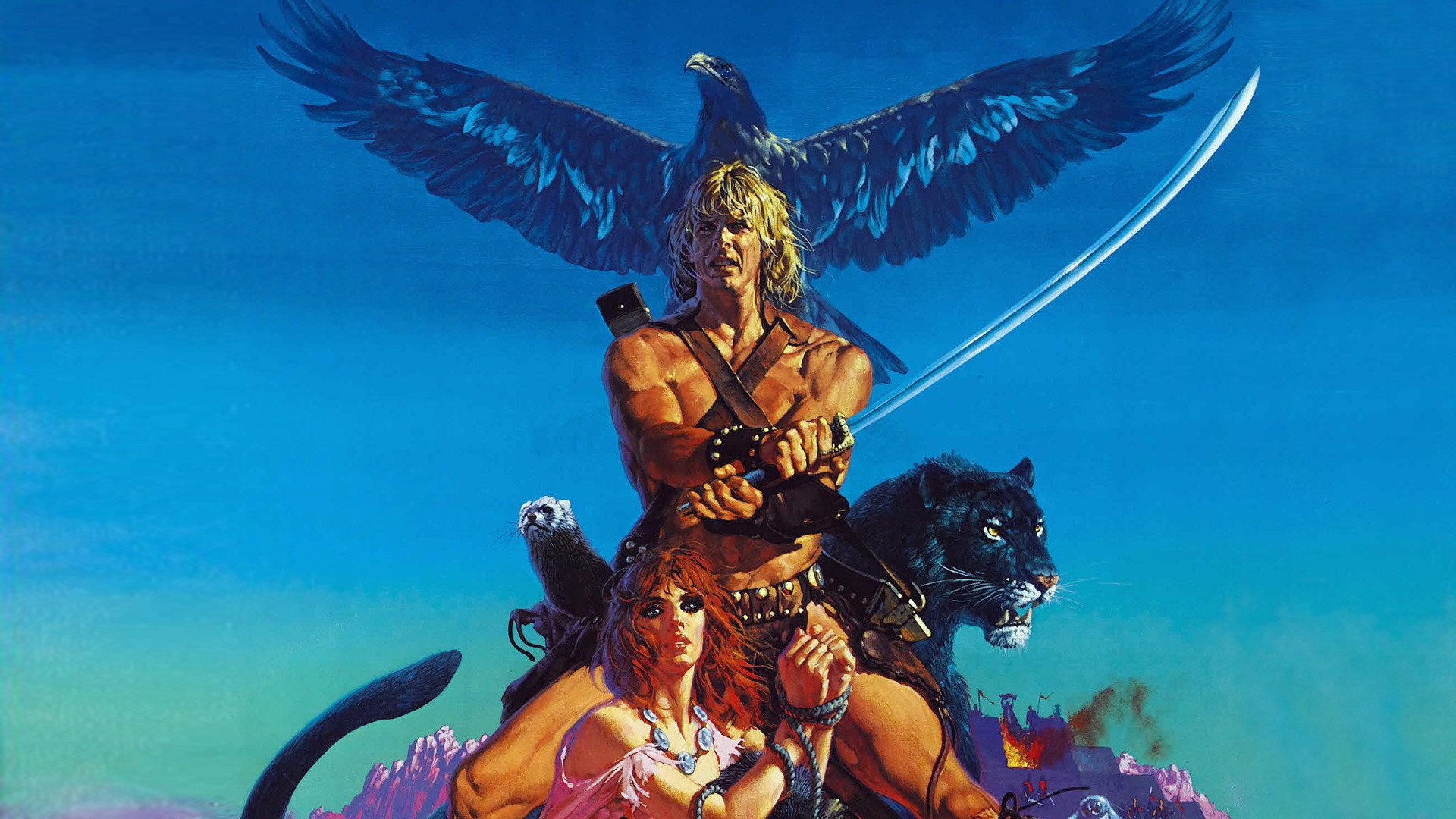 As a child of the 80s, I grew up with the long, lazy summers and a full cable package. We had the whole boat: HBO, Cinemax, Showtime and The Movie Channel. All four of these channels had the Big Movies that would be their major draws… but they still needed to fill out the rest of the 24/7 schedule with whatever they could get. That means there were plenty of weak movies that were played, over and over again. And a lot of the time, I watched those movies, over and over again.
Did I like those movies?
Sometimes yes, sometimes no. A lot of the times they were just on, and so why not? They were the cinematic equivalent of absently eating cold French fries just because they’re on a plate in front of you rather than actual hunger.
It seems like a lot of wasted time in my youth, no? Well, nothing is ever truly wasted if you learned something, right? And you do definitely learn something when you watch the same mediocre movie again and again. Like how to bait your hooks to get someone to watch it.
There’s a joke out there that I like to repeat whenever I can, though I don’t claim originating it, and that’s there was that one summer when HBO stood for, “Hey, Beastmaster’s On.” This joke is utterly, utterly true. I think it was the summer of 1983. Possibly 1984. I’m not sure, but I’m sure I saw Beastmaster many, many times. It, more than any other film, is key to my interest in fantasy as a genre.
For the seven people out there who haven’t seen it, Beastmaster is your basic sword-and-sorcery flick. In fact, by the mid-80s it was one of the few, and possibly best, sword-and-sorcery flick that didn’t involve Conan in it. Hell, I’ll say it’s better than Conan the Barbarian, a movie that will not be featured in this series because I actually find it a chore to sit through. I’ll even go right ahead and say it’s probably the best sword-and-sorcery flick to be made between 1975 and 2000. This is less a statement of its quality and more of the dire state of the genre.
The plot goes basically like this: warrior with animal-talking powers deals out some sword (and tiger) fueled justice on an evil priest. Sounds pretty simple, but there is a crazy amount of crazy going on here.
The movie starts a bronze-age city-state with an evil high-priest and a not-evil king. The high priest Maax (Rip Torn) learns via his prophetic butter-faced witches that the king’s unborn son will be his downfall. So one of these witches, in a totally creepy sequence, sneaks into the royal bedchamber with a cow and magicks the baby out of the queen and into the cow. She then takes the cow a fair distance away, gives it a quick Caesarean and gets ready for some ritualized baby-killing. Unfortunately for her, she’s interrupted by a passing hunter/farmer/whoever who realizes that crazy witch-ladies killing babies is bad, and he kills her and raises the baby as his own son.
So, right there, we’ve got hooks with a classic trope-- a bad guy’s attempt to thwart his destiny sets the stage for his destiny to come into place.
Dar (Marc Singer) grows up in this village with his adopted father, learns he can talk to animals, and then is the only survivor when his village is attacked by the Jun Horde. After this, he spends some time wandering around shirtless, picking up animal friends and killing anyone he meets. Seriously, this whole section of the movie plays like a D&D campaign where the GM is just winging it and throwing random encounters out there. Most of note is the creepy, people-eating bat creatures that leave Dar alone because he has hawk and they worship birds.
Eventually Dar meets a half-naked Tanya Roberts and he decides to follow after her, hooking up with John Amos and a twelve-year-old wearing a diaper. The party having teamed up, they first rescue Tanya Roberts, and then go to rescue the captured king in the city-state. The captured king is, of course, Dar’s actual father, but he doesn’t know this. There’s also a bit where Dar rescues a kid from Maax’s daily sacrifice by having his pet hawk fly the kid away. I have to commend Rip Torn in this bit, because he does the perfect turn on a dime of having a “What the hell just happened?” look on his face to spinning the whole thing to mean MORE sacrifices.
The sequence of rescuing the king from Maax’s temple is fantastic, but for all the wrong reasons. There’s a bit where Tonya Roberts vanishes for a second and comes back in a slightly different outfit, though Dar reacts like she’s now totally decked out in something different. I swear, a significant portion of my 12-year-old brainpower was spent trying to figure out what he’s so startled about. Then there’s Maax’s S&M army: stooges who have their brains melted before encased in spiked leather. There’s literally a whole bit where we’re shown, step-by-step, the S&M Stoogemaking process. This is important later. No, sorry, I mean never.
Anyway, they get out of town with the king, who is a total dick to Dar. Despite this, they all go back to the city to take on Maax, which is kind of a fiasco. Maax kills the king, but then gets killed in a kamikazi attack by one of Dar’s ferrets. A ferret is dead, and it’s very sad. But, hey, they won, all good, right?
Wrong, because the Jun Horde is coming. Why are they coming? I don’t recall it ever being made clear, but I’d like to believe Maax had some sort of Dead Man’s Switch deal with them—like, if he didn’t send up white smoke, they’re supposed to come get their horde on. They do give enough advance notice for Dar to work up a plan.
The plan, I have to admit, is kind of brilliant. The city is surrounded by a moat filled with oil and tar, so Dar and the rest of the town move the bridge back a few meters, cover the moat with dirt, and let the horde plow right into it. This mostly just slows the horde down, but it’s also only Phase I. Phase II? Creepy, people-eating bat-creatures.
It really is just like Anton Chekhov said: if you show people-eating bat-creatures in the first act, they must eat a horde of invaders in the third act.
In the end, the twelve-year-old in the diaper is the new king, which Dar could claim since he’s got the king’s brand on his hand. But he doesn’t want to be king. Instead, Dar goes back off on his travels to nowhere in particular, since he’s a rebel, a loner. But then Tanya Roberts follows him, showing up out of nowhere on the top of a mesa, and they make out. She’s his cousin, but the movie glosses over that for the sake of romance.
Beastmaster spawned a couple off well-after-the-fact direct-to-VHS sequels, as well as a syndicated TV series. None of these are any good.
Lesson I learned from Beastmaster: Practical storytelling applications of Greek drama: namely, the use of prophecy for inevitable fate, and the use of dues ex machina. Deus ex machina, also, can be totally awesome if it takes the form of people-eating bat-creatures.
Monday, March 18, 2013
Worldbuilding: Hard and Soft Imports
In the earliest days of this blog, I talked about my "fantasy manifesto", and part of it was, "Do Not Copy And Paste Cultures". I still believe in that fundamental idea, but the more I've thought about it, the more I think it's about Hard Imports and Soft Imports.
I mean, when building secondary world fantasy, you can't help bringing in certain elements from the real world. There has to be an anchor of some sort for the reader to get a hold of the fantasy world. The only question is, how much do you bring? And more specifically, how much do you bring from any one culture?
This is how I define things, roughly: if you bring a lot, give yourself plenty of well-known aspects for the reader to get a hold of, with recognizable titles and tropes-- in other words, copy-and-paste before you tweak it with your own elements, that's a Hard Import. If you bring only a bit, just enough to give it a familiar sense but not enough to feel like a full copy-and-paste, then that's a Soft Import.
The way I see it, the rule one should live by is this: You get ONE Hard Import. And your Hard Import should be your Viewpoint Culture.
Viewpoint Culture is, of course, the culture of your POV characters. And in fantasy, let's face it, 95% of the time, we're talking about some form of Medieval/Renaissance British/Western European culture. There are some variants-- Scott Lynch brings a certain Venetian flair to his, for example-- but that's typically what fantasists use. I'm not excepting myself either: the British elements* of Druthal are undeniably there, though I've also brought in elements that are distinctly American as well, and I hope that makes for something intriguing in the final mix.
The main point is, with your Hard Import, you're letting familiarity with real world elements and standard tropes do some of your heavy lifting, on the principle that you need a certain amount of heavy lifting done for you to get things moving. Someone once told me that "readers will allow you only one Big Idea"-- in other words, that you're world's basic set-up needs to be describable with a simple high-concept to define it.
So now we have the Soft Imports, and this is where you can really get yourself into trouble. Soft Imports are best where you can see what the influence is, but it's little more than influence. You read it and can say, "OK, this has a Middle Eastern flair" or "This has a Japanese flavor to it". But that's all. Those elements, again, give the reader some grounding of familiarity as building blocks for the worldbuilding that's going to dazzle them. But then you can take it that hint too far, that bit that's too much from our own world's equivalent culture, which will make them shake their head, and possibly even put the book down.
And it can be so little. It can be a single word. Jihad. Pharaoh. Samurai. Something that is too specific, and collapses your house of cards.
This also applies to Hard-and-Soft Imports from other fantasy works. Not to put too fine a point on it, but if you've got Elves and Dwarves and Orcs, well... everything else in your book better be very special.
--
*- One critiquer of the first chapter of an early draft of Holver Alley Crew commented, "I thought it was very British. Very, very British. As in, I'm shocked to learn you're not British."**
**- I did consume a lot of Monty Python and Douglas Adams in formative years, but even with that, I'm not sure what to make of that comment.
I mean, when building secondary world fantasy, you can't help bringing in certain elements from the real world. There has to be an anchor of some sort for the reader to get a hold of the fantasy world. The only question is, how much do you bring? And more specifically, how much do you bring from any one culture?
This is how I define things, roughly: if you bring a lot, give yourself plenty of well-known aspects for the reader to get a hold of, with recognizable titles and tropes-- in other words, copy-and-paste before you tweak it with your own elements, that's a Hard Import. If you bring only a bit, just enough to give it a familiar sense but not enough to feel like a full copy-and-paste, then that's a Soft Import.
The way I see it, the rule one should live by is this: You get ONE Hard Import. And your Hard Import should be your Viewpoint Culture.
Viewpoint Culture is, of course, the culture of your POV characters. And in fantasy, let's face it, 95% of the time, we're talking about some form of Medieval/Renaissance British/Western European culture. There are some variants-- Scott Lynch brings a certain Venetian flair to his, for example-- but that's typically what fantasists use. I'm not excepting myself either: the British elements* of Druthal are undeniably there, though I've also brought in elements that are distinctly American as well, and I hope that makes for something intriguing in the final mix.
The main point is, with your Hard Import, you're letting familiarity with real world elements and standard tropes do some of your heavy lifting, on the principle that you need a certain amount of heavy lifting done for you to get things moving. Someone once told me that "readers will allow you only one Big Idea"-- in other words, that you're world's basic set-up needs to be describable with a simple high-concept to define it.
So now we have the Soft Imports, and this is where you can really get yourself into trouble. Soft Imports are best where you can see what the influence is, but it's little more than influence. You read it and can say, "OK, this has a Middle Eastern flair" or "This has a Japanese flavor to it". But that's all. Those elements, again, give the reader some grounding of familiarity as building blocks for the worldbuilding that's going to dazzle them. But then you can take it that hint too far, that bit that's too much from our own world's equivalent culture, which will make them shake their head, and possibly even put the book down.
And it can be so little. It can be a single word. Jihad. Pharaoh. Samurai. Something that is too specific, and collapses your house of cards.
This also applies to Hard-and-Soft Imports from other fantasy works. Not to put too fine a point on it, but if you've got Elves and Dwarves and Orcs, well... everything else in your book better be very special.
--
*- One critiquer of the first chapter of an early draft of Holver Alley Crew commented, "I thought it was very British. Very, very British. As in, I'm shocked to learn you're not British."**
**- I did consume a lot of Monty Python and Douglas Adams in formative years, but even with that, I'm not sure what to make of that comment.
Thursday, January 17, 2013
Worldbuilding: Complexity in the Political Landscapes
As part of Way of the Shield, I've been delving deeper into the politics of Druthal. In doing so, I'm taking into account the same thing I said about strawmen villains, but taking that to a macro scale. Sure, it would be easy to break the Parliament into two sides, and say, "This side are the right-thinking heroes, and this side are the villainous morons". But then you don't have a story, you have a screed. If a screed is what you want to write, go for it. Didn't hurt Ayn Rand's sales. But that doesn't interest me.
Druthal is a Parliamentary Monarchy, in which I've played some mix-and-match with aspects from traditional monarchies, parliamentary systems and healthy dose of US-style democracy. It's not a perfect system. It's not supposed to be. It's a messy, flawed sausage grind, and that's what I like about it.
The Druth Parliament probably has more in common with the US Senate than, say, the British Parliament.* There are 100 members (Chairs) to the august body, 10 from each of the archduchies. Each Chair serves a 5-year term, with no term limits. Elections are staggered, so every year there are two chairs per archduchy up for re-election. Chairs are ranked by seniority, so the 1st Chair of Acora is the longest-serving member from that archduchy, 2nd Chair of Acora is second-longest, and so on to 10th Chair for the newest member.
Elections are not winner-take-all, since two Chairs are available in any given election. Once votes are counted and illegitimate ones are tossed**, the top two candidates receive the Chairs. Since no candidate needs an actual majority to win a Chair, there are more than two political parties holding Chairs in the Parliament. In fact, there are six.***
Now, in designing these six, it was very important to give each party a valid platform that people can believe in. No one is "wrong".
All of this, of course, is mostly the under-the-surface part of Way of the Shield; I've gotten more infodumpish here than I do in the actual text. The important part, for me, is the shades of grey. There is no these-people-are-right-these-people-are-wrong dichotomies. I have heroes on both sides of the aisle, as it were, and villains as well.
And for me, that makes for a more interesting story.
---
*- This is mostly because I am American, and I'm far more familiar with our government than anyone else's.
**- Most common form of this tends to be people voting for someone ineligible; namely, someone who is already serving and isn't actually up for re-election in that cycle.
***- At least, six that have members in the Parliament.
Druthal is a Parliamentary Monarchy, in which I've played some mix-and-match with aspects from traditional monarchies, parliamentary systems and healthy dose of US-style democracy. It's not a perfect system. It's not supposed to be. It's a messy, flawed sausage grind, and that's what I like about it.
The Druth Parliament probably has more in common with the US Senate than, say, the British Parliament.* There are 100 members (Chairs) to the august body, 10 from each of the archduchies. Each Chair serves a 5-year term, with no term limits. Elections are staggered, so every year there are two chairs per archduchy up for re-election. Chairs are ranked by seniority, so the 1st Chair of Acora is the longest-serving member from that archduchy, 2nd Chair of Acora is second-longest, and so on to 10th Chair for the newest member.
Elections are not winner-take-all, since two Chairs are available in any given election. Once votes are counted and illegitimate ones are tossed**, the top two candidates receive the Chairs. Since no candidate needs an actual majority to win a Chair, there are more than two political parties holding Chairs in the Parliament. In fact, there are six.***
Now, in designing these six, it was very important to give each party a valid platform that people can believe in. No one is "wrong".
- Traditionalists (or "Dishers", colloquially) believe in the fundamental necessity of archduchies (and below that, duchies and baronies) understanding their own needs. They want to maintain and strengthen the local authority of minor nobility; a baron knows his own barony better than anyone else, after all.
- Loyalists ("Crownies") believe that Druthal needs to stand as a united nation, that a strong center, where everyone is given access to the same infrastructure, rights and opportunity raises the whole nation up.
- Free Commerce ("Minties") believe that Druthal grows by trade and business, and by providing the means for commerce to thrive (including secure, easily traveled roads, well-protected sea-routes and minimal taxes and tariffs), the average Druth has the opportunity to succeed on their own merits.
- Ecclesials ("Books") believe in the fundamentals of community and moral centers, and that the grounding the church gives serves the needs of the people, on a local level, far more than any well-meaning directive from the capitol.
- Functionalists ("Frikes") do not hold to specific ideologies of "what is good for Druthal"-- what's good is what works; if it doesn't work, you don't keep grinding at it. They do tend to believe that simple, small steps work better in the long run than grand, sweeping gestures, and that moderation is the key to functionality.
- Populists ("Salties") believe that the people themselves are the backbone of Druthal, and that the core industries of day-to-day living (farming, ranching, mining, fishing, etc.) are the true center that everything is built off of. By helping the people who do those things, all of Druthal is helped.
All of this, of course, is mostly the under-the-surface part of Way of the Shield; I've gotten more infodumpish here than I do in the actual text. The important part, for me, is the shades of grey. There is no these-people-are-right-these-people-are-wrong dichotomies. I have heroes on both sides of the aisle, as it were, and villains as well.
And for me, that makes for a more interesting story.
---
*- This is mostly because I am American, and I'm far more familiar with our government than anyone else's.
**- Most common form of this tends to be people voting for someone ineligible; namely, someone who is already serving and isn't actually up for re-election in that cycle.
***- At least, six that have members in the Parliament.
Thursday, September 27, 2012
Reliability: The Writer's Most Crucial Trait
Back at the ArmadilloCon Writers' Workshop, one piece of advice I felt comfortable dispensing to the crowd of students was about any social media presence they might have. Namely, I said, "If you're going to have a blog, then have a blog." It's advice I live by: I've steadily posted here twice a week for a year and a half, and here I am with my 250th entry. But the reasoning behind my advice is this: if you're going to have a presence online as a writer (and you should, and you should be building it before you really "make a name" for yourself), then make sure your presence is one that shows you as a person who gets stuff done, regularly and systematically.
I know when I've had to research fledgling writers, there's nothing quite as disappointing as finding their blog with only a handful of haphazard entries, like thirteen scattered over the course of a year. Or with a flurry of daily entries for about three weeks, that then tapers off to an unpredictable drip. These things show me that a writer cannot follow through, or that they are incredibly unfocused. If I were a publisher or an agent, and I found that, I would be highly disinclined to sign with such a person, regardless of their talent.
For example, I read a fair amount of media tie-in books as my "popcorn" reading. There is one particularly prolific author in the media tie-in world whose style... I'm not a fan of. But he keeps getting work. Why? I suspect the "prolific" part plays into it. He takes the job and gets it done. You can't deny the appeal of that.
Because when it comes down to it, reliability trumps talent in the business side of things. Not that talent isn't crucial as well, but looking at the business side, which would you rather have: someone who might give you something amazing, but you're not sure when (or if) you'll actually get it, or someone who will make every deadline and deliver something that's acceptable? Not brilliant or earthshattering... but perfectly fine. You need something on the shelves in October, so you want the job done, period.
Of course, ideally, one tries to be brilliant and reliable. Still working on that one.
I know when I've had to research fledgling writers, there's nothing quite as disappointing as finding their blog with only a handful of haphazard entries, like thirteen scattered over the course of a year. Or with a flurry of daily entries for about three weeks, that then tapers off to an unpredictable drip. These things show me that a writer cannot follow through, or that they are incredibly unfocused. If I were a publisher or an agent, and I found that, I would be highly disinclined to sign with such a person, regardless of their talent.
For example, I read a fair amount of media tie-in books as my "popcorn" reading. There is one particularly prolific author in the media tie-in world whose style... I'm not a fan of. But he keeps getting work. Why? I suspect the "prolific" part plays into it. He takes the job and gets it done. You can't deny the appeal of that.
Because when it comes down to it, reliability trumps talent in the business side of things. Not that talent isn't crucial as well, but looking at the business side, which would you rather have: someone who might give you something amazing, but you're not sure when (or if) you'll actually get it, or someone who will make every deadline and deliver something that's acceptable? Not brilliant or earthshattering... but perfectly fine. You need something on the shelves in October, so you want the job done, period.
Of course, ideally, one tries to be brilliant and reliable. Still working on that one.
Thursday, September 13, 2012
The Plotless Meander
"Celeste And Jesse’s script... is shapeless and witless, aiming for an offhandedness in the
interactions that instead comes off as contrived, or sometimes just
bland" - AV Club review of Celeste And Jesse
I'm not specifically going to knock on Celeste and Jesse-- I haven't seen it, and I really have no opinion on it. But the above quote does hit right on the sweet spot of my major complaint with a lot of "independent" film, as well as some of the slush novels and plays I've had the displeasure of reading.
Namely, the tendency to eschew plot structure in favor of a characterization heavy, plotless meander. Three Acts are replaced with Zero Acts. In a novel, this sort of writing is downright excruciating, at least to me.
Now, this can work a bit better on stage or screen, or in short story format. But, frankly, that relies on the character coming through as being so compelling that you don't really care that nothing much actually happens. Frankly, on stage or screen, you have a charismatic actor doing the heavy lifting. In prose of any length, it would rely on the writer's skills... and if they aren't doing plot work, then their character and mood work might not be all that strong either.
Not that I'm not guilty of it myself. Lord knows that the (mercifully trunked) Crown of Druthal was more about characters that I thought were fun to hang around with, and therefore it was worth sailing around on a ship and going to places and having them talk about history and language and NO PLOT REALLY HAPPENS. Well, a plot happens, but it takes a SERIOUS back seat to character and worldbuilding meander. Frankly, I decided first the route I wanted the characters to travel, and then threaded a weak plot to match that route. Not compelling writing. My several failed attempts at space opera (namely, USS Banshee) suffers from the same problem.
So I have to ask, what is the compulsion to write this sort of thing? Is it that we come up with characters and settings that, frankly, we geek out about (again, going back to the "fandom of one" problem) so much that the fact we don't really have a story to tell doesn't dissuade us?
I'm not specifically going to knock on Celeste and Jesse-- I haven't seen it, and I really have no opinion on it. But the above quote does hit right on the sweet spot of my major complaint with a lot of "independent" film, as well as some of the slush novels and plays I've had the displeasure of reading.
Namely, the tendency to eschew plot structure in favor of a characterization heavy, plotless meander. Three Acts are replaced with Zero Acts. In a novel, this sort of writing is downright excruciating, at least to me.
Now, this can work a bit better on stage or screen, or in short story format. But, frankly, that relies on the character coming through as being so compelling that you don't really care that nothing much actually happens. Frankly, on stage or screen, you have a charismatic actor doing the heavy lifting. In prose of any length, it would rely on the writer's skills... and if they aren't doing plot work, then their character and mood work might not be all that strong either.
Not that I'm not guilty of it myself. Lord knows that the (mercifully trunked) Crown of Druthal was more about characters that I thought were fun to hang around with, and therefore it was worth sailing around on a ship and going to places and having them talk about history and language and NO PLOT REALLY HAPPENS. Well, a plot happens, but it takes a SERIOUS back seat to character and worldbuilding meander. Frankly, I decided first the route I wanted the characters to travel, and then threaded a weak plot to match that route. Not compelling writing. My several failed attempts at space opera (namely, USS Banshee) suffers from the same problem.
So I have to ask, what is the compulsion to write this sort of thing? Is it that we come up with characters and settings that, frankly, we geek out about (again, going back to the "fandom of one" problem) so much that the fact we don't really have a story to tell doesn't dissuade us?
Subscribe to:
Posts (Atom)