Earlier this week, I got tagged over on Facebook with that "list ten books that stuck with you" meme, and I listed ten books with little additional commentary, save to note that "stuck with you" does not mean the same thing as "loved".
Here's the list:
1. Watership Down - Richard Adams
2. The Belgariad - David Eddings
3. Jitterbug Perfume - Tom Robbins
4. Hitchhikers' Guide to the Galaxy - Douglas Adams
5. World According to Garp - John Irving
6. Caves of Steel - Isaac Asimov
7. The Green-Sky Trilogy - Zilpha Keatley Snyder
8. Guns, Germs and Steel - Jared Diamond
9. Time Enough For Love - Robert Heinlein
10. ...And Eternity - Piers Anthony
I should note that the first seven are all books I first read between the ages of thirteen and eighteen. I would have a hard time isolating exactly when I read which for most-- I know Green-Sky Trilogy was around seventh grade, Belgariad was the summer I was sixteen-- but they all were formative-reading-years books. And those two-- both series, but the sort of series that are essentially One Big Story-- are the most Traditional Fantasy on this list. Well, Belgariad is traditional fantasy. Green-Sky is more Traditional Fantasy with New Age Sci-Fi hidden inside it like a Russian Nesting Doll.
I've talked before about how Watership Down is one of my favorite books of all time. And this book is really the Fantasy Epic that resonates the most with me. It's sweeping in scope while being deeply personal, and it's filled with worldbuilding top to bottom. The fact that it's a cast of rabbits is almsot incidental. And despite being often labeled as a "children's book"-- mostly because back then a fantasy novel or a novel with a cast of rabbits would never be designated anything else-- it's filled with maturity and complexity. I re-read it every few years and still find new discoveries.
Jitterbug Perfume is also fantasy, but you won't find it on those shelves, mostly because Tom Robbins is Tom Robbins and he's pretty much his own genre. But a story about a man who lives a thousand years, and occasionally hangs out with the god Pan? Yeah, that's a fantasy book. World According to Garp isn't genre at all, save for crafting an alternate history where Jenny Fields is a major political figure, and there's an extreme feminist movement that involves cutting one's own tongue out. But it is a book that's almost entirely character study, really forsaking anything resembling a traditional plot. It takes a special talent to make that engaging, and it was one I attempted to emulate in early versions of trunked novels.
Caves of Steel is here as the standard-bearer for all the Asimov I read, which includes the rest of the Robot books and the Foundation books, and scores of short stories. Caves also stuck with me because it showed me that with sci-fi (and fantasy), a simple plot like a murder mystery can be the gateway into a strongly built world. You can take two cops solving a murder and put it anywhere and have the promise of a good story.
Hitchhikers is just plain fun, and it was definitely an early influence. I think somewhere in a box I have a hand-written start-of-a-novel from my teenage years that was, without any doubt, Hitchhikers with the serial numbers filed off. My one vaguely clever idea in that was that no other civilization in the galaxy had mastered Visine, so having a small bottle in his pocket gave my protagonist a significant amount of wealth on other worlds.
Guns, Germs and Steel I've talked about several times here, and it's the only non-fiction book here. It formed the template for my worldbuilding ideas, beyond simplistic things like, "Here is the psuedo-Europe, here is the psuedo-Arabia, etc...".
And then there are the last two, which "stuck with me" entirely for bad reasons. Both represent authors and/or stories that just went off the rails in such a train-wreck fashion that they actually angered me. And strangely, both of them involve immoral sex and time travel.
...And Eternity is the seventh and sort-of-final* book in his Incarnations of Immortality series, a series that starts relatively strong with In A Pale Horse (or at least did to my teenage self), and wavers up and down before crashing into the ground with this book. There's a lot wrong with it, such as a climax where one character's prophesized "saving the world" from the first book turns out to be casting a deciding vote in the Senate on whether or not God is Dead (and said vote actually removes God, as the Incarnation of Good, from his place so a new person can fill it... it's very strange.) But the real Oh My God What element for me involves one of the main characters: a 15-year-old prostitute, who over the course of the book gets cleaned up and straightened out by two ghosts, and then takes up a romantic relationship with a judge. Yes, a fifteen-year-old-girl and a judge. But he justifies what he's doing to himself because the fifteen-year-old girl essentially time-travelled ahead four years. So even though he knows she's only fifteen, on paper she's nineteen, so he decides what he's doing is fine.
Time Enough For Love has a different kind of skeezy. There you have two-thousand-year-old Lazarus Long in the 41st century, more or less ready to finally give up and die, because he's done everything he can do, so what else is there? What else is there? Why, there's new theories that might make time travel practical, for one! Once Lazarus learns this, he's got a new spring in his step. He's back to being alive and vital, so he can finally cross the final frontier: going back in time to seduce his own mother. The last third of the book is entirely about that.
So those last two books had a valuable lesson: Writers can let you down, and hard.
--
*- In that Anthony wrote an eighth book many years later, which I never read, but I'm given to understand it doesn't so much continue the story as shade in more background detail.
Showing posts with label books. Show all posts
Showing posts with label books. Show all posts
Monday, September 8, 2014


Monday, June 30, 2014
Picking Up the Gauntlet
So because of my post last week, I received a lot of spirited defenses of self/indy publishing, many of which struck me as missing the central point I was making: that agents and editors dig through a lot of crap to find the things they publish. Several people argued that "people aren't waiting for publishers to tell them what to read, they're listening to reviews and recommendations from friends." What this fails to recognize is that traditional publication is, in essence, a powerful form of recommendation: someone said, "I think this book is so worth reading, I'm financially backing it."
So powerful that many reviewers and sellers take notice. It is on that recommendation that most reviewers will accept the book to read. (Most will not review self/indy books.) It is on that recommendation that the sellers-- bookstores-- agree to stock it. (Many will not stock self/indy books.) And the individual people who work there will give their personal opinions to the customers.
So don't tell me that no one is listening to publishers for recommendation, because that is literally what the traditional model is.
The other argument I heard boiled down to, "Thanks to indy/self publishing, so many amazing books that wouldn't have seen the light of day are now available. Readers can decide for themselves."
This may well be true.
I'm game. I'd like to know what some of these amazing books are. So, I'd like to hear some recommendations.
But wait! I've got some rules.
1. You can't recommend your own book. The main reason for this is I think recommending your own book undermines the point of "so many amazing books are now available". If you just tell me about your own book, what you're telling me is that you don't really care about all those amazing books, other than in the abstract sense of how promoting the idea helps your own book. You're not telling me how indy/self helps readers "decide for themselves", you're telling me how indy/self helps writers sell their books. If the system really is for the benefit for the readers, I want to know how it benefited you as a reader.
2. No recommendations that started indy/self and then were picked up by a traditional publisher. Because they've already received that recommendation bump. I can find them in the traditional market, even if their path there wasn't entirely traditional. Recommend something that I can't find on the traditional market.
So let's hear some recommendations! Put my money where your mouth is.
So powerful that many reviewers and sellers take notice. It is on that recommendation that most reviewers will accept the book to read. (Most will not review self/indy books.) It is on that recommendation that the sellers-- bookstores-- agree to stock it. (Many will not stock self/indy books.) And the individual people who work there will give their personal opinions to the customers.
So don't tell me that no one is listening to publishers for recommendation, because that is literally what the traditional model is.
The other argument I heard boiled down to, "Thanks to indy/self publishing, so many amazing books that wouldn't have seen the light of day are now available. Readers can decide for themselves."
This may well be true.
I'm game. I'd like to know what some of these amazing books are. So, I'd like to hear some recommendations.
But wait! I've got some rules.
1. You can't recommend your own book. The main reason for this is I think recommending your own book undermines the point of "so many amazing books are now available". If you just tell me about your own book, what you're telling me is that you don't really care about all those amazing books, other than in the abstract sense of how promoting the idea helps your own book. You're not telling me how indy/self helps readers "decide for themselves", you're telling me how indy/self helps writers sell their books. If the system really is for the benefit for the readers, I want to know how it benefited you as a reader.
2. No recommendations that started indy/self and then were picked up by a traditional publisher. Because they've already received that recommendation bump. I can find them in the traditional market, even if their path there wasn't entirely traditional. Recommend something that I can't find on the traditional market.
So let's hear some recommendations! Put my money where your mouth is.
Monday, December 31, 2012
Goals for the Coming Year
So, from my clock, 2012 has a mere 13 hours and change left to it. 2013 is coming, so its high time to set some unrealistic goals for the year:
1. Book deals for Thorn of Dentonhill, Holver Alley Crew, and Maradaine Constabulary. If we're really aiming pie-in-the-sky, this deal will involve the same publisher and all three at once. That would be very nice, indeed, Universe. But in the case of all three, I think I've really done what I can do, and it's past time to be focused on the Next Project.
2. Finish Rough Draft of Way of the Shield. I should have finished this last year, but between various rewrites of the other three, a hectic summer and a few other things on my plate, it didn't come together. Part of that was due to a flawed outline, which I think I've got a handle on now. I understand why it wasn't working, which is a big hurdle to clear. Time to drive it forward.
3. Finish Rough Draft of Banshee. This is a project that's gone through significant conceptual changes over the years (you may notice that it's no longer USS Banshee, which is one major shift), but I've finally found an angle that combines character, plot and worldbuilding in a way that works pretty well, at least so far.
4. Attend my first Worldcon. It's in San Antonio, it's literally taking the place of ArmadilloCon this year, so it's what I'm doing. Hopefully I'll have something good to do there. (See point 1)
5. Have a good reason to start second books of Thorn, Holver Alley or Constabulary. See point 1.
6. Hash out some of these random ideas into usable outlines. Because if I accomplish 2 & 3 before I accomplish 1, I'll have no good reason to do 5. So I'll need a new "new project", as it were.
7. Never give up. But this one's a given.
1. Book deals for Thorn of Dentonhill, Holver Alley Crew, and Maradaine Constabulary. If we're really aiming pie-in-the-sky, this deal will involve the same publisher and all three at once. That would be very nice, indeed, Universe. But in the case of all three, I think I've really done what I can do, and it's past time to be focused on the Next Project.
2. Finish Rough Draft of Way of the Shield. I should have finished this last year, but between various rewrites of the other three, a hectic summer and a few other things on my plate, it didn't come together. Part of that was due to a flawed outline, which I think I've got a handle on now. I understand why it wasn't working, which is a big hurdle to clear. Time to drive it forward.
3. Finish Rough Draft of Banshee. This is a project that's gone through significant conceptual changes over the years (you may notice that it's no longer USS Banshee, which is one major shift), but I've finally found an angle that combines character, plot and worldbuilding in a way that works pretty well, at least so far.
4. Attend my first Worldcon. It's in San Antonio, it's literally taking the place of ArmadilloCon this year, so it's what I'm doing. Hopefully I'll have something good to do there. (See point 1)
5. Have a good reason to start second books of Thorn, Holver Alley or Constabulary. See point 1.
6. Hash out some of these random ideas into usable outlines. Because if I accomplish 2 & 3 before I accomplish 1, I'll have no good reason to do 5. So I'll need a new "new project", as it were.
7. Never give up. But this one's a given.
Thursday, November 22, 2012
Thanksgiving Quick Post
Happy Thanksgiving, all. I've got pies and stuffing and turkey to make*, so I won't go on for too long on this post**. I had considered just linking to some past posts, like on worldbuilding holidays or food details. But I didn't want to be quite that lazy.
So: state of the writer, thankfulness version.
First and foremost, I'm thankful for by amazing wife, whose love and support have kept me going through this journey. She's put up with the many, many times I've stayed awake into the wee hours or sequestered myself with headphones on and nose in the computer, accepted the fact that my head is quite literally in some other world half the time, and has kept the fire under my feet when I get distracted. She's willing for me to not only have giant maps printed, but to have them framed and hung in our studio. Thanks to her I've got three novels*** in my agent's hands, and more on the way.
Second, my agent. It's hard to quantify what an agent does for someone, but in the time we've been together, he's been a source of support, as well as inspiration. He's pushed those three books into being better than they were without him. He's regularly plugged this very blog. He's working for me, and he doesn't make a dime from me until we have a sale. And when we do, you damn well better believe he's earned his percentage. I sure do.
I'm thankful for my health and my energy, and that I've had the ability and freedom to keep working like I have been. I'm thankful that I've just finished a draft of a short story, and wrote another short play last week. I'm thankful that I have more ideas than I know what to do with. Novels are cooking and brewing in this brain, and I have every intention of continuing to crank them out.
I'm thankful for all the people who've given help and advice over the past year and more-- from my mentor and friend Stina Leicht to my worldbuilding brainstorming partner Dan Fawcett to the café manager who doesn't charge me every once in a while because she likes supporting writers. Too many people to name. Besides, that's what the acknowledgement page of books are for, right?
All right, time to hit the kitchen, folks. Have a good one.
___
*- I'm a traditionalist, but that ties to my roots as a worldbuilder and an amateur food historian. Turkey, potatoes & corn are all native foods to the Americas. That's important, in my mind. That's why desert is a chocolate pecan pie.
**- I swear, half the times I say that, I end up writing twice as much as a normal post.
***- And two trunked ones. I don't think anything tests the patience of a writer's spouse quite like a trunk novel.
So: state of the writer, thankfulness version.
First and foremost, I'm thankful for by amazing wife, whose love and support have kept me going through this journey. She's put up with the many, many times I've stayed awake into the wee hours or sequestered myself with headphones on and nose in the computer, accepted the fact that my head is quite literally in some other world half the time, and has kept the fire under my feet when I get distracted. She's willing for me to not only have giant maps printed, but to have them framed and hung in our studio. Thanks to her I've got three novels*** in my agent's hands, and more on the way.
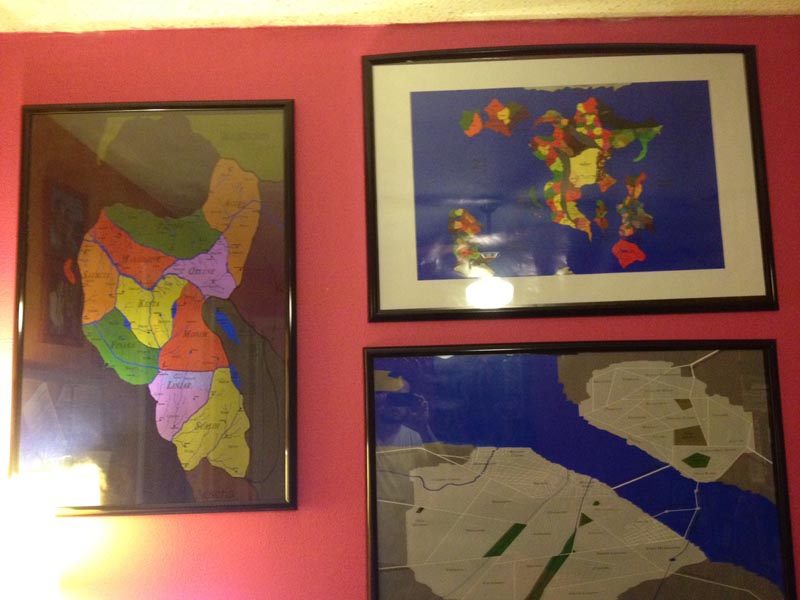
Second, my agent. It's hard to quantify what an agent does for someone, but in the time we've been together, he's been a source of support, as well as inspiration. He's pushed those three books into being better than they were without him. He's regularly plugged this very blog. He's working for me, and he doesn't make a dime from me until we have a sale. And when we do, you damn well better believe he's earned his percentage. I sure do.
I'm thankful for my health and my energy, and that I've had the ability and freedom to keep working like I have been. I'm thankful that I've just finished a draft of a short story, and wrote another short play last week. I'm thankful that I have more ideas than I know what to do with. Novels are cooking and brewing in this brain, and I have every intention of continuing to crank them out.
I'm thankful for all the people who've given help and advice over the past year and more-- from my mentor and friend Stina Leicht to my worldbuilding brainstorming partner Dan Fawcett to the café manager who doesn't charge me every once in a while because she likes supporting writers. Too many people to name. Besides, that's what the acknowledgement page of books are for, right?
All right, time to hit the kitchen, folks. Have a good one.
___
*- I'm a traditionalist, but that ties to my roots as a worldbuilder and an amateur food historian. Turkey, potatoes & corn are all native foods to the Americas. That's important, in my mind. That's why desert is a chocolate pecan pie.
**- I swear, half the times I say that, I end up writing twice as much as a normal post.
***- And two trunked ones. I don't think anything tests the patience of a writer's spouse quite like a trunk novel.
Thursday, October 11, 2012
Next Big Thing
Rebecca Schwartz tagged me in her Next Big Thing entry. So here are my answers:
1. What is the title of your Work in Progress?
It's called The Way of the Shield, though the title itself is a work in progress. I've also got a short story brewing that, right now, I'm calling "Hard Vacuum Coyote", but that's still in its nascent stages.
2. Where did the idea come from for the book?
That's actually a complex question. The main drive of it was to explore a place where traditional fantasy-- kings and knights in armor and such-- and modern, complex social structure overlap and clash. There is an old order of traditional warriors, and young men who still want to be a part of it-- but in a setting that has more in common with 19th Century London or Boston. What role can that old order have-- as well as the traditional nobility-- in a society with a standing army, city constabulary and elected officials?
3. What genre does your book fall under?
It's fantasy, though I'm not sure of the subgenre. Political/action fantasy?
4. Which actors would you choose to play your characters in a movie rendition?
You know, I never like thinking in terms of actors-- certainly not famous ones. Because more often than not, the best choice is someone who doesn't bring too much baggage to the table. I mean, if you asked Suzanne Collins when she was writing Hunger Games, I doubt she would have even been aware of Jennifer Lawrence.
(That said, at 6'3" with a puppy-dog honest face, Liam Hemsworth from Hunger Games wouldn't be a terrible match for Dayne.)
5. What is a one-sentence synopsis of the book?
Disgraced warrior returns home to find himself neck-deep in political scandal, assassination plots and revolution.
6. Will your book be self-published or represented by an agency?
Agency.
7. How long did it take you to write the first draft of the manuscript?
Again, a complicated question. I first conceived of the book back in 2008-- when I also came up with Thorn of Dentonhill, Holver Alley Crew and Maradaine Constabulary. All four are in the same setting, but as separate "book one of a series" concepts. I wrote Thorn first, with the idea that I would do Shield second. But then Holver Alley felt right as the second, and the Constabulary as the third, with Shield getting pushed back each time. I didn't get properly started on it until March 2012, and even then, it's been in fits and starts, as other things (such as minor rewrites of the other three) took some of my attention. But it's still being drafted, hopefully finishing the rough draft by the end of the year.
8. What other books would you compare this story to in your genre?
I'm not sure. In genre, the closest thing I can think of would be David Eddings's The Elenium-- for the knightly orders and the politics. But there are a lot of out-of-genre influences, so it ends up being the small junction in a Venn diagram of The Elenium, Les Miserables and The Pelican Brief. That's a strange combination. I'm sure there's a spot-on in-genre comparison that I'm ignorant of.
9. Who or what inspired you to write this book?
Daniel J. Fawcett has been my long-term brainstorming partner, and so a great deal of my inspiration comes from hashing out core ideas of the fantasy genre and worldbuilding with him. Pure and simple, the city of Maradaine (and the rest of the world around it), as well as the characters that inhabit it in all four books, would not be what they are without his input and influence.
10. What else about your book might pique the reader’s interest?
I'm challenging myself on this one with my first attempt at a solid romantic subplot. So if that's the sort of thing you need in your fantasy books, it'll be there. But if you need guys with swords hitting each other, there's that as well.
1. What is the title of your Work in Progress?
It's called The Way of the Shield, though the title itself is a work in progress. I've also got a short story brewing that, right now, I'm calling "Hard Vacuum Coyote", but that's still in its nascent stages.
2. Where did the idea come from for the book?
That's actually a complex question. The main drive of it was to explore a place where traditional fantasy-- kings and knights in armor and such-- and modern, complex social structure overlap and clash. There is an old order of traditional warriors, and young men who still want to be a part of it-- but in a setting that has more in common with 19th Century London or Boston. What role can that old order have-- as well as the traditional nobility-- in a society with a standing army, city constabulary and elected officials?
3. What genre does your book fall under?
It's fantasy, though I'm not sure of the subgenre. Political/action fantasy?
4. Which actors would you choose to play your characters in a movie rendition?
You know, I never like thinking in terms of actors-- certainly not famous ones. Because more often than not, the best choice is someone who doesn't bring too much baggage to the table. I mean, if you asked Suzanne Collins when she was writing Hunger Games, I doubt she would have even been aware of Jennifer Lawrence.
(That said, at 6'3" with a puppy-dog honest face, Liam Hemsworth from Hunger Games wouldn't be a terrible match for Dayne.)
5. What is a one-sentence synopsis of the book?
Disgraced warrior returns home to find himself neck-deep in political scandal, assassination plots and revolution.
6. Will your book be self-published or represented by an agency?
Agency.
7. How long did it take you to write the first draft of the manuscript?
Again, a complicated question. I first conceived of the book back in 2008-- when I also came up with Thorn of Dentonhill, Holver Alley Crew and Maradaine Constabulary. All four are in the same setting, but as separate "book one of a series" concepts. I wrote Thorn first, with the idea that I would do Shield second. But then Holver Alley felt right as the second, and the Constabulary as the third, with Shield getting pushed back each time. I didn't get properly started on it until March 2012, and even then, it's been in fits and starts, as other things (such as minor rewrites of the other three) took some of my attention. But it's still being drafted, hopefully finishing the rough draft by the end of the year.
8. What other books would you compare this story to in your genre?
I'm not sure. In genre, the closest thing I can think of would be David Eddings's The Elenium-- for the knightly orders and the politics. But there are a lot of out-of-genre influences, so it ends up being the small junction in a Venn diagram of The Elenium, Les Miserables and The Pelican Brief. That's a strange combination. I'm sure there's a spot-on in-genre comparison that I'm ignorant of.
9. Who or what inspired you to write this book?
Daniel J. Fawcett has been my long-term brainstorming partner, and so a great deal of my inspiration comes from hashing out core ideas of the fantasy genre and worldbuilding with him. Pure and simple, the city of Maradaine (and the rest of the world around it), as well as the characters that inhabit it in all four books, would not be what they are without his input and influence.
10. What else about your book might pique the reader’s interest?
I'm challenging myself on this one with my first attempt at a solid romantic subplot. So if that's the sort of thing you need in your fantasy books, it'll be there. But if you need guys with swords hitting each other, there's that as well.
Thursday, May 3, 2012
Reading Report: Kingdoms of Dust by Amanda Downum
Disclaimer: Amanda Downum is a friend and a critique partner. So this won't be an "objective" review. It's probably not even really a review.
---
 Kingdoms of Dust by Amanda Downum
This is the third book in Amanda's Necromancer Chronicles (the first two being The Drowning City and The Bone Palace). Of the three, Bone Palace is probably my favorite. But Kingdoms is a close second.
One of the things I really admire about the Necromancer Chronicles is how Amanda has pulled off displaying her worldbuilding without having it feel like a "travelogue" sort of series. Drowning takess place in Symir, which has a fantasy southeast Asia feel, Palace in Erisín, which is more western/northern Europe in flavor, and then Kingdoms is in Assar, which has a Middle Eastern bent. But one thing that is crucial is none it comes off as a cheap copy-and-paste of those Earth cultures... just familiar enough to give a sense of bearing. But more importantly, since the Necromancer Chronicles are so grounded in the character of Isyllt Iskaldur, the movements from place to place feel organic and natural. Isyllt is a spy, after all, and in Drowning she's away on a mission, in Palace she's back home, and in Kingdoms she's abroad again due to the fallout of events in Palace. And despite the chronological progression, each book stands nicely on its own as a singular adventure.
Kingdoms more or less opens up with some "getting the band back together" of characters from Drowning-- there's only one secondary character from Palace that carries over-- while setting up the stakes for this book.
I love how Isyllt is kind of self-loathing and messed-up, but without it just being telegraphed that she is self-loathing and messed-up, or having that be her defining characteristics. She's a straight-up hero in my book, but part of her heroism comes from her own self-loathing. She's the kind of hero that is presented with Bad Choice A and Bad Choice B, and through her own ingenuity comes up with Bad Choice C, which gives more solution than A or B, and most of the bad falls on her shoulders.
My one complaint is the character of Moth, who carries over from Palace as Isyllt's new apprentice. For the first half of the book, she's there mostly as furniture, mentioned in passing as usually out doing her own thing. The second half has Moth suddenly becoming active, but mostly complaining that Isyllt doesn't pay any attention to her. For me, it came out of left field. Though Moth is the one key character who, unless I'm mistaken, we never get a point-of-view from. A better sense of her perspective in the first half would have given her complaints in the back half more weight.
All in all, a fun, enjoyable read.
---

This is the third book in Amanda's Necromancer Chronicles (the first two being The Drowning City and The Bone Palace). Of the three, Bone Palace is probably my favorite. But Kingdoms is a close second.
One of the things I really admire about the Necromancer Chronicles is how Amanda has pulled off displaying her worldbuilding without having it feel like a "travelogue" sort of series. Drowning takess place in Symir, which has a fantasy southeast Asia feel, Palace in Erisín, which is more western/northern Europe in flavor, and then Kingdoms is in Assar, which has a Middle Eastern bent. But one thing that is crucial is none it comes off as a cheap copy-and-paste of those Earth cultures... just familiar enough to give a sense of bearing. But more importantly, since the Necromancer Chronicles are so grounded in the character of Isyllt Iskaldur, the movements from place to place feel organic and natural. Isyllt is a spy, after all, and in Drowning she's away on a mission, in Palace she's back home, and in Kingdoms she's abroad again due to the fallout of events in Palace. And despite the chronological progression, each book stands nicely on its own as a singular adventure.
Kingdoms more or less opens up with some "getting the band back together" of characters from Drowning-- there's only one secondary character from Palace that carries over-- while setting up the stakes for this book.
I love how Isyllt is kind of self-loathing and messed-up, but without it just being telegraphed that she is self-loathing and messed-up, or having that be her defining characteristics. She's a straight-up hero in my book, but part of her heroism comes from her own self-loathing. She's the kind of hero that is presented with Bad Choice A and Bad Choice B, and through her own ingenuity comes up with Bad Choice C, which gives more solution than A or B, and most of the bad falls on her shoulders.
My one complaint is the character of Moth, who carries over from Palace as Isyllt's new apprentice. For the first half of the book, she's there mostly as furniture, mentioned in passing as usually out doing her own thing. The second half has Moth suddenly becoming active, but mostly complaining that Isyllt doesn't pay any attention to her. For me, it came out of left field. Though Moth is the one key character who, unless I'm mistaken, we never get a point-of-view from. A better sense of her perspective in the first half would have given her complaints in the back half more weight.
All in all, a fun, enjoyable read.
Monday, April 23, 2012
Nothing In, Nothing Out: I'm Not Reading Enough
Back when I did the DFW Writer's Conference last year, the keynote speaker said, in part of her keynote speech, "Stephen King reads four hours a day and writes four hours a day. That's fundamental"* The quote got posted to Twitter, and then retweeted like crazy until it reached the level of public consciousness that my wife** quoted it back to me. Of course, upon hearing this, many complained that they, unlike the esteemed Mr. King, do not have eight hours a day to devote to their craft. This misses the point: it's not the total hours, it's the ratio.
Of late, my ratio has been off. Very off, and I think that it's had an impact on writing the rough draft of Way of the Shield. It's not quite writers' block, but it is a sort of slow-as-molasses drip of words that isn't coming as easily as I would think it ought to be.
And I think the problem is I simply haven't been reading like I should. The Writer Brain is a hungry beast, and if nothing goes in, nothing comes out. I've been justifying this to myself in saying that I haven't had time to read, but I know that's really not true. The truth is I hadn't managed my time of late to make reading a priority.
That's got to change.
So I went to my bookshelf and took down all the books on my ever-growing shortlist. Here it is, in no particular order***:

So, starting with Kingdoms, which I'm about a third of the way through, I'm going to devote the next few weeks to reading all of these. I'm going to TRY to read one a week, and write about each one here.
Because, when it comes down to it, being a better reader makes one a better writer. I'm kind of amazed when I hear people say they want to write a book, but when pressed they basically will tell you they don't read at all. AT ALL. It shocks me.
If anyone has suggestions about reading order (in other words, what I tackle after Kingdoms), I'm all ears.
---
*- I cannot comment on whether the quote is accurate of Mr. King's actual habits.
**- My wife is relatively off-the-grid, and certainly not connected to the writerly blogosphere. If something viral reaches her, it mean it's gone airborne.
***- The order is pretty much "Order I grabbed them off the shelf and made into a pile".
Of late, my ratio has been off. Very off, and I think that it's had an impact on writing the rough draft of Way of the Shield. It's not quite writers' block, but it is a sort of slow-as-molasses drip of words that isn't coming as easily as I would think it ought to be.
And I think the problem is I simply haven't been reading like I should. The Writer Brain is a hungry beast, and if nothing goes in, nothing comes out. I've been justifying this to myself in saying that I haven't had time to read, but I know that's really not true. The truth is I hadn't managed my time of late to make reading a priority.
That's got to change.
So I went to my bookshelf and took down all the books on my ever-growing shortlist. Here it is, in no particular order***:

- Kingdoms of Dust by Amanda Downum
- The Wizard Hunters by Martha Wells
- Perdido Street Station by China Meiville
- Among Thieves by Douglas Hulick
- Palimpsest by Catherine M. Valente
- The Windup Girl by Paolo Bacigalupi
- And Blue Skies from Pain by Stina Leicht
- Blood of Ambrose by James Enge
- Boneshaker by Cherie Priest
- Shadow's Master by John Sprunk
- Throne of the Crescent Moon by Saladin Ahmed
- Ink and Steel by Elizabeth Bear
So, starting with Kingdoms, which I'm about a third of the way through, I'm going to devote the next few weeks to reading all of these. I'm going to TRY to read one a week, and write about each one here.
Because, when it comes down to it, being a better reader makes one a better writer. I'm kind of amazed when I hear people say they want to write a book, but when pressed they basically will tell you they don't read at all. AT ALL. It shocks me.
If anyone has suggestions about reading order (in other words, what I tackle after Kingdoms), I'm all ears.
---
*- I cannot comment on whether the quote is accurate of Mr. King's actual habits.
**- My wife is relatively off-the-grid, and certainly not connected to the writerly blogosphere. If something viral reaches her, it mean it's gone airborne.
***- The order is pretty much "Order I grabbed them off the shelf and made into a pile".
Thursday, January 26, 2012
Using Structure to Best Effect
Like I've always said, I'm a planner and an outliner. I can't just wing my way through a novel.I need my big picture.
Part of having that big picture outlook is knowing what the meat and bones of the story are ahead of time. The dressing, the sinew, the sauce (depending on which metaphor you feel like using), that always comes out in the writing itself. Sometimes on the second draft. (Case in point, in the currently-wrapping-up Maradaine Constabulary, I've found Minox's whole extended family, something that didn't exist before. Taking him out of the standard 'loner' trope has had some interesting effects.)
But a problem I've run into, almost every time, is that desire to write those "meat and bones" scenes, making it something of a challenge to write those "sinewy tissue" scenes, that are just as necessary. Each time, on Thorn, on Holver Alley, and on Maradaine Constabulary, I reached a point where, in frustration, I would write a [SCENE ABOUT THIS] notation and move ahead.
And that's fine. I think every writer needs to learn their own particular process, and accept how they work it. It took me a while to realize I had to be a planner. I had many, many crash-and-burns romanticizing the "just write and see where it takes me" method. It doesn't work for me.
(If that works for you, excellent. I'm not knocking on any one person's methods. If your methods work for you, then continue with what works. Though I think people should always analyze whether something REALLY works for them, or they just THINK it does.)
Anyhow, I've now accepted that simply writing straight through in a linear way doesn't work for me. I need to satisfy those urges to write the big tentpole sequences that hold the story up, and then use the ropes and canvas to hold it all together.
(I'm just throwing all sorts of metaphors around, aren't I?)
So, this is the experiment with Way of the Shield. It'll also be my first attempt at writing a novel entirely on Scrivener. Scrivener, of course, it's quite useful in non-linear writing. Scenes can be written individually, and then assembled in the desired order, new scenes stuck in-between, and so forth. I believe that this will yield faster results, as my finish-by goal for the rough draft is May 15th.
Down to the word mines I go.
Part of having that big picture outlook is knowing what the meat and bones of the story are ahead of time. The dressing, the sinew, the sauce (depending on which metaphor you feel like using), that always comes out in the writing itself. Sometimes on the second draft. (Case in point, in the currently-wrapping-up Maradaine Constabulary, I've found Minox's whole extended family, something that didn't exist before. Taking him out of the standard 'loner' trope has had some interesting effects.)
But a problem I've run into, almost every time, is that desire to write those "meat and bones" scenes, making it something of a challenge to write those "sinewy tissue" scenes, that are just as necessary. Each time, on Thorn, on Holver Alley, and on Maradaine Constabulary, I reached a point where, in frustration, I would write a [SCENE ABOUT THIS] notation and move ahead.
And that's fine. I think every writer needs to learn their own particular process, and accept how they work it. It took me a while to realize I had to be a planner. I had many, many crash-and-burns romanticizing the "just write and see where it takes me" method. It doesn't work for me.
(If that works for you, excellent. I'm not knocking on any one person's methods. If your methods work for you, then continue with what works. Though I think people should always analyze whether something REALLY works for them, or they just THINK it does.)
Anyhow, I've now accepted that simply writing straight through in a linear way doesn't work for me. I need to satisfy those urges to write the big tentpole sequences that hold the story up, and then use the ropes and canvas to hold it all together.
(I'm just throwing all sorts of metaphors around, aren't I?)
So, this is the experiment with Way of the Shield. It'll also be my first attempt at writing a novel entirely on Scrivener. Scrivener, of course, it's quite useful in non-linear writing. Scenes can be written individually, and then assembled in the desired order, new scenes stuck in-between, and so forth. I believe that this will yield faster results, as my finish-by goal for the rough draft is May 15th.
Down to the word mines I go.
Monday, January 16, 2012
Fantasy Tropes: The Gentleman Thief
Right now my fiction-reading* is Among Thieves by Douglas Hulick, which I had heard from several sources as being the best fantasy book from a debut author in 2011. So far, I'm enjoying it, but it is definitely a cozy walk down some familiar road. The worldbuilding aspects are a bit more info-dumpish than I care for, but certainly workable-- especially given a first-person narrator that has an interest in history. But on the whole, it's an underworld romp with a thief-hero that does what it says on the tin.
I have to admit, I'm kind of fascinated by how common the thief-hero is in the fantasy genre. We have tons of them. Gray Mouser in Leiber. Prince Kheldar in Eddings. Vlad Taltos in Brust. Locke Lamora in Lynch. You could even make the argument for Bilbo Baggins as a thief-hero.
I'm not immune to it myself. Veranix in Thorn of Dentonhill certainly has thief-hero qualities, and Asti and Verci Rynax, as well as the rest of the Holver Alley Crew, are thief-heroes as well. In both cases, I at least try and subvert the trope a bit. Neither Veranix or the Rynax brothers are just work-a-day thieves in the guild. (It's always a guild, isn't it?) Not to say that's all other writers are doing, but that is the common trope, to the point that Pratchett specifically mocks it in Discworld.
But what is it about the charming scofflaw that appeals to us, as readers? Do we just love the bad boy? I don't think it is quite that simple. We (by which I mean audiences in general) do love to see an underdog win, especially if he does it in a fun way. Heist movies, of course, have the same appeal. We love to see someone beat the system by being clever.
But it's always a tricky balance to walk-- you want your thief-hero to do bad things, but never so far that you can't call him a hero. That's my hiccup with Hulick's book so far-- his main character starts out torturing someone for information. It's a bit hard to get on someone's side when that's how you first see him.
Any favorite thief-heroes that I didn't mention?
___________
*- At any given time, I'm probably reading three different things: one fiction (Among Thieves), one non-fiction (The Edible History of Humanity) and one for-critique for a fellow writer (Elle Ven Hensbergen's latest, for which writing up my comments is on this week's to-do list).
I have to admit, I'm kind of fascinated by how common the thief-hero is in the fantasy genre. We have tons of them. Gray Mouser in Leiber. Prince Kheldar in Eddings. Vlad Taltos in Brust. Locke Lamora in Lynch. You could even make the argument for Bilbo Baggins as a thief-hero.
I'm not immune to it myself. Veranix in Thorn of Dentonhill certainly has thief-hero qualities, and Asti and Verci Rynax, as well as the rest of the Holver Alley Crew, are thief-heroes as well. In both cases, I at least try and subvert the trope a bit. Neither Veranix or the Rynax brothers are just work-a-day thieves in the guild. (It's always a guild, isn't it?) Not to say that's all other writers are doing, but that is the common trope, to the point that Pratchett specifically mocks it in Discworld.
But what is it about the charming scofflaw that appeals to us, as readers? Do we just love the bad boy? I don't think it is quite that simple. We (by which I mean audiences in general) do love to see an underdog win, especially if he does it in a fun way. Heist movies, of course, have the same appeal. We love to see someone beat the system by being clever.
But it's always a tricky balance to walk-- you want your thief-hero to do bad things, but never so far that you can't call him a hero. That's my hiccup with Hulick's book so far-- his main character starts out torturing someone for information. It's a bit hard to get on someone's side when that's how you first see him.
Any favorite thief-heroes that I didn't mention?
___________
*- At any given time, I'm probably reading three different things: one fiction (Among Thieves), one non-fiction (The Edible History of Humanity) and one for-critique for a fellow writer (Elle Ven Hensbergen's latest, for which writing up my comments is on this week's to-do list).
Monday, August 8, 2011
And now some things I didn't vote for
Last week I talked about what I voted on for NPR's top 100 SF/F novels of all time. Voting is now closed, but the winners haven't been announced yet.
So I thought I'd talk about some specific things I didn't vote for. Of course, books that I never read I wouldn't count. This is stuff that I've read and strongly felt shouldn't be on such a list.
The Incarnations Of Immortality Series, by Piers Anthony: I was shocked to see this on the voting. I mean, the first book of the series, On a Pale Horse, is solid and interesting. But each subsequent book falls further and further apart, to the point that the "crucial choice" Luna will make that is hinted at in the first book turns out to be a vote in the US Senate declaring that God is Dead. Because what the Senate votes on has actual, binding affects on the Almighty in this series. Add in the level of virginity-fetish Anthony has with most of his female characters and a bit where statutory rape is justified with time travel ("We've moved four years into the future, so legally you're nineteen now!") and the interesting things early out are pretty well sullied.
Cryptonomicon, by Neal Stephenson: As often as I've complained about Stephenson's failure to end many of his books well, this one takes the cake as being the worst, at least for me. Mostly because it seemed to be moving towards accomplishing a certain goal, and then at the end the actual thing the characters were trying to achieve turned out to be completely different for no reason. Plus there's the random attack from a well-forgotten character from early in the book. One comparison I saw (I can't take credit for this) which I thought was apt: "It was as if Lord of the Rings ended with Frodo climbing up Mount Doom to be suddenly attacked by one of the Sacksville-Bagginses, and after Frodo kills him, he blows up Mount Doom. The End."
Time Enough For Love, by Robert Heinlein: After being nigh-immortal for a couple thousand years, Lazarus Long decides he really has done it all, and it's time to let himself lie down and die. Until he realizes he hasn't done it all, since at least two things were missing: A. clone teenage female versions of himself, and have sex with them, and B. travel back in time to his youth so he can have sex with his mom. I AM NOT MAKING THESE THINGS UP.
So I thought I'd talk about some specific things I didn't vote for. Of course, books that I never read I wouldn't count. This is stuff that I've read and strongly felt shouldn't be on such a list.
The Incarnations Of Immortality Series, by Piers Anthony: I was shocked to see this on the voting. I mean, the first book of the series, On a Pale Horse, is solid and interesting. But each subsequent book falls further and further apart, to the point that the "crucial choice" Luna will make that is hinted at in the first book turns out to be a vote in the US Senate declaring that God is Dead. Because what the Senate votes on has actual, binding affects on the Almighty in this series. Add in the level of virginity-fetish Anthony has with most of his female characters and a bit where statutory rape is justified with time travel ("We've moved four years into the future, so legally you're nineteen now!") and the interesting things early out are pretty well sullied.
Cryptonomicon, by Neal Stephenson: As often as I've complained about Stephenson's failure to end many of his books well, this one takes the cake as being the worst, at least for me. Mostly because it seemed to be moving towards accomplishing a certain goal, and then at the end the actual thing the characters were trying to achieve turned out to be completely different for no reason. Plus there's the random attack from a well-forgotten character from early in the book. One comparison I saw (I can't take credit for this) which I thought was apt: "It was as if Lord of the Rings ended with Frodo climbing up Mount Doom to be suddenly attacked by one of the Sacksville-Bagginses, and after Frodo kills him, he blows up Mount Doom. The End."
Time Enough For Love, by Robert Heinlein: After being nigh-immortal for a couple thousand years, Lazarus Long decides he really has done it all, and it's time to let himself lie down and die. Until he realizes he hasn't done it all, since at least two things were missing: A. clone teenage female versions of himself, and have sex with them, and B. travel back in time to his youth so he can have sex with his mom. I AM NOT MAKING THESE THINGS UP.
Subscribe to:
Posts (Atom)