Showing posts with label tools of the writers. Show all posts

Monday, October 27, 2014

Worldbuilding: Building Blocks and Lists

I've talked before about the importance of understanding how agriculture and domestication of animals influences the building of societies.  Cultures don't move past hunter-gather stages without domesticating animals and mastering agriculture, and they can't do that if the proper plants or animals aren't present. 

So, what are the "proper" plants and animals? 

Well, I've done research (built off other people's research, of course), and compiled it here for easy access. 

ANIMALS

Here's a list of forty animals which form the basis for early-culture domestication.  I'll break this into three sections: large domesticatible animals, small domesticatible animals, and semi-domesticatible animals.  The semi-domesticatibles are ones where various individual factors (such as ability to breed in captivity, or demeanor) prevent full domestication from occurring.  I've also included how each animal can be useful to the culture domesticating them. 

Large
Alpaca (Vicugna pacos) USES: fibre, meat, show, pets
Domestic Bactrian camel (Camelus bactrianus) USES: milk, transportation, working, hunting, plowing, draft, mount, fighting, show, racing, meat, hair
Domestic pig (Sus scrofa domesticus) USES: meat, leather, research, show, racing, fighting, truffles, pets
Yak (Bos grunniens) USES: milk, transportation, working, plowing, mount, racing, fighting, meat, fibre
Domestic dromedary camel (Camelus dromedarius) USES: transportation, working, hunting, plowing, draft, mount, show, racing, fighting, milk, meat
Bali cattle (Bos javanicus domestica) USES: meat, milk, show, racing, working, plowing, draft
Donkey (Equus africanus asinus) USES: transportation, working, plowing, draft, mount, meat, milk, pets, racing, guarding
Domestic goat (Capra aegagrus hircus) USES: milk, meat, fibre, skin, show, racing, fighting, clearing land, pets
Horse (Equus ferus caballus) USES: transportation, meat, working, guiding, servicing, hunting, execution, plowing, draft, mount, fighting, show, racing, milk, pets
Water buffalo, including "river buffalo" (Bubalus arnee) and "swamp buffalo" (Bubalus bubalis carabenesis) USES: working, plowing, draft, mount, fighting, meat, show, racing, milk
Zebu (Bos primigenius indicus) USES: meat, milk, leather, hides, working, plowing, draft, vellum, blood, transportation, soil fertilization, fighting, show, racing
Gayal (Bos frontalis) USES: meat
Cattle (Bos primigenius taurus) USES: meat, milk, leather, hides, working, plowing, draft, vellum, blood, transportation, soil fertilization, fighting, show, pets
Llama (Lama glama) USES: transportation, working, draft, pack, meat, show, racing, pets, guarding
Sheep (Ovis aries) USES: fibre, meat, milk, leather, pelt, vellum, pets, show, racing, research, guarding, fighting, ornamental

SMALL
Domestic goose (Anser anser domesticus) USES: meat, feathers, eggs, show, guarding, pets
Domestic duck (Anas platyrhynchos domesticus) USES: meat, feathers, eggs, pets, show, racing, ornamental
Domestic pigeon (Columba livia domestica) USES: show, ornamental, messenger, meat, racing, pets
Chicken (Gallus gallus domesticus) USES: meat, eggs, feathers, leather, show, racing, ornamental, fighting, pets
Ferret (Mustela putorius furo) USES: pets, hunting, pest control, show, racing
Domestic turkey (Meleagris gallopavo) USES: meat, feathers, eggs, show, pets
Domestic silkmoth (Bombyx mori) USES: silk, animal feed, pets, meat
Guinea pig (Cavia porcellus) USES: pets, meat, show, racing, research
Domestic rabbit (Oryctolagus cuniculus) USES: meat, pelt, fibre, pets, show, racing, research
Cat (Felis silvestris catus) USES: pets, pest control, show, pelt, research
Dog (Canis lupus familiaris) USES: Pets, hunting, herding, guarding, pest control, transportation, draft, working, show, racing, sport, rescuing, guiding, servicing, meat, research
Domestic guineafowl (Numida meleagris) USES: meat, eggs, pest control, show, alarming, pets

SEMI
Mandarin duck (Aix galericulata) USES: meat, ornamental
Stingless bee (Melipona beecheii) USES: honey, pollination
Indian peafowl (Pavo cristatus) USES: show, feathers, meat, ornamental, pets
Egyptian mongoose (Herpestes ichneumon) USES: pest control, pets
Addax (Addax nasomaculatus) USES: meat, horns, leather, skin
Muscovy duck (Cairina moschata) USES: meat, feathers, eggs, show, pets
Red deer
(Cervus elaphus) USES: meat, velvet, hides, leather, antlers
Western honey bee (Apis mellifera), including subspecies Italian bee (A. mellifera ligustica), European dark bee (A. mellifera mellifera), and Carniolan honey bee (A. mellifera carnica) USES: honey, wax, pollination
Fallow deer (Dama dama) USES: meat, hides, antlers
Semi-domesticated reindeer (Rangifer tarandus) USES: meat, milk, transportation, working, draft, mount, hides, racing, leather, antlers
Asiatic honey bee (Apis cerana), including subspecies Indian honey bee (Apis cerana indica) USES: honey, pollination
Asian elephant (Elephas maximus), including subspecies Indian elephant (Elephas maximus indicus) USES: working, transportation, hunting, show, racing, fighting
Scimitar oryx (Oryx dammah) USES: meat, hides, horns

AGRICULTURE

For this list, I'm going to look less at individual plants, and more at centers of origin for plant domestication.  Roughly speaking, there were eight "centers of origin" on Earth for independent rise of agriculture (two with subcenters), so the more realistic option would be to keep these various species of plants grouped together.  So here are the centers, including where they were developed.

Center 1  (Mexico/Central America)
Grains and Legumes: maize, common bean, lima bean, tepary bean, jack bean, grain amaranth
Melon Plants: malabar gourd, winter pumpkin, chayote
Fiber Plants: upland cotton, bourbon cotton, henequen (sisal)
Miscellaneous: sweetpotato, arrowroot, pepper, papaya, guava, cashew, wild black cherry, chochenial, cherry tomato, cacao.

Center 2 (South America, northwestern region)
Root Tubers: potato, Other endemic cultivated potato species. Fourteen or more species with chromosome numbers varying from 24 to 60, edible nasturtium
Grains and Legumes: starchy maize, lima bean, common bean
Root Tubers: edible canna, potato
Vegetable Crops: pepino, tomato, ground cherry, pumpkin, pepper
Fiber Plants: cotton
Fruit and Miscellaneous: cocoa, passion flower, guava, heilborn, quinine tree, tobacco, cherimoya
2A (Chilean region)
Common potato (48 chromosomes), Chilean strawberry
2B (Brazilian region)
manioc, peanut, rubber tree, pineapple, Brazil nut, cashew, Erva-mate, purple granadilla.

Center 3 (Mediterranean Coasts)
Cereals and Legumes: durum wheat, emmer, Polish wheat, spelt, oats, sand oats, canarygrass, grass pea, pea, lupine
Forage Plants:  clover, white clover, crimson clover, serradella
Oil and Fiber Plants: flax, rape, black mustard, olive
Vegetables: garden beet, cabbage, turnip, lettuce, asparagus, celery, chicory, parsnip, rhubarb,
Ethereal Oil and Spice Plants: caraway, anise, thyme, peppermint, sage, hop.

Center 4 (Middle East)
Grains and Legumes: einkorn wheat, durum wheat, poulard wheat, common wheat, oriental wheat, Persian wheat, two-row barley, rye, Mediterranean oats, common oats, lentil, lupine
Forage Plants: alfalfa, Persian clover, fenugreek, vetch, hairy vetch
Fruits: fig, pomegranate, apple, pear, quince, cherry, hawthorn.

Center 5 (Ethiopia)
Grains and Legumes: Abyssinian hard wheat, poulard wheat, emmer, Polish wheat, barley, grain sorghum, pearl millet, African millet, cowpea, flax, teff
Miscellaneous: sesame, castor bean, garden cress, coffee, okra, myrrh, indigo.


Center 6 (Central Asia)
Grains and Legumes: common wheat, club wheat, shot wheat, peas, lentil, horse bean, chickpea, mung bean, mustard, flax, sesame
Fiber Plants: hemp, cotton
Vegetables: onion, garlic, spinach, carrot
Fruits: pistacio, pear, almond, grape, apple.


Center 7 (India)
Cereals and Legumes: rice, chickpea, pigeon pea, urd bean, mung bean, rice bean, cowpea,
Vegetables and Tubers: eggplant, cucumber, radish, taro, yam
Fruits: mango, orange, tangerine, citron, tamarind
Sugar, Oil, and Fiber Plants: sugar cane, coconut palm, sesame, safflower, tree cotton, oriental cotton, jute, crotalaria, kenaf
Spices, Stimulants, Dyes, and Miscellaneous: hemp, black pepper, gum arabic, sandalwood, indigo, cinnamon tree, croton, bamboo.
7A (Southeast Asia)
Cereals and Legumes: Job's tears, velvet bean
Fruits: pummelo, banana, breadfruit, mangosteen
Oil, Sugar, Spice, and Fiber Plants: candlenut, coconut palm, sugarcane, clove, nutmeg, black pepper, manila hemp.

Center 8 (China)
Cereals and Legumes: e.g. broomcorn millet, Italian millet, Japanese barnyard millet, Koaliang, buckwheat, hull-less barley, soybean, Adzuki bean, velvet bean
Roots, Tubers, and Vegetables: e.g. Chinese yam, radish, Chinese cabbage, onion, cucumber
Fruits and Nuts: e.g. pear, Chinese apple, peach, apricot, cherry, walnut, litchi
Sugar, Drug, and Fiber Plants: e.g.sugar cane, opium poppy, ginseng camphor, hemp.


Hopefully, you'll find these lists helpful to build some interesting things.  Good luck.

Monday, December 16, 2013

Tools of the Writer: Growing with the times

You know, way, way back in the day-- by which I mean high school-- I did my writing on WordPerfect, using the 8088 PC-clone that I had at the time.  Before that I had an Apple II+, and I don't recall having a word processing program on that.  I did actually learn to type on a typewriter, though it was probably a weird and strange choice made by a weird and strange child*.  But my high school creative writing classes had us go to the computer labs, where we had to sign in with our TOTALLY SECRET IDS** and use WordPerfect to write our stories.

 At some point around when I started college, I switched over to WordPerfect for Windows, which I mostly used on my dad's computer, since it would have made my 8088 explode.  This did create a challenge in the college computer labs later, which all used-- I want to say WordStar for Windows, but it might have just been Mircosoft Word-- but the important thing was, NOT WordPerfect, and trying to transfer a *.WPW into one of those formats was an exercise in futility.

Ah, the early days of computer usage. 

As a matter of fact, the process of transferring archives from one computer to another, regardless of utility, means I still actually have some *.WPW files on the laptop I'm currently working on.

Eventually, I switched over to Microsoft Word, once I got a desktop that could handle it, and pretty much stayed with it for quite some time.  And that was handy, because it was a format I could use on computers at home and at work, and plenty of early writing was done on that.   Even going back and forth between using PCs and Macs didn't impede me.  Portability of projects was a very crucial thing for me.

Trunked novels "Fifty Year War" and "Crown of Druthal", as well as many plays, unfinished projects, and the early drafts of Thorn of Dentonhill, Holver Alley Crew and Maradaine Constabulary were all written on Word.  And while I never had a problem with Word, the challenges of writing an entire novel on it were quite clear.

And thus, eventually, I went, heels dragging, to Scrivener.  Which now that I'm here, I totally love it.  I won't lie, it had a bit of learning curve that I resisted.  But the process of transferring the drafts of those three novels so I could rework them into Scrivener taught me how it could be a valuable resource to me.  Especially in terms of keeping all sorts of character and outline and conceptual information in one place, and being able to visualize the scope of the story. 

And in writing Banshee, where I've been jumping around like crazy with regards to what part I'm writing any given day, Scrivener has been absolutely perfect.

Will I change again, when some other format presents itself?  Hard to say.  I know that any form of cloud-based writing holds very little appeal to me.  Perhaps that's because I'm already gypsy enough with taking my laptop anywhere, but also because I like the files I'm working on to actually be on the computer I'm using.   

But things may someday reach a point where I'm a dinosaur with my dying MacBook Pro, typing into outdated Scriviner files with the antiquated "keyboard", telling all you kids to get off my lawn.


----

*- Seriously.  I went to a day camp as a child that let you sign up each day for your afternoon activity.  While most children signed up for "soccer" or "swimming", yours truly, at the tender age of eight, signed up for "typewriting".  And I'm pretty sure most of the other people in there were high school kids obliged to do it for summer school. 
**- Mine was "MARMAR".  My friend Dan Fawcett was "FAWDAN".  Ken Chang was "CHAKEN".  You can see how they stayed up all night coming up with the system here.

Thursday, June 13, 2013

Perils of the Writer: The Editing Process

After taking a couple weeks away from Way of the Shield, it's time to dive into the editing process. 

For me, the first step in editing a rough draft is that time away.  One friend of mine said, "Forty days and forty nights."  I think that's a bit much, especially if one is under a deadline.* But you need to freshen your eyes on the project.  So, step away, read something completely different, cleanse the palate.  I took two weeks, which is plenty.

Also during this time: get other eyes on it.  Preferably someone who isn't going to just be all gushy and, "Oh, you wrote a book, wonderful!"  You need someone who will throw a critical eye on it, but also not just be mean.  Critiquing is an art, telling the writer what they need to hear without drowning their baby.  Though some baby killing will come into it.  But good, reliable beta-readers are like gold, and you should treasure them if you find them.

Next for me: change the font you wrote in, and print a hard copy.  This gives you a editing/reading experience that is an utterly different from the writing experience.  You'd be amazed how much that makes those little mistakes pop out.  So many tense/typo/spelling problems show themselves in reading through the hard copy.  The other big thing to do at this stage is figure out when I've tangled up my phrasings, using twenty words when fifteen would do.  I go through with a red pen** and mark the manuscript all to hell.   Here's where I figure out my chapter breaks.  I never do that in the actual writing.  I'm not sure why, it just doesn't feel organic at that stage.

Then next, I go back to Scrivener, and implement the red-pen changes, as well as any new changes I've worked out on going through it there.  That usually catches everything.  I also add any new scenes or tweak existing scenes, based on the notes I get from my beta.

In theory, that's when it's time to send to the agent.  Then he'll usually have notes for another go-round.

And so, time to get to it.  See you all Monday.
---
*- I'm not technically under a deadline for Way of the Shield, but by my own standards it's overdue.  Sometimes the only way to get a project done is to behave as if it is under deadline.
**- Actually, it's purple, but the principle is the same.

Thursday, June 6, 2013

Worldbuilding: Constructed languages and how we think

I'm not much one of one for doing the Constructed Languages work.  That may seem funny, given how much of a worldbuilding purist and completist I otherwise am, but while I can draw maps of finer and finer detail all day long, and craft cuisine for cultures that define them in numerous detail-- language construction lingers outside of my patience grasp. 

I do have a lot of respect for the people who can do that, because it is an undertaking, and hopefully doing it brings about good results for your worldbuilding.  I kind of wish I did have the patience and temperament for it, because I think I could use it to good effect.*

But I came across an article which should be intriguing for the nascent language-builder.  The underlying gist of it is the nature of a language influences the way native speakers think.  The most dramatic example used involves an Australian aboriginal language in which fixed, cardinal directions are key to the language.  Things are not "to the left" or "behind you", but always "to the northeast" or "in your southwest hand".  Even standard greetings are based on this.  So it becomes almost impossible to speak at all unless you know where north is. 

I imagine if that was your native tongue, you rarely get lost looking for that one store on the other side of town you never go to.

There's some other intriguing ideas over there, which are quite usable, even if, like me, you don't have the patience for the full-language build.  General concepts that can inform a culture.  For example, in Russian all the words in a sentence have to match the gender of the subject.  What if, say, you had a culture with a very rigid social structure?  Could the language reflect that?  Could a language demand that the sentence agrees with the caste or rank of the subject?  Or the caste and rank of who you are talking to?

I'm almost tempted-- almost, mind you-- to do some more detailed conlang work.  But I'm sure I'll get over that.


----
*- Currently I have a sense of the historical evolution of languages-- how they branch off over time-- but that's in name only (i.e. Ancient Kieran branches into Old High Kieran, Old Vernacular Kieran and Old Trade.  Old Trade then evolves into Middle Trade, which then branches into Waish Trade, Druth Trade and Acserian Trade, each of which absorbed elements from the old languages of their area) but actual words, structure, syntax?  Yeah, not doing that.  Not yet.

Thursday, May 16, 2013

Tools of the Writer: POV and Trust

Point-of-View is one of those funny things writers get very worked up about.  And I've noticed, reading through some older* books I have, making concrete POV choices is a relatively recent development.  I mean, yes, certainly, the distinction between first-person and third-person was always clear.  But third-person was often more of a muddled third-person-omniscient instead of the discrete multi-person third-person-limited, where individual scenes have a clear POV character.  Even the idea of a "POV Violation" as a writing mistake seems to be a relatively new thing.

Because, let me tell you, a lot of classics are just loaded with POV Violations.

However, the standard today is for clear, discrete definition of whose head your in for any given scene or chapter. George R. R. Martin's Song of Fire and Ice books do this explicitly, telling you who the POV character is instead of a chapter title.

There are a lot of "rules" of how to do a POV character, who can be one in your book and when you can let them be one.  I'm of the opinion that who can be one and when is whoever you need it to be for the scene, whenever you need that scene to be. 

My big thing with POV is trust.  Unless the Unreliable Narrator is a technique you're utilizing, then you have to present your POV character in an honest way.  You have to trust that character and what his engagement in the plot is. 

Now, that doesn't mean the POV is limited to the "good guys".  I love my antagonist POVs, as long as they are antagonists that I can trust are being honest with how they engage in the plot.  If I have a character who is against the hero privately, but acts as his friend, and I don't want the reader to know that... then that character can't be a POV character.  But if I want that betrayal clear, then that's exactly who I want as POV.

This was especially hard for me in Maradaine Constabulary, which is probably my most constrained work, POV-wise, in that I only have Satrine and Minox as POV characters.   This is because, at its core, it's a murder mystery, and if you go into the head of murderer, then the mystery is given up.  By limiting the POV to my two Inspectors, then the reader has the same set of data that they do.  

On my current work-in-progress, Way of the Shield, it's more complicated than that, but similar rules of not using a character for POV apply.  There are people whose motivation and trustworthiness I want the reader to keep in question, even in a subconscious way.  Ideally, when their truths come to light, it will hit the reader like a hammer, because they might not have even suspected it. 

We'll see if I pull it off.

---
*- Of course, when I say "older", I'm mostly talking about from the 80s.  But, of course, older than that as well.

Monday, May 13, 2013

Fantasy Worldbuilding: Kellirac

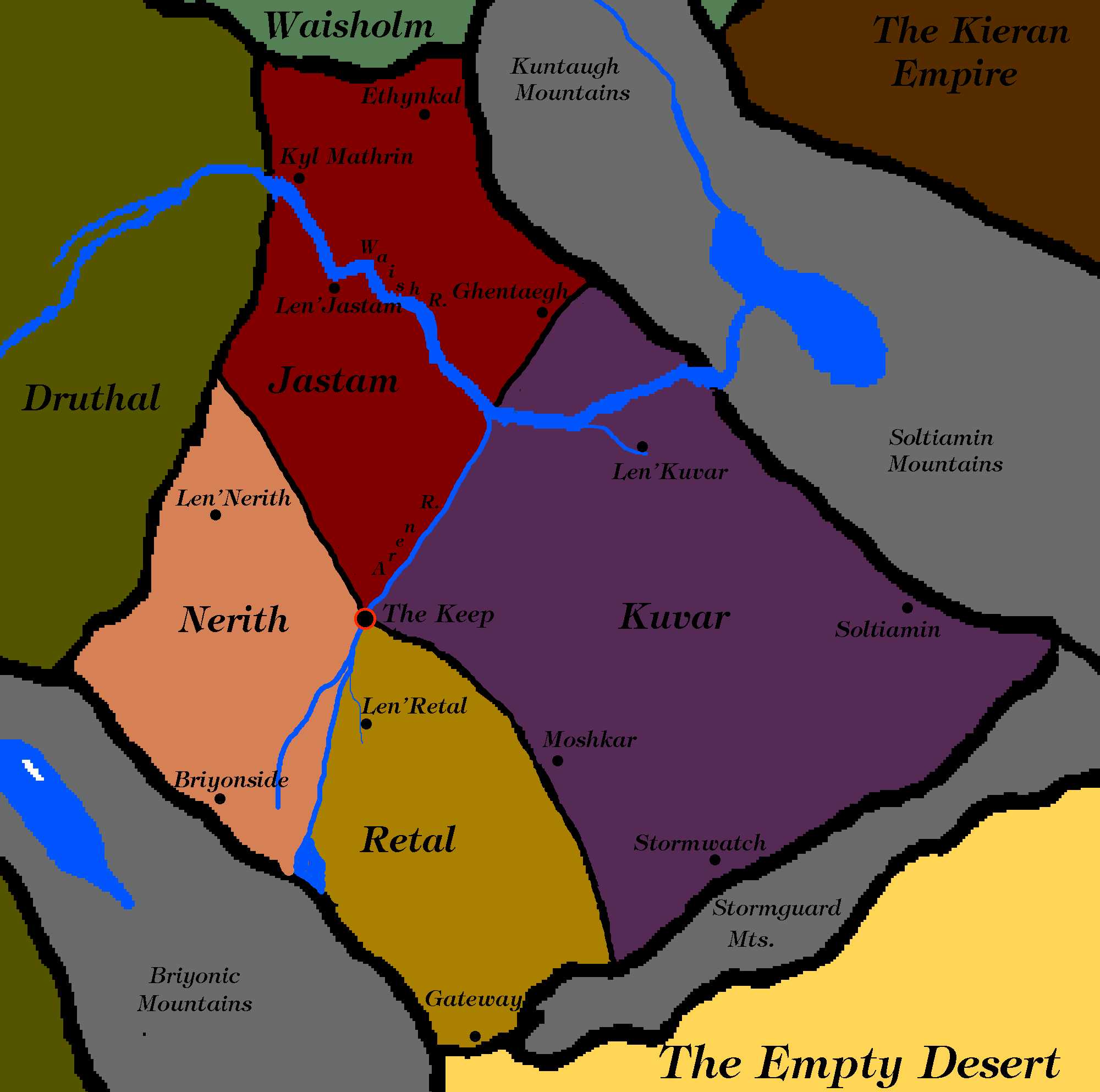
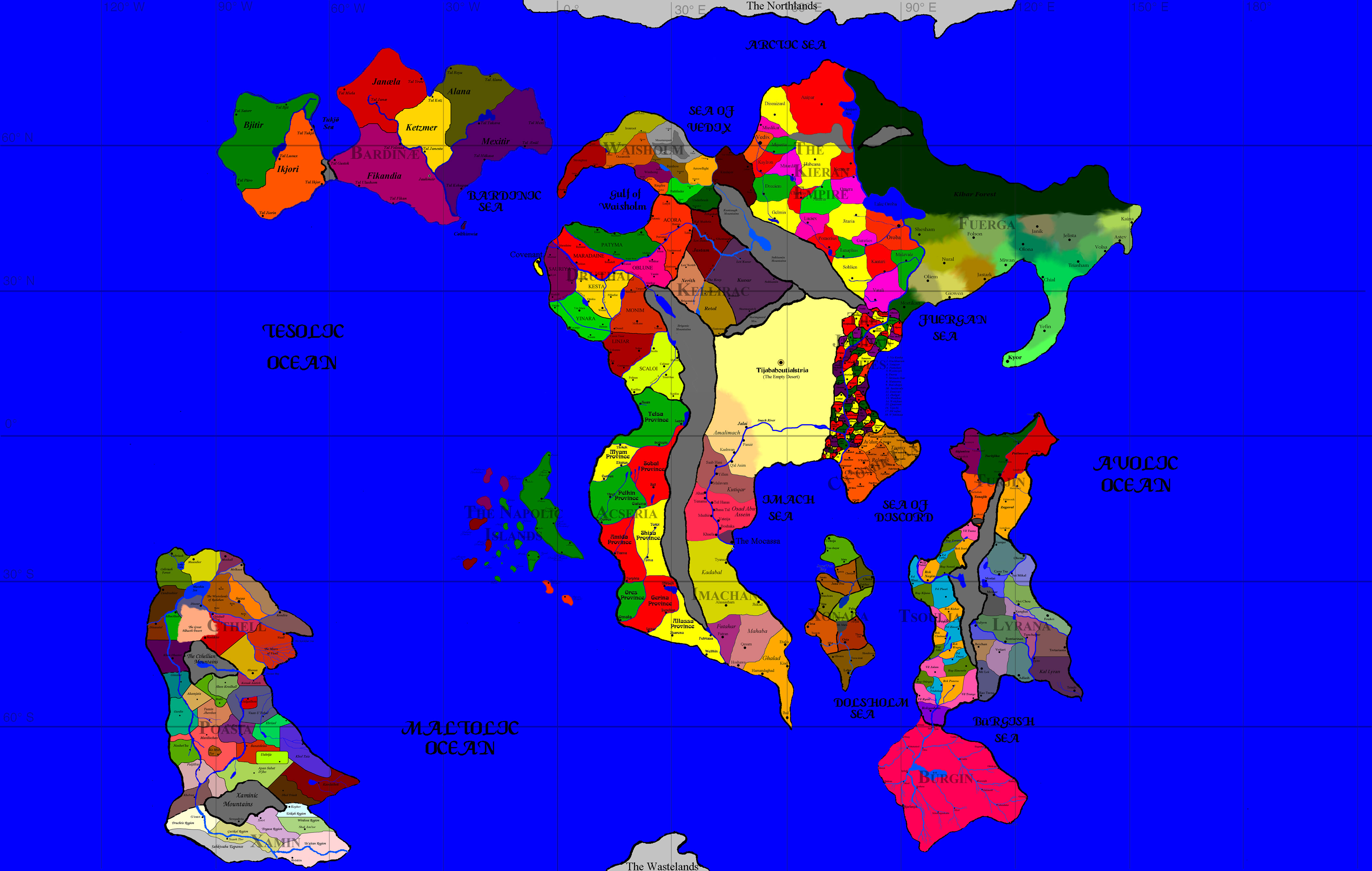
The tour around Druthal continues, with map and write-up on the eastern neighbor, Kellirac.
---
"Kellirac is not as dangerous as they say. But when I see the bonfires, I make sure my boots are on and my sword is sharp." -Desenánderez, Acserian missionary
"I'd rather have them as an ally than an enemy. Never make an enemy of people who eat their own dead." -Darius Estinian, Kieran Senator

"Magic is like flowing water, and in most of the world it is a mighty river, coursing with strength and dependability.  In Kellirac, it is a dry creekbed, churning rapids and a waterfall, all at once." –Xaveem Alassam, Imach Warlock

"You cannot kill the fire.  You cannot kill the storm. You cannot even kill my army.  The dead never leave us.”   -Kellirac Warlord Luten Torgsed


The nation of Kellirac is thought by most other nations to be full of primitive, almost animalistic people. The mere mention of Kellirac bonfires is enough to scare children in Acora and Oblune, and the sight of Kellirac troops on the field of battle can terrify most western armies.
There is talk of wild magic, impossible beasts, cannibalism and even the dead walking and speaking.
This attitude is mostly based on misunderstandings, rumors, and half-truths. The truth is Kellirac has much in common with where Druthal and Waisholm were a few centuries ago. But while Kellirac is harsh and unforgiving, it is more than fierce warriors and terrifying folk customs. Kellirac is a region of rich history.

Kellirac is not a unified nation, but four: Jastam, Nerith, Retal, and Kuvar.  Over the centuries the Kelliracqui people have repeated the cycle of coming together under a single strong ruler, and then broken back up into the four regions.   Each of the four provinces is governed by a feudal Lord, and all four Lords make decisions regarding their region. Any small degree of unity depends on the moods and alliances of the four Lords, but typically they all agree that none of them may take the Unworthy Throne in the Keep. The Keep was originally a fortress built by the Kierans during their occupation of the region. It has stood for centuries, and has become the center of Kellirac political life.

Each local warlord has men (and sometimes women) in his official employ that act as a local law authority. This office is called Meeschun, and enforces the property rights, tax levies, and other decrees of the nobility.

In theory, Kellirac obeys the Kieran legal code that was established during the Empire's highest days. In reality, crime in Kellirac is handled personally. The wronged party regularly takes revenge as he or she sees fit. "Kellirac Justice" is an often-used phrase to mean bloody revenge.

     This leaves the office of the Meeschun with little to do but arrest poachers and collect taxes. However, crime is not much of a problem in Kellirac, as life is too much of a daily struggle to worry about who stole from whom. For many communities, if an entire day has gone by with no injuries, illnesses, or deaths, a celebration is held. In this environment, theft is a rare occurrence. Adding to this fact, there is little to steal, and few well defined laws. As a result, Kellirac tends to have little need for an organized system of punishment.

Criminal activity in Kellirac is an affair best left to those involved. In general, disagreements and disputes are settled simply, either by gathering up one's brothers to beat the offending party senseless, or asking the Meeschun to deputize the offended party, who then gathers his brothers to beat the offending party senseless. In more extreme cases, the offended party can challenge the other to a duel. Duels in Kellirac are far less formal and ritualized than they are in the rest of the world. They consist of a challenge, two swords, and one person dying.

One tradition that stands in many of the smaller, more remote communities is “Sticking.”  Sticking occurs after a crime that offends the sensibilities of the community, such as impregnating a young girl then refusing to marry her. In this punishment, the strongest males in the community form two lines, and each one carries a heavy cudgel. The offender must walk, not run, between these two lines, and each man takes as many hard swings as he wishes at the offender’s head and upper body. If the offender makes it to the end of the line alive, he is forgiven by the community. Few people survive Sticking.

Kellirac does not have a standing army. Instead, the feudal system of responsibility in Kellirac allows a Lord or noble to gather his warriors and vassals at any time. Refusal to serve a noble is considered a crime in some areas, but not in others, and the severity depends on the noble involved. However, few men refuse the call to arms when it has been made.
Desertion, on the other hand, is common. Many men who are conscripted for a prolonged battle fear for the well being of their families, and desert to return home for planting and harvest. This has led to the aphorism “The Kellirac fight with the seasons.” Desertion for reasons of cowardice is punishable by death, but desertion to return for harvest or planting is often forgiven. In one recent engagement on the Druth border, a battle between the Kellirac and the Druth waged for several weeks, but ended abruptly when the early onset of harvest season took the Kellirac by surprise. In the morning, after Druth battle lines had been re-drawn, the Druth cavalry discovered that the Kellirac had gone home, leaving only one small unit behind who delivered the message “We shall come again after harvest.”

The Kellirac armies are considered formidable despite their technological disadvantage, partly as a result of their reputation for savage fearlessness. During the Rebellion, as Kellirac fought on the side of the Empire, many Druth and Waish warriors told stories of atrocities, such as the dismembering of dead enemies to keep as trophies, and the ritual eating of the slain. While cannibalism is a fairly well documented historical practice in specific, ritualized circumstances, there is no proof that cannibalism has been a part of Kellirac military practice since the days of Arengi.

 Kellirac soldiers are reckless and wild by the standards of the other Trade Nations. They have few skilled archers, and virtually no cavalry, as there is little call for it in mountainous Kellirac. But what the Kellirac lack in formalized training, they make up for in passion, ferocity, cunning, and reputation. The sight of naked or fur-clad Kellirac, waving axes and picks, shouting bloody war cries as stag horned trumpeters blow horns from the hilltops and javelin wielding troops appear from the hills and melt back into the mists have routed more than one line of Druth cavalry.

Despite their large deposits of precious metals, Kellirac is relatively poor in metals that are useful for weapons and armor. As a result, most Kellirac warriors are equipped with simple leather armor, spears, and wooden shields. Swords are expensive, and are almost exclusively used by knights and lords.

 There is no formal system of education in Kellirac. Those young people (men and women) who show intellectual aptitude early are sent to one of the many Acserian missions in the region to study, or on rare occasions sent to Druthal. On the other hand, Kellirac children are taught by their parents to hunt, track, forge, sew, and perform many other tasks necessary for their culture and survival. While Trade is spoken throughout Kellirac, the traditional language of Sechiall (pronounced sake-hi-ell) is spoken by far more people, particularly those in more isolated settings. In fact, given a choice between raising a child to speak Trade or Sechiall, Kellirac mothers will choose Sechiall first. In the eyes of a Kellirac, Trade is a fine language for describing politics and economics, but fails miserably when trying to describe the intricacies of day-to-day life of the Kell character. However, many subtle intricacies of the Kellirac language are lost in translation, making Kelliracs sound stilted and confused when speaking Trade.

Only a small minority of Kelliracs can read the Trade language, and that is mostly restricted to the nobles and richer families.

Although a Trade Nation, Kellirac has poor relations with the other members in general. Kellirac has a long history of attacking Waisholm and Druthal. For the last several decades, relations have been antagonistic, but rarely openly hostile.  The Kellirac still harbor bitterness over several crushing defeats at the hands of the Druth and Waish armies.

Many Kellirac have fled their own country, living as wanderers or as an outskirter subculture in Druthal.  These Racquin mostly keep to themselves, and hold on to elements of Kell culture and language.

The Kellirac are a superstitious people, and the constant numinic storms and magic flares do nothing to ease these feelings. The Kellirac are very suspicious about magic, and as they see it, its connection to the dead. Many Kellirac consult diviners and necromancers regularly. But as much as the people of Kellirac respect magic, they fear it as well. Kellirac know that magic is a volatile, often unpredictable force, and treat mages with respect, awe, and fear combined. The Kellirac are more likely to practice ritualized magic than any other people are. Bonfires, ritual effigy burning, and (according to Acserian rumor) human sacrifices are part of Kellirac ritual observances, and have developed an unfairly negative reputation among outsiders.

In the minds of most outsiders, particularly the Acserian missionaries, the bonfires and cannibalism are the most frightening and the vilest of Kellirac superstitions. According to Kellirac folklore, some of The Wretched (see below) entice human followers with promises of wealth, power, and glorious battles. Those Kellirac who agree to follow The Wretched set bonfires at the waning Blood Moon, and chant ancient, forbidden death chants. These people then become vessels for The Wretched, who feed on the flesh of the living as a source of their power. After nine nights of bonfires, ritual sex and dancing, and preparations for battle, these groups of Human Wretched will attach the nearest village. Many Kellirac villages have taken to launching surprise raids on the bonfire encampments, as the Human Wretched require the full nine nights in order to fully transform.

The religion is based upon the dead. The goal is to die honorably, and be reunited with one's ancestors in the next world. Those who die dishonorably, particularly by an act of cowardice in a lost battle, become "The Wretched," spirits who are tainted, not allowed passage beyond. Those who die in a losing battle but die with honor or those who do not die in battle become The Wanderers, undead spirits who aid humanity in hopes of being allowed to move on.

When Acserianism came to Kellirac, attempts were made to "civilize and educate" the Kellirac. However, the new religion never supplanted the original pagan beliefs. While some Kellirac have become Acserians, most notably Valsam Du Retal, one of the Kellirac Lords, most are either still pagans, or have become part of a splinter faith of Acserianism. This religion, called Samacheriai, is a blend of traditional Kell beliefs and somewhat obscure Acserian beliefs. Samacheriai believes that there is one all-powerful God, and that he sends prophets to the world to help humanity understand his ways. However, it also assumes that the Wretched, spirits and creatures of supernatural power represent aspects of God that can be petitioned for help and knowledge.

The major Kellirac holiday is Hultachia, which means "Death Walk." On this day, all Kellirac prepare for sunset by making as much food as they can, which they will eat some of in a giant meal right before nightfall. The leftovers will be left for the dead. They set candles at the doors and windows, and let the fireplace burn all day. The belief is that at sundown, the borders between this world and the next fall, and any Wanderers who have been deemed worthy will come to visit their loved ones once more before passing into the next world. However, the Wretched will do everything they can to keep the Wanderers from crossing over.

Another major holiday is the Straw Bear Festival, which is a strange development from an Arengish festival that drives out evil. While the specifics of the Arengish traditional festival have been lost, the modern version is a day long festival where a boy who is nearing adulthood dresses in a suit of straw, branches, and greenery. He travels from house to house, howling and dancing. At each home, the woman of the house comes outside with a broom and pantomimes beating the “bear” away. At sundown, the entire town comes out, and all of the village children tear the suit away from the boy within. The suit is burned, and the boy is given gifts, cakes, and small trinkets. This festival is more for the children, who spend the day singing and playing games. Often, groups of children follow the “bear” from house to house, jeering and making fun of the “bear” as he is driven away by the women of the village.

The Kellirac have many ceremonies, but one stands out in importance. After death in battle, the surviving relatives of a slain warrior will place candles at the slain's bedposts. At sundown, the spirit of the slain warrior is believed to return to rest, and to learn the outcome of the battle. If the slain warrior's side won, he is released into the next world. If his side lost, he becomes one of The Wanderers. If he died dishonorably, he becomes one of The Wretched.

Once a year like clockwork, an enormous storm, both magical and natural in make, erupts over Eastern Kellirac. It has become a badge of honor to "Ride the Storm," which means that the warrior in question plants his sword into the ground, and stands in place as the storm buffets him. Most "Storm Riders" do not survive the attempt.

Monday, May 6, 2013

Fantasy Worldbuilding: Acseria, maps and worldbuilding

Another busy day here-  the rough draft of Way of the Shield has almost reached the point of going over the top of the hill, so it's now a matter of getting all the pieces in place before the drop*.  So I'll share another bit of worldbuilding: Druthal's southern neighbor, Acseria.

--

“And a new nation will stand.  A nation of God, by God and for God.  And such a nation, built on principles of faith, shall be like to none before seen.”  -The Book of Galena, The Acseram

“There must be a God, for no man could make that happen.” –Clwythnn Strongtree, after seeing Acserian zealots storm the bridge at Fencal.

“I have no quarrel with their God.  I just fail to see why he must dabble in politics.”  -Archduke Louis Gauchon of Linjar

“They are a decent people, but I cannot fathom a man who would rather eat a horse than a chicken.” –Olona ab Calisien, Ninth Chair of the Fuergan Syndicate
Acseria is a nation centered on their religion and their church.  The church rules the nation.  The rest of the Trade Nations have felt the church’s influence, as the faith has spread, to a varying degree, throughout them.  The church as some very strict tenets and scripture, but the rigidity with which they are followed can vary.

Acseria is a theocracy, ruled by the Acserian church.  The titles in the church stem from the old Futralian titles, and the hierarchy of the church is as follows.
  • Rei- The highest authority of Acseria-- the Rei has the ear of God, and God has his.  When he makes an official proclamation it is law (although it must pass through the Kannan Assembly to confirm that the Rei has not wavered from his faith), and all of Acseria will move at his word.  He also votes with the Kannan Assembly, with his vote counting as twenty.
  • DaiKanna-There are eighteen DaiKanna, two for each province of Acseria.  They comprise the upper echelon of the Kannan Assembly.  Only a DaiKanna can call for a vote. Some matters, such as the elevation of someone to the rank of Kanna, can be voted on only by DaiKanna.
  • Kanna- The main body of the Kannan Assembly, with their being 162 Kanna (18 for every province).  The Kanna, like the DaiKanna, are only representatives of their province.  While they may bear affiliation for a certain sect or order of the church, they do not specifically represent them.
  • Manall- This is the rank of the leaders of most sects and orders, as well as the central figure religious figure of cities and communities.
  • Shannar- The Shannar is the lowest rank of fully ordained priest, and is the one that the common man has close contact to.
  • Chosen- The Chosen are ministers who lead services and give spiritual comfort and leadership to the people, but the are not ordained, and cannot perform some ceremonies.

In addition to the church leadership, each of the nine provinces (Telsa, Myam, Sobal, Pelkin, Amida, Shisa, Ores, Gerina and Allassa) has a Prince who has ruling authority, as long as that prince stays in good standing with the church.  This is a hereditary title, unless the church sees fit to remove one line of Princes and replace it with another.  The Prince is at the top of the feudal system, with nobles below him, who are simply called Lords.  Princes live a challenging life, since each one has twenty Kanna and DaiKanna who each feel they have authority over him, and each one will have their own agenda.

Law in Acseria is specifically church law, edicts handed down from the Kannan Assembly, all (presumably) based on interpretation of the and other sacred documents.  Over the centuries, laws change due interpretation of the scripture and the prevailing attitudes of those in charge.

The Code of Life is a primary component of the law.  These are handed down from old Futralian codes, and the translation and interpretation of them is the cornerstone of Acserian debate.  Fundamentalists feel they mean “One must not,” while Reformists think they mean, “One should not.”  As it stands, the Code of Life (in the Reformist standard) includes:

  • One should not touch one’s brother or sister, parent or child, in the manner one touches one’s wife.
  • One should not eat that which is not blessed and properly prepared.
  • One should not take that which they do not own.
  • One should not separate soul from body.
  • One should respect their betters. One should not speak that which is untrue.
  • One should not touch another man’s wife in the manner they touch their own, nor any who is not their wife.
  • One should not drink that which is impure or intoxicating.
  • One should not take more food than is needed when another is hungry.
  • One should not desire that which is not theirs, nor that cannot be had.
  • One should not take credit for work of God or another man.
  • One should not commit an act borne from anger
  • One should not make one’s rest force another to work, nor rest to leave the work to fallow.

Magic fluctuates in acceptance in Acseria.  Currently, the official standpoint is that magic is useful and acceptable to God, but it had often in the past been considered heresy and sacrilege.  Many Acserians still hold this opinion, and react badly to displays of magic.

When accused of a crime, be it against man or God, one is brought before a church leader (usually one of the Chosen, sometimes someone higher) for trial.  If guilt is determined, then the criminal is given an Act of Penance, which can range from a series of prayers, to self-flagellation to taking on some form of vow or missionary work.  The criminal has the right to volunteer an act for the priest to approve, or else the priest will assign one.  Failure to do the Penance Act is High Sacrilege.

Any form of High Sacrilege (which requires a Manall to determine) can be punished by Excommunication.  Someone who is excommunicated is not part of the community and has no rights.  If they aren’t executed shortly after the excommunication (which used to be the fashion, but is currently frowned upon), then they will typically flee to Druthal or another nation.

The Acserian military is not strongly organized, but when they lack in structure they make up for in devotion.  They are essentially a militia of faithfuls with informal training in how to use their weapons.  However, they have been known to fight with fearless abandon.  These ordinary soldiers are usually referred to as zealots.

These militias are under the authority of the Princes, who use their Lords and vassals to bring it together.  The Princes only can call them together with a call to arms from the Rei or the Kannan Assembly.

The centerpiece of the Acserian life is their religion.  It is a monotheistic relgion, in which their God (referred to simply as God), has a plan for the faithful to follow.  In order to help follow the plan, they must act according to his wishes (such as live by the Code of Life), for which they will be rewarded by their souls joining God in the next life. 
God lets his plan be known to them through signs and omens, as well as use of his divine servants and nine Prophets who are to help guide them.  As of 1215, six of the Prophets have come, and three more are expected.  The most important Prophet is the second, Acser.
In Acser’s time, Acseria was a number of protecterate provinces of the Kieran Empire, and the people living there were somewhat lost in terms of spiritual and cultural identity.  Acser started preaching to them about the God and spreading his word, recreating their hope and identity.  Acser also brought an end to a conflict with the Imachs that the Kierans were ignoring, and then confronted the Kierans about their hypocrisy.  The Kieran legions publicly killed him for this.  They then tried to stop his followers and his message, but it instead thrived and spread.
Acserians believe that mankind, at least the faithful, have a soul which is separate from the body.  The soul is the important, eternal part of the person, and the body is merely a flawed physical expression of the soul.  Life on this world is about the triumph of the soul over the body—living in a good and correct manner despite the flaws of the body bringing incorrect urges. 
They also consider birds, especially hawks, to be sacred creatures—messengers of God and carriers of souls.  Most Acserians will wear a talisman of a hawk to show their faith.
While the church itself has several orders and sects, the primary division is between the Reformists and the Fundamentalists.  They each control a large amount of Kannan Assembly, and essential represent liberal and conservative views of Acserian politics and theology.

MAJOR FACTIONS OF THE ACSERIAN CHURCH
The following is in no way a complete list of all the factions, orders and sects of the Acserian church.  Rather, these are the major factions, the ones that have the most influence in the Acserian church.  There are dozens of lesser orders and sects throughout Acseria.
  • FUNDAMENTALISTS- The Fundamentalists believe in returning to the core values of the Acserian faith as outlined by the old Futralian.  Morality, to the Fundamentalists, is not a matter of debate, but rather has already been strictly defined by Meliphol and Acser, and therefore by God.  The Code of Life centers around how one must live their life.  Service to God (and the Acserian community, by extension) must be the primary goal of one’s life.  There are further sub-factions of the Fundamentalists, broken down into which book of the Acseriad in the Acseram is most important—the larger sub-factions prefer Ansom, Chedrik and Zanik.
  • REFORMISTS- They believe in following the spirit of faith over the letter of it.  The texts of old Futralian (and to an extent, the writings of Meliphol) should be looked at as parable and example, not utter truth.  They interpret the Code of Life as being a guideline to what one should do.  Sin and transgression are forgivable, and one should be tolerant of new ideas and debate.  Sub-factions based on which book is more important exist, but they are more casual, usually just used as points of debate rather than true disagreement.  They tend to favor Nalesta, Clienthis and Hiedrovik. 
  • PURISTS- Similar to the Fundamentalists, but even more orthodox.  They trying and live life as exactly as possible as how the Futralians would.  Devoting their lives to service to God, believing that any tolerance of sin is equivalent to the act of sin itself.  They also believe that all elements of the texts of the Acseram, even the apocrypha, are sacred and holy, and should be adhered to.
  • LUMINARIES- This order focuses on learning and saving knowledge.  Monks of the order are the primary instructors and teaching missionaries.  It is the Luminaries who copy, save and archive sacred texts and other writings.
  • THE CIRCLE- This group centers around the idea of God as a more abstract concept, shying away from strict adherence to text and dogma.  They tend to be extremely tolerant of sin, transgression and other religions, as they believe that God, in his infiniteness, intends for such things to exist.
  • THE ORDER OF THE HAWK- This is a semi-militaristic order of proselytizers.  Members tend to work in or with the armies of Acseria, as officers, chaplain or elite soldiers.  They will also do much missionary work in dangerous territories.  They do study some fighting and mystical skills, but they focus more on preaching and spreading the good word of the Acseram, with views that lean to the Fundamentalist side.
  • OVALSHANS- This is a smaller sect who have dedicated themselves to the study and care of the Citadel, the architectural masterwork of the prophet Ovalsha.  They will be the first to proclaim any event at the Citadel as a miraculous message of Ovalsha, and feel that he is second only to Acser in importance.
  • THE BROTHERHOOD OF THE FEATHER- This order focuses on the Acser presented within the book of Nalesta—Acser as pacifist.  The Brotherhood is opposed to the use of violence, and will always work to achieve peaceful solutions.  Study of mystical arts is well known to the Brotherhood.
  • EASTERN ACSERIANS- This group is more often referred to as a “cult” by the larger factions, but it has a strong block of followers in the province of Allassa.  Eastern Acserianism blends Acserian belief with Imach mindset.  Like the Purists, this leads to a stricter lifestyle, intolerant of deviation, and the views of the Eastern Acserians lean toward the Fundamentalist.  Fundamentalists, however, tend to eschew the Eastern Acserians, except when it is politically convenient not to.


---

*- That was a mixed metaphor, wasn't it?

Thursday, May 2, 2013

Worldbulding: Nation/Culture Building Template

Way back when I first started the Serious Worldbuilding Process for the world Druthal is in, the internet was still in its toddlerhood.  So when I first cooked up the National Documents, I didn't have a lot of precedent to build from.  In retrospect, I was essentially building a proto-wiki template for worldbuilding.  I was also less well-read, less researched and less-practiced at the time.  As a result, what the National Document was became something I was unsatisfied with.

So I've made some changes to the template-- using how many actual nations are broken now on Wikipedia as a basis-- and have come up with something that I find... stronger.  Like all things, it's a work in progress.   But you might find it useful.


NATION
Basic description*

Politics
  • Government
  • Laws
  • Military
  • Foreign Relations
Territories/Subdivisions
  • Internal Relations
Geography and Ecology
  • Notable Natural Landmarks
  • Notable Flora/Fauna
Demographics/Culture
  • Languages
  • Religion
  • Familial Units 
  • Social Rituals
  • Clothing and Hairstyles
  • Cuisine
  • Entertainment/Games/Sports
  • Art and Other Great Works
  • Notable Subcultures
History

Key People
  • Current
  • Historical
One advantage this form also has is that it's nestable.  For example, you could create one for, say, a sprawling empire, and then use the template for each of the principalities and protectorates of that empire, and then again for each region within the principalities, and then again for each city.  You could even go down to neighborhoods of the city, if you've crafted it to that level of detail.

So, if this is useful for you: have at it.  If you have suggestions, I'm happy to hear them.

---
*- As you can see from my post on Waisholm, I enjoy putting a few in-world quotes about the culture from both insider and outsider perspectives.  For me, it's a good way to get into the mindset.

Monday, April 29, 2013

Worldbuilding: A Glance Under the Hood

So, last week, I shared a map and some worldbuilding details for one of the nations in the world I've been building, and opened the floor for questions. The questions I got were more about process than the world itself, which is just fine with me. 


I loved the level of detail that you spent on the government.  Do you have a process that you use?  Perhaps you can write it down and share it with your peers?

So, in this case, I've been particular blessed to have a worldbuild/brainstorm partner, in Dan Fawcett.  Dan is far more of an academic than I am, and while I'm pretty good at the research side of worldbuilding, he's really the master.  He's the one who first turned me on to Jared Diamond's works Guns, Germs & Steel and Collapse, both of which I consider required reading for worldbuilders.

As to the process itself: Dan and I hashed out the real broad-brushstrokes, soft-import, high-concept stuff of each nation/cultural area.  Then we came up with tour National Document template-- something I want to rework to a degree, but that's neither here nor there-- which I would use to write up each nation*, and then pass it off to him.  He'd tear into it, usual with questions about specifics, which would help us drag each culture away from its broad-brushstrokes, soft-import, high-concept origins and give it something unique.

In the case of Waisholm, a big aspect was making it something that Druthal wasn't.  Druthal is a parliamentary monarchy, a relative enlightened state for a fantasy/renaissance type of culture, and I wanted Waisholm to be... not so much harsher, but further back on that path.  And more to the point, a place where small-group insularity and in-fighting was the main thing holding them back.  So this required the throne to be a weak title compared to the local lords, and a place where "civil wars" are a relatively common part of their history.  So this required creating a government system where fealty and identity function strongest at the local level.

The question was about achieving that level of detail, which I attribute to the national document, which is relatively comprehensive (what I posted came from sections on government, military, law and criminal activity, for example), and it went through that question-and-respond process to make it stronger.

How did you create the actual map?

The maps have had a long history-- the initial map started nearly twenty years ago, hand-drawn of the whole world.  I eventually got that scanned (and this was in the 90s, where "getting something scanned" meant going to Kinkos and giving them your 3.5" disk to put the scan on), and started making more detailed maps of each respective part.  Over the course of time, as the capabilities of the computers and drawing programs I had access to improved, so did the details of the maps.

So maps that had their origins in hand-drawn, followed by MS Paint, have now been worked over in PhotoShop 6.  There are some that I haven't updated as much as others, of course-- Druthal itself has had the most evolution-- but on the whole it's a far more advanced and detailed work.  And, more to the point, more advanced and detailed than it could have been back then.  Somewhere in the house I still have the 3.5" floppies that have zipped-up files of the maps-- i.e. it took multiple disks and compression to carry it all.  Now I have map files that would have made the old computer explode.


--
*- There are a few nations he did the initial write-up of, though I don't recall which ones off the top of my head.

Monday, April 8, 2013

Perils of the Writer: Clarity and "Literary" Writing

There are, of course, several schools of thought on what makes "good" writing.  And, frankly, half the time I'm at something of a loss.  By which I mean, many times I will read something that's been identified as "great writing" and think it's a muddled mess.  And many times I'll read things that are scathingly referred to as "puerile" or "simplistic" and think it's fun and entertaining.

When it comes to "great writing"-- in other words, writing that aspires to be literature-- some writers come away with an idea that they need to be obscure.  That just coming out and saying what happened is too base or something.  That to be great, you have to make your readers work for it.

I don't get that.

More to the point, this idea creates the impression among learning writers that they need to avoid clarity in favor of obfuscating the action.  Especially on the academic level, this sort of idea is drilled into heads to the point where it's very hard to knock those bad habits out.

I read one sample chapter for workshopping in which the actual action in the chapter involved the main character visiting the grave of her friend.  I had to re-read the chapter four times before I figured that out.  Words like "grave" or "cemetery" or "headstone" did not appear.  Why?  I can only presume the author had gotten the idea that they needed to avoid direct telling of events in favor of sensory details.

This may not be a popular opinion among writers, but "sensory details" can be the death of clear writing.

Not that sensory details are bad, but many times it's done in a way to be obscure.  Instead of telling the reader that the character sees an elephant, the writer tells us about the sight of large leathery ears, the earthy scent of dung, trumpeting calls and the ground shaking from a thunderous walk, and they hope that we put those pieces together and come up with "elephant".  That type of thing can be fun, in a puzzle-box sort of way, but it isn't necessarily good writing. 

Also, too often I see sensory details are thrown out the for the sake of putting sensory details. I remember one piece of writing advice that said something along the lines of, "If you go a page without each sense being represented, you're doing something wrong".  This is terrible advice.  A sensory detail should be used if it's relevant to the action.

Take smell, for example.  Are you smelling something right now?  Is the fact that you're smelling it strongly on your mind?  To put that to writing, in the scene itself, is the fact that a smell is being noticed key to the scene?  Or is it a detail you're adding because you feel you're supposed to add sensory details?

Of course, sometimes confusing the readers is the point.  And that can be fun, but if you're going to do that, do it well.  For every Dirk Gently's Holistic Detective Agency, there are dozens of books that are just unclear.

Thursday, March 14, 2013

Future Worldbuilding: Geopolitics in the Interstellar (Part Three)

Borders are a hell of a thing in three dimensions.  They aren't lines, of course.  They aren't usually even walls.  If anything, they're planes where spheres intersect. 

I made a decision about how my FTL drive works that kept the whole "space is a lot of big empty nothing" front and center-- namely, you're still navigating in real space, you've just created a field around your vessel in which reacts to normal space in an amplified way.  So if you're going from Earth to Alpha Centauri, you still have 4 light years to traverse, just you can do it in, say, three weeks instead of twice as many years. 

What this means is there's a lot of space to "control", once a civilization has decided it wants to hold dominion over a region of space.  What even is a "region" of space?

I have to confess something: I really loathe when sci-fi has some area of space defined as "Sector 47" or such, because it seems so utterly random.  What is a Sector?  Why is that one "47"?  I like a bit of sense and order to these things.  I like the idea that they were designed by someone who had a system.

So I had a system.  Actually, two, in a way, but the same root beneath it, that root being a Cartesian coordinate mapping system.  I prefer Cartesian coordinates to the Right Ascension/Declination system*.  An X-Y-Z grid, marked by light-years, creates a clean system similar to latitude and longitude.  So, since this is a human system, Earth is the "Greenwich", at point 0,0,0.**  Thus, Indus Colony, for example, has the coordinates (5.66, -3.16, -9.9). 

This system breaks all of space into eight Divisions, based on where they are, positive or negative, on the X-, Y- and Z-axes.  Initially, I went with Greek letters-- Alpha to Theta-- to name the divisions, but A. that struck me as to close to Trek's "Alpha Quadrant" and such, B. offered potential for confusion, since the FTL system also used the Greek alphabet.  So I took a different form of classical, with the eight divisions being: Zeus, Hermes, Gemini, Poseidon, Athena, Artemis, Apollo and Taurus.  It has a certain degree of arbitrary to it, of course, but human naming systems can be arbitrary from time to time.

Next, I broke those Divisions into Sectors and Regions.  A Sector is simply a cubic light year, defined by its Divisions and Cartesian Coordinates.  So Indus Colony is in Sector Taurus-6-4-10.  An alien colony, further away, is Paxin Gamma, (9.82, -7.78, -27.33), and it's in Sector Taurus-10-8-28. 

But when you're talking in terms of space, a cubic light year is nothing.  Traveling from Indus Colony to Paxin Gamma takes you through 18 sectors, and there really isn't anything there.  Some of those sectors are clearly Human controlled, some are Paxin controlled, and some... aren't much of anything.  So, where is the border between Human Space and Paxin Space?  Is it defined, or is there a no-man's land somewhere between? 

So, Regions give something with a little more scope, though they are only 1000 cubic light years.  "Only", as if a 10x10x10 ly cube was something to sneeze at, but again, in an interstellar scope, that's still zip codes on an global scale.  But it gives one an area of space that is easier to define, and define "ownership" of.  Taurus-111 is clearly Human, for example, while Taurus-113 is Paxin controlled. Taurus-112, in between them?  That's more disputable...

The other system divides the neighborhood into Expanses-- which are 30x30x30, aka 27,000 cubic lightyears.  Expanses are kind of the Celsius to the other system's Fahrenheit. It still uses Cartesian, and uses eight division, but it just numbers them 1-8.  Then each 30-ly block is letter-coded.  Expanses aren't as useful for figuring out, say, borders or areas of control-- that Indus-to-Paxin Gamma trip is all in Expanse 7AAA-- it's helpful for figuring out larger geopolitical interactions.  Sectors and even Regions are rarely populated by more than one species.  Looking at Expanses gives you a better sense of how they bump into each other.  But even that can be daunting-- in my defined 150-ly radius sphere, there are over 600 Expanses. 

So that can give you some idea how big the "big picture" really can be.

--
*- Though I'm given to understand that RA/D is preferred by astronomers. 
**- Which it is on Star Trek as well, despite the fact that the Federation is supposedly formed by many species.  Earth is still the center.  Hmmm.

Thursday, February 28, 2013

Future Worldbuilding: Geopolitics in the Interstellar (Part Two))

Last time, I talked about working out every culture's homeworld, how advanced they are, and when they achieved FTL tech.  So, knowing that, the rest is simple, right?  Whoever has the most advanced tech, who gets there first, they're the most powerful, right?

Not necessarily.

First of all, there's a matter of location.  Where species are in terms of not only each other, but other worlds, and what those resources mean.  A species that hits the stars and finds they have thirty-some odd other stars within 10 light-years, and most of those have vibrant solar systems chock full of potential resources-- they're going to have a different interstellar experience than a species whose closest star is 15 light-years away. 

Even with that, I make deliberate decisions, since I'm the worldbuilder here, for example, if a species takes an aggressive or isolationist stance in exploration.  If they focus on staying close to home, or perhaps try and spread themselves thinner than they should.

For example-- I've set up my FTL rules so increases in velocity jump in increments.  Ships form a field around themselves, and the level of that field determines their velocity.  An Alpha Field is the slowest FTL field, then Beta Field, Gamma and so on.*  This gave me an easy way to benchmark future tech-- I can measure general advancement of cultures compared to each other without having to get too specific about what that means, techwise.  A culture that can form a Zeta field is more advanced in general than a culture that one can only form a Delta field.  I don't need to figure out the specifics of hull composition or missile yields for every different culture.  So, every culture is rated by their maximum speed.  And with that, I can estimate a reasonable radius a species can maintain control over.  That Zeta culture can spread out, say, 30 light-years from home, while the Delta really can only manage 16.  But at the same time, a culture's nature might be to push themselves.  They might have to push themselves to reach resources they need.

So, that process of building every culture out from their homeworlds, figuring out what they build and where, who they bump into, what they decide to do when they bump into each other-- that's the real gearwork of the worldbuild here.  It's not sexy, and it's not stuff that really appears in the text.  Iceberg rules apply in spades here.

Then comes the next big step: figuring out who the Big Dogs are.  Of course, the Big Dogs are the ones I chose-- especially the ones that are big dogs because they joined up to form larger empires.  I've got eight First Tier* level powers, and four of those are joint-species collectives of some sort or another.  And also, that isn't just about tech level, but about dominion and influence. The Colmerohn are more advanced than the Zutheka-- but the Colmerohn are slow and deliberate, and would rather withdraw than engage in conflict, while the Zutheka are hyper-aggressive conquerors.  So the Colmerohn are a Third Tier power, and the Zutheka are First Tier.

The next step: figuring out the "borders".

-----
*- I've worked out the math, but you knew I did.  An Alpha field will make the trip to Alpha Centauri in 2.95 years.  With a Delta field, it takes 40 days.  An Epsilon field cuts that down to under two weeks.  If you managed to form a Xi field**, that trip is slightly over a minute.
**- No one has a Xi-field level of tech.
***- There are also three Zeroth-level, i.e. very high tech isolationists.  

Thursday, February 7, 2013

Everything You Wanted To Know About Worldbuilding

Some time ago, I posted links to my various Worldbuilding posts.  I've written quite a lot more of them since then, so it was high time to reorganize. It occurs to me this could add up to a whole course.  I might have to start teaching a class...


Wonder and Amazement
Food and Regionalism 
Setting Limits
Fantasy and Sports
Constructed Languages
Calendars and Holidays 
You Are Who Your Neighbors Make You 
Language: Idioms and Slang
Cultural Perception Filters 
Elves and Originality 
Uncommon Questions in Worldbuilding 
Organization of Worldbuilding 
Adding a Hint of Mustard 
Further Small Steps for Man 
Unfolding the Future 
Geography of the Interstellar 
New Life, New Civilizations, and the Mos Eisley Cantina 
My Love of Spreadsheets and Map Tools
Stellar Maps
Aliens: Form Follows Function
Good and Bad Neighbors 
Mapping in 4-D
Fantasy Fiction and Democracy
Worldbuilding, Psychohistory and the Power of Numbers
Religious Texts
Alien Perspectives and Communication
Space Opera and the Future of Food
Complexity in Political Landscapes
Great Forces in History
Building the Non-Humanocentric Universe
Art and Culture in the Fantasy World      

History of Druthal:
Part One
Part Two
Part Three
Part Four


Old links:
Worldbuilding, and the real world intruding on that
  

Thursday, January 31, 2013

A Deep Bench of Tertiary Characters

I have to confess, there's a small part of me that cringes whenever I realize I need another character.  Or characters.  Especially a character with a name.  Because I know, each named character adds a new dimension of complexity, and with that, the risk of losing a reader who doesn't want to keep track of too many characters. 

Usually, such a character first comes into the story on a purely functional basis: I need someone for Colin to talk to in this scene.  I need Jeric to have a peer group among the Tarian initiates. I need Lesk to be building up his own crew of neighborhood flunkies.  Serving the mechanical needs of the story, keeping the gears moving.  This is fine, of course, but in and of itself, rarely dynamic. 

So I put myself in the frame of mind of my theatre roots: make every role interesting.  Think in terms of casting: what would a great character actor do with this part?*  How can I make it more than just functional, but without going off on a tangent that has little to do with the rest of the story? 

On top of that, it's often in these tertiary characters that the biggest surprises of the writing process is born.  Something that starts as functional blossoms into a more crucial role.

One of my favorite examples of this comes from Deep Space Nine**: Damar.  Damar first shows up in the 4th season episode "Return to Grace", and his purpose is entirely functional.  He's the guy on the bridge of Dukat's ship who speaks, so someone can say those "Target at four hundred thousand, sir" and "Phasers ready" lines.  He's the personification of Dukat's whole crew, and little else.  But over the course of the series, he stayed at Dukat's right hand as Dukat became the de jure leader of Cardassia under Dominion rule.   And once Dukat's madness removed him from that position, there was Damar: now the puppet in charge, and the slow cost that had on his soul became a key storyline in the final season.  

Not too shabby for a character that starts out as purely functional.

And that, I think, is the key aspect when bringing any new named character into the mix: investing them with the potential to become something so much more.  I can't even begin to tell you how many times I've started a new scene and realized that the best choice of POV character for that scene is someone I hadn't even considered existing when I drafted the outline. 

The other key aspect?  Keep the names dynamic.  I know when I'm reading a book-- especially a sci-fi or fantasy book-- and there's some minor character named Vesslin and another one named Vettlan I am going to mix up which one is which.  Heck, when I was twelve and tried to reader Lord of the Rings for the first time, I couldn't keep Sauron and Saruman straight.  They were both bad guys with S-r-n name constructions.***

Right now on Way of the Shield I'm working on a scene where a functional character exists to bring a main character from Point A to Point B-- in a literal, "get him on a carriage and deliver him somewhere" way.  In writing the scene, I asked myself, "Who is this guy, and how did he get this job?", and in asking that, I found a common thread between him and the main character in the scene, which then helps build his story, and does a bit of worldbuilding work in the process.

Again,  not too shabby for a character that starts out as purely functional.

---
 *- An interesting effect of the success of the Harry Potter movies is how it managed to get some of Britain's greatest actors to do little more than oddly-dressed cameos. 
**- I do use Star Trek examples a lot, don't I?
***- Tolkien's habit of giving the same character multiple names didn't help me much either.

Thursday, December 13, 2012

Analyzing Flawed Arc Structure, Part 5

Parts one, two, three and four of looking at Star Trek: Enterprise's third season Xindi Arc.

"Home", the third episode* of the fourth season of Star Trek: Enterprise served as an epilogue to the Xindi Arc, primarily by dealing with the emotional fallout of the character subplots.   Specifically, it focused on Capt. Archer, and Trip & T'Pol.  Both of these aspects work fine in terms of the episode itself.  For Archer, he's somewhat broken by the things he did in the Delphic Expanse.  He specifically mentions the theft of the warp core, which as mentioned last week, was his greatest sin.  But beyond that, his optimism about exploration in general is broken, despite the fact that things did end relatively well. This ties into the one other minor plot thread in "Home"-- the Enterprise crew might be hailed as heroes, but there are some people who aren't thrilled with the fact that they had spent two years running around space saying, "Hey, we're from Earth.  Come on over and smack us around, why don't you?"**  For Trip & T'Pol, their subplots of his grief over his dead sister (more or less resolved in "The Forgotten") and her emotional damage due to self-inflicted Trellium exposure*** dovetailed into their semi-romantic friendship.  So they go to Vulcan together, and deal with T'Pol's family drama. 

So, in the end, what worked, and what didn't in the Xindi Arc?

For me, the broad brushstrokes worked: a threat is presented, and to defend themselves from that threat, core principles are challenged and strained.  Despite that, in the end, it is those core principles that saves the day: friendship is achieved with (most of) the Xindi council, creating a lasting peace through conversation. 

What didn't work, though, is how things went in terms of character.  Specifically, character never tied into plot in a real organic way.  The closest was with Archer, who's moral center was challenged, but that balance between what he needed to do and what he had to bring himself to do always came more with an axe instead of a scalpel.  Archer doesn't get a slow descent into darkness.  He gets one questionable moment (putting a pirate in an airlock to get answers) and one really bad no-win scenario (the theft of the warp core).  Beyond that, what does he do?  True, he doesn't blow up the refinery in "The Shipment", but that seems less of a Moral Choice, and more thinking in terms of long-term strategy: going in guns blazing isn't the smartest thing to do if you've only got one shot at that, and you haven't found the right target.  In the final third of the season, Archer seems ready-- even eager-- to die for the cause, but why he's gone semi-suicidal isn't really explored.  Despite Daniels coming from the future TWICE to tell him, "Yeah, you're important, you can't die," he seems hellbent on it anyway.  There is a bit of lip service of not wanting to order someone else to their deaths, but that wasn't something ever really discussed.

What also didn't work was the lack of focus.  Most of the first two-thirds is spent wandering: some of it ties to the Xindi or the Spheres, but the rest is largely irrelevant.  It doesn't move the plot, nor is it called back later.  So it doesn't serve a purpose.  Perhaps if it had done more worldbuilding of the Expanse, creating encounters that mattered, so that they could be called upon at the endgame, then it would have seemed more meaningful.  And that would have also tied into a Trek solution: humans build communities, create allies, so when the chips are down, friends come to their aid.  But no species in the Expanse really were important other than the Xindi and the Spherebuilders.  The Spherebuilders were, at the core, the Big Bad, and the Xindi-- while having solid individual character-actors-- themselves had no definition beyond "five subspecies in fractious alliance". 

As counterpoint, I might present the end of Farscape's second-season.  After two seasons of more or less random encounters-- those stand-alone episodes-- the crew is faced with having to do a Big Crazy Plan.  And to pull it off, John Crichton calls on various species and people they've met along the way.  Now those stand-alone's tie into the solution, and to worldbuilding as a whole. 

But, credit where it's due: they took chances, and in the end, created something that had value.  In my recent re-watch of it all, I was largely entertained.  With a little more streamlining and focus (which, admittedly, in the world of episodic television, especially a decade ago, is challenging), it really could have stood out as something special. 


---
*- The first two episodes had nothing to do with the Xindi storyline.  Instead it involved time-traveling Nazi aliens, and served mostly to tie off the Temporal Cold War storyline, which had never been very well handled.  "Zero Hour" ended with an exceptionally bizarre Hail Mary of a cliffhanger, and those episodes are at best a serviceable affair of digging themselves out of that hole, as well as the entire TCW one. 
**- Though you have to wonder why, when the Xindi weapon showed up, Earth's only defense was, apparently, a single Andorian cruiser.  It made for some satisfying drama, but didn't make much sense.
***- A clumsy drug-addiction metaphor.

Monday, December 10, 2012

Analyzing Flawed Arc Structure, Part 4

Parts one, two and three

The third act of the Xindi Arc is pretty action packed.  On some level, it does make up for the heel-dragging and aimlessness of the first two thirds:  Episodes are: "Hatchery", "Azati Prime", "Damage", "The Forgotten", "E2", "The Council", "Countdown" and "Zero Hour".  

Of these eight, really only two are inessential: "Hatchery" and "E2".  But both of them do speak to the character of the Enterprise crew.  Since the one character-arc that's really tied to story-arc is "How far will Archer go?", to a degree "Hatchery" answers the question, "How far will the crew let him go?"  Now, it approaches it from a different angle, where Archer goes to extreme measures to help a creche of Xindi-Insectoid infants, and the crew, sensing something wrong, engage in a mini-mutiny.  As Archer is Being Affected By Something (a Trek staple to avoid actual conflict or responsibility), the real conflict boils down to the crew vs. Major Hayes, since Hayes just follows orders.  This is also the closest thing we get to something resembling focus on the Xindi-Insectoids, who in terms of story never amount to actual characters, simply additional muscle to back up the Reptilians.  "E2" is a kind of fun what-might-be time-travel episode, where the crew meets their descendents from a failed future-version of their mission, but other than turning the screws a bit tighter on the Trip/T'Pol romance, it's largely a placeholder.

That said, the three in between those episodes, "Azati Prime", "Damage" and "The Forgotten" do a very nice job illustrating the Collapse-Retreat-Recovery aspect of the Twelve-Part structure.  The ship is really hammered, but at the same time Archer makes some connection with Degra and the other Xindi-Primates.  It's here that the core Trek principles are pushed to their limits: having discovered the Xindi world-destroyer weapon, the first plan is just to blow it up.  This goes wrong, and Archer gets captured, but in being captured, he uses his knowledge from "Stratagem" to his advantage.  This convinces Degra enough to at least listen, and stop the Reptilians from attacking the Enterprise.  Degra (with the help of the semi-enigmatic Aquatics) returns Archer to the broken ship, and sends message for a secret rendezvous a few light-years away.  The ship being in such a state, making that rendezvous is impossible without a new warp-coil.  Fortunately, there's another damaged ship nearby, and Archer feels forced to take theirs by force in order to make the meeting.  This is without question his lowest point, committing for all intents an act of piracy in the name of saving Earth.  It's very non-Trek, which works excellently for the sake of drama.  Capt. Archer is torn up to do it, but he feels he has no choice.  You could easily see, for example, Cmdr. Adama, John Crichton or Malcolm Reynolds doing the exact same thing under the same circumstances.  The only question is, would they feel the same weight?  As horrible as the act is, it is in service of, ultimately, a Trek-solution: solving the Xindi situation through dialogue instead of violence.

Of course, the cracks in the plotting armor are quite evident.  Degra could have this clandestine meeting somewhere easier for Archer to reach, given that Degra knows the state Enterprise is in.  He even could just go to Enterprise directly, and not even be clandestine.  The need for secrecy from the Reptilians (and Insectoids) is a bit artificial.  And that's a big part of the problem with this plotting, in that it forces Enterprise to go from Point A to Point B (this necessitating the stolen warp coil) and then from Point B to Point C (this using the subspace passage that creates the timetravel accident in E2, which is neatly avoided, meaning the second Enterprise may have "never existed".)  It's mostly hoop-jumping so Degra can use Archer as a surprise in "The Council".

"The Council" is, in theory, Archer presenting his case that Earth is not a danger to the Xindi and that the Sphere-Builders/Guardians have been playing the Xindi for their own purposes.  It's the latter point that is most crucial, since the Guardians are worshiped as deities by the Xindi, though they were unaware of the connection between the Guardians and the Spheres.  While the Xindi Council has five groups, really only three matter: the Arboreals back up the Primates, and the Insectoids back up the Reptilians.  And the Aquatics are the enigmatic deciders.  In terms of character, it really boils down to Degra (Primate) and Dolim (Reptilian). 

It should be noted that Randy Oglesby and Scott MacDonald deserve a lot of praise.  Both are journeyman actors who have done tons of guest roles on various shows, including all four of the modern Treks.*  They do solid work, often under a lot of latex, and you have to respect that kind of actor. In fact the real dramatic centerpiece of "The Council", and to a degree the turning point of the story arc itself, is between these two actors. 

The final wrap-up of "Countdown" and "Zero Hour" is serviceable, in that the Xindi-Reptilians cement their role as the irredeemable villains, who have tied themselves to the Guardians.  The Guardians, of course, want to reshape reality-- terraforming our space, as it were, to one that they can survive in.  The Reptilians are their willing dupes.  Even the Insectoids wise-up, though all they do is wonder why the Spheres are suddenly working to help their efforts to destroy the Earth before the Reptilians sudden-but-inevitable betrayal.  The final push, in which Archer enlists Reed and Hoshi to destroy the weapon, saving the Earth, while Trip, T'Pol and Phlox destroy the Spheres themselves, saving the Xindi (and all of reality)-- is entertaining and fun, but sadly mostly involves pushing buttons and punching aliens.  The highlight in terms of What-Makes-It-Trek is not the bit where annoying-time-travel-exposition-fairy Daniels pulls Archer to the founding of the Federation (to convince Archer not to sacrifice himself, something Archer is pretty hellbent to do).  Instead, it's the moment where the Andorians show up to help defend the Earth.  Jeffery Combs-- another strong member of Trek character-actor stable-- sells the hell out of it as the Andorian Commander Shran, and that's a lot of fun. 

But in the end, it's a Big Finale: Things go Boom, and the Day Is Saved?  Is that all there is?  Is that all there can be?  That's the big question remaining.


--
*- I'm fairly certain that the two of them and Jonathan Frakes are the only actors to appear in all four modern Treks.