The real test of a civilization is not just its laws, but how its laws are put into practice. Criminal law is one aspect, of course: does the society care more about justice, or maintaining order? Are trials designed to be fair, and truly find the guilty, or simply expedite a resolution. Are the people protected from the state, or is the state protected from the people?
But civil law is another matter, and is often less examined in worldbuilding. How do two citizens resolve a dispute or wrong in which, strictly speaking, no crime has occurred? At least, in something resembling a culturally-accepted "official" way. For some people, regardless of the level of civilization, the answer is, "Punch the other person in the face." And at that point, quite possibly, a crime has occurred, or if nothing else, the situation will continue to escalate into more violence.
However, a society, in general, is going to want to avoid "punch person in the face" solutions in favor of non-violent, non-escalating one.
Depending on how advanced the society is, this can take a lot of forms. Sometimes it's just a ritual in which one party acknowledges they wronged the other, gives some form of recompense, and things return to normal. However, the larger a society is, the more likely the two parties are complete strangers, and have little reason to trust each other to "do the right thing". The right thing must be imposed, usually by contract or third-party arbitration. Is this a formal or an informal process? Is the third-party's authority universally recognized, or is simply agreed upon by the initial parties involved?
Now, in a lot of fantasy fiction, which often has its roots in an idealized version of medieval or Renaissance Europe, there is often the solution that is violent, but under strictly controlled rules and traditions. I'm speaking, of course, of the duel. But the duel does boil down to a formalized version of "punch the other person in the face" where it's designed to not escalate into further fighting, or even war.
So, how does it work in your worlds, when no crime has been committed, but someone's honor must be satisfied, or a grievance must be addressed, or some other wrong righted?
Showing posts with label culture. Show all posts
Showing posts with label culture. Show all posts
Monday, October 20, 2014


Monday, September 1, 2014
Worldbuilding: From the Neolithic to the Agricultural
Progressing from my initial ideas of bottom-up worldbuilding, once you've established your geography, your basic flora and fauna, and then had your people rise up and spread throughout the world, you've more or less finished your paleolithic phase. Can you go into more detail here? Absolutely. Especially if you're interested in doing stories that are paleolithic or paleo-to-neolithic-transition in nature.*
But odds are you'll be ready to move into defining those neolithic cultures, and their multi-millennia transition to agricultural cultures-- if that's something they are going to logically do. And there are plenty of reasons why they wouldn't.
Cultures don't transition from hunter-gatherer to agricultural without good reason, mostly in terms of geographical conditions. Climate, water source and base foods that are easily domesticated all need to be present. Egypt had perfect conditions, for example, since you had the gentle Nile with predictable flooding patterns, allowing for easily irrigated and constantly renewed soil, as well as early native wheats to domesticate. As a contrast, southwestern Australia had similar environmental conditions, but no native plants worth domesticating.
And without some form of agricultural revolution, your cultures won't progress toward civilization or past stone-age technology. I'm not assigning that any sort of value judgment-- simply that the two go hand-in-hand. You can't have a culture that remains hunter-gatherer but yet has cities with electricity and quantum computers.**
So, what foods can be the ones people eat and domesticate in this period? You can look to the "founder crops", which were crucial in our Fertile Crescent, but that wasn't the only place where agriculture appeared. There are other ways to go.
Fortunately, Lynne Olver has put tons of work into The Food Timeline, a website that is an absolute treasure trove of information. Pretty much every kind of food, she tells you when and where it came into use.
It's important to remember this transition is a slow one, taking several thousand years, and once it get going, it tends to spread, at least along east-west lines. But that means a lot of things can be happening in your world long before anyone figures out to write it down.
---
*- Is Stonepunk a thing? If not, shouldn't it be?
**- Not to poke at any specific Hugo-winning novel.
But odds are you'll be ready to move into defining those neolithic cultures, and their multi-millennia transition to agricultural cultures-- if that's something they are going to logically do. And there are plenty of reasons why they wouldn't.
Cultures don't transition from hunter-gatherer to agricultural without good reason, mostly in terms of geographical conditions. Climate, water source and base foods that are easily domesticated all need to be present. Egypt had perfect conditions, for example, since you had the gentle Nile with predictable flooding patterns, allowing for easily irrigated and constantly renewed soil, as well as early native wheats to domesticate. As a contrast, southwestern Australia had similar environmental conditions, but no native plants worth domesticating.
And without some form of agricultural revolution, your cultures won't progress toward civilization or past stone-age technology. I'm not assigning that any sort of value judgment-- simply that the two go hand-in-hand. You can't have a culture that remains hunter-gatherer but yet has cities with electricity and quantum computers.**
So, what foods can be the ones people eat and domesticate in this period? You can look to the "founder crops", which were crucial in our Fertile Crescent, but that wasn't the only place where agriculture appeared. There are other ways to go.
Fortunately, Lynne Olver has put tons of work into The Food Timeline, a website that is an absolute treasure trove of information. Pretty much every kind of food, she tells you when and where it came into use.
It's important to remember this transition is a slow one, taking several thousand years, and once it get going, it tends to spread, at least along east-west lines. But that means a lot of things can be happening in your world long before anyone figures out to write it down.
---
*- Is Stonepunk a thing? If not, shouldn't it be?
**- Not to poke at any specific Hugo-winning novel.
Monday, August 25, 2014
Worldbuilding and the Challenges of the Cosmopolitan City
So, I've finally begun the work on The Little East (aka the sequel to A Murder of Mages) in earnest. Without delving too deep into spoilers, it deals with investigations in the sub-neighborhood generally referred to as The Little East, which is kind of Maradaine's equivalent to Chinatown, Koreatown, Little Italy and Little Ukraine all rolled together.
Except not exactly, because none of the foreign cultures that are enclaved the Little East are really equivalent to Earth cultures. Not exactly.
And that's the big challenge I've given myself with this book. I need to depict these cultures as their own thing, unique to my world. If readers start going through and going, "Oh, these people are just Japan with the serial numbers filed off" or something like that... then I've done something wrong.
So, how do I accomplish that, exactly? One way is by trying to avoid any cultural buzzwords that will immediately but a specific culture in mind, especially in combinations. You might be able to get away with "silk" or "paper lanterns" without evoking China, but put both together, and that's where your readers will go.
The other thing I try to do is give each culture some unique element or feel that doesn't directly evoke any real world culture. For one culture, for example, there's a caste system that involves dying the hair specific colors.
How do you evoke new cultures in your worldbuilding without making it feel like a copy-and-paste job?
Except not exactly, because none of the foreign cultures that are enclaved the Little East are really equivalent to Earth cultures. Not exactly.
And that's the big challenge I've given myself with this book. I need to depict these cultures as their own thing, unique to my world. If readers start going through and going, "Oh, these people are just Japan with the serial numbers filed off" or something like that... then I've done something wrong.
So, how do I accomplish that, exactly? One way is by trying to avoid any cultural buzzwords that will immediately but a specific culture in mind, especially in combinations. You might be able to get away with "silk" or "paper lanterns" without evoking China, but put both together, and that's where your readers will go.
The other thing I try to do is give each culture some unique element or feel that doesn't directly evoke any real world culture. For one culture, for example, there's a caste system that involves dying the hair specific colors.
How do you evoke new cultures in your worldbuilding without making it feel like a copy-and-paste job?
Thursday, July 17, 2014
Worldbuilding: Columbian Exchange in Secondary Worlds
Many of the worlds you'll build will have multiple continents, and if you're doing things correctly, each of those continents will have their own biodiversity. Each one will have its own specific native plants and animals that may or may not be domesticatible, and the nature of those species help determine the civilizations that thrive there.
But sooner or later in the history of your world, those two cultures are going to meet, and when they do... interesting things will happen.
Some call when that happened in our world-- when Eurasian/African biodiversity met American-- the Columbian Exchange. Now, just ignoring the political and social elements of what happened when Columbus and those that followed him came to Americas, on a pure level of biological exchange, it was incredibly uneven for the Americas.
By which I mean, the Columbian Exchange meant that the cultures of Europe, Asia and Africa got. to name a few: potatoes, beans, corn, blueberries, peppers, tomatoes, chocolate and vanilla. Foodstuffs and flavors that were nutritiously dense and became integral parts of the diets of those cultures, and helped result in population booms throughout those continents. And the Americas got a Disease Apocalypse. Yes, the Americas also got horses, pigs, cattle and wheat, but those mostly came with settlers who moved into the Americas, which was relatively easy to do, what with the Disease Apocalypse, killing an estimate 80% of the population.
So, that's the big question: does your worldbuilding take into account what may (or did) happen when Culture A crosses the ocean and meets up with Culture B? Will that exchange be relatively equal, or will it strongly weigh in favor of one or the other? How will those cultures see each other? Will there be unintended consequences from that meeting? How will your world be changed?
But sooner or later in the history of your world, those two cultures are going to meet, and when they do... interesting things will happen.
Some call when that happened in our world-- when Eurasian/African biodiversity met American-- the Columbian Exchange. Now, just ignoring the political and social elements of what happened when Columbus and those that followed him came to Americas, on a pure level of biological exchange, it was incredibly uneven for the Americas.
By which I mean, the Columbian Exchange meant that the cultures of Europe, Asia and Africa got. to name a few: potatoes, beans, corn, blueberries, peppers, tomatoes, chocolate and vanilla. Foodstuffs and flavors that were nutritiously dense and became integral parts of the diets of those cultures, and helped result in population booms throughout those continents. And the Americas got a Disease Apocalypse. Yes, the Americas also got horses, pigs, cattle and wheat, but those mostly came with settlers who moved into the Americas, which was relatively easy to do, what with the Disease Apocalypse, killing an estimate 80% of the population.
So, that's the big question: does your worldbuilding take into account what may (or did) happen when Culture A crosses the ocean and meets up with Culture B? Will that exchange be relatively equal, or will it strongly weigh in favor of one or the other? How will those cultures see each other? Will there be unintended consequences from that meeting? How will your world be changed?
Thursday, May 15, 2014
Perils of the Writer/Worldbuilding: Avoiding the Chakotay Problem
I've talked before about worldbuilding and the challenges of just doing a copy-and-paste of Earth cultures, which, of course, you don't want to do. Draw inspiration from real-world cultures? Sure. But if you just drop them in, unconsidered, and say, "That, plus magic makes a fantasy culture", you're going to cause trouble for yourself.
The biggest problem in doing something like that is when you do that, if you don't do the research work, then you could easily fall into the trap of making your fantasy culture merely the stereotype of the Earth culture you're inspired by. And then you'll fall face first into the Chakotay Problem.
Chakotay, if you aren't aware, was the first officer on Star Trek Voyager, played by Robert Beltran, and his primary character trait was being Native American. What kind of Native American was relatively vague, though at least one episode narrowed it down to a tribe in the Amazon river basin of South America.
Not that it mattered, because the show's presentation of him was "vaguely Native American", slapping any sort of poorly thought out trope or stereotype onto him. They did this with no regard to where in the Americas it came from, or even if it had legitimate origins at all. Part of this came from poor research. Apparently, the document prepared for the showrunners by an "expert" to draw from was written by a sham artist-- someone who claimed to be an expert on Native American culture, but had zero ties to it, no scholarship on the subject, and made things up whole cloth.
So the end result was a mish-mash of stereotypes and Chakotay mentioning "his people" having sayings, stories or traditions, all of which were utterly made up. Tripe that was at best ignorant, and more often than not, highly offensive.
Clearly, this is a thing you want to avoid in your worldbuilding.
The best thing you can do is give your cultures dimensionality. Do the proper research. Make sure that the real-world cultures you are drawing inspiration from aren't immediately obvious. Build depth into them, and don't rely on trite stereotypes. Otherwise, all you'll do is highlight your writing as something not to take seriously.
The biggest problem in doing something like that is when you do that, if you don't do the research work, then you could easily fall into the trap of making your fantasy culture merely the stereotype of the Earth culture you're inspired by. And then you'll fall face first into the Chakotay Problem.
Chakotay, if you aren't aware, was the first officer on Star Trek Voyager, played by Robert Beltran, and his primary character trait was being Native American. What kind of Native American was relatively vague, though at least one episode narrowed it down to a tribe in the Amazon river basin of South America.
Not that it mattered, because the show's presentation of him was "vaguely Native American", slapping any sort of poorly thought out trope or stereotype onto him. They did this with no regard to where in the Americas it came from, or even if it had legitimate origins at all. Part of this came from poor research. Apparently, the document prepared for the showrunners by an "expert" to draw from was written by a sham artist-- someone who claimed to be an expert on Native American culture, but had zero ties to it, no scholarship on the subject, and made things up whole cloth.
So the end result was a mish-mash of stereotypes and Chakotay mentioning "his people" having sayings, stories or traditions, all of which were utterly made up. Tripe that was at best ignorant, and more often than not, highly offensive.
Clearly, this is a thing you want to avoid in your worldbuilding.
The best thing you can do is give your cultures dimensionality. Do the proper research. Make sure that the real-world cultures you are drawing inspiration from aren't immediately obvious. Build depth into them, and don't rely on trite stereotypes. Otherwise, all you'll do is highlight your writing as something not to take seriously.
Monday, April 29, 2013
Worldbuilding: A Glance Under the Hood
So, last week, I shared a map and some worldbuilding details for one of the nations in the world I've been building, and opened the floor for questions. The questions I got were more about process than the world itself, which is just fine with me.
So, in this case, I've been particular blessed to have a worldbuild/brainstorm partner, in Dan Fawcett. Dan is far more of an academic than I am, and while I'm pretty good at the research side of worldbuilding, he's really the master. He's the one who first turned me on to Jared Diamond's works Guns, Germs & Steel and Collapse, both of which I consider required reading for worldbuilders.
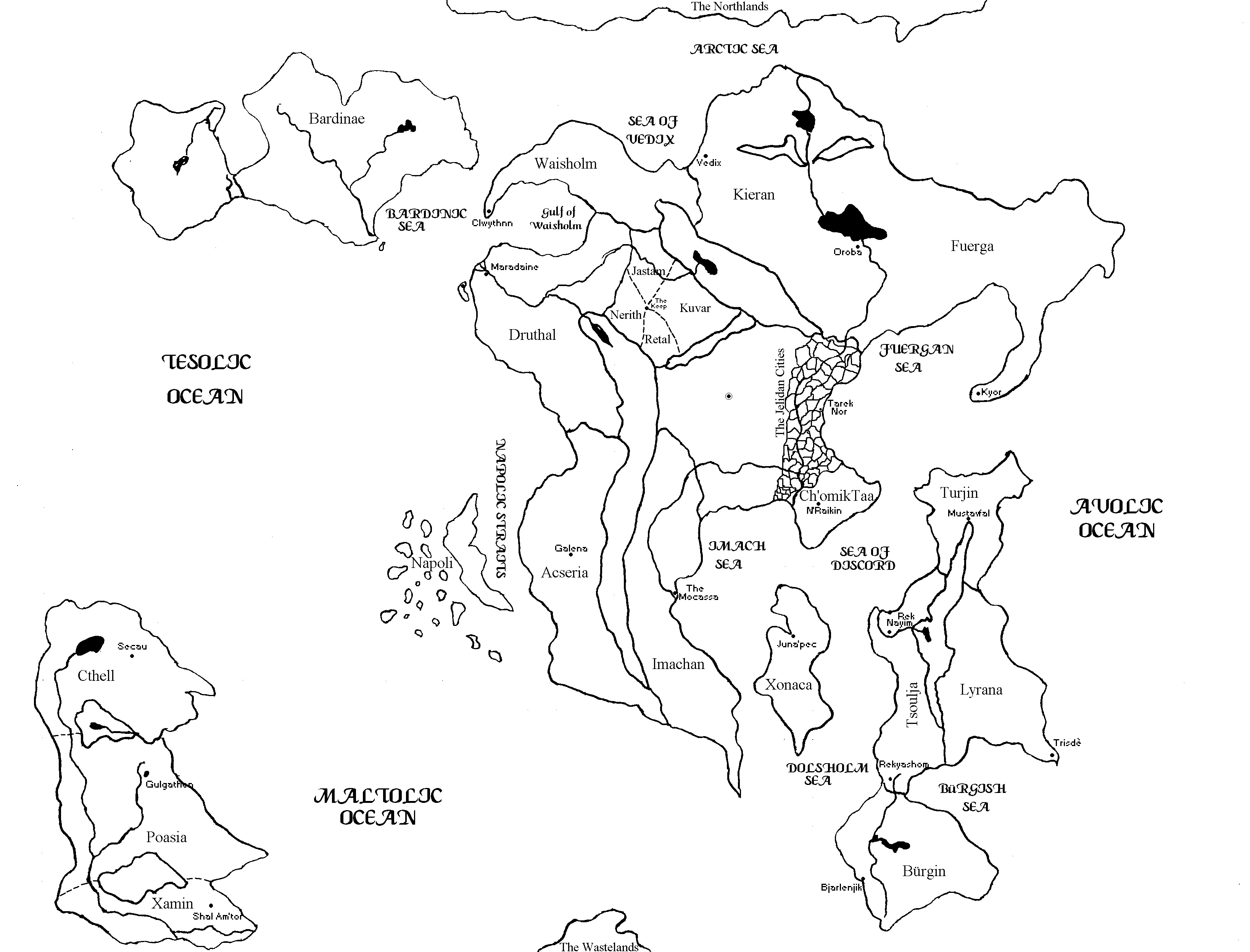 As to the process itself: Dan and I hashed out the real broad-brushstrokes, soft-import, high-concept stuff of each nation/cultural area. Then we came up with tour National Document template-- something I want to rework to a degree, but that's neither here nor there-- which I would use to write up each nation*, and then pass it off to him. He'd tear into it, usual with questions about specifics, which would help us drag each culture away from its broad-brushstrokes, soft-import, high-concept origins and give it something unique.
In the case of Waisholm, a big aspect was making it something that Druthal wasn't. Druthal is a parliamentary monarchy, a relative enlightened state for a fantasy/renaissance type of culture, and I wanted Waisholm to be... not so much harsher, but further back on that path. And more to the point, a place where small-group insularity and in-fighting was the main thing holding them back. So this required the throne to be a weak title compared to the local lords, and a place where "civil wars" are a relatively common part of their history. So this required creating a government system where fealty and identity function strongest at the local level.
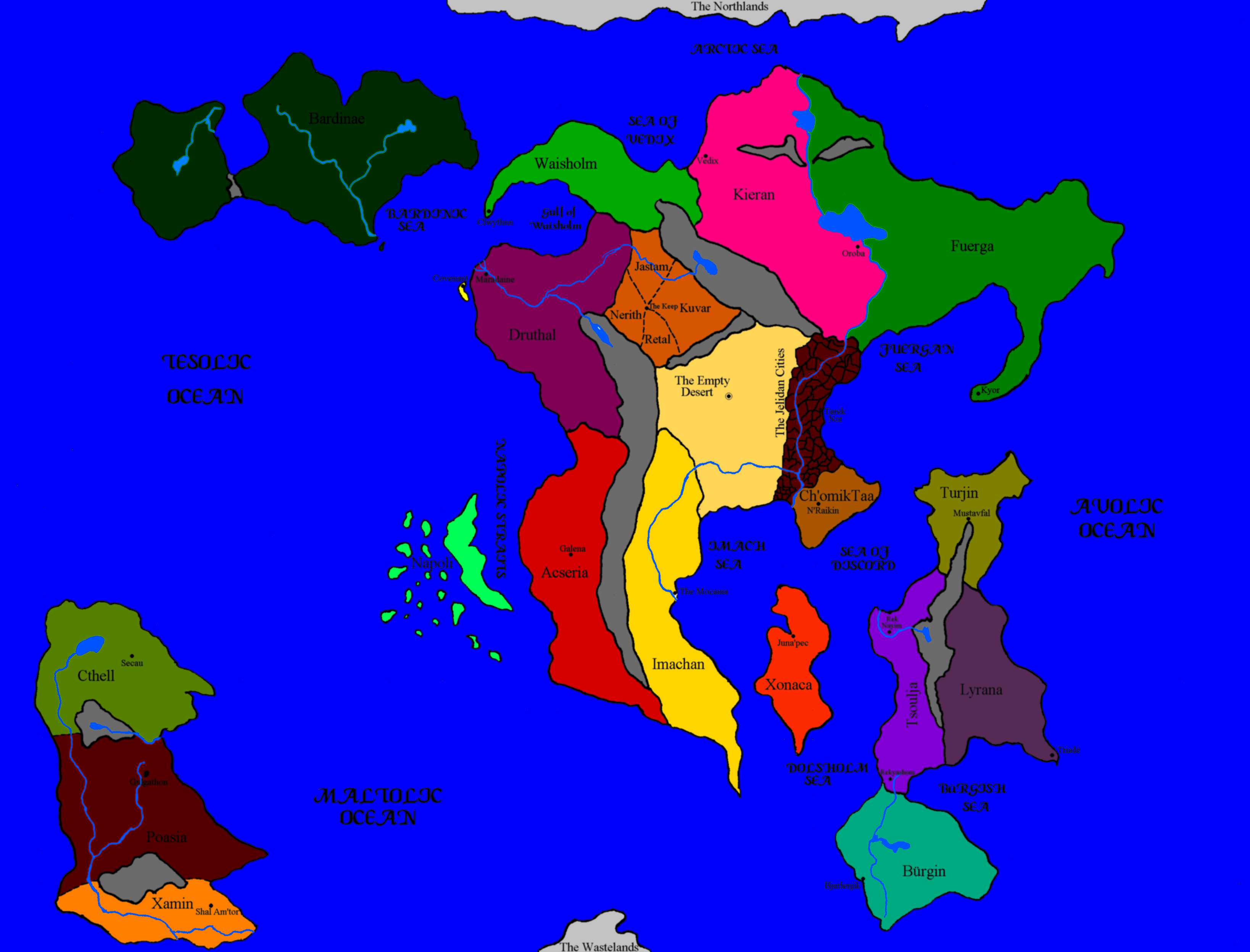
The question was about achieving that level of detail, which I attribute to the national document, which is relatively comprehensive (what I posted came from sections on government, military, law and criminal activity, for example), and it went through that question-and-respond process to make it stronger.
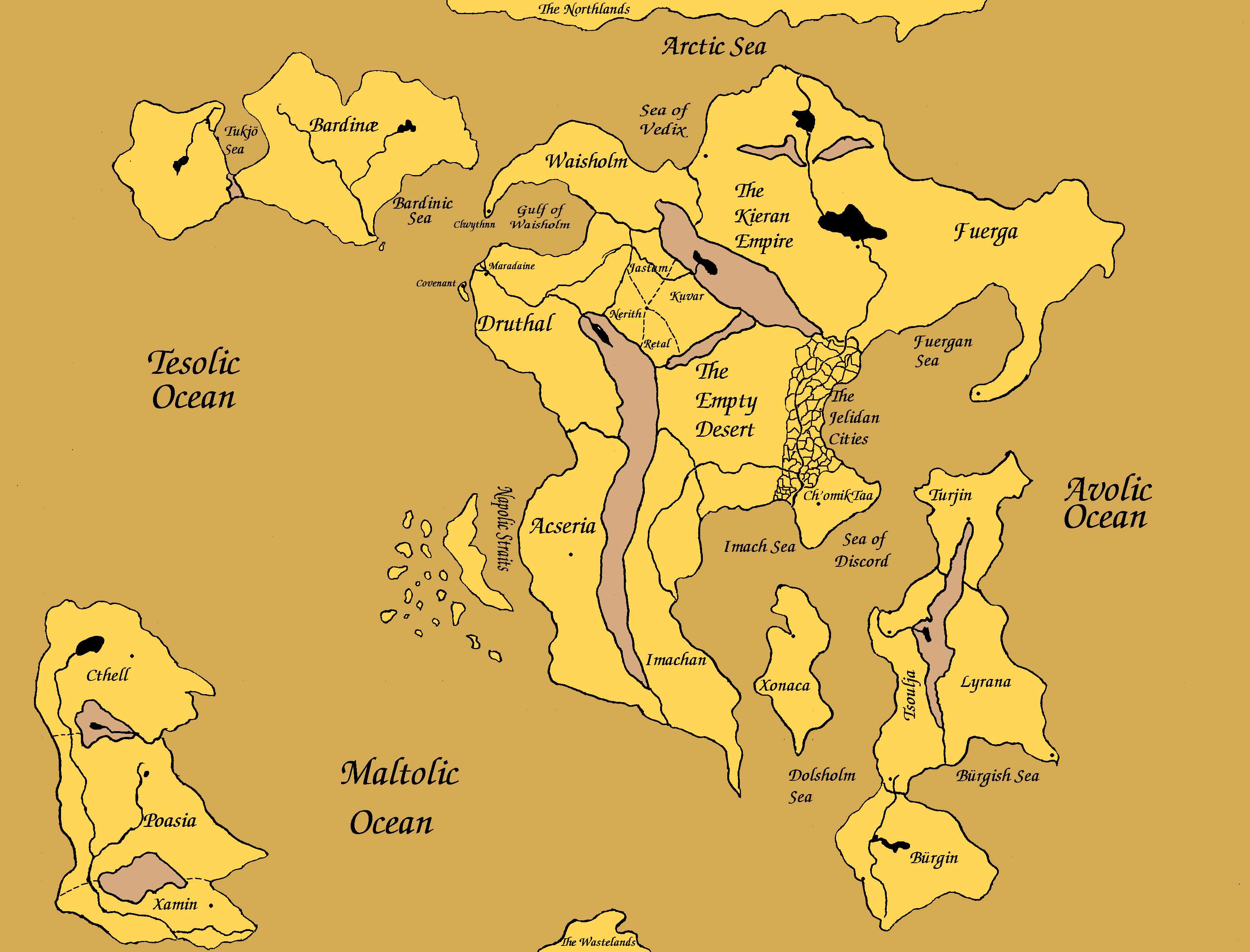 The maps have had a long history-- the initial map started nearly twenty years ago, hand-drawn of the whole world. I eventually got that scanned (and this was in the 90s, where "getting something scanned" meant going to Kinkos and giving them your 3.5" disk to put the scan on), and started making more detailed maps of each respective part. Over the course of time, as the capabilities of the computers and drawing programs I had access to improved, so did the details of the maps.
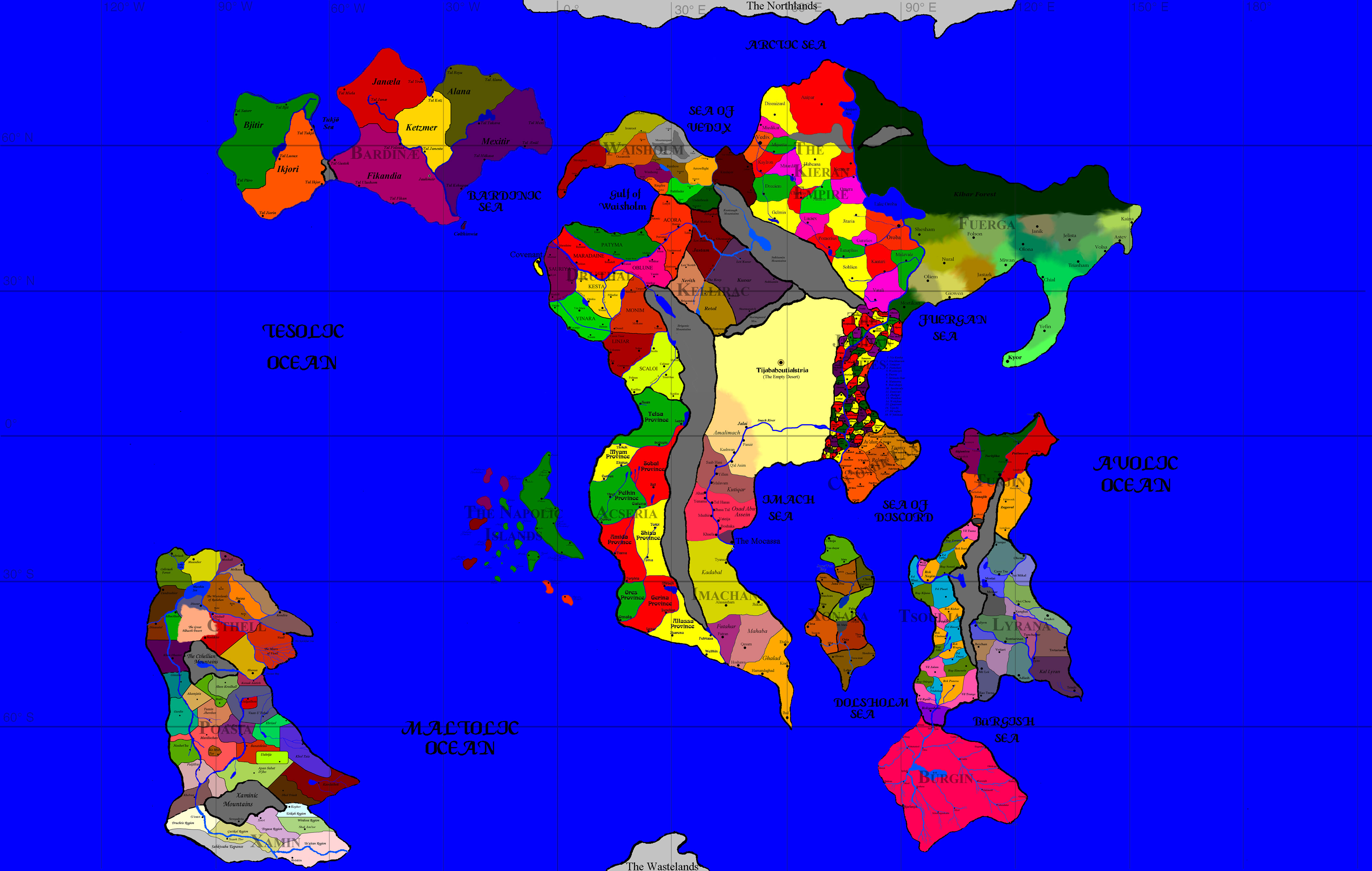
So maps that had their origins in hand-drawn, followed by MS Paint, have now been worked over in PhotoShop 6. There are some that I haven't updated as much as others, of course-- Druthal itself has had the most evolution-- but on the whole it's a far more advanced and detailed work. And, more to the point, more advanced and detailed than it could have been back then. Somewhere in the house I still have the 3.5" floppies that have zipped-up files of the maps-- i.e. it took multiple disks and compression to carry it all. Now I have map files that would have made the old computer explode.
--
*- There are a few nations he did the initial write-up of, though I don't recall which ones off the top of my head.
I loved the level of detail that you spent on the government. Do you have a process that you use? Perhaps you can write it down and share it with your peers?
So, in this case, I've been particular blessed to have a worldbuild/brainstorm partner, in Dan Fawcett. Dan is far more of an academic than I am, and while I'm pretty good at the research side of worldbuilding, he's really the master. He's the one who first turned me on to Jared Diamond's works Guns, Germs & Steel and Collapse, both of which I consider required reading for worldbuilders.
As to the process itself: Dan and I hashed out the real broad-brushstrokes, soft-import, high-concept stuff of each nation/cultural area. Then we came up with tour National Document template-- something I want to rework to a degree, but that's neither here nor there-- which I would use to write up each nation*, and then pass it off to him. He'd tear into it, usual with questions about specifics, which would help us drag each culture away from its broad-brushstrokes, soft-import, high-concept origins and give it something unique.In the case of Waisholm, a big aspect was making it something that Druthal wasn't. Druthal is a parliamentary monarchy, a relative enlightened state for a fantasy/renaissance type of culture, and I wanted Waisholm to be... not so much harsher, but further back on that path. And more to the point, a place where small-group insularity and in-fighting was the main thing holding them back. So this required the throne to be a weak title compared to the local lords, and a place where "civil wars" are a relatively common part of their history. So this required creating a government system where fealty and identity function strongest at the local level.
The question was about achieving that level of detail, which I attribute to the national document, which is relatively comprehensive (what I posted came from sections on government, military, law and criminal activity, for example), and it went through that question-and-respond process to make it stronger.
How did you create the actual map?
So maps that had their origins in hand-drawn, followed by MS Paint, have now been worked over in PhotoShop 6. There are some that I haven't updated as much as others, of course-- Druthal itself has had the most evolution-- but on the whole it's a far more advanced and detailed work. And, more to the point, more advanced and detailed than it could have been back then. Somewhere in the house I still have the 3.5" floppies that have zipped-up files of the maps-- i.e. it took multiple disks and compression to carry it all. Now I have map files that would have made the old computer explode.
--
*- There are a few nations he did the initial write-up of, though I don't recall which ones off the top of my head.
Thursday, April 18, 2013
Worldbuilding: Cultural Rituals and Coming of Age
I just turned 40, and my son just turned 13, which has me thinking of significant milestones and coming of age. We make a big deal out of turning 40, of course, and 13 is considered at least a gateway into adulthood.
When I was 13, I went to several bar- and bat-mitzvahs (and one b'nai mitzvah), and I always found the highly ritualized element of "and now you are an adult" fascinating. Of course, in that case, it was partly fascinating because, on many levels, it was just about the ritual. My friends weren't expected to get their own apartments and get jobs, after all: they were only 13.
How a culture deals with that transition into adulthood can be a fun bit of worldbuilding. It can be something very specialized and ritualized, or it can be a casual observance. Here in North America, the tradition of a Sweet Sixteen/Quinceñera party is more the latter, but it says the same thing: you are (nominally) an adult now.
In Druthal, it's not much of an observance at all. Druths tend to be a practical, unsentimental people, so it's mostly understood that at 15 you start some sort of work or higher schooling. In Thorn, Veranix is 17 and is in his third year at the University of Maradaine. In Maradaine Constabulary, one of Minox's younger brothers is 15, and he's just started as page in the constabulary-- the traditional form of apprenticeship before becoming a proper patrolman.
Other cultures on that world have more specialized methods of marking their coming of age. In Acseria, a theocratic state, there is the Rite of Declaration, where a young adult commits themselves to one of the specific sects of the church, as well as claiming their "adult" name. These two choices are, of course, deeply personal, and represent the child's readiness to be their own adult person.
Another culture with a highly ritualized coming-of-age process is the Bardinæ, who are divided into clans. Clan affiliation is not finalized until the age of thirteen, when children and their clan-guardians take a pilgrimage to the holy city of Jaukmeira, and each child is allowed-- for the only time in their life-- to touch the Jaukmeir, the great sacrosanct obelisk in the center of the city. From touching the Jaukmeir, they then declare to either join their clan or be one of the Yja, the clanless holy men. If they choose their clan, then the mark of that clan is tattooed onto their face.*
 However, my favorite tradition comes from the Bürgin, a culture of loose city-states. Bürgin is the farther southern part of its continent, close to the antarctic circle, and it's filled with nearly-frozen rivers. These rivers are the life-blood of the culture: the source of food, trade and power. So if you're a child the community believes is ready to be considered an adult, the ritual is very simple: they throw you in the river.
If you manage to survive and swim to shore: congratulations. You're an adult. If not, you weren't ready. Too bad.
--
*- Since children aren't marked as being in a clan, it is a tradition amongst the Bardinæ to kidnap children from rival clans, and then deliver them to the Jaukmeir as their own.
When I was 13, I went to several bar- and bat-mitzvahs (and one b'nai mitzvah), and I always found the highly ritualized element of "and now you are an adult" fascinating. Of course, in that case, it was partly fascinating because, on many levels, it was just about the ritual. My friends weren't expected to get their own apartments and get jobs, after all: they were only 13.
How a culture deals with that transition into adulthood can be a fun bit of worldbuilding. It can be something very specialized and ritualized, or it can be a casual observance. Here in North America, the tradition of a Sweet Sixteen/Quinceñera party is more the latter, but it says the same thing: you are (nominally) an adult now.
In Druthal, it's not much of an observance at all. Druths tend to be a practical, unsentimental people, so it's mostly understood that at 15 you start some sort of work or higher schooling. In Thorn, Veranix is 17 and is in his third year at the University of Maradaine. In Maradaine Constabulary, one of Minox's younger brothers is 15, and he's just started as page in the constabulary-- the traditional form of apprenticeship before becoming a proper patrolman.
Other cultures on that world have more specialized methods of marking their coming of age. In Acseria, a theocratic state, there is the Rite of Declaration, where a young adult commits themselves to one of the specific sects of the church, as well as claiming their "adult" name. These two choices are, of course, deeply personal, and represent the child's readiness to be their own adult person.
Another culture with a highly ritualized coming-of-age process is the Bardinæ, who are divided into clans. Clan affiliation is not finalized until the age of thirteen, when children and their clan-guardians take a pilgrimage to the holy city of Jaukmeira, and each child is allowed-- for the only time in their life-- to touch the Jaukmeir, the great sacrosanct obelisk in the center of the city. From touching the Jaukmeir, they then declare to either join their clan or be one of the Yja, the clanless holy men. If they choose their clan, then the mark of that clan is tattooed onto their face.*
 However, my favorite tradition comes from the Bürgin, a culture of loose city-states. Bürgin is the farther southern part of its continent, close to the antarctic circle, and it's filled with nearly-frozen rivers. These rivers are the life-blood of the culture: the source of food, trade and power. So if you're a child the community believes is ready to be considered an adult, the ritual is very simple: they throw you in the river.
If you manage to survive and swim to shore: congratulations. You're an adult. If not, you weren't ready. Too bad.
--
*- Since children aren't marked as being in a clan, it is a tradition amongst the Bardinæ to kidnap children from rival clans, and then deliver them to the Jaukmeir as their own.
Monday, February 4, 2013
Worldbuilding: Art and Culture in the Fantasy World
The most fundamental way to define a culture is through its art. Geography, food, religion, technology and government are critical as well, of course, but none of those quite get to the soul of a people in the same way. With fantasy fiction, we're mostly dealing with forms of art of limited technology: painting, sculpture, architecture, music, poetry, literature and theater.
Music tends to be the way many fantasy writers go, to the point of cliché. Especially with songs. This is probably one of the quirks of genre that we inherited from Tolkien. Let's face it, Tolkien loved his songs. Personally, when I was reading him, whenever I saw indented, italicized text, I knew it was time to skip ahead a bit. The same thing with poetry. Now, part of the reason why these parts of a book seem so disposable is because the writers are not the poets/songsmiths of the ages that the work purports them to be. It's one thing to say that a poem is a soulcrushing work of rhyme and meter that drives men to tears; it's another to actually write it. I could do without it, personally. I could also do without mention of lutes or mandolins.*
Painting, sculpture and architecture, I'll admit, are a little out of my ken. Especially architecture. For painting and sculpture, I tend to go in the direction of what they depict, rather than how they're depicted. That's a nice way to drop a little worldbuilding history into the mix without it being as much of an infodump. At the very least, having your characters seeing a painting or statue of a former king gives a slightly more organic way to drop in some background.
Literature and theater are my favorite, though I tend to again go for what such pieces are about (and what that says about the culture) over trying to come up with excerpts. In Thorn of Dentonhill, I have a snippet of dialogue from Three Men and Two Wives, which is going on in the background while Veranix is searching for someone in the public square. Three Men and Two Wives is one of the ribald comedies of Darren Whit, a playwright from the previous century that I occasionally mention that is the Druth equivalent of Shakespeare**. At a different point, I have Kaiana quoting from one of Whit's history plays, Queen Mara. But, again, only snippets. And in Holver Alley Crew, there's mention of the banned play The Marriage of the Jester, which is being performed in an especially shabby part of town. While Three Men and Two Wives is a lusty, romantic farce (filled with crossdressing and confused identity), The Marriage of the Jester is little more than smut, presented to give the audience a cheap thrill, or for a little more coin, the opportunity to join in.
I have to admit, I have fun just brainstorming potential play titles.
I intend to include a little bit of loftier theatre in Way of the Shield-- perhaps even an opera, if I can make it work. Amanda Downum's The Bone Palace has a nice bit where her main characters go to the opera, and it's the blood-soaked tragedy kind.
The other element I'm interested in adding to the mix is the use of magic in creating art. I've hinted around that in Way of the Shield as well. Still pondering that. It's something I'd like to do, but at the same time, I don't want to stop the story dead in its tracks just to include it.
---
*- Yes, historical, but they also come off as Fantasy Clichés.
**- I also have some equivalents to Jonson, Marlowe and Webster. Definitely Webster. The Druth do so love a blood-soaked tragedy. Especially since Whit was rarely a tragedist.
Music tends to be the way many fantasy writers go, to the point of cliché. Especially with songs. This is probably one of the quirks of genre that we inherited from Tolkien. Let's face it, Tolkien loved his songs. Personally, when I was reading him, whenever I saw indented, italicized text, I knew it was time to skip ahead a bit. The same thing with poetry. Now, part of the reason why these parts of a book seem so disposable is because the writers are not the poets/songsmiths of the ages that the work purports them to be. It's one thing to say that a poem is a soulcrushing work of rhyme and meter that drives men to tears; it's another to actually write it. I could do without it, personally. I could also do without mention of lutes or mandolins.*
Painting, sculpture and architecture, I'll admit, are a little out of my ken. Especially architecture. For painting and sculpture, I tend to go in the direction of what they depict, rather than how they're depicted. That's a nice way to drop a little worldbuilding history into the mix without it being as much of an infodump. At the very least, having your characters seeing a painting or statue of a former king gives a slightly more organic way to drop in some background.
Literature and theater are my favorite, though I tend to again go for what such pieces are about (and what that says about the culture) over trying to come up with excerpts. In Thorn of Dentonhill, I have a snippet of dialogue from Three Men and Two Wives, which is going on in the background while Veranix is searching for someone in the public square. Three Men and Two Wives is one of the ribald comedies of Darren Whit, a playwright from the previous century that I occasionally mention that is the Druth equivalent of Shakespeare**. At a different point, I have Kaiana quoting from one of Whit's history plays, Queen Mara. But, again, only snippets. And in Holver Alley Crew, there's mention of the banned play The Marriage of the Jester, which is being performed in an especially shabby part of town. While Three Men and Two Wives is a lusty, romantic farce (filled with crossdressing and confused identity), The Marriage of the Jester is little more than smut, presented to give the audience a cheap thrill, or for a little more coin, the opportunity to join in.
I have to admit, I have fun just brainstorming potential play titles.
I intend to include a little bit of loftier theatre in Way of the Shield-- perhaps even an opera, if I can make it work. Amanda Downum's The Bone Palace has a nice bit where her main characters go to the opera, and it's the blood-soaked tragedy kind.
The other element I'm interested in adding to the mix is the use of magic in creating art. I've hinted around that in Way of the Shield as well. Still pondering that. It's something I'd like to do, but at the same time, I don't want to stop the story dead in its tracks just to include it.
---
*- Yes, historical, but they also come off as Fantasy Clichés.
**- I also have some equivalents to Jonson, Marlowe and Webster. Definitely Webster. The Druth do so love a blood-soaked tragedy. Especially since Whit was rarely a tragedist.
Subscribe to:
Posts (Atom)