As I've said before, when it comes to worldbuilding on an interstellar scale, your neighbors' choices can define your culture. This is especially true when a starfaring culture comes across a planetbound culture, because the starfaring culture is in complete control of defining the relationship it has with the planetbound culture.
So when I'm looking at my maps, when I see that a starfaring culture is going to come across a planetbound culture, I ask myself: what are they going to do?
Ignore: Let's face it, an alien species might fly by a planet, observe that a thriving-but-primitive culture exists on that planet... and shrug and move on. It's just not something that interests them.
Look, but don't touch: Here, the starfaring aliens show a bit of curiosity, observing the culture but not interfering with the planetbound species. At its heart, this is what Star Trek's Prime Directive is about.
Look, but don't... okay, touch a little: Like the above, but let's face it, to really understand the biology of an alien species, you're going to have to grab a few, poke and prod a little, run some tests, and then tag and release. And, hey, there are several billion of them down there, it's not like they'll really miss a few dozen, right? And it's for science, after all.
Preserve and Protect: This is taking "Ignore" or "Look But Don't Touch" to a more active level. Not only is one choosing to keep a planetbound culture uncontaminated, but they will defend it to keep anyone else from getting their filthy appendages on it.
Greet and Welcome: This is more or less the opposite of not contaminating the culture... it's showing up with the fruitbasket and saying hi, friendly-like, and being willing to let the planetbound species take that information and process it how they will.
Missionary: Look, these primitive people need help, you see? We're going to go down there and show them how to not make the mistakes we did, or teach them the best ways to make clean energy, maximize food yields, and educate their young properly. Look, it's for their own good.
Play God: Sure, the "missionary" method is nice, but it's inefficient. After all, you pretty much are like gods to these primitives, so just embrace that. Make a few proclamations from on high.
Open Trade Routes: Like "Greet and Welcome", you recognize the validity of this primitive culture, and are willing to treat them fairly in bringing them into an interstellar community. Or, you know, relatively fairly.
Benevolent Integration: The next level of Open Trade Routes, the primitive culture is welcomed, and brought into the interstellar community, as citizens of a protectorate of your empire.
Hostile Integration: AKA "Conquer".
Colonize: Just because this planet is inhabited doesn't mean we can't build here. The beaches are lovely, and they aren't using most of the resources they have! They don't even know what Lerian Quartz Crystals are for, so they won't miss them when we set up the mining facility. And these natives are just so adorable, hopefully they won't make much fuss.
Eradicate: The planet would be perfect for colonization, were it not for the infestation. Open fire.
Look and Touch. A lot.: These genetic experiments have to be done somewhere, right?
Any options I missed? Let me know.
Monday, October 8, 2012


Thursday, October 4, 2012
Being Too Aware of the Gearwork
Last weekend I went to see two plays. Frankly, neither one was worth my time. But in very different ways.
One was just plain bad. It was ostensibly a children's play, but the kind of children's play that makes the assumption that kids are just morons and a vague mish-mash of music, gyration and animal masks is all you need to capture their attention. It was just a failure, but the kind of failure that most anyone watching would have been aware of. A pure, unfiltered F.
The other one was more subtle in its problems. For me, it was a B-/C+, where a problematic script was held up by strong performances.* But the script problems were ones that were obvious to me-- or at least to my particular tastes and proclivities-- because I've had experience in playwrighting to know what I'm looking at when I lift up the hood to check out the engine.
There is a writing tick I see a lot in plays, and it bothers me immensely. Usually, it takes the form of a "thing", be it a moment of shared history, a mutual secret, or knowledge of an upcoming event, that informs the emotional threads of the characters or the entire plot. Now, a lot of the time, characters just Don't Talk About the thing. Where it becomes a problem, at least for me, is when you have characters Talk About Not Talking About It, aka the Dance Of Vague References. You know you've seen it.
Joe: I have to say, it's nice to fly First Class.
Bob: True, but I've done it once before.
Joe: You have? When? Was it... that trip?
Bob: That... oh, no. Different time. But anyway....
Ideally, this sort of thing can be used to set up a mystery or plot point, foreshadowing its revelation later: the gun hanging on the wall in the first act is fired in the third act. However, in its inartful, clunky usage (which is often), you are essentially having characters screaming, "LOOK AT THE GUN ON THE WALL! LOOK AT IT! I WONDER IF ANYONE WILL SHOOT IT LATER?"
The first half of the play was essentially littered with the three characters pasting a whole arsenal of guns on the wall, many of which were fired in the back half by the use of a direct-to-audience monologue.
Now, maybe it's just me, that I'm aware of how these things work, that I can't not see the internal workings, and that just plain ruins a lot of theatre for me. Oddly, not movies or TV, even though often the same ticks apply. I wonder if that's because I hold live theatre to a higher standard, or is it because the nature of stagecraft makes it harder to balance gravity and importance with subtlety.
---
*- As much as I like to believe that text is the most crucial aspect of a play, the truth is an excellent performance can bring a mediocre script out of the depths, and even a fantastic script will be lost if the actors can't do the heavy lifting.
One was just plain bad. It was ostensibly a children's play, but the kind of children's play that makes the assumption that kids are just morons and a vague mish-mash of music, gyration and animal masks is all you need to capture their attention. It was just a failure, but the kind of failure that most anyone watching would have been aware of. A pure, unfiltered F.
The other one was more subtle in its problems. For me, it was a B-/C+, where a problematic script was held up by strong performances.* But the script problems were ones that were obvious to me-- or at least to my particular tastes and proclivities-- because I've had experience in playwrighting to know what I'm looking at when I lift up the hood to check out the engine.
There is a writing tick I see a lot in plays, and it bothers me immensely. Usually, it takes the form of a "thing", be it a moment of shared history, a mutual secret, or knowledge of an upcoming event, that informs the emotional threads of the characters or the entire plot. Now, a lot of the time, characters just Don't Talk About the thing. Where it becomes a problem, at least for me, is when you have characters Talk About Not Talking About It, aka the Dance Of Vague References. You know you've seen it.
Joe: I have to say, it's nice to fly First Class.
Bob: True, but I've done it once before.
Joe: You have? When? Was it... that trip?
Bob: That... oh, no. Different time. But anyway....
Ideally, this sort of thing can be used to set up a mystery or plot point, foreshadowing its revelation later: the gun hanging on the wall in the first act is fired in the third act. However, in its inartful, clunky usage (which is often), you are essentially having characters screaming, "LOOK AT THE GUN ON THE WALL! LOOK AT IT! I WONDER IF ANYONE WILL SHOOT IT LATER?"
The first half of the play was essentially littered with the three characters pasting a whole arsenal of guns on the wall, many of which were fired in the back half by the use of a direct-to-audience monologue.
Now, maybe it's just me, that I'm aware of how these things work, that I can't not see the internal workings, and that just plain ruins a lot of theatre for me. Oddly, not movies or TV, even though often the same ticks apply. I wonder if that's because I hold live theatre to a higher standard, or is it because the nature of stagecraft makes it harder to balance gravity and importance with subtlety.
---
*- As much as I like to believe that text is the most crucial aspect of a play, the truth is an excellent performance can bring a mediocre script out of the depths, and even a fantastic script will be lost if the actors can't do the heavy lifting.
Monday, October 1, 2012
In which I channel my madness
So I had reached the point where the floodwaters of my creative process couldn't take further damming, and the levees were going to break. This would have probably resulted in full-on madness. It would not have been productive.
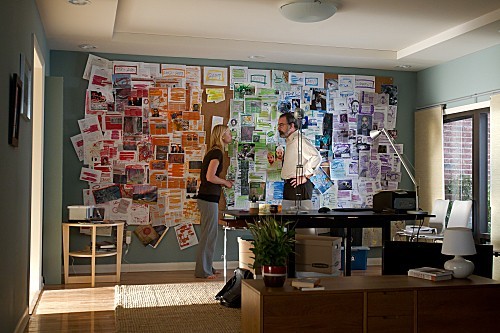
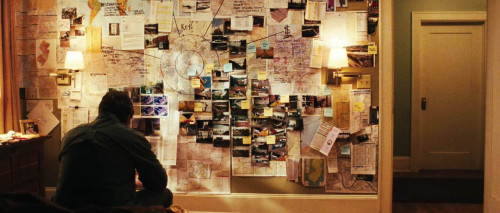
So I channeled it, knowing that I should go with that urge to make a Wall of Crazy to help figure out Way of the Shield, in a way I can visualize, get my hands on it in a tactile way. If I actually went true WALL of crazy, my wife would probably not approve. So I dug through the garage and found a large board.
 And now it all makes perfect sense.
OK, not really, but it makes more sense to me, and that's what matters. It also helped me see why I was having such challenges making things work.
Every project, of course, has a different process to midwife it, and this one has been especially trying. Sometimes it's about figuring out the flaw in the center of the second act. Sometimes it's just about finding the right music to work to.
I once wrote a short story once that would not come out until I was listening to a mix of Madonna, Britney, Pink and Lady Gaga. This is not what I normally listen to, but it was what made that story come together. I honestly do not understand it. I just accepted it.
And, hey, you can read that story, if you're so inclined, since it's in the anthology The Protectors, now available on Amazon and Barnes & Noble.
So I channeled it, knowing that I should go with that urge to make a Wall of Crazy to help figure out Way of the Shield, in a way I can visualize, get my hands on it in a tactile way. If I actually went true WALL of crazy, my wife would probably not approve. So I dug through the garage and found a large board.

OK, not really, but it makes more sense to me, and that's what matters. It also helped me see why I was having such challenges making things work.
Every project, of course, has a different process to midwife it, and this one has been especially trying. Sometimes it's about figuring out the flaw in the center of the second act. Sometimes it's just about finding the right music to work to.
I once wrote a short story once that would not come out until I was listening to a mix of Madonna, Britney, Pink and Lady Gaga. This is not what I normally listen to, but it was what made that story come together. I honestly do not understand it. I just accepted it.
And, hey, you can read that story, if you're so inclined, since it's in the anthology The Protectors, now available on Amazon and Barnes & Noble.
Thursday, September 27, 2012
Reliability: The Writer's Most Crucial Trait
Back at the ArmadilloCon Writers' Workshop, one piece of advice I felt comfortable dispensing to the crowd of students was about any social media presence they might have. Namely, I said, "If you're going to have a blog, then have a blog." It's advice I live by: I've steadily posted here twice a week for a year and a half, and here I am with my 250th entry. But the reasoning behind my advice is this: if you're going to have a presence online as a writer (and you should, and you should be building it before you really "make a name" for yourself), then make sure your presence is one that shows you as a person who gets stuff done, regularly and systematically.
I know when I've had to research fledgling writers, there's nothing quite as disappointing as finding their blog with only a handful of haphazard entries, like thirteen scattered over the course of a year. Or with a flurry of daily entries for about three weeks, that then tapers off to an unpredictable drip. These things show me that a writer cannot follow through, or that they are incredibly unfocused. If I were a publisher or an agent, and I found that, I would be highly disinclined to sign with such a person, regardless of their talent.
For example, I read a fair amount of media tie-in books as my "popcorn" reading. There is one particularly prolific author in the media tie-in world whose style... I'm not a fan of. But he keeps getting work. Why? I suspect the "prolific" part plays into it. He takes the job and gets it done. You can't deny the appeal of that.
Because when it comes down to it, reliability trumps talent in the business side of things. Not that talent isn't crucial as well, but looking at the business side, which would you rather have: someone who might give you something amazing, but you're not sure when (or if) you'll actually get it, or someone who will make every deadline and deliver something that's acceptable? Not brilliant or earthshattering... but perfectly fine. You need something on the shelves in October, so you want the job done, period.
Of course, ideally, one tries to be brilliant and reliable. Still working on that one.
I know when I've had to research fledgling writers, there's nothing quite as disappointing as finding their blog with only a handful of haphazard entries, like thirteen scattered over the course of a year. Or with a flurry of daily entries for about three weeks, that then tapers off to an unpredictable drip. These things show me that a writer cannot follow through, or that they are incredibly unfocused. If I were a publisher or an agent, and I found that, I would be highly disinclined to sign with such a person, regardless of their talent.
For example, I read a fair amount of media tie-in books as my "popcorn" reading. There is one particularly prolific author in the media tie-in world whose style... I'm not a fan of. But he keeps getting work. Why? I suspect the "prolific" part plays into it. He takes the job and gets it done. You can't deny the appeal of that.
Because when it comes down to it, reliability trumps talent in the business side of things. Not that talent isn't crucial as well, but looking at the business side, which would you rather have: someone who might give you something amazing, but you're not sure when (or if) you'll actually get it, or someone who will make every deadline and deliver something that's acceptable? Not brilliant or earthshattering... but perfectly fine. You need something on the shelves in October, so you want the job done, period.
Of course, ideally, one tries to be brilliant and reliable. Still working on that one.
Monday, September 24, 2012
Writers' Tools: The practical, actual tools
I won't lie: as a science-fiction writer, I love living in the future. Not just because of the pure gadgetry of it, though that is cool*, but how much easier it is to be a novelist today then it was just twenty-five years ago. But the main thing I have is the ability to work quickly and easily, with a lot of mobility. Here are my tools, both hardware and software.
HARDWARE
Computer: I've got a MacBook Pro laptop, which is where I do most of my writing. For the most part, I use it on the shared office table where I work with my wife, the two of us sitting across from each other. But my ability to work just about anywhere is something I prize greatly. I think a good chunk of the rough draft of Maradaine Constabulary was written in the car in a drive out to West Texas. For someone who grew up with the idea of a "computer" being a rather bulky thing that lived, planted in a workspace, that's still pretty incredible, even if we now take it for granted.
Bluetooth Headphones: I need music to write. And sharing my primary workspace with my wife, she doesn't always need my music. Plus there's something I find very focusing in having the music be right in my ears. Frankly, I have an imaginative brain that is easily distracted my shiny things, so music gives that distraction-hungry part of my brain something to grasp onto.**
Portable Laptop Station: Handy device that elevates my laptop so it's less straining on my eyes and wrists. I love this thing. If you're interested, google its SKU*** number: UB2400-25J. Well worth it, in my opinion.
SOFTWARE
At any given point, I'm running the following:
Scrivener: This is my go-to writing program, and I find it very useful for writing, editing and outlining. My only complaint is the corkboard/research functions don't let you go full-on Wall Of Crazy. If someone has written a Wall of Crazy program, please let me know. I would be all over that. Because, let's face it, even as dedicated outliner/planner, it's not always a sane or linear process.
Freedom: Yeah, that distraction-hungry brain of mine? Sometimes I just have to starve it, and that means just shutting the damn internet off.
Excel: I may have mentioned my love of spreadsheets. Especially to keep track of 4.2 million cubic lightyears worth of space.
ChView: My beloved, if outdated and unsupported star mapping program.
iTunes: To play music for said headphones.
--
*- I mean, come on. I have a device that I carry in my pocket that allows me to have a live video call with someone on the other side of the world, at no extra cost to its standard use. Plus it carries several hundred songs. I have another device that I can easily carry in my bag, with which I can decide I want to read a certain book, press a few buttons and start reading it. I can tell you, 1987 me would have flipped at that. 1987 me had a calculator watch and thought that was freaking amazing, so he might not be the best judge. 1987 me also had every episode of Star Trek on fourteen VHS tapes. DVR would have blown his mind. Sure, I can't do a quick jaunt to a space station, but as far as 1987 me is concern, I am living in Science Fiction.
**- Seriously, do you have any idea how many times I've switched tabs and read a few paragraphs of something while writing this?
***- One job I held, back in the Wild West days of the internet, was to take a bunch of SKU-- Stock Keeping Unit-- numbers, and then with pre-Google search engines, try and classify and categorize those various items, as well as dig up some standardized specifications. I don't think that company stayed in business very long.
HARDWARE
Computer: I've got a MacBook Pro laptop, which is where I do most of my writing. For the most part, I use it on the shared office table where I work with my wife, the two of us sitting across from each other. But my ability to work just about anywhere is something I prize greatly. I think a good chunk of the rough draft of Maradaine Constabulary was written in the car in a drive out to West Texas. For someone who grew up with the idea of a "computer" being a rather bulky thing that lived, planted in a workspace, that's still pretty incredible, even if we now take it for granted.
Bluetooth Headphones: I need music to write. And sharing my primary workspace with my wife, she doesn't always need my music. Plus there's something I find very focusing in having the music be right in my ears. Frankly, I have an imaginative brain that is easily distracted my shiny things, so music gives that distraction-hungry part of my brain something to grasp onto.**
Portable Laptop Station: Handy device that elevates my laptop so it's less straining on my eyes and wrists. I love this thing. If you're interested, google its SKU*** number: UB2400-25J. Well worth it, in my opinion.
SOFTWARE
At any given point, I'm running the following:
Scrivener: This is my go-to writing program, and I find it very useful for writing, editing and outlining. My only complaint is the corkboard/research functions don't let you go full-on Wall Of Crazy. If someone has written a Wall of Crazy program, please let me know. I would be all over that. Because, let's face it, even as dedicated outliner/planner, it's not always a sane or linear process.
Freedom: Yeah, that distraction-hungry brain of mine? Sometimes I just have to starve it, and that means just shutting the damn internet off.
Excel: I may have mentioned my love of spreadsheets. Especially to keep track of 4.2 million cubic lightyears worth of space.
ChView: My beloved, if outdated and unsupported star mapping program.
iTunes: To play music for said headphones.
--
*- I mean, come on. I have a device that I carry in my pocket that allows me to have a live video call with someone on the other side of the world, at no extra cost to its standard use. Plus it carries several hundred songs. I have another device that I can easily carry in my bag, with which I can decide I want to read a certain book, press a few buttons and start reading it. I can tell you, 1987 me would have flipped at that. 1987 me had a calculator watch and thought that was freaking amazing, so he might not be the best judge. 1987 me also had every episode of Star Trek on fourteen VHS tapes. DVR would have blown his mind. Sure, I can't do a quick jaunt to a space station, but as far as 1987 me is concern, I am living in Science Fiction.
**- Seriously, do you have any idea how many times I've switched tabs and read a few paragraphs of something while writing this?
***- One job I held, back in the Wild West days of the internet, was to take a bunch of SKU-- Stock Keeping Unit-- numbers, and then with pre-Google search engines, try and classify and categorize those various items, as well as dig up some standardized specifications. I don't think that company stayed in business very long.
Thursday, September 20, 2012
Worldbuilding: Skip the Travelogue Plot. Just Write the Honest Travelogue.
In my worldbuilding efforts, I'm often trying to think of new ways to present the information about different places in dynamic and interesting ways. I've considered the wiki route, writing things up as if they were being presented in a dictionary.
My problem with that was narrowing the perspective, figuring out authorship. Perspective always has some bias, and even if the author is coming at things from, say, an academic perspective, it will still have bias. Even the attempt to maintain neutrality can create bias: it depends on who the author is.
This is my longwinded way of saying I attempted to write my worldbuilding documents "neutrally", but I never felt that worked.
Now, on top of that, in having done so much worldbuilding, I was first struck with the urge to go full on travelogue. As I've mentioned before, this can usually only give terrible results. If your story is driven by where people go, as opposed to why they go there, then the plot is going to feel inorganic.
Then it hit me: combine that urge with the exercises I talked about last time. Instead of writing a travelogue plot, where I make some poor attempt to string together a plot that serves the purpose of going from point A to B to C, why not just create a small group of academic characters, and have them write a travelogue. Journal entries of their perspective as they go from place to place. No pretense of plot. Just going around, experiencing culture, meeting people, trying the food.
Essentially, the fantasy (or space opera, depending) equivalent of No Reservations.
It wouldn't be a novel, of course. Or even a short story. It really wouldn't be more than for my own edification.
But, I think it would be a fun exercise. And it would be useful in knocking these cobwebs out of my creative centers.
Maybe, if I like them, I'll even post a few...
My problem with that was narrowing the perspective, figuring out authorship. Perspective always has some bias, and even if the author is coming at things from, say, an academic perspective, it will still have bias. Even the attempt to maintain neutrality can create bias: it depends on who the author is.
This is my longwinded way of saying I attempted to write my worldbuilding documents "neutrally", but I never felt that worked.
Now, on top of that, in having done so much worldbuilding, I was first struck with the urge to go full on travelogue. As I've mentioned before, this can usually only give terrible results. If your story is driven by where people go, as opposed to why they go there, then the plot is going to feel inorganic.
Then it hit me: combine that urge with the exercises I talked about last time. Instead of writing a travelogue plot, where I make some poor attempt to string together a plot that serves the purpose of going from point A to B to C, why not just create a small group of academic characters, and have them write a travelogue. Journal entries of their perspective as they go from place to place. No pretense of plot. Just going around, experiencing culture, meeting people, trying the food.
Essentially, the fantasy (or space opera, depending) equivalent of No Reservations.
It wouldn't be a novel, of course. Or even a short story. It really wouldn't be more than for my own edification.
But, I think it would be a fun exercise. And it would be useful in knocking these cobwebs out of my creative centers.
Maybe, if I like them, I'll even post a few...
Monday, September 17, 2012
Perils of the Writer: The Creative Freedom of Deleted Scenes
Of late, I've been a bit blocked, creatively. Not exactly writers' block-- but more a sense that the flow isn't what it should be. Even writing this is taking more effort than it ought to.
I know what part of the problem is. Space Opera has been crawling through my brain like a fungus, absorbing my focus away from the things I'm trying to finish. But it's still all setting, very little character or plot. Also, it's not what I'm "supposed" to be working on, in as much as I'm required to write any specific thing at this juncture.*
But more of the problem is just a general creative malaise. The juices are just stagnant, or at best only oozing when they should be bursting at the seams.
So, how to get past this? Part of what I do in times like this is more work on worldbuilding, and in a pinch, mapwork or other goofing around on photoshop**. This helps do a degree, changing the creative channels in my brain and shaking things up.
But this time, I think I need something else. Something to really blow the doors off my brain. I have almost a perverse urge to cover the walls in giant sheets of paper and start scrawling, in an explosion of brainstorming and long term planning. I like the pure visceral feeling of doing this, physically writing these things down. As much as I love working on my laptop and with Scrivener, there is something cathartic in actually writing things out.
I probably won't do that-- at least, not in a giant, take-over-the-walls way. I don't think my wife would approve.
But the other thing I can do is get a better grasp on these elements that are causing me trouble, especially with the space opera stuff. Character and plot are still eluding me, so some writing exercises to play around with these things might be in order. Not stories, not anything that have to have structure or beginnings or endings. Just vignettes, sequences, with no purpose beyond getting my head together. Deleted scenes that no one is going to read.
There's a lot of freedom in this. If you know you have no intentions of sale or audience, it's just for your own growth, you can be indulgent. Infodump like crazy. Have characters just chat, without the conversation having to mean something or drive the plot forward.
I think this can be a very helpful exercise, and might be just what I need to break through these blocks.
---
*- I would prefer to have at least a rough draft of Way of the Shield, so I have all four of my intended Heroes of Maradaine series started before I move into Space Opera proper. But a big part of this blockage is Dayne is not being a cooperative protagonist.
**- Frankly, this mostly serves to remind myself that I am not an artist.
I know what part of the problem is. Space Opera has been crawling through my brain like a fungus, absorbing my focus away from the things I'm trying to finish. But it's still all setting, very little character or plot. Also, it's not what I'm "supposed" to be working on, in as much as I'm required to write any specific thing at this juncture.*
But more of the problem is just a general creative malaise. The juices are just stagnant, or at best only oozing when they should be bursting at the seams.
So, how to get past this? Part of what I do in times like this is more work on worldbuilding, and in a pinch, mapwork or other goofing around on photoshop**. This helps do a degree, changing the creative channels in my brain and shaking things up.
But this time, I think I need something else. Something to really blow the doors off my brain. I have almost a perverse urge to cover the walls in giant sheets of paper and start scrawling, in an explosion of brainstorming and long term planning. I like the pure visceral feeling of doing this, physically writing these things down. As much as I love working on my laptop and with Scrivener, there is something cathartic in actually writing things out.
I probably won't do that-- at least, not in a giant, take-over-the-walls way. I don't think my wife would approve.
But the other thing I can do is get a better grasp on these elements that are causing me trouble, especially with the space opera stuff. Character and plot are still eluding me, so some writing exercises to play around with these things might be in order. Not stories, not anything that have to have structure or beginnings or endings. Just vignettes, sequences, with no purpose beyond getting my head together. Deleted scenes that no one is going to read.
There's a lot of freedom in this. If you know you have no intentions of sale or audience, it's just for your own growth, you can be indulgent. Infodump like crazy. Have characters just chat, without the conversation having to mean something or drive the plot forward.
I think this can be a very helpful exercise, and might be just what I need to break through these blocks.
---
*- I would prefer to have at least a rough draft of Way of the Shield, so I have all four of my intended Heroes of Maradaine series started before I move into Space Opera proper. But a big part of this blockage is Dayne is not being a cooperative protagonist.
**- Frankly, this mostly serves to remind myself that I am not an artist.
Subscribe to:
Posts (Atom)