Happy Thanksgiving, all. I've got pies and stuffing and turkey to make*, so I won't go on for too long on this post**. I had considered just linking to some past posts, like on worldbuilding holidays or food details. But I didn't want to be quite that lazy.
So: state of the writer, thankfulness version.
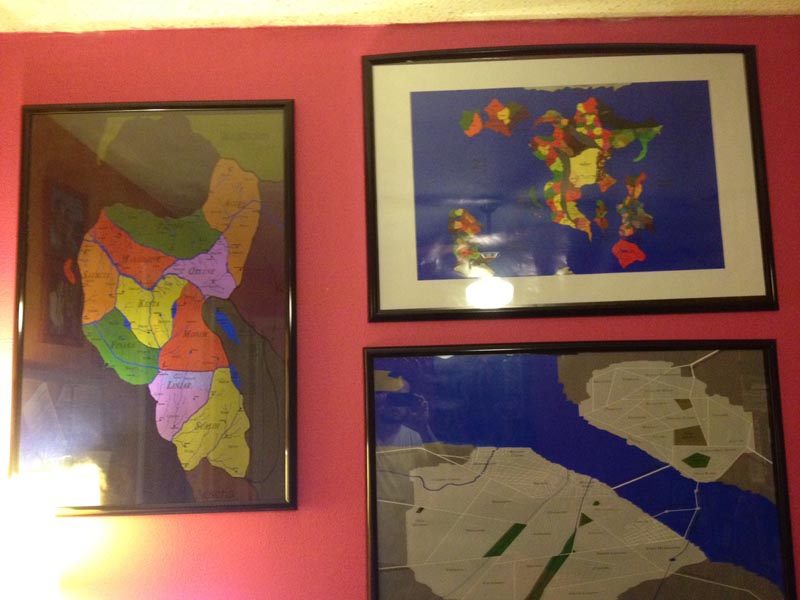
First and foremost, I'm thankful for by amazing wife, whose love and support have kept me going through this journey. She's put up with the many, many times I've stayed awake into the wee hours or sequestered myself with headphones on and nose in the computer, accepted the fact that my head is quite literally in some other world half the time, and has kept the fire under my feet when I get distracted. She's willing for me to not only have giant maps printed, but to have them framed and hung in our studio. Thanks to her I've got three novels*** in my agent's hands, and more on the way.
Second, my agent. It's hard to quantify what an agent does for someone, but in the time we've been together, he's been a source of support, as well as inspiration. He's pushed those three books into being better than they were without him. He's regularly plugged this very blog. He's working for me, and he doesn't make a dime from me until we have a sale. And when we do, you damn well better believe he's earned his percentage. I sure do.
I'm thankful for my health and my energy, and that I've had the ability and freedom to keep working like I have been. I'm thankful that I've just finished a draft of a short story, and wrote another short play last week. I'm thankful that I have more ideas than I know what to do with. Novels are cooking and brewing in this brain, and I have every intention of continuing to crank them out.
I'm thankful for all the people who've given help and advice over the past year and more-- from my mentor and friend Stina Leicht to my worldbuilding brainstorming partner Dan Fawcett to the café manager who doesn't charge me every once in a while because she likes supporting writers. Too many people to name. Besides, that's what the acknowledgement page of books are for, right?
All right, time to hit the kitchen, folks. Have a good one.
___
*- I'm a traditionalist, but that ties to my roots as a worldbuilder and an amateur food historian. Turkey, potatoes & corn are all native foods to the Americas. That's important, in my mind. That's why desert is a chocolate pecan pie.
**- I swear, half the times I say that, I end up writing twice as much as a normal post.
***- And two trunked ones. I don't think anything tests the patience of a writer's spouse quite like a trunk novel.
Thursday, November 22, 2012


Monday, November 19, 2012
Out of Ink Season Again
For the past 13 years, I've participated in Austin Scriptworks Out of Ink ten-minute playwriting "fling", as it is called, which basically works like this: Every year in November, on a Friday evening we receive three "rules" for a ten-minute play. The deadline is 48 hours later (give or take, since it's usually by 6pm on Sunday). Then eight of those ten-minute plays are selected for production in April-ish. (It varies from year-to-year, but it's usually April.)
It's a process I really enjoy, and it keeps various tools in my toolbox sharp. This is a key reason why I participate every year.
2000: Last Train Out of Illinois (Selected) My first year with Scriptworks, the rules involved boots, a character directly addressing the audience, and someone performing an "aria". I had, at the time, had the vague idea of a Tom Waitsish Musical called "Last Train Out of Illinois", but all I had was Atmosphere and an Ending. Which is just fine for a ten-minute piece.
2001: Dead Air On The Open Road (Not Selected) I don't remember all the details, but one of the rules here was an "incongruous element". So the story involved people in a car breaking down in the desert, and then a foul-mouthed puppet shows up to save them. When we did the reading, it was actually pretty hysterical, but I can see that as a script, it's rather thin.
2002: Freaks of Nature and Acts of God (Selected) The rules aren't quite in my memory, save "only one chair" as set. I came up with three young women stuck in a near-empty beach house during a hurricane, who are then rescued by a pizza-delivery guy who has the wrong address. It's probably the weakest of mine that was chosen.
2003: Danger Girl's Night Off (Selected) The rules dictated 1. something involving superheroes and 2. a seduction, so I immediately thought of a grown-up sidekick who just wanted to have a date night. This was a lot of fun. Elements of this story ended up fueling the core ideas behind my story in The Protectors, which you can still purchase on Amazon.
2004: Triangles and Broken Circles (Not Selected) The rules had something to do with chalk and a ceremony, but what I wrote was pretty much weak sauce. Can't blame it not being selected.
2005: No Entry. This year, for budgetary reasons (I think, I could be wrong) the format changed, asking for a 5-minute radio play. I was at something of a loss with that idea, so I didn't enter this time around.
2006: Alignment of Celestial Bodies (Not Selected) Of the "not selected" ones, this is probably my favorite. I forget the details of the rules, but it was a sweet romantic story of a couple going stargazing, with an interconnecting Creation-of-the-World Myth of my own creation.
2007: Hourglass (Selected) I'm really pleased with this one. The rules involved 1. A physical transformation on stage, 2. a secret and 3. a piece of music connecting to a memory. This may have been, for me, the most synergous set of rules. The discovery of an old hourglass reminds an old woman of the true paternity of her child. Hannah Kenah did really lovely work on stage going from 107 to 20.
2008: Ten Minutes Ago (Selected) The play goes backwards! That was the rule that had to define this one. The idea I was struck with here was having an innocuous instigation (a woman answering her door) lead to events that had disastrous consequences (her husband and a stranger dead in her living room), and then show it Consequences-Events-Instigation. This one was challenging to stage, but enjoyable.
2009: The Q (Not Selected) Here, I think I bit off more than I could chew. The core idea was about people being smuggled out of a quarantine-zone after a biological attack. I think it ended up too dense and too vague. I like it, I may revisit it at some point, but I'll admit in the writing, I wasn't quite "feeling" it. So when it wasn't chosen, I wasn't all that surprised.
2010: Entropy (Selected) "Time is Running Out", "Use the Beginning and End of Finnegan's Wake" and "A Ceremony of Forgetting". How does this NOT say "two people stuck in a time loop"? OK, it does to me, because I'm a sci-fi geek.
2011: Slept the Whole Way (Selected) Again, the rules sent me to an SF place: the play needed to span 3000 years and have 300 characters. So a cryosleep ship that missed its target and kept everyone in stasis for 3000 years made perfect sense to me.
2012: I Asked My Friend Art, And He Said It Isn't Him. Given that I just sent this, and don't know what it's fate is, I won't talk about it too much. I will say I enjoyed writing it a lot. I found myself cackling and grinning much of the time, and I'm hoping that's a good sign.
It's a process I really enjoy, and it keeps various tools in my toolbox sharp. This is a key reason why I participate every year.
2000: Last Train Out of Illinois (Selected) My first year with Scriptworks, the rules involved boots, a character directly addressing the audience, and someone performing an "aria". I had, at the time, had the vague idea of a Tom Waitsish Musical called "Last Train Out of Illinois", but all I had was Atmosphere and an Ending. Which is just fine for a ten-minute piece.
2001: Dead Air On The Open Road (Not Selected) I don't remember all the details, but one of the rules here was an "incongruous element". So the story involved people in a car breaking down in the desert, and then a foul-mouthed puppet shows up to save them. When we did the reading, it was actually pretty hysterical, but I can see that as a script, it's rather thin.
2002: Freaks of Nature and Acts of God (Selected) The rules aren't quite in my memory, save "only one chair" as set. I came up with three young women stuck in a near-empty beach house during a hurricane, who are then rescued by a pizza-delivery guy who has the wrong address. It's probably the weakest of mine that was chosen.
2003: Danger Girl's Night Off (Selected) The rules dictated 1. something involving superheroes and 2. a seduction, so I immediately thought of a grown-up sidekick who just wanted to have a date night. This was a lot of fun. Elements of this story ended up fueling the core ideas behind my story in The Protectors, which you can still purchase on Amazon.
2004: Triangles and Broken Circles (Not Selected) The rules had something to do with chalk and a ceremony, but what I wrote was pretty much weak sauce. Can't blame it not being selected.
2005: No Entry. This year, for budgetary reasons (I think, I could be wrong) the format changed, asking for a 5-minute radio play. I was at something of a loss with that idea, so I didn't enter this time around.
2006: Alignment of Celestial Bodies (Not Selected) Of the "not selected" ones, this is probably my favorite. I forget the details of the rules, but it was a sweet romantic story of a couple going stargazing, with an interconnecting Creation-of-the-World Myth of my own creation.
2007: Hourglass (Selected) I'm really pleased with this one. The rules involved 1. A physical transformation on stage, 2. a secret and 3. a piece of music connecting to a memory. This may have been, for me, the most synergous set of rules. The discovery of an old hourglass reminds an old woman of the true paternity of her child. Hannah Kenah did really lovely work on stage going from 107 to 20.
2008: Ten Minutes Ago (Selected) The play goes backwards! That was the rule that had to define this one. The idea I was struck with here was having an innocuous instigation (a woman answering her door) lead to events that had disastrous consequences (her husband and a stranger dead in her living room), and then show it Consequences-Events-Instigation. This one was challenging to stage, but enjoyable.
2009: The Q (Not Selected) Here, I think I bit off more than I could chew. The core idea was about people being smuggled out of a quarantine-zone after a biological attack. I think it ended up too dense and too vague. I like it, I may revisit it at some point, but I'll admit in the writing, I wasn't quite "feeling" it. So when it wasn't chosen, I wasn't all that surprised.
2010: Entropy (Selected) "Time is Running Out", "Use the Beginning and End of Finnegan's Wake" and "A Ceremony of Forgetting". How does this NOT say "two people stuck in a time loop"? OK, it does to me, because I'm a sci-fi geek.
2011: Slept the Whole Way (Selected) Again, the rules sent me to an SF place: the play needed to span 3000 years and have 300 characters. So a cryosleep ship that missed its target and kept everyone in stasis for 3000 years made perfect sense to me.
2012: I Asked My Friend Art, And He Said It Isn't Him. Given that I just sent this, and don't know what it's fate is, I won't talk about it too much. I will say I enjoyed writing it a lot. I found myself cackling and grinning much of the time, and I'm hoping that's a good sign.
Thursday, November 15, 2012
Riding the Muse Where it Takes You
Sometimes it just doesn't come together. And that's okay.
I'm in a strange position, writing-wise. Three novels are out there, shopping at various publishing houses. Any or all could hit tomorrow, or in a month or six months or never.* If and when that happens, I need to be ready to shift focus to the Needs of Publication-- including and not limited to starting the Book II of whatever series hits.
But until that happens, it behooves me to continue to produce more first-of-a-series novels, which is where Way of the Shield comes in. It ties to the other three novels, in that they are all set in the same city at around the same time**, but it is not necessary to the other novels (as they aren't necessary to each other). While it would be ideal for me to have Way of the Shield done, and get a deal in which all four books are published in rapid succession, that's not necessary either.***
This is all a rather long-winded way of me saying that no one, with the possible exception of my agent, is really asking for Way of the Shield to be written right now. And I'd be willing to bet if I sent him something else, say something space-opera, my agent wouldn't complain.
Which is good, because The Muse, as it were, has been muttering Space Opera and aliens and interstellar politics and how Lt. Samantha Kengle of the Terran Stellar Fleet wants people to know that the hairless monkeys from Sol III are not to be trifled with.****
And that's what you have to do sometimes: listen to the Muse, and figure out where it's taking you. Ignoring it, frankly, just makes everything work slower. And that doesn't mean one project is dead because focus is shifted onto another. Quite the opposite. It's getting a chance to breathe.
---
*- Personally, I'm hoping more in the tomorrow-to-a-month range, myself.
**- Strictly speaking, Way of the Shield takes place about a week after the end of Holver Alley Crew, which itself starts about a week after Maradaine Constabulary, which starts three days after the events of Thorn of Dentonhill. Yes, I have a whole calendar. Yes, I am that obsessively detail oriented about these things.
***- In fact, that's pretty damn pie-in-the-sky.
****- Her language is a bit coarser on the subject. Sailor's mouth on that one.
I'm in a strange position, writing-wise. Three novels are out there, shopping at various publishing houses. Any or all could hit tomorrow, or in a month or six months or never.* If and when that happens, I need to be ready to shift focus to the Needs of Publication-- including and not limited to starting the Book II of whatever series hits.
But until that happens, it behooves me to continue to produce more first-of-a-series novels, which is where Way of the Shield comes in. It ties to the other three novels, in that they are all set in the same city at around the same time**, but it is not necessary to the other novels (as they aren't necessary to each other). While it would be ideal for me to have Way of the Shield done, and get a deal in which all four books are published in rapid succession, that's not necessary either.***
This is all a rather long-winded way of me saying that no one, with the possible exception of my agent, is really asking for Way of the Shield to be written right now. And I'd be willing to bet if I sent him something else, say something space-opera, my agent wouldn't complain.
Which is good, because The Muse, as it were, has been muttering Space Opera and aliens and interstellar politics and how Lt. Samantha Kengle of the Terran Stellar Fleet wants people to know that the hairless monkeys from Sol III are not to be trifled with.****
And that's what you have to do sometimes: listen to the Muse, and figure out where it's taking you. Ignoring it, frankly, just makes everything work slower. And that doesn't mean one project is dead because focus is shifted onto another. Quite the opposite. It's getting a chance to breathe.
---
*- Personally, I'm hoping more in the tomorrow-to-a-month range, myself.
**- Strictly speaking, Way of the Shield takes place about a week after the end of Holver Alley Crew, which itself starts about a week after Maradaine Constabulary, which starts three days after the events of Thorn of Dentonhill. Yes, I have a whole calendar. Yes, I am that obsessively detail oriented about these things.
***- In fact, that's pretty damn pie-in-the-sky.
****- Her language is a bit coarser on the subject. Sailor's mouth on that one.
Monday, November 12, 2012
Perils of the Writer: False Starts
It hits like lightning across the forebrain. The Brilliant Idea that will be the Next New Book. And every thought is consumed with the "Oh, wow!"ness of this new idea. It's fresh and exciting, especially if it hits in the hard-middle-slog of a novel. Then, it inhabits your brain like new lover, with promises of how everything is going to be easy and light and problem free and THIS is the project you should be working on.
And the initial worldbuilding snaps together, characters are as clear as day. You open up a document and just start writing, because isn't that's how it's supposed to be? Isn't that how real writers write, right? They just pound it out and go where the story takes them and they do it brilliantly on their first draft and that's what you're going to do this time because it's brilliant and you're brilliant and this is the best novel ever written by anyone ever and--
CRASH
Somewhere between five and fifteen thousand words, the fiery passion part is burnt out, and then you're poking at those dying embers and realizing, "I don't actually have a plot here, do I?"
So you put it do the side, mourning its failure for a bit. Get back to work on the things that need work, where the work is paying off, slowly and surely.
But, of course, the siren call is there, summoning you back with the promise that this time it's going to work. This time it's going to be brilliant.
I've gone through this particular cycle with USS Banshee several times now. I do have a good sense what "went wrong" on my first few attempts: namely, that lack of plot. But with later ones, it was almost as if I didn't want to actually get to the plot. Put simply, I kept wanting to just write a "hang out" book. I was having fun with the various sets of characters in different sections of the ship, just playing with the personalities, showing off shiny toys, that I could never manage to get to the point where they went anywhere for something to actually happen. One failed draft reached 40,000 words of NOTHING.
That's the most prominent false-start in my stable. I keep coming up with new takes on it, one of which I'm currently quite excited about. Still hashing it out, but I think this one might work. But I've thought that before. Not to mention, there's all the "terminal cases" I have in my writing folders. But USS Banshee is, frankly, the one I can never give up on.
And the initial worldbuilding snaps together, characters are as clear as day. You open up a document and just start writing, because isn't that's how it's supposed to be? Isn't that how real writers write, right? They just pound it out and go where the story takes them and they do it brilliantly on their first draft and that's what you're going to do this time because it's brilliant and you're brilliant and this is the best novel ever written by anyone ever and--
CRASH
Somewhere between five and fifteen thousand words, the fiery passion part is burnt out, and then you're poking at those dying embers and realizing, "I don't actually have a plot here, do I?"
So you put it do the side, mourning its failure for a bit. Get back to work on the things that need work, where the work is paying off, slowly and surely.
But, of course, the siren call is there, summoning you back with the promise that this time it's going to work. This time it's going to be brilliant.
I've gone through this particular cycle with USS Banshee several times now. I do have a good sense what "went wrong" on my first few attempts: namely, that lack of plot. But with later ones, it was almost as if I didn't want to actually get to the plot. Put simply, I kept wanting to just write a "hang out" book. I was having fun with the various sets of characters in different sections of the ship, just playing with the personalities, showing off shiny toys, that I could never manage to get to the point where they went anywhere for something to actually happen. One failed draft reached 40,000 words of NOTHING.
That's the most prominent false-start in my stable. I keep coming up with new takes on it, one of which I'm currently quite excited about. Still hashing it out, but I think this one might work. But I've thought that before. Not to mention, there's all the "terminal cases" I have in my writing folders. But USS Banshee is, frankly, the one I can never give up on.
Thursday, November 8, 2012
Worldbuilding, Psychohistory, and the Power of Numbers
So, now our election is over, and if one thing can be declared an uncontested winner, it's Math. Despite having his vocal detractors, Nate Silver's meticulous statistical analysis of polls produced an electoral college map that was spot on. You might not like what his results were, but you can't argue with their accuracy.
Any old-school Asimov fan could have told you that. While I doubt any of us would argue that Hari Seldon's level of psychohistorical projection is probably impossible, there is a simple truth that pure math has no bias.
Now, applying this to worldbuilding. I will fully admit that I'm more of a numbers geek than your average writer, so I will do things that would probably make most people weep at the prospect of it.
Take, for example, my latest bit of Build Process, incorporating a dimension of time into my already-complex 150-ly radius Space Opera Setting. I looked at my several hundred intelligent species*, and even knowing their technology level, I asked myself, "Yes, but who got their first? How did they expand?"
So, I start with some assumptions, some of which probably have underlying errors, but work in terms of large-scale worldbuilding as a whole. It also works in terms of applying the Guns, Germs and Steel ideas on an interstellar scale.
Assumption #1: That all intelligent species in question, in this patch of interstellar neighborhood, were all at an equivalent state of Intelligent, Pre-Civilized Hunter/Gatherer at the same time. This is a HUGE presumption, especially in terms of evolution and cosmic time. It more or less requires some form of direct Precursor Intervention, which I've included in the model. The point is, the bell is rung at 11,000 BC, and at that point, every species starts the race.
Assumption #2: All species hit certain Technology Level Benchmarks, and the time ratio for those benchmarks is consistent. These benchmarks are broad brushstrokes, and don't represent the details of how a culture gets from A to B to C, or exactly what that Tech Level might mean at any given point. But it takes into account that the journey from Pre-Civilization to Early Metalworking is a much longer one than from Late Industrial to Technological.
Now, with those two assumptions, I add in two Randomizing factors to tweak those ratios for each Alien Civilization. One broadly represents Ingenuity-- how quickly a species as a whole comes up with and enacts new ideas-- and the other represents Resources-- having the natural means on hand that enable enacting new ideas. As per the underlying thesis of the Guns, Germs & Steel Model, Resources is the bigger determining factor.
For example, for the sake of the model, I assign Humans an Ingenuity Factor and Resource factor of 1. With the Ingenuity, the range of variance is pretty minute: with one exception (a species I wanted to beat everyone else to space by a wide margin), the range of Ingenuity is between .95 and 1.05. No species is really significantly smarter than anyone else.**
Resource Factor had a much bigger range, and small changes in the range could generate much larger effects. The range was, for the most part, between 0 and 2, but for species that I wanted still in a Hunter/Gatherer phase, the RF might be well into the negatives.***
And then I generate an equation that plugs the IF and RF into the Advancement Ratio I've already created, and: Bam. I now know to the year when every alien culture breaks the FTL barrier, and where every culture is, broadly speaking, in any given year.
Now, whether or not this is really useful information for a writer to know, that's debatable. It certainly falls under the Iceberg Principle of worldbuilding: stuff the reader will never see above the surface.
---
*- Yes, I am a loon. We've established this.
**- Not to mention, the "Ingenuity" factor really represents several different factors that don't necessarily tie into "Intelligence", such as broad social factors that could enhance or hamper scientific advancement. But I'm not a sociologist, and the math here was complicated enough. A single number that represents all those things broadly was sufficient.
***- Which could represent a lot of things: a complete lack of domesticatible animals or crops, or a sparsity of easy-to-work metals like copper or tin, for example.
Any old-school Asimov fan could have told you that. While I doubt any of us would argue that Hari Seldon's level of psychohistorical projection is probably impossible, there is a simple truth that pure math has no bias.
Now, applying this to worldbuilding. I will fully admit that I'm more of a numbers geek than your average writer, so I will do things that would probably make most people weep at the prospect of it.
Take, for example, my latest bit of Build Process, incorporating a dimension of time into my already-complex 150-ly radius Space Opera Setting. I looked at my several hundred intelligent species*, and even knowing their technology level, I asked myself, "Yes, but who got their first? How did they expand?"
So, I start with some assumptions, some of which probably have underlying errors, but work in terms of large-scale worldbuilding as a whole. It also works in terms of applying the Guns, Germs and Steel ideas on an interstellar scale.
Assumption #1: That all intelligent species in question, in this patch of interstellar neighborhood, were all at an equivalent state of Intelligent, Pre-Civilized Hunter/Gatherer at the same time. This is a HUGE presumption, especially in terms of evolution and cosmic time. It more or less requires some form of direct Precursor Intervention, which I've included in the model. The point is, the bell is rung at 11,000 BC, and at that point, every species starts the race.
Assumption #2: All species hit certain Technology Level Benchmarks, and the time ratio for those benchmarks is consistent. These benchmarks are broad brushstrokes, and don't represent the details of how a culture gets from A to B to C, or exactly what that Tech Level might mean at any given point. But it takes into account that the journey from Pre-Civilization to Early Metalworking is a much longer one than from Late Industrial to Technological.
Now, with those two assumptions, I add in two Randomizing factors to tweak those ratios for each Alien Civilization. One broadly represents Ingenuity-- how quickly a species as a whole comes up with and enacts new ideas-- and the other represents Resources-- having the natural means on hand that enable enacting new ideas. As per the underlying thesis of the Guns, Germs & Steel Model, Resources is the bigger determining factor.
For example, for the sake of the model, I assign Humans an Ingenuity Factor and Resource factor of 1. With the Ingenuity, the range of variance is pretty minute: with one exception (a species I wanted to beat everyone else to space by a wide margin), the range of Ingenuity is between .95 and 1.05. No species is really significantly smarter than anyone else.**
Resource Factor had a much bigger range, and small changes in the range could generate much larger effects. The range was, for the most part, between 0 and 2, but for species that I wanted still in a Hunter/Gatherer phase, the RF might be well into the negatives.***
And then I generate an equation that plugs the IF and RF into the Advancement Ratio I've already created, and: Bam. I now know to the year when every alien culture breaks the FTL barrier, and where every culture is, broadly speaking, in any given year.
Now, whether or not this is really useful information for a writer to know, that's debatable. It certainly falls under the Iceberg Principle of worldbuilding: stuff the reader will never see above the surface.
---
*- Yes, I am a loon. We've established this.
**- Not to mention, the "Ingenuity" factor really represents several different factors that don't necessarily tie into "Intelligence", such as broad social factors that could enhance or hamper scientific advancement. But I'm not a sociologist, and the math here was complicated enough. A single number that represents all those things broadly was sufficient.
***- Which could represent a lot of things: a complete lack of domesticatible animals or crops, or a sparsity of easy-to-work metals like copper or tin, for example.
Monday, November 5, 2012
Fantasy Fiction and Democracy
Let's face it: democracy is not a key factor in most fantasy fiction. It is a genre that has its foundations built on a primarily European-based aristocracy/nobility model. One of the tired tropes of the genre is the idea of rule-through-birthright: the king of Return of the King is the great-to-the-infinite-power grandson of a long-gone king, and the rulers of Gondor are "stewards" who have essentially been waiting for an heir of Isildur to bother to show up and claim his throne. Same thing in The Belgariad: Garion is the heir of the secretly-preserved line of Riva, and the empty throne has waited for the Rivan King to show up for 800 years.
Seriously, these are some patient people, since they go centuries working on the premise of, essentially, a temporary regency waiting for the "proper" ruler to show up, even though the ancestor who last occupied the throne is long out of living memory.* Why do they put up with this? Because, apparently, in this type of fantasy, birthright never fades. Nobility is important.
I'm not entirely immune to this: Druthal has a king (Maradaine XVIII) whose line comes from the first king of Druthal (Maradaine I), and that line being on the throne was not continuous. There are some key differences, though: The line broke in the first place because the son of Maradaine I was something of a dullard, so other various lords quietly shuffled him to the side while someone else claimed the throne. Second, the line was restored to the throne nine centuries later not out of prophecy or divine providence, but because a small group of conspirators discovered that a minor noble they liked was a direct descendant of that dullard son, but more importantly because the current king was a complete and total loon and they were desperate to get rid of him. So the line claim was really only about giving their revolution a bit of extra legitimacy. It didn't launch a golden age where everything in Druthal was now wonderful since the Rightful Line was Restored.**
But, while I have those European nobility influences-- Druthal has a king, not to mention archdukes, dukes, earls and barons-- it also has a Parliament. An elected Parliament, where the real legislative power lies. Democracy is a crucial element of how Druthal works. The people's voice is important, even if it gets corrupted and twisted and bought out from time to time.
I am having fun with that in Way of the Shield, where the partisan make-up of the Parliament, how various aspects of the press interpret what the Parliament does, how people feel about the Parliament (ESPECIALLY Dangerous Fringe Elements) all come into play. It's messy, because democracy is messy, which is how I like it.
I won't get too political here, but the thing I love about democracy is the element of dissent and disagreement. I love that I can have an enormous, pitched argument with someone on the polar opposite side of an issue, and the end of the day, we'll both think the other guy is just plain wrong, but neither of us is going to get taken in by the police in the middle of the night for what we said. And in a little bit, we're going to have an election, and shortly afterwards a little more than half of us will be pleased, and a little less than half will be pissed. But that little-less-than-half will dust themselves off and gear up for the next fight. And that's awesome. That's what it's about.
And, hopefully, I can work a bit of that into by fantasy writing, and get some good drama out of it.
---
*- Essentially, even though both LOTR and Belgariad have functionally-immortal characters. Strictly speaking, there is living memory of Isildur and Riva, but it's not amongst the common people living day-to-day under the regency rule.
**- Also note, this is just an incident in the extensive history my insane-worldbuilder brain has created. It's three centuries before the stories I'm telling.
Seriously, these are some patient people, since they go centuries working on the premise of, essentially, a temporary regency waiting for the "proper" ruler to show up, even though the ancestor who last occupied the throne is long out of living memory.* Why do they put up with this? Because, apparently, in this type of fantasy, birthright never fades. Nobility is important.
I'm not entirely immune to this: Druthal has a king (Maradaine XVIII) whose line comes from the first king of Druthal (Maradaine I), and that line being on the throne was not continuous. There are some key differences, though: The line broke in the first place because the son of Maradaine I was something of a dullard, so other various lords quietly shuffled him to the side while someone else claimed the throne. Second, the line was restored to the throne nine centuries later not out of prophecy or divine providence, but because a small group of conspirators discovered that a minor noble they liked was a direct descendant of that dullard son, but more importantly because the current king was a complete and total loon and they were desperate to get rid of him. So the line claim was really only about giving their revolution a bit of extra legitimacy. It didn't launch a golden age where everything in Druthal was now wonderful since the Rightful Line was Restored.**
But, while I have those European nobility influences-- Druthal has a king, not to mention archdukes, dukes, earls and barons-- it also has a Parliament. An elected Parliament, where the real legislative power lies. Democracy is a crucial element of how Druthal works. The people's voice is important, even if it gets corrupted and twisted and bought out from time to time.
I am having fun with that in Way of the Shield, where the partisan make-up of the Parliament, how various aspects of the press interpret what the Parliament does, how people feel about the Parliament (ESPECIALLY Dangerous Fringe Elements) all come into play. It's messy, because democracy is messy, which is how I like it.
I won't get too political here, but the thing I love about democracy is the element of dissent and disagreement. I love that I can have an enormous, pitched argument with someone on the polar opposite side of an issue, and the end of the day, we'll both think the other guy is just plain wrong, but neither of us is going to get taken in by the police in the middle of the night for what we said. And in a little bit, we're going to have an election, and shortly afterwards a little more than half of us will be pleased, and a little less than half will be pissed. But that little-less-than-half will dust themselves off and gear up for the next fight. And that's awesome. That's what it's about.
And, hopefully, I can work a bit of that into by fantasy writing, and get some good drama out of it.
---
*- Essentially, even though both LOTR and Belgariad have functionally-immortal characters. Strictly speaking, there is living memory of Isildur and Riva, but it's not amongst the common people living day-to-day under the regency rule.
**- Also note, this is just an incident in the extensive history my insane-worldbuilder brain has created. It's three centuries before the stories I'm telling.
Thursday, November 1, 2012
Perils of the Writer: The Slow Process of Getting the Ball Rolling
¡Feliz día de los muertos! We're now in November, which for some writerly types, means NaNoWriMo, aka Nation Novel Writing Month. If you aren't in the know, participants pledge to write a 50,000 word novel over the course of November. This translates to writing approximately 16,666 words a day. Back in the early days of writing, I participated, but I don't anymore, since every month is Novel Writing Month, and at this point in my life, a pace of 50K a month for 12 months is not something I could ever hope to maintain. Writing at my own pace is just fine by me.
In my opinion, NaNoWriMo is an excellent exercise in terms of process, in learning how to write a novel... but not one in terms of results. The novel you write in one month won't be a particularly useful one, not without significant editing. Briefly: I think it's a wonderful way to crank out a trunk novel. One of my trunk novels was, in fact, a NaNoWriMo.*
But exercise and process are important, especially when it comes to getting started. Getting a novel started is, for me, a very slow and deliberate process, in that the path from conception to writing actual text can take quite some time. I sometimes make the metaphor of my writing brain being like a kitchen, with various projects on front and back burners. But then there is other stuff in crockpots on back counters, slowly stewing away for years until they are really ready to work.
Phase One: Conception.
This is, more or less, the Big Idea phase of things, where the thunderstrike of a Shiny New Story smashes across your brainpan. It's usually the broadest of brushstrokes: Steampunk Airship Flying Through Alternate Universe Texas! Secret Telepath War In Manhattan! Abducted Human Wakes from Hibernation Sleep on a Dying Ship Full of other Abducted Aliens! Cold hard truth: 75-90% of projects never get out of this phase. It's always a bit fun and exciting, but it's also easy to mistake that Fun and Exciting for "And now I will write the book". That never works, at least for me. Though I suspect that many people-- at least non-writers-- believe that this phase is all you need to write the book.**
Phase Two: Setting.
Once I have an idea, I need to build the place where it unfolds. I'm a worldbuilder, it's what I do. For me, this phase is all too crucial: it's about placing the gears that will power the engine behind the story. This phase can often be the longest, because it is filled with working and reworking things out. If it doesn't work, if it doesn't make sense to me, then the center doesn't hold. Case in point: when I initially conceived my Space Opera Setting, back in 2002, I created some initial star maps with colonies and alien homeworlds and such and so forth. But as I first tried to write, this signal of WRONG WRONG WRONG across my brain was jamming things up. Why? It took a while to realize, but I finally hit upon it: the stars of these colonies and alien worlds, while being in close proximity to Earth, had nothing to do with actual stars close to Earth. Back to the drawing board.
Phase Three-A: Characters.
Phase Three-B: Circumstances.
I put these two together like this because they tend to go hand in hand, but I can't honestly say which one goes first. Both things are crucial to figuring out what the actual story is: what's happening, and who it's happening to. It's a strange, intertwined process that, frankly, I haven't quite mastered. Trying to craft circumstances without knowing character at the center can yield something soulless and mechanical. But crafting characters without really knowing the story can make an unholy mess, where you end up with numerous people standing around with very little to do. The best solution I've found is to, at this phase, focus on just the core characters and the ripe circumstances that initiates things, and let it flow from there.
Phase Four: Outline
Now that I've worked out the key elements, who, what, where, when and (to a degree) why, it's a time for a big helping of how. Of course, I use my Twelve-Part Structure as a base, writing out about a paragraph for each part. With that finally in hand, THEN I can start Actually Writing.
___
*- I gave it significant editing afterwards. It's still a trunk novel, and that's what it deserves, frankly.
**- This is where those, "I've got a great idea for a book, so you write it and we'll split the profits!" pitches come from.
In my opinion, NaNoWriMo is an excellent exercise in terms of process, in learning how to write a novel... but not one in terms of results. The novel you write in one month won't be a particularly useful one, not without significant editing. Briefly: I think it's a wonderful way to crank out a trunk novel. One of my trunk novels was, in fact, a NaNoWriMo.*
But exercise and process are important, especially when it comes to getting started. Getting a novel started is, for me, a very slow and deliberate process, in that the path from conception to writing actual text can take quite some time. I sometimes make the metaphor of my writing brain being like a kitchen, with various projects on front and back burners. But then there is other stuff in crockpots on back counters, slowly stewing away for years until they are really ready to work.
Phase One: Conception.
This is, more or less, the Big Idea phase of things, where the thunderstrike of a Shiny New Story smashes across your brainpan. It's usually the broadest of brushstrokes: Steampunk Airship Flying Through Alternate Universe Texas! Secret Telepath War In Manhattan! Abducted Human Wakes from Hibernation Sleep on a Dying Ship Full of other Abducted Aliens! Cold hard truth: 75-90% of projects never get out of this phase. It's always a bit fun and exciting, but it's also easy to mistake that Fun and Exciting for "And now I will write the book". That never works, at least for me. Though I suspect that many people-- at least non-writers-- believe that this phase is all you need to write the book.**
Phase Two: Setting.
Once I have an idea, I need to build the place where it unfolds. I'm a worldbuilder, it's what I do. For me, this phase is all too crucial: it's about placing the gears that will power the engine behind the story. This phase can often be the longest, because it is filled with working and reworking things out. If it doesn't work, if it doesn't make sense to me, then the center doesn't hold. Case in point: when I initially conceived my Space Opera Setting, back in 2002, I created some initial star maps with colonies and alien homeworlds and such and so forth. But as I first tried to write, this signal of WRONG WRONG WRONG across my brain was jamming things up. Why? It took a while to realize, but I finally hit upon it: the stars of these colonies and alien worlds, while being in close proximity to Earth, had nothing to do with actual stars close to Earth. Back to the drawing board.
Phase Three-A: Characters.
Phase Three-B: Circumstances.
I put these two together like this because they tend to go hand in hand, but I can't honestly say which one goes first. Both things are crucial to figuring out what the actual story is: what's happening, and who it's happening to. It's a strange, intertwined process that, frankly, I haven't quite mastered. Trying to craft circumstances without knowing character at the center can yield something soulless and mechanical. But crafting characters without really knowing the story can make an unholy mess, where you end up with numerous people standing around with very little to do. The best solution I've found is to, at this phase, focus on just the core characters and the ripe circumstances that initiates things, and let it flow from there.
Phase Four: Outline
Now that I've worked out the key elements, who, what, where, when and (to a degree) why, it's a time for a big helping of how. Of course, I use my Twelve-Part Structure as a base, writing out about a paragraph for each part. With that finally in hand, THEN I can start Actually Writing.
___
*- I gave it significant editing afterwards. It's still a trunk novel, and that's what it deserves, frankly.
**- This is where those, "I've got a great idea for a book, so you write it and we'll split the profits!" pitches come from.
Subscribe to:
Posts (Atom)